
JSA and JSEA Form Template (Job Safety Analysis)
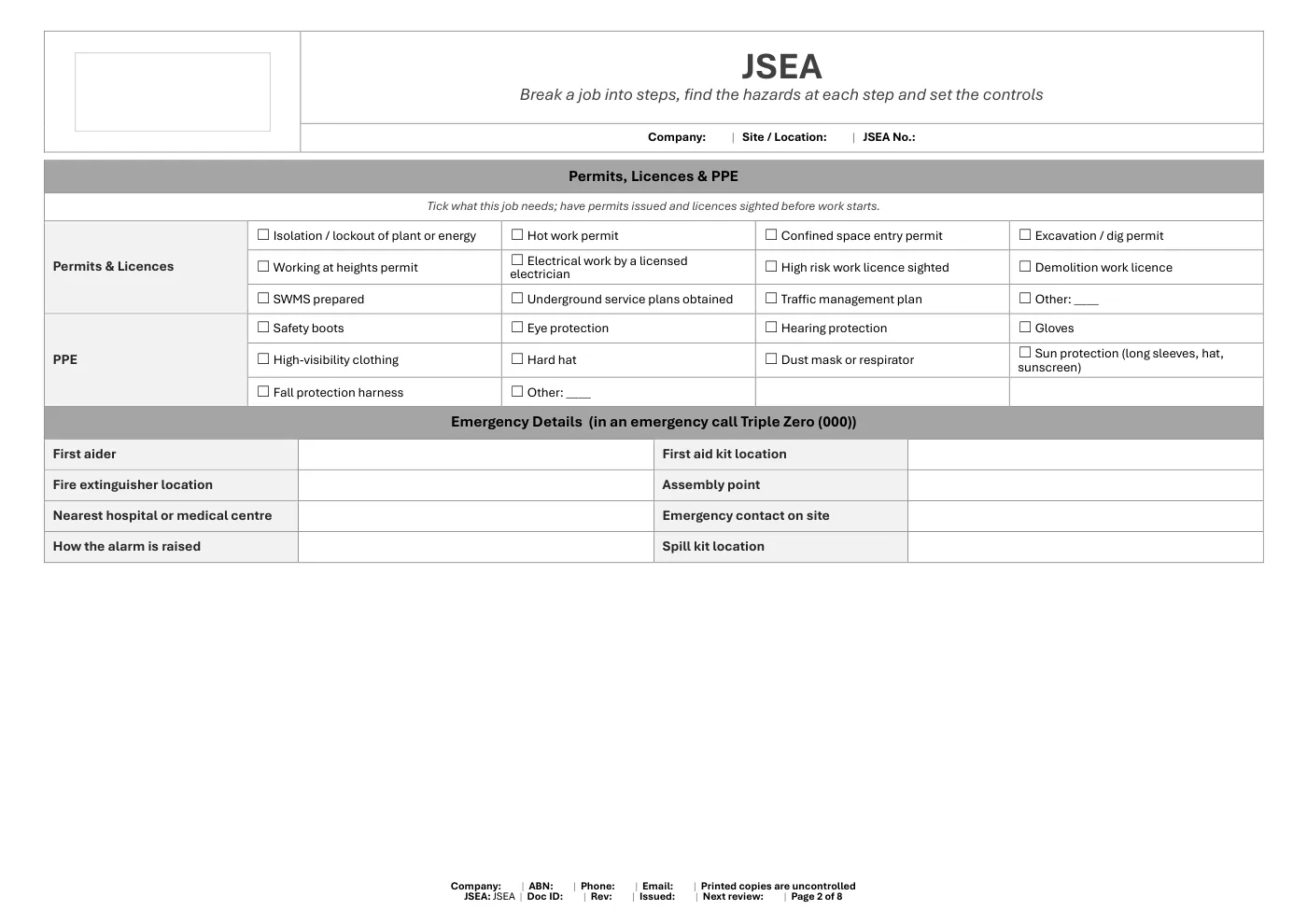
Editable Word JSA and JSEA form for Queensland jobs: list each job step, record the safety, health and environmental hazards, set controls in order and score the risk before and after. Six worked steps show how to fill it in, with a high risk construction work check, pre-start checks and a crew sign-on.
RG
Written by Ryan Graham, health and safety professional (16 years on Queensland sites)
$19.99 incl. GST
AUD · one-off purchase · instant download
- Instant download · your links arrive by email straight after checkout and work for 3 months, so save your copy
- Your business name and logo · we fill them into every document for A$29 (free on orders of A$500 or more), or edit it yourself in Microsoft Word
- Quality guarantee · we'll fix any problem, then refund you or give store credit if you're still not happy
- Secure checkout · card, Apple Pay or Google Pay through Stripe
About this template
A JSA (job safety analysis) template is a form for working through a job before it starts: the steps, the hazards in each step and the controls. This editable Microsoft Word form for Queensland jobs also works as a JSEA (job safety and environmental analysis), and has a high risk construction work check, a 5 x 5 risk matrix, pre-start checks, a crew sign-on and six worked job steps.
What is in the JSA template
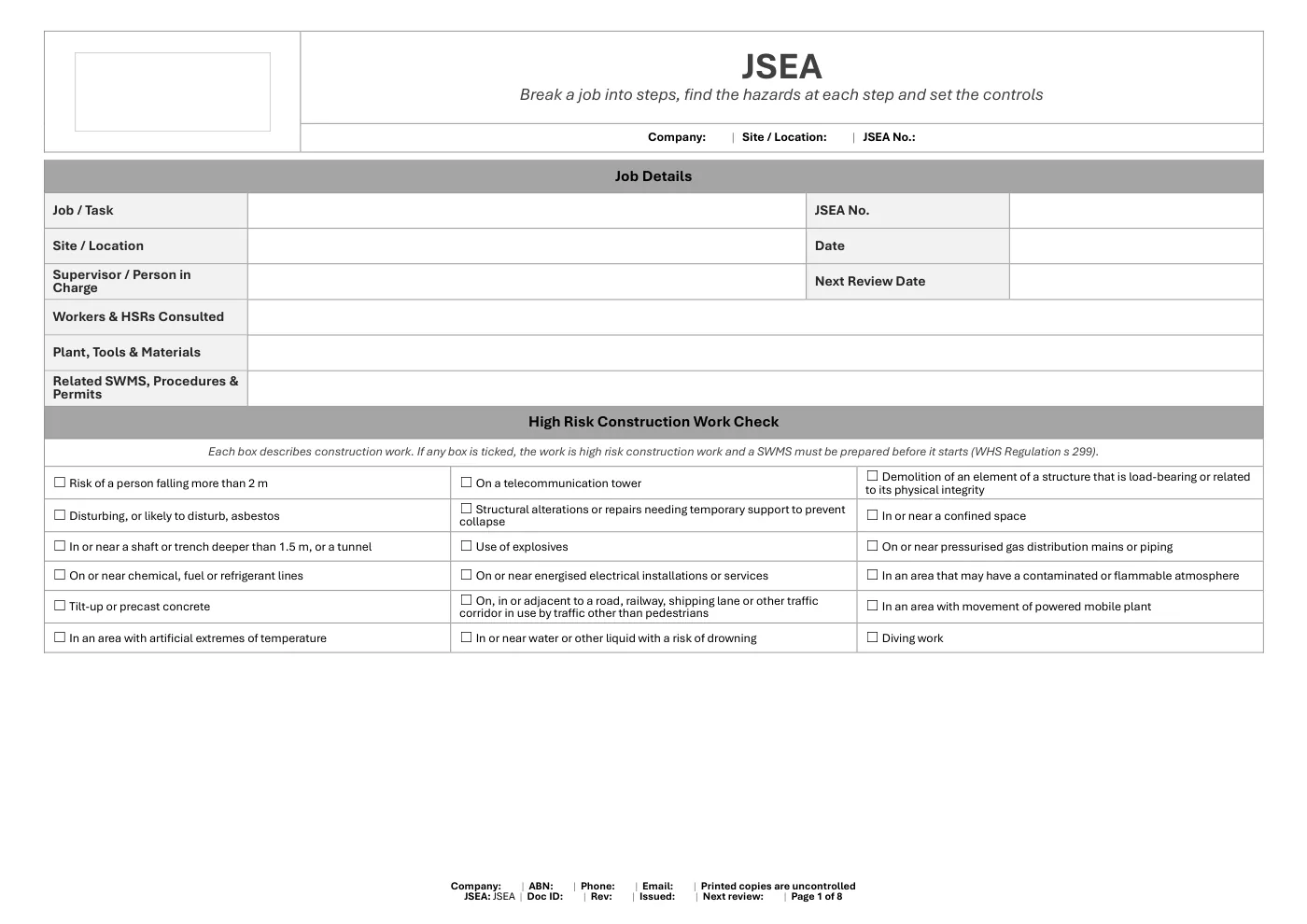
- Assessment details: the task, assessment number, site, date assessed, who assessed it, next review date, who was consulted, and the related safe work method statements (SWMS), procedures and permits
- 5 x 5 risk matrix: likelihood from 1 (rare) to 5 (almost certain) and consequence from 1 (insignificant) to 5 (catastrophic), with the action each score band calls for
- Hierarchy of controls: a strip from elimination down to personal protective equipment (PPE)
- High risk construction work check: a tick list of every category in section 291 of the Work Health and Safety Regulation 2011 (Qld), with a line that a SWMS must be prepared before the work starts if any box is ticked (section 299)
- Permits and licences, PPE and emergency details: tick lists for the permits and licences the job needs, the PPE and the emergency contacts, first aid, fire extinguisher and assembly point
- Pre-start site checks: weather and ground, overhead and underground services, access, other trades, plant and tools, and whether the crew has been briefed
- Stop work triggers and crew sign-on: the points at which work stops, and a sign-on for every person on the job
- Changes on the Day box: a place to record changes in conditions, people or method, stop, reassess the step and brief the crew again
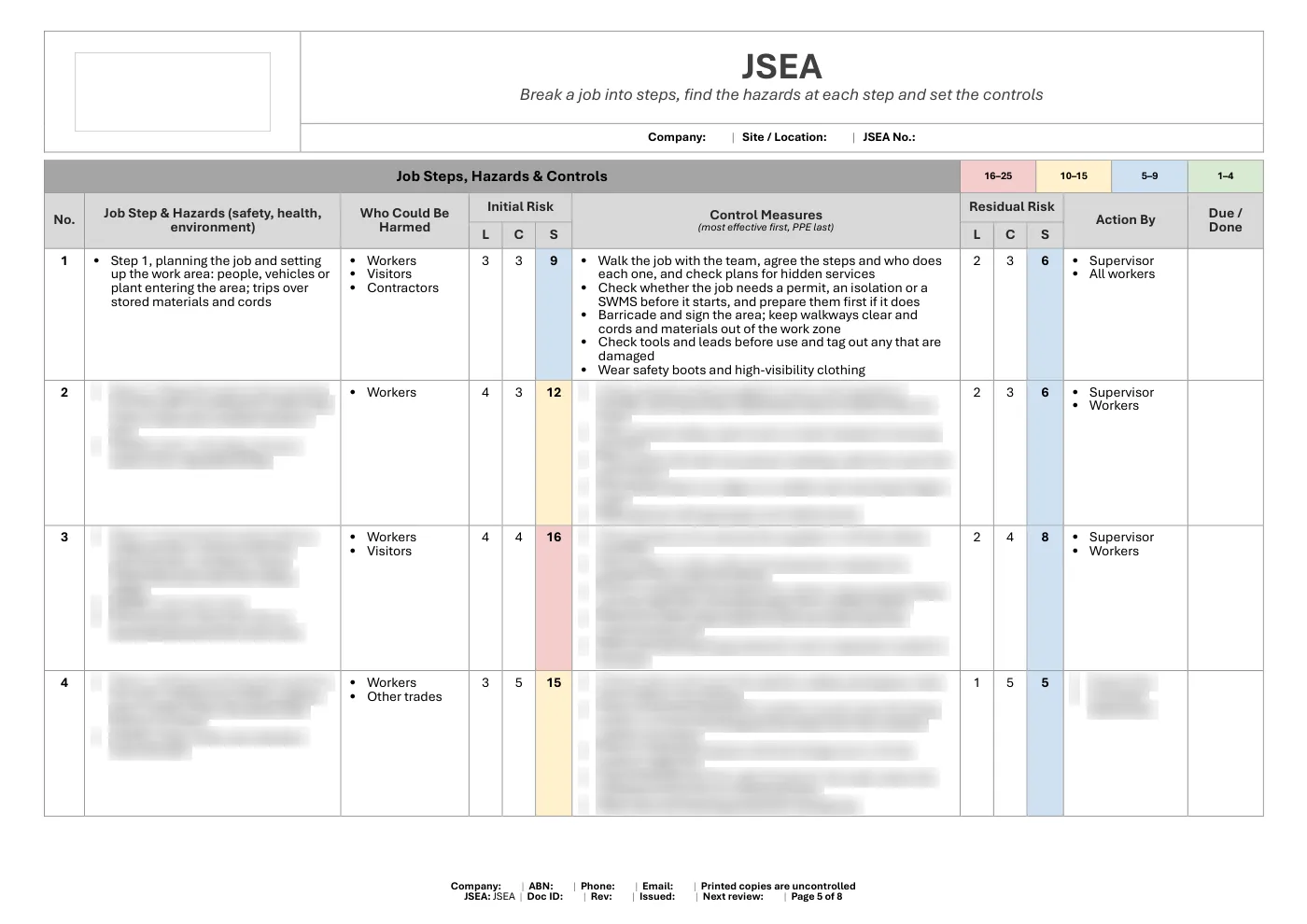
- Job step table: one row per step with the hazard (what could go wrong), who could be harmed, the risk before controls, the controls, the risk after controls, who acts and a due or done column
- Six worked job steps: a job fixing a panel to a wall, from planning and setting up to cleaning up, with health and environmental hazards included
- Blank rows for your own job steps
- Review record and sign-off for the assessor and the manager
- Document control: business name, ABN, contact details, document ID, revision, issue and review dates and the form owner
It is an editable Microsoft Word file (8 pages), A4 landscape. Your business details are typed once and fill in every page, and there is a logo space in the header. The JSEA Documents Pack has this form and the JSEA Policy (Job Safety and Environmental Analysis) in one download, for less than buying the two separately.
A worked example: lifting a panel and carrying it to the wall
The six worked steps follow one job, fixing a panel to a wall. This is step 2: the risk is scored, the controls follow the hierarchy of controls with PPE last, and the risk is scored again with the controls in place.
- Step: 2, lifting the panel and carrying it to the wall
- Hazards: an awkward, bulky load slips or tips and crushes hands or feet; health: back, shoulder and arm strain from repeated lifting
- Who could be harmed: workers
- Risk before controls: likelihood 4 (likely) x consequence 3 (moderate) = 12, a substantial risk
- Controls: order panels small enough for one or two people to handle, and have them delivered close to where they are fixed; use a panel trolley, sack truck or hoist instead of carrying by hand; plan a team lift with one person leading, and walk the route first and clear it; set panels down on edge on a stable rack and keep fingers clear; wear gloves with good grip and safety boots
- Risk after controls: likelihood 2 (unlikely) x consequence 3 (moderate) = 6, a low risk
- Who acts: supervisor and workers
The other five steps use the same layout. Step 3, trimming the panel with an angle grinder, scores 16 (a high risk) before the controls and 8 after. In every worked row the consequence score stays the same and the controls bring the likelihood down.
JSA or JSEA: what is the difference?
A JSA, or job safety analysis, breaks a job into steps, lists the hazards in each step and sets the controls. A JSEA adds the environment, so each step also asks what could harm the surroundings, such as dust and offcuts spreading beyond the work area. A JHA (job hazard analysis) is another name for the same method.
These are workplace terms. The Work Health and Safety Act 2011 (Qld) and the Work Health and Safety Regulation 2011 (Qld) use none of them and set no format for any of them. A job safety analysis template gives the crew a set layout to fill in for each job, and this form works as either a JSA or a JSEA. For more, read what a JSA is and how it works in Queensland.
How to fill in a JSA in five steps
- Describe the job and talk to the people who do it. Fill in the assessment details, including who was consulted. A business must consult the workers who are, or are likely to be, directly affected, so far as is reasonably practicable, when it identifies hazards, assesses risks and decides on controls (sections 47 and 49 of the Work Health and Safety Act 2011 (Qld)).
- Break the job into steps in the order they happen. Walk the job with the crew and give each step its own row.
- List the hazards in each step and who could be harmed. Include health and environmental hazards as well as safety. The Regulation requires you to identify reasonably foreseeable hazards that could give rise to risks to health and safety (section 34 of the Work Health and Safety Regulation 2011 (Qld)).
- Score the risk, choose the controls and score it again. Multiply likelihood by consequence on the 5 x 5 matrix. Eliminate the risk if that is reasonably practicable. If it is not, substitute, isolate or use engineering controls, then, if a risk remains, use administrative controls and, if a risk still remains, use PPE last (sections 35 and 36 of the Regulation). Score it again with the controls in place. The score ranks the risks; a specific requirement in the Regulation still has to be followed (section 33).
- Name who acts, brief the crew and review it. Give each action a person and a due date, and check on the day that the controls are in place and used correctly, because a control must stay effective and be installed, set up and used correctly (section 37 of the Regulation). Review the controls, and update the JSA, when a control does not control the risk, before a change at the workplace that is likely to create a new or different risk that the control may not control, when a new hazard is identified, when consultation shows a review is needed or when a health and safety representative requests a review (section 38 of the Regulation).
More detail is in our guide to the hierarchy of controls, the Hierarchy of Controls Risk Control Worksheet, how to use a 5×5 risk matrix and when a risk assessment should be carried out.
Is a JSA required in Queensland?
No, not under the Work Health and Safety Act 2011 (Qld) or the Work Health and Safety Regulation 2011 (Qld). Neither requires a business to complete a JSA. What the law requires is that a business manages risk: it must eliminate risks to health and safety so far as is reasonably practicable and, where it cannot, minimise them so far as is reasonably practicable (section 17 of the Act). The Regulation sets the steps of identifying hazards, using the hierarchy of controls, keeping the controls effective and reviewing them (sections 34 to 38). None of those sections says the assessment must be written down, although some activities have their own written assessment rule, such as entering a confined space (section 66(3)) and general diving work (section 176(3)). A JSA is a common way to plan the controls with the crew and keep a record that you did. The How to Manage Work Health and Safety Risks Code of Practice 2021 says an assessment can be as simple as a discussion with your workers. Many principal contractors ask for a JSA before a job starts, which is contract practice, not law.
High risk construction work is different. A safe work method statement (SWMS) must be prepared before it starts (section 299(1) of the Regulation). It must identify the high risk construction work, state the hazards and risks, describe the control measures and describe how they will be implemented, monitored and reviewed (section 299(2)). A JSA does not take its place unless it carries everything section 299(2) requires of a SWMS: the Regulation sets the content of a SWMS and sets none for a JSA. Section 291 defines high risk construction work by the type of work, not by a risk score, so a low score on a matrix does not take work off the list. The list includes construction work that involves a risk of a person falling more than 2 m (step 5 of the worked example flags this), construction work in or near a trench deeper than 1.5 m and construction work on or near energised electrical installations or services. Electrical work on or near energised electrical equipment also needs its own recorded risk assessment and SWMS (section 199 of the Electrical Safety Regulation 2026 (Qld)).
JSA, risk assessment or SWMS: which do you need?
They are different records for different jobs:
- Free JSA template: a shorter step-by-step form with three worked steps. Use the Free JSA Template (Job Safety Analysis) for Queensland to try the method, and this form when you want the environment, the high risk construction work check and six worked steps.
- JSA or JSEA: the risk assessment of one job, step by step, done with the crew before the job starts. This template.
- Risk assessment: the hazards in a task, area or activity as a whole, with scores and controls. Use the Free Risk Assessment Template for Queensland, or the Risk Assessment Template (Excel) for a spreadsheet that works out the scores.
- SWMS: the statement required before high risk construction work starts. Read what a safe work method statement is and the difference between a SWMS and a JSA, and use the Free SWMS Template for Queensland.
- Toolbox meeting or Take 5: to brief the crew on a completed JSA, use the Free Toolbox Meeting Template; to teach a quick check before each task, use the Take 5 and Dynamic Risk Assessment Toolbox Talk.
- Hazard report and register: for hazards workers notice day to day, use the Free Hazard Report Form Template and log them in the Free Hazard Register Template.
Adjust the template to suit your business and your sites, and talk it through with your workers before the job starts.
JSA template: frequently asked questions
What is a JSA?
A JSA (job safety analysis) breaks a job into steps, lists the hazards in each step and sets the controls that keep people safe, before the work starts. The supervisor and the crew complete it together, and each step is scored for risk before and after the controls. This template is an editable Word form for doing that, with six worked steps to copy from.
What is the difference between a JSA and a SWMS (safe work method statement)?
A SWMS must be prepared before high risk construction work starts (section 299 of the Work Health and Safety Regulation 2011 (Qld)), and that section sets what it must contain, including how the controls will be implemented, monitored and reviewed. A JSA is a planning form for any job, and the Regulation sets no content for it. A JSA does not take the place of a SWMS unless it carries everything section 299 of the Regulation requires of a SWMS, and many crews use both.
Is a JSA a legal requirement in Queensland?
No, not under the Work Health and Safety Act 2011 (Qld) or the Work Health and Safety Regulation 2011 (Qld). Neither requires a JSA, but a business must manage risks: eliminate them so far as is reasonably practicable, otherwise minimise them, and review the controls (section 17 of the Act and sections 34 to 38 of the Regulation). A JSA is a common way to do that and keep a record of it, and many principal contractors ask for one as a condition of the contract. High risk construction work needs a SWMS (section 299 of the Regulation).
What is the difference between a JSA and a risk assessment?
A JSA is a risk assessment of one job, broken into steps in the order they happen. A general risk assessment covers a task, an area or an activity as a whole, listing the hazards, scores and controls without that step-by-step order. Both follow the same method: identify the hazards, assess the risk, choose controls from the top of the hierarchy down and review them.
Who completes a JSA?
A business must consult the workers who are, or are likely to be, directly affected, so far as is reasonably practicable, when it identifies hazards, assesses risks and decides on controls (sections 47 and 49 of the Work Health and Safety Act 2011 (Qld)). In practice the supervisor or person in charge completes the form with the workers who will do the job. If the workers have a health and safety representative, the consultation must involve that representative (section 48(2) of the Act).
How often should a JSA be done?
Do one for each job that is new, rarely done or changed, such as a new site, new plant, a new crew or different conditions. The How to Manage Work Health and Safety Risks Code of Practice 2021 says an earlier assessment can be reused where the hazards, tasks, equipment, workers and circumstances are all the same and nobody will be exposed to a greater, additional or different risk. The controls must be reviewed when one does not control the risk, before a change at the workplace that is likely to create a new or different risk that the control may not control, when a new hazard is identified, when consultation shows a review is needed and when a health and safety representative requests a review (section 38 of the Regulation).
Can I use this JSA template for any trade?
Yes. It is an editable Word form, so you overwrite the worked steps with your own job and use the blank rows for your own steps. The worked example is a job fixing a panel to a wall, and it shows how each column is filled in. If the work is high risk construction work, it also needs a SWMS.
Is there a free JSA template?
Yes. The Free JSA Template (Job Safety Analysis) for Queensland is an editable Word form with three worked steps. This paid JSA and JSEA form adds an environment check for every step, a tick list of the high risk construction work categories in section 291 of the Work Health and Safety Regulation 2011 (Qld), six worked steps, a full risk matrix page, pre-start site checks, a Changes on the Day box and a crew sign-on for 16 people.
What is the difference between a JSA and a JSEA?
A JSEA (job safety and environmental analysis) is a JSA with the environment added, so each step also asks what could harm the surroundings, such as dust and offcuts spreading beyond the work area or adhesive and packaging reaching floor drains. The method is the same, and the Work Health and Safety Act 2011 (Qld) and the Work Health and Safety Regulation 2011 (Qld) use neither term. This form works as either, because its worked rows show safety, health and environmental hazards.
This page is general information about work health and safety in Queensland, not legal advice.
Having trouble with your download? Contact us any time. Please read our Disclaimer before downloading.
How to use it
From download to site in three steps
Buy and download
Check out with card, Apple Pay or Google Pay. Your download buttons appear straight away and the links are emailed to you. Links work for 3 months, so save your copies.
Make it yours
Add your logo and business details in Word or Excel, or tick branding at checkout (A$29) and we add them. Then add your site and job details.
Brief your crew
Talk it through with the workers doing the job, have them sign on, and keep it on site. Review it whenever the job or conditions change.
What format is it?
Microsoft Word. Edit it in Word, or free in Word for the web, and add your own logo and business details. Or let us do it: tick "Add my business name and logo to every document" at checkout (A$29, free on orders of A$500 or more) and fill in a short form after payment.
How do I get it after I pay?
Your download buttons appear as soon as checkout finishes, and the links are emailed to you. You can re-download from your account at any time.
Is it compliant with Queensland law?
It's written around Queensland's Work Health and Safety Act 2011 and Regulation 2011. Tailor it to your site, consult your workers and review it whenever conditions change; no template can guarantee compliance on its own.
What if it isn't right for my job?
If it doesn't match its description or has a fault, tell us and we'll fix it. If you're still not happy, we'll refund you or give you store credit, your choice. Check the sample pages first, as we don't refund a change of mind.
Only logged in customers who have purchased this product may leave a review.
Reviews