
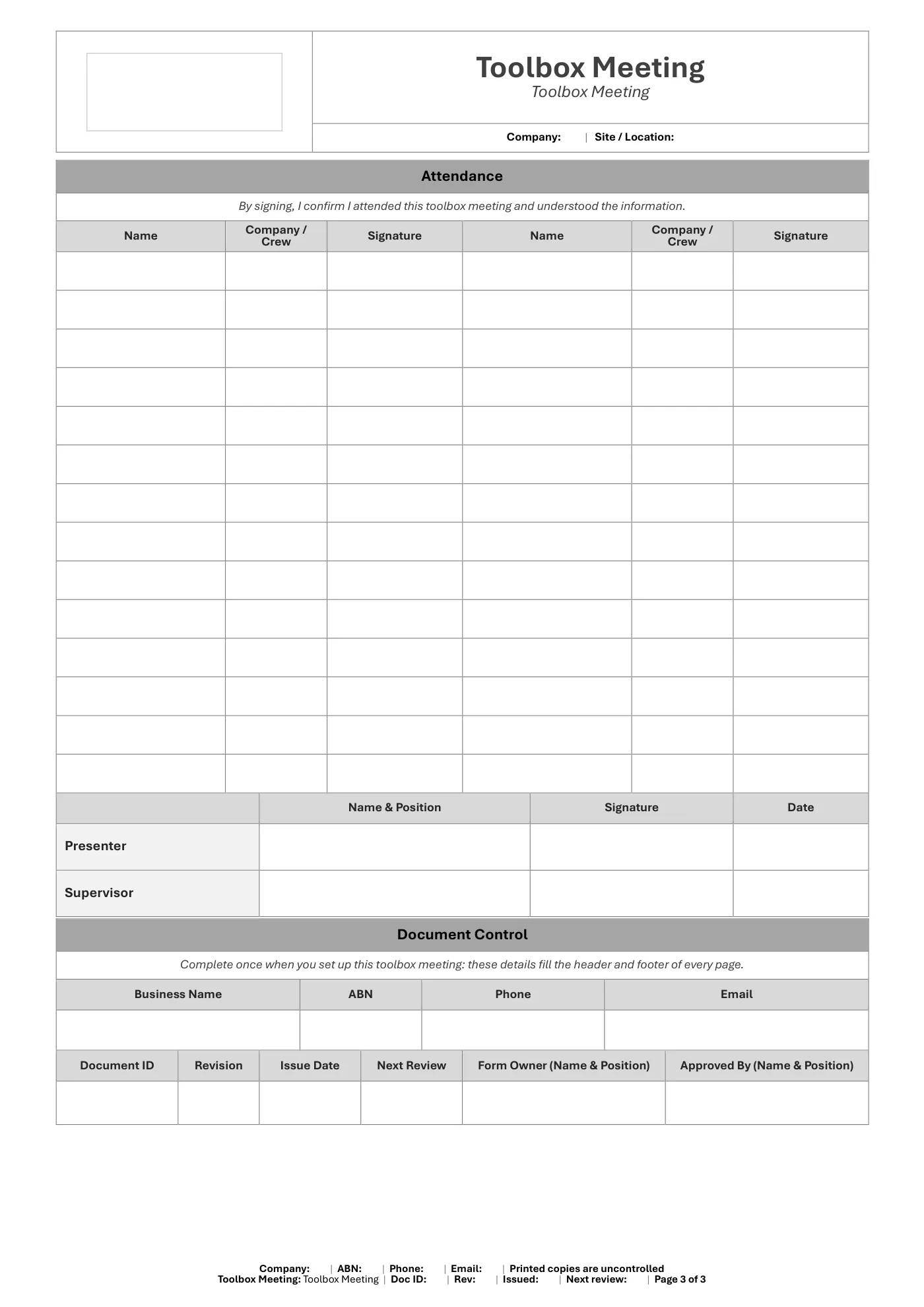
Free Toolbox Meeting Template
Free editable Word toolbox talk template, also called a toolbox meeting template, for Queensland sites: record the topic, key points, questions, hazards, actions and who attended on a sign-on sheet.
RG
Written by Ryan Graham, health and safety professional (16 years on Queensland sites)
Free
No payment needed · instant download
- Instant download · it appears as soon as you send the form
- Make it yours in minutes · edit in Microsoft Word and add your logo
- If it has a fault · tell us and we'll fix it
- No card needed · free to download, with no payment details asked for
About this template
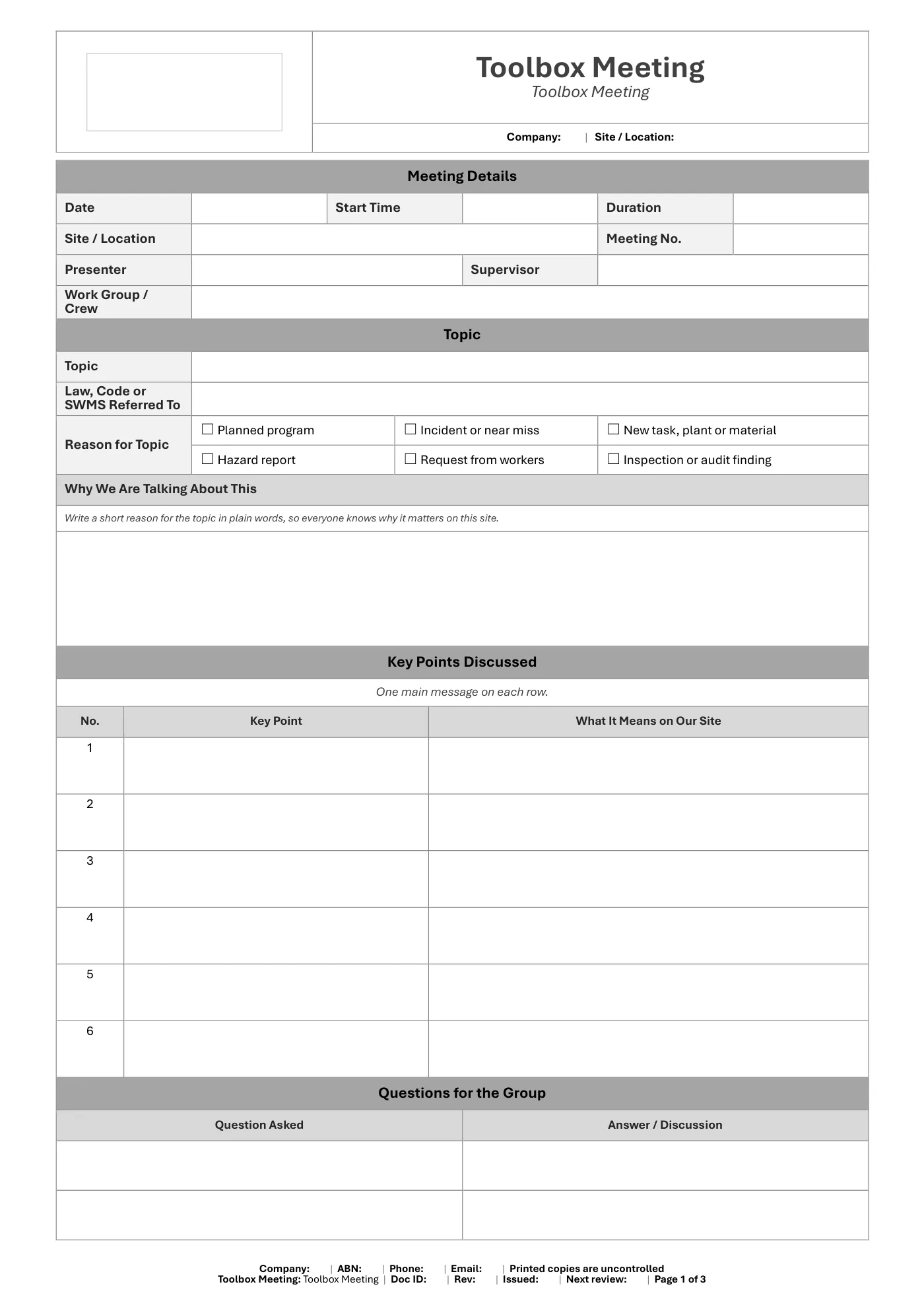
This free toolbox talk template, also called a toolbox meeting template, is an editable Microsoft Word form for running and recording a short safety talk on any topic. It records the topic and why you are talking about it, the key points, the questions the group asks, the hazards and controls discussed, the actions agreed and who attended, with a sign-on sheet at the end. It suits construction sites, workshops and any crew that wants the same record every time.
What is a toolbox talk?
A toolbox talk is a short safety meeting, usually 10 to 15 minutes at the start of a shift, where the crew talks through one hazard, the controls for it and any concerns. Toolbox talk and toolbox meeting are two names for the same thing. The record is what shows the talk happened, what was covered and who was there.
What is in the free toolbox talk template
- Meeting details: date, start time, duration, site, meeting number, presenter, supervisor and crew
- Topic and reason: the topic, the law, code or SWMS it refers to, and why you are talking about it (six tick boxes: planned program; incident or near miss; new task, plant or material; hazard report; request from workers; inspection or audit finding)
- Key points: six rows, one main message on each and what it means on your site
- Questions for the group: the question asked and the answer or discussion
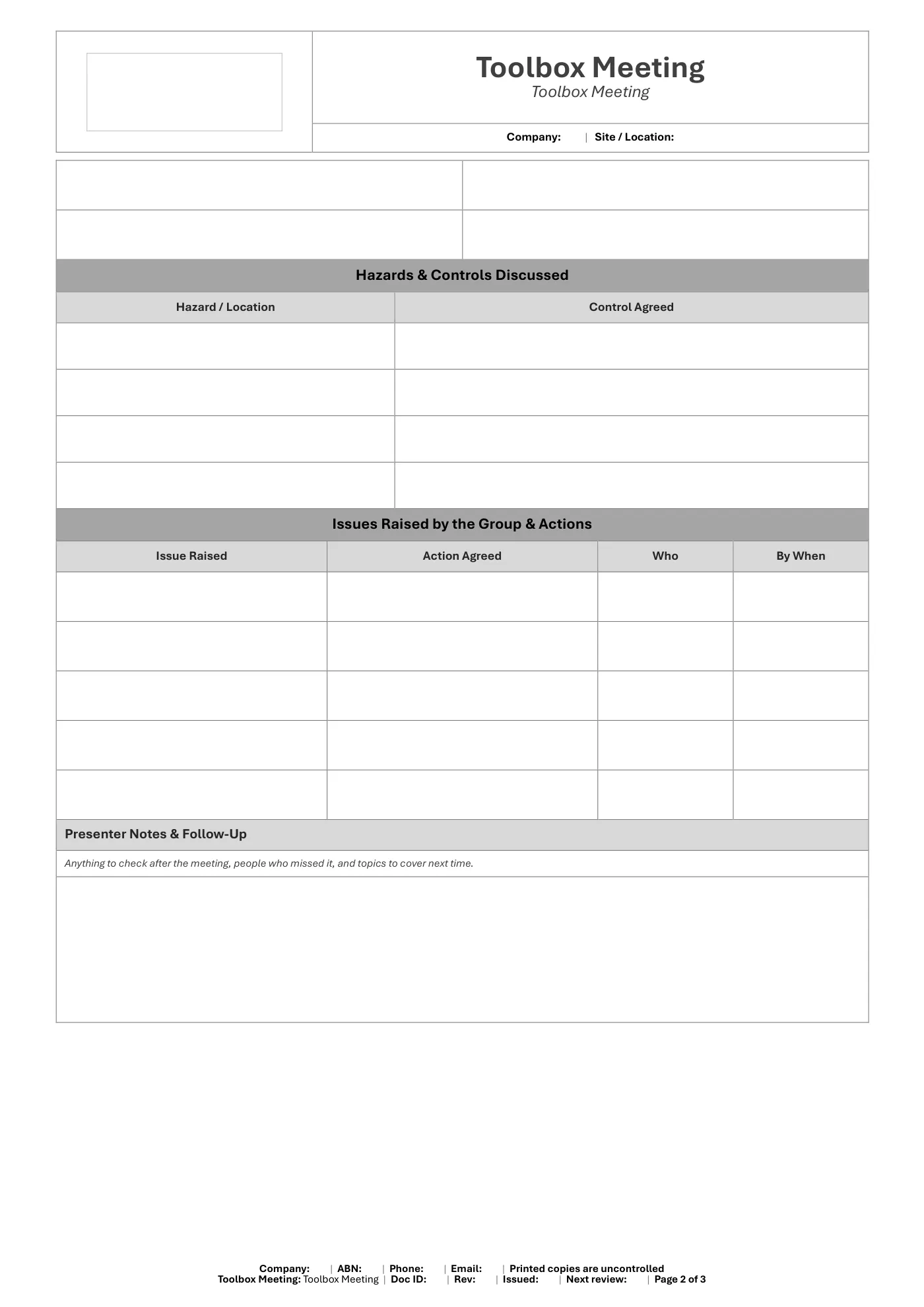
- Hazards and controls: the hazard or location and the control agreed
- Issues and actions: the issue raised, the action agreed, who is responsible and by when
- Presenter notes and follow-up
- Attendance: a sign-on sheet with presenter and supervisor sign-off
- Document control: details typed once that fill the header and footer of every page
It is an editable Microsoft Word file (3 pages), A4 portrait, with a space for your logo.
A worked example: a completed toolbox talk record
This is how a short talk on housekeeping is recorded. The template itself is blank, so you type your own topic, points and actions.
- Meeting details: Tuesday, meeting 14, 6.30 am, 10 minutes, site shed; the leading hand presents and the site supervisor oversees; framing crew
- Topic and reason: housekeeping and trip hazards, raised because a worker made a hazard report about offcuts and leads across the walkway to the stairs
- Key points: clear offcuts as you go and put them in the bin; keep leads off walkways; if you cannot clear a hazard yourself, tell the supervisor straight away
- Question from the group: who clears the offcuts when a trade has left? Answer: each trade clears its own before knock-off and the leading hand checks at the end of the day
- Hazard and control agreed: offcuts and leads across the walkway to the stairs; walkway cleared now, a bin placed at the stairs and leads moved overhead
- Issue and action: not enough bins on level 2; the site supervisor orders two more by Friday
- Attendance: everyone present signs on, then the presenter and the supervisor sign off
How to run a toolbox talk
- Pick one topic that matters today: a new task, a change on site, a recent near miss, the weather, or a step in the SWMS. Short of ideas? See 101 toolbox talk ideas for the construction industry or the Toolbox Talk Topics Calendar.
- Prepare the key points. Read up on the topic, write the main messages in the template and have the equipment, PPE or photos you need to show them.
- Keep it short and practical. Ten to fifteen minutes, on site, using the real equipment where you can.
- Cover the hazard, the controls and what to do if something goes wrong.
- Demonstrate it. A short demonstration of the safe method or the correct use of equipment helps the crew remember it.
- Ask questions and listen. The crew often knows the risks better than anyone; record what they raise.
- Recap the key points before you finish, so everyone leaves with the same message.
- Agree actions with a name and a due date, and follow them up at the next talk.
- Get everyone to sign on, including subcontractors, and file the form with your site records.
Are toolbox talks required in Queensland?
Neither the Work Health and Safety Act 2011 (Qld) nor the Work Health and Safety Regulation 2011 (Qld) uses the words “toolbox talk”, but a regular talk helps you meet two clear duties:
- Consulting workers. A business must consult the workers who are, or are likely to be, directly affected, so far as is reasonably practicable (section 47 of the Work Health and Safety Act 2011 (Qld)), including when it identifies hazards and assesses risks, decides how to eliminate or minimise them and proposes changes that may affect health or safety (section 49).
- Information, training and instruction. A business must ensure, so far as is reasonably practicable, the provision of any information, training, instruction or supervision that is necessary to protect all persons from risks to their health and safety arising from the work (section 19(3)(f) of the Act). Information, training and instruction must be suitable and adequate for the work, the risks and the controls in place and, so far as is reasonably practicable, readily understandable (section 39 of the Work Health and Safety Regulation 2011 (Qld)).
The Work Health and Safety Consultation, Co-operation and Co-ordination Code of Practice 2021 lists toolbox talks as one way to consult workers, and as a practical way to consult contractors and on-hire workers engaged for specific tasks. A signed toolbox record is your evidence that the talk happened and who was there.
Toolbox talk, pre-start meeting or Take 5?
They overlap, but they are not the same record:
- Toolbox talk: a planned short talk on one topic, recorded with this template.
- Pre-start meeting: the daily meeting about the work planned for the day, the hazards and controls, other trades, SWMS and permits. Use the Pre-Start Meeting Record.
- Take 5: a quick check a worker does before starting a task. See Take 5 safety checklist: how to do a Take 5 in Queensland and the Take 5 and Dynamic Risk Assessment Toolbox Talk.
Toolbox talk topics and ready-made talks
- 101 toolbox talk ideas for the construction industry: 101 topics, nearly all linked to their own guide
- Toolbox Talk Topics Calendar: an Excel calendar of 52 weekly topics linked to ready toolbox talks, with a delivered and attendance tracker
- Toolbox Meeting Attendance Register: an Excel meeting log with signatures, hazards raised, actions and monthly counts
- Ready-to-run talks with the key points already written: browse the toolbox talk templates, packs such as the Site Safety Basics Toolbox Talk Pack and the Workplace Hazards Toolbox Talk Pack, and single talks such as Hazard and Near Miss Reporting Toolbox Talk and Hot Weather and Hydration Toolbox Talk
Review the template, adjust it to suit your business, your sites and the way your team works, and talk it through with your workers.
Toolbox talk template: frequently asked questions
What is a toolbox talk?
A toolbox talk is a short safety meeting, usually 10 to 15 minutes at the start of a shift, where the crew talks through one hazard, the controls for it and any concerns. The talk is recorded on a form like this one, with the topic, key points, actions and who attended.
What is the difference between a toolbox talk and a toolbox meeting?
Nothing: they are two names for the same short safety meeting. This form is called a toolbox meeting template and works as a toolbox talk template for any topic.
Are toolbox talks required in Queensland?
Neither the Work Health and Safety Act 2011 (Qld) nor the Work Health and Safety Regulation 2011 (Qld) uses the words toolbox talk, but a regular talk helps a business meet its duty to consult workers, so far as is reasonably practicable (sections 47 and 49 of the Act), and its duty, so far as is reasonably practicable, to provide the information, training, instruction and supervision needed to protect people (section 19(3)(f) of the Act), which must be suitable and adequate for the work (section 39 of the Regulation). The Work Health and Safety Consultation, Co-operation and Co-ordination Code of Practice 2021 lists toolbox talks as one way to consult workers.
How long should a toolbox talk be, and how often should you hold one?
Most toolbox talks run for 10 to 15 minutes. The Work Health and Safety Act and Regulation do not set how many you must hold, so the number is up to your business: many crews hold one each week, plus one before a new task, after a near miss or when something changes on site.
What should a toolbox talk record include?
The date, time and place, who presented and who supervised, the topic and the reason for it, the key points covered, the questions asked, the hazards and the controls agreed, any actions with a name and a due date, and a signature from everyone who attended. This template has a place for each of these.
Who can run a toolbox talk?
A supervisor, a leading hand or any worker who knows the topic can present it. The presenter and the supervisor both sign off the record, and everyone who attends signs on.
What is the difference between a toolbox talk and a pre-start meeting?
A toolbox talk is a planned short talk on one topic. A pre-start meeting is the daily meeting about the work planned for the day: the hazards and controls, other trades, SWMS and permits. The Pre-Start Meeting Record is the form for that meeting.
Can I use this template for any topic or industry?
Yes. The topic, key points and actions are blank, so you can use it for any topic in any industry. For talks with the key points already written, browse the toolbox talk templates in the store.
Is this toolbox talk template free?
Yes. Enter your first name and email address and the download button for the Word file appears straight away, with no card needed. You will also get our free safety newsletter, and you can unsubscribe at any time.
This page is general information about work health and safety in Queensland, not legal advice.
Having trouble with your download? Contact us any time. Please read our Disclaimer before downloading.
How to use it
From download to site in three steps
Fill in the form and download
Enter your name and email. Your download buttons appear straight away and the links are emailed to you.
Make it yours
Open it in Microsoft Word or Excel. Add your logo, business details, site and job information, and adjust it to how the work is done.
Brief your crew
Talk it through with the workers doing the job, have them sign on, and keep it on site. Review it whenever the job or conditions change.
What format is it?
Microsoft Word. Edit it in Word, or free in Word for the web, and add your own logo and business details.
How do I get it?
Fill in your name and email on this page. Your download buttons appear as soon as you send the form, and the links are emailed to you. You can download it again from your account at any time.
Is it compliant with Queensland law?
It's written around Queensland's Work Health and Safety Act 2011 and Regulation 2011. Tailor it to your site, consult your workers and review it whenever conditions change; no template can guarantee compliance on its own.
What if it isn't right for my job?
Check the sample pages first. If the template has a fault or doesn't match its description, tell us and we'll fix it. Every template is a starting point that you tailor to your own work.
Only logged in customers who have purchased this product may leave a review.
Reviews