Working at Heights SWMS
$49.99
Instant download · Editable Word & Excel files · Secure checkout with Apple Pay & Google Pay
About · Contact · Help & FAQ · My downloads

Manuals and plans
Full systems and bundles
Full safety system
Manual, policies, SWMS, forms and registers for your industry, in one download.
From $750.00
Tell us what you need. Popular requests get written and added to the store.
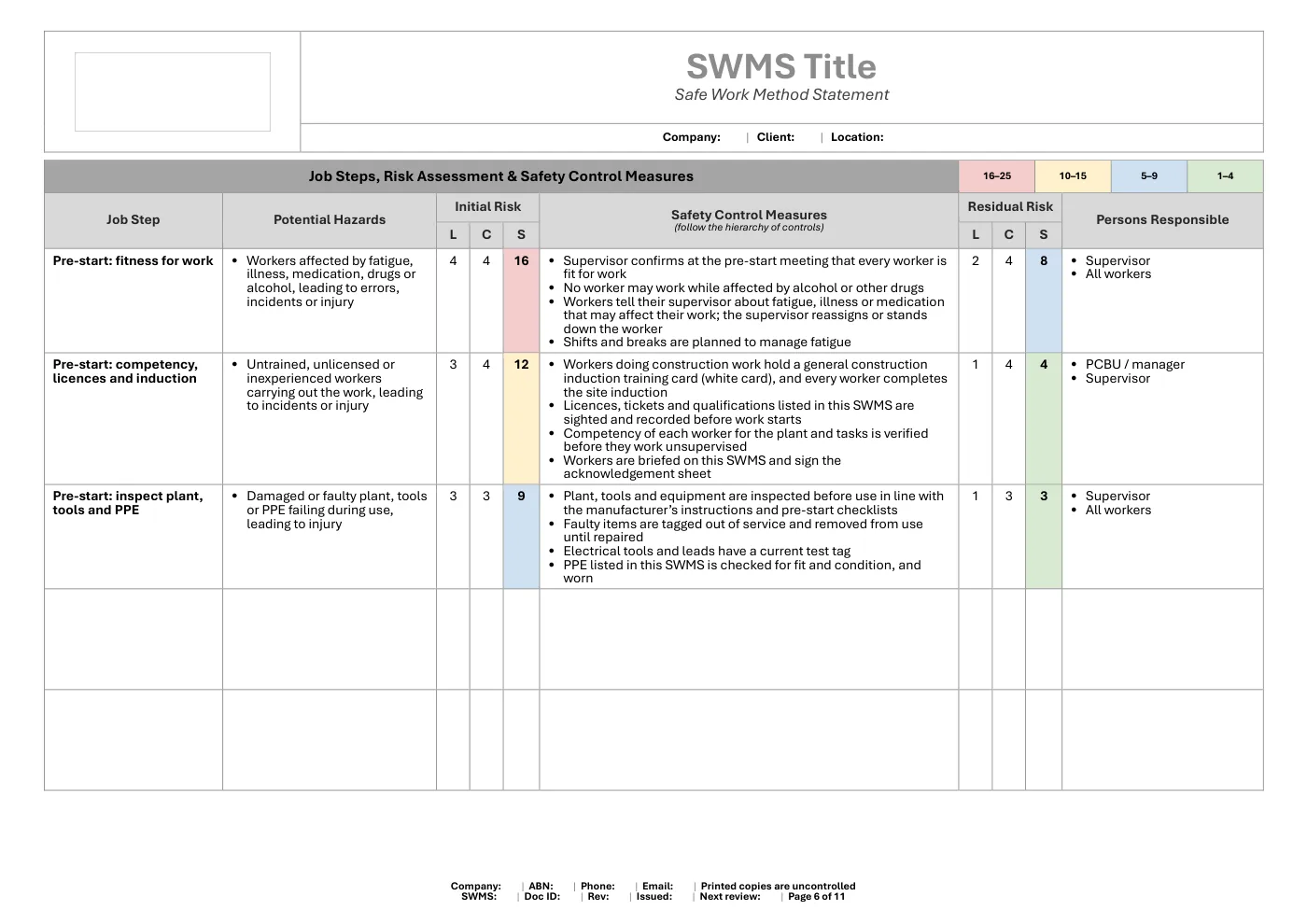
A free Safe Work Method Statement template for Queensland in Microsoft Word. Type your details once, add your logo, then work through the high risk construction work checklist, risk matrix and job steps for your job.
RG
Written by Ryan Graham, health and safety professional (16 years on Queensland sites)
Free
No payment needed · instant download
About this template
This free SWMS template for Queensland is a Microsoft Word safe work method statement you can fill in for your own job. A SWMS (safe work method statement) is a written plan for high risk construction work. It states the hazards, the controls, and how the controls will be put in place, monitored and reviewed.
The free SWMS template includes the high risk construction work checklist, a worker consultation record, a 5 x 5 risk matrix, a job steps table with three worked pre-start rows, an additional controls log, a revision history and a worker sign-on sheet.
This free Safe Work Method Statement (SWMS) template is a Microsoft Word document set up for high risk construction work in Queensland. It is laid out on A4 landscape pages and follows the SWMS rules in the Work Health and Safety Regulation 2011 (Qld), so you can turn it into a SWMS for your own job and crew.
Learn more: What is a safe work method statement?
New to SWMS? Read our plain-English guide to what a Safe Work Method Statement is and when you need one in Queensland.
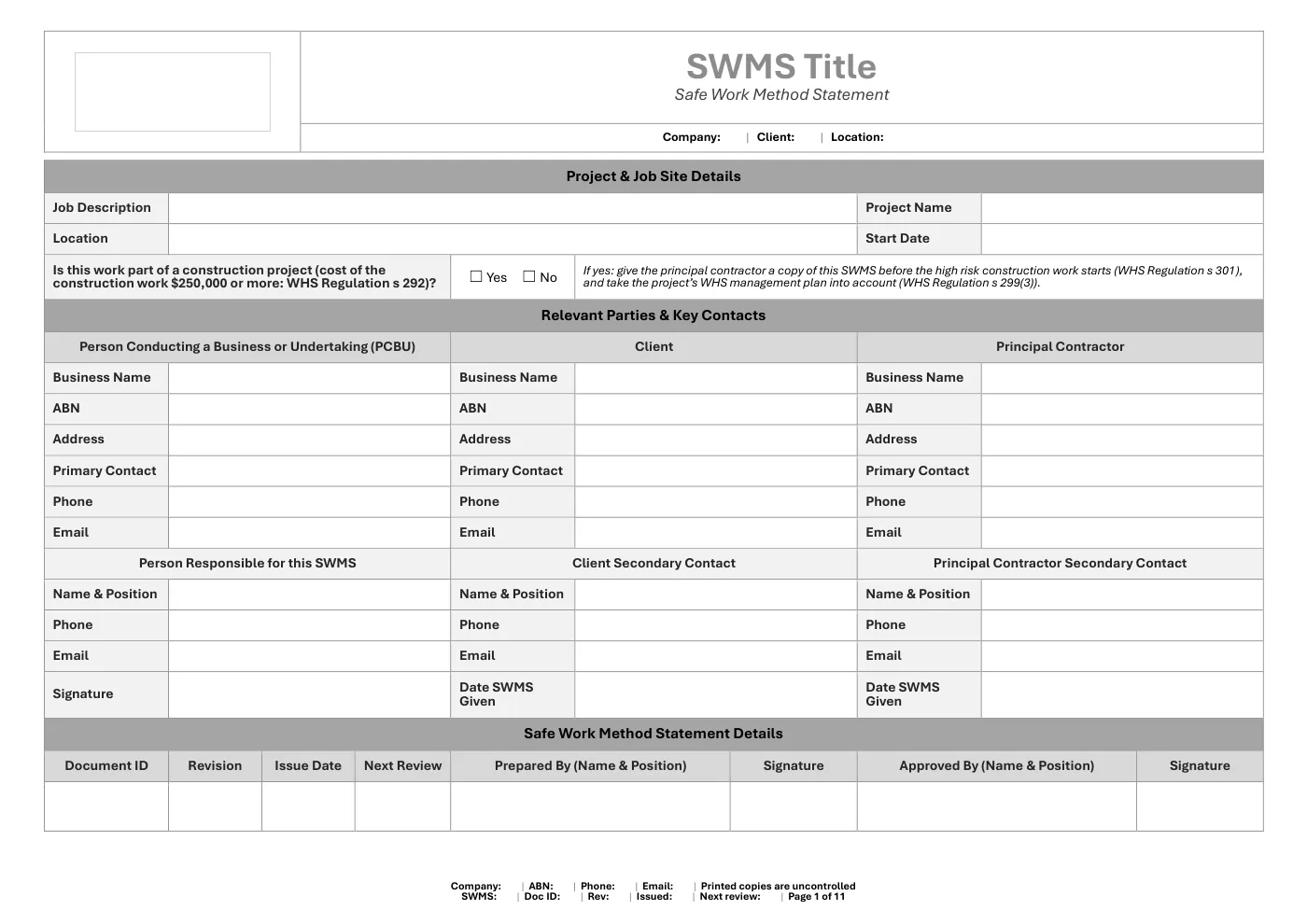
The screenshots below show a filled-in copy for a made-up building business, so you can see what goes where. Open the template in Microsoft Word (desktop, or Word for the web) and click Enable Editing if Word asks. Save a copy for each job before you start.
Click into each grey box and type. The business name, ABN, SWMS title (Job Description), location, client and document details only need to be typed once: Word copies them into the header and footer of every page. Fill in the client and principal contractor columns for the job, and answer the construction project question. If the job is part of a construction project, the principal contractor needs a copy before the high risk construction work starts.
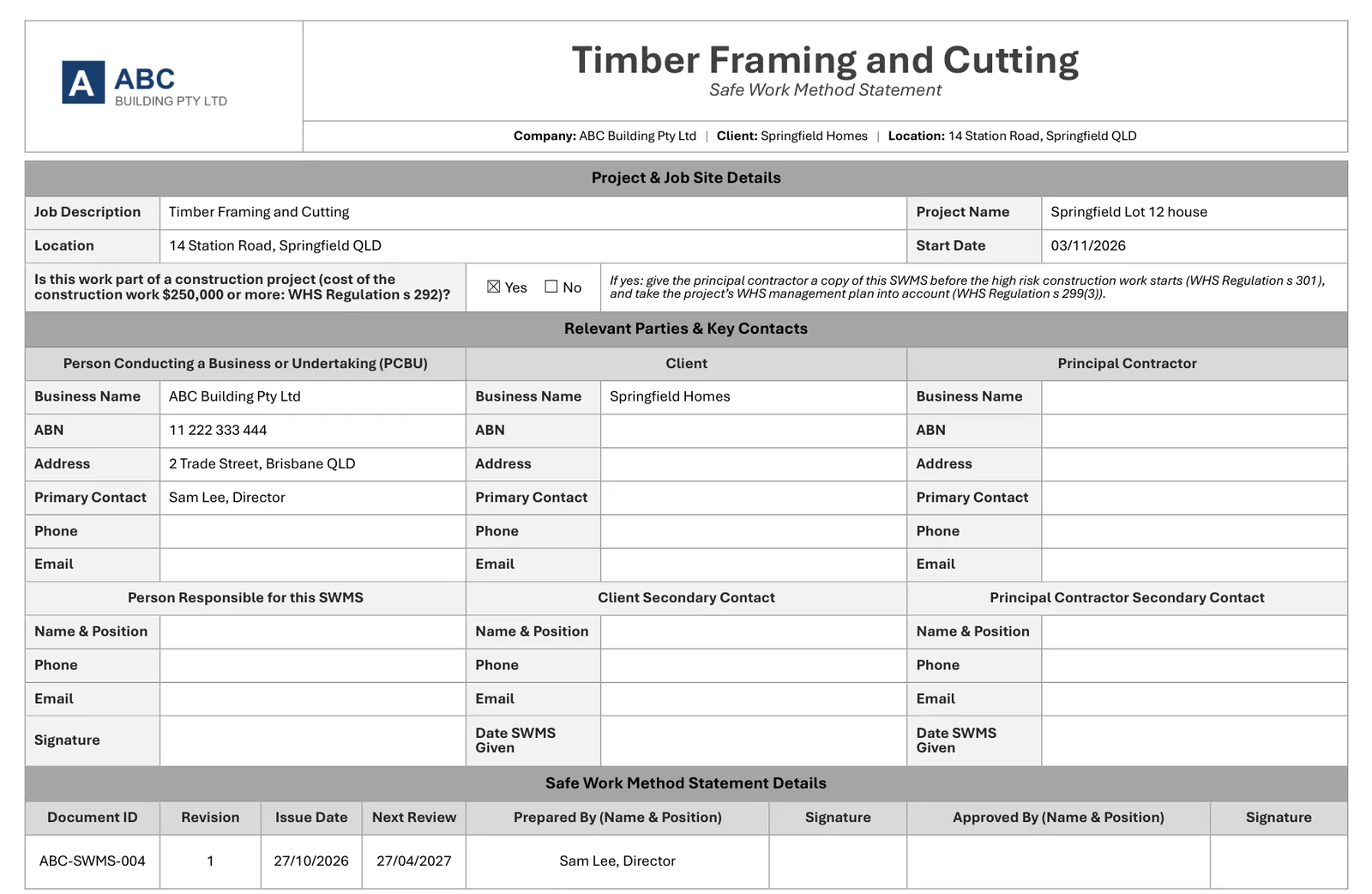
Click the empty box at the top left of any page, choose the picture icon and pick your logo file. Word fits it inside the box and shows it on every page.

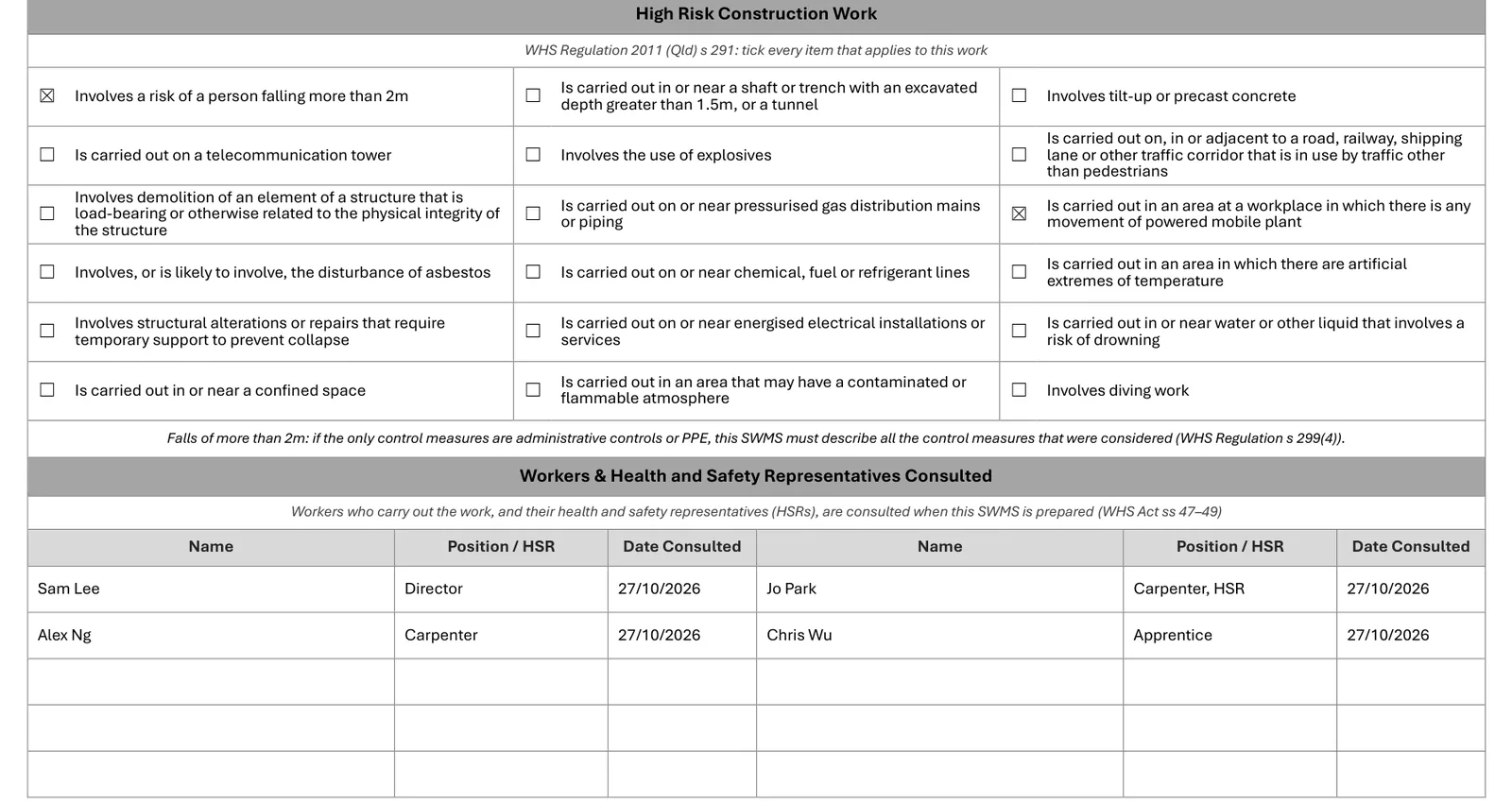
On page 2, tick every item of high risk construction work that applies to the job. Then list the workers and health and safety representatives you consulted while preparing the SWMS, with their position and the date. To add more names, click in the last box of the table and press Tab.
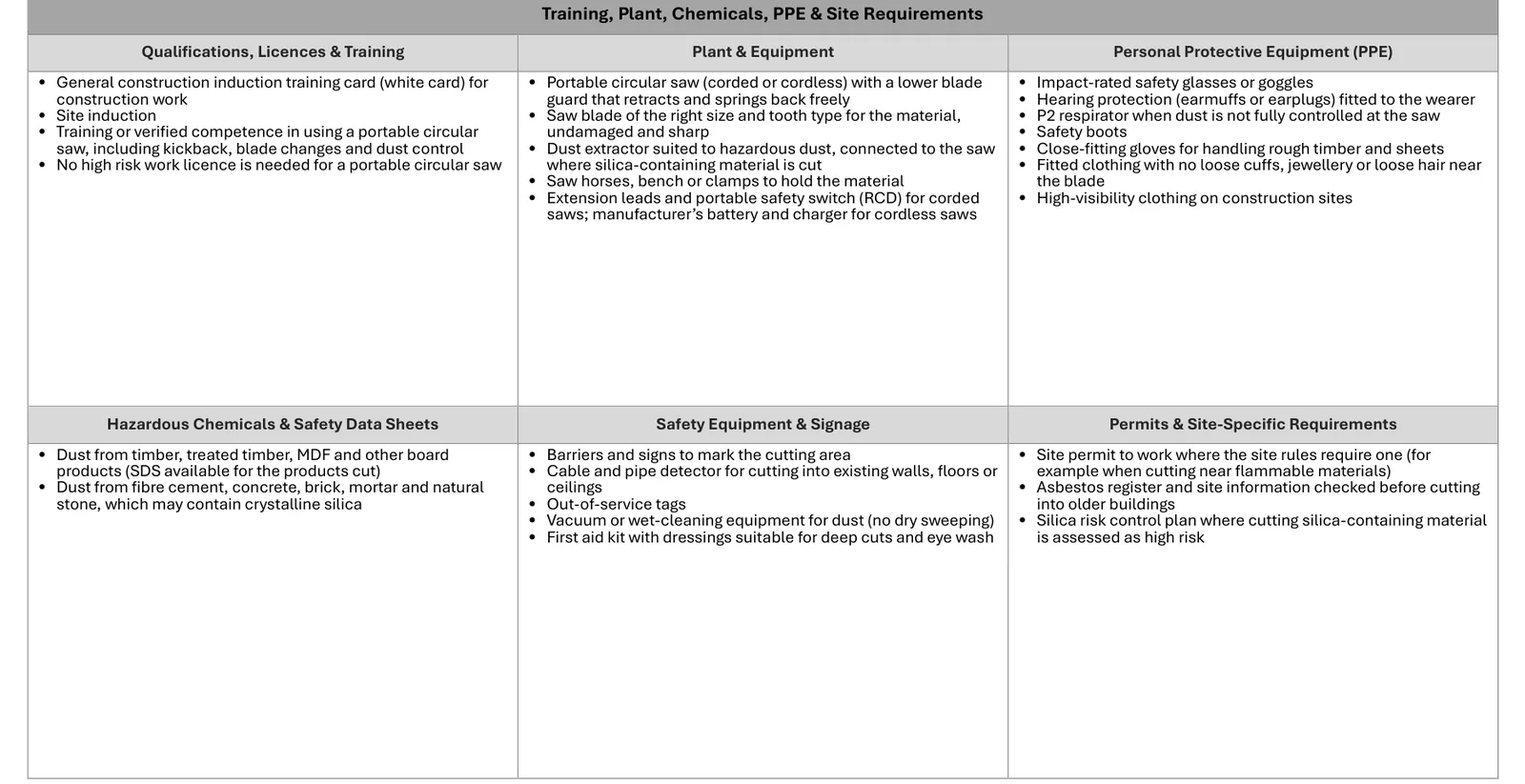
On page 3, list the licences and training, plant and equipment, PPE, hazardous chemicals (keep their Safety Data Sheets on site), safety equipment and signage, and any permits or site rules for the job. Each box has plenty of room and grows if you need more.
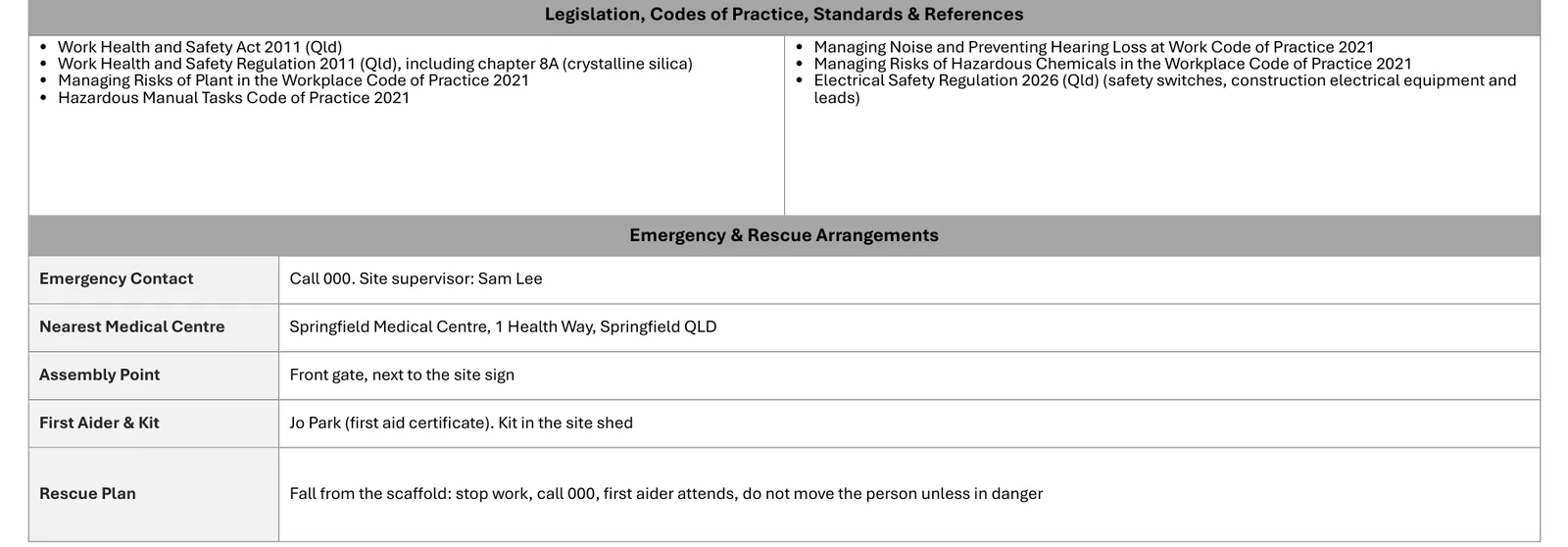
On page 4, list the legislation and codes of practice you relied on, then fill in the emergency contacts, nearest medical centre, assembly point, first aider and first aid kit, and the rescue plan for this job.
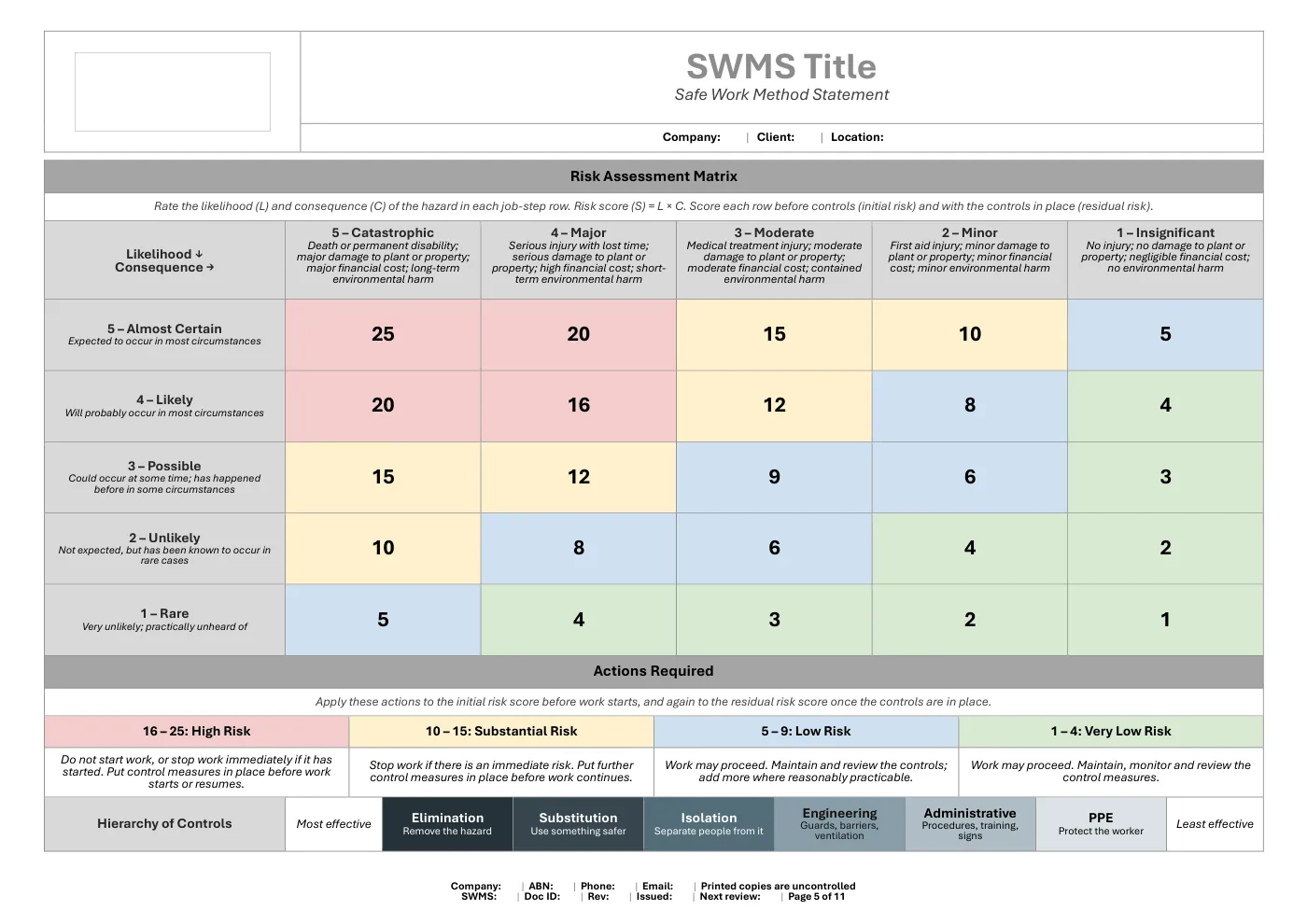
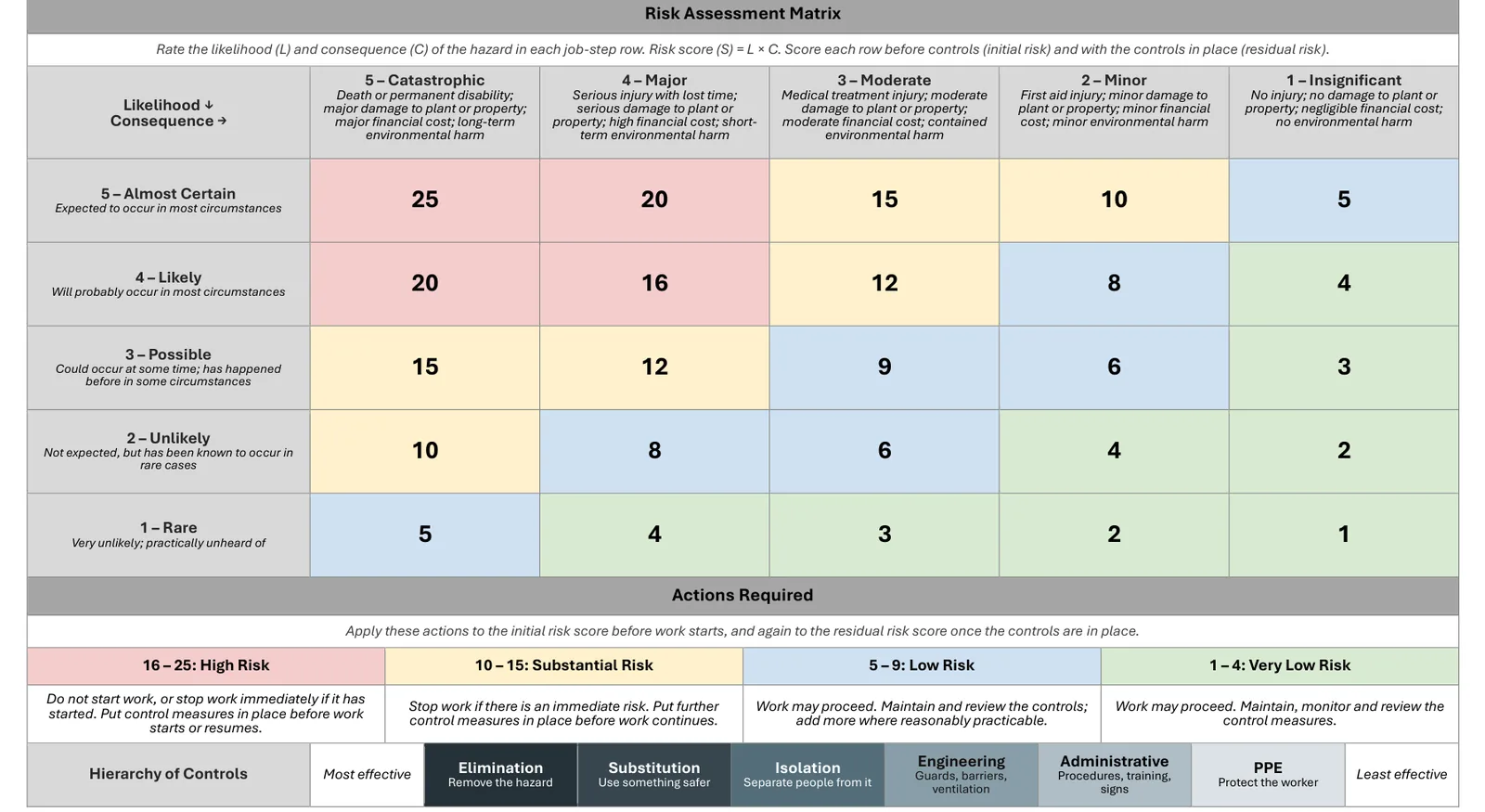
Page 5 explains the scoring. For each hazard, pick how likely it is (L, 1 to 5) and how bad the outcome could be (C, 1 to 5). The risk score (S) is L times C. Score it twice: before controls (initial risk) and with your controls in place (residual risk), and follow the action for that score.
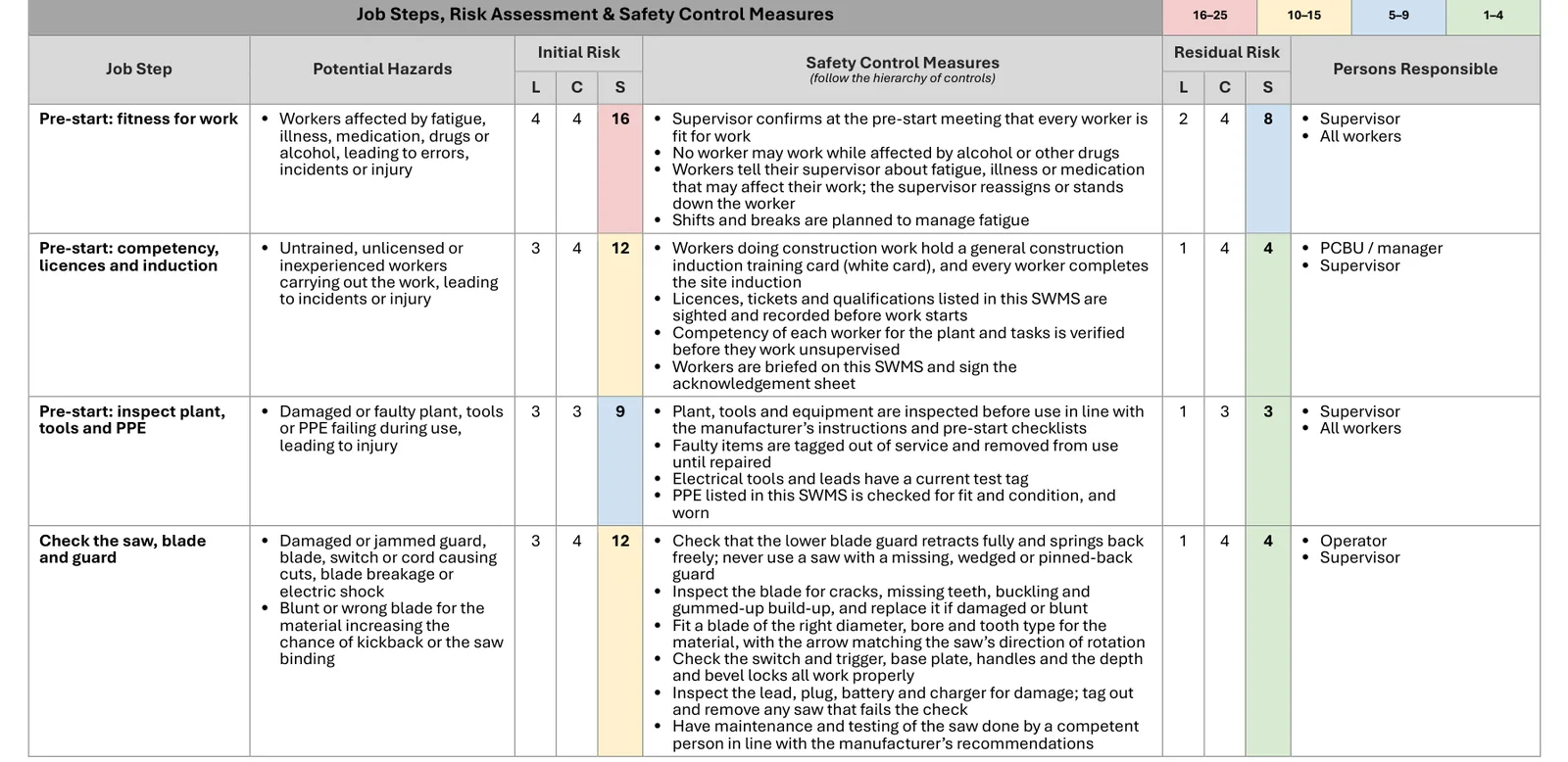
Break the work into steps in the order they happen. For each step, list the hazards, the initial score, the control measures (start with the most effective, following the hierarchy of control), the residual score and who is responsible. The first three pre-start rows are already filled in as a guide; keep them, change them or replace them. To add rows, right-click a row and choose Insert, then Insert Rows Below. If you like, shade each S box to match its colour band (select the box, then Shading on the Table Design tab).
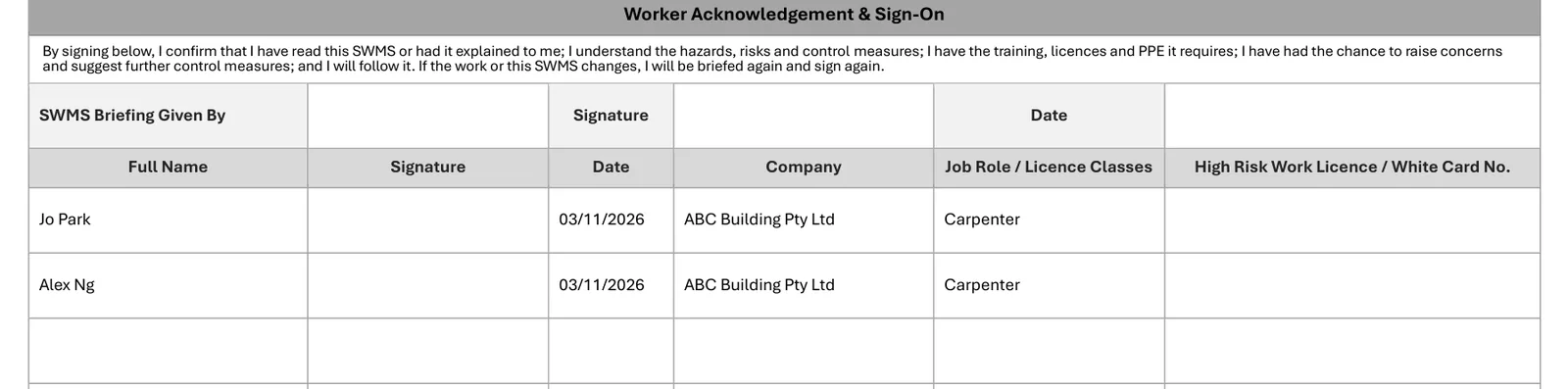
Before work starts, talk the SWMS through with everyone doing the work and have them sign the sign-on sheet. Record any extra controls agreed with workers on the additional controls page, and log every review on the revision history page. Keep a copy where workers can get to it until the work is finished.
Under section 299 of the Work Health and Safety Regulation 2011 (Qld), a business must make sure a SWMS is prepared before high risk construction work starts. The SWMS must:
It must take into account the conditions at the workplace (and the WHS management plan if the work is part of a construction project), and it must be set out so the people using it can readily understand it. Where the only controls for a fall risk of more than 2 metres are administrative controls or PPE, the SWMS must describe all the controls that were considered.
Once it’s in place, the work must be done in line with the SWMS. If it isn’t, the work must stop as soon as it is safe and only restart in line with the SWMS (section 300). The SWMS must be reviewed, and revised if needed, whenever the related control measures are revised (section 302), and kept until the work is finished, or for at least 2 years if a notifiable incident happens (section 303).
A template is a starting point, not a finished SWMS. Before you use it, change it to suit the actual job: the site, the plant, the people doing the work and the way the work is really done. Talk it through with your workers, add the hazards that are specific to the site, and review it whenever the job or the conditions change. One SWMS can cover several high risk construction work activities, as long as it deals with how they affect each other.
Learn more: How often do SWMS need to be reviewed (and how to review them)?
Read our guide on when a SWMS must be reviewed and how to do it.
A SWMS is a safe work method statement. It is a written document that identifies the high risk construction work, states the hazards and the risks to health and safety, describes the measures that will control those risks, and describes how the controls will be put in place, monitored and reviewed (section 299 of the Work Health and Safety Regulation 2011 (Qld)).
Before any high risk construction work starts, whatever the size or value of the job. High risk construction work is the list in section 291 of the Work Health and Safety Regulation 2011 (Qld), for example work with a risk of a person falling more than 2 metres, work in or near a shaft or trench deeper than 1.5 metres, work in or near a confined space, or work on or near energised electrical installations. Work that is not on that list does not need a SWMS under that Regulation. Electrical work on or near energised electrical equipment also needs a SWMS under section 199 of the Electrical Safety Regulation 2026 (Qld).
The business doing the high risk construction work must make sure a SWMS is prepared before the work starts, or that one has already been prepared by another person (section 299 of the Work Health and Safety Regulation 2011 (Qld)). The business must also put arrangements in place to make sure the work is carried out in line with the SWMS (section 300).
The Regulation does not require workers to sign a SWMS. It requires the SWMS to be set out in a way that people using it can readily understand (section 299), and the business must consult workers so far as is reasonably practicable (sections 47 to 49 of the Work Health and Safety Act 2011 (Qld)). A signed sign-on sheet, like the one in this template, is a common way to record that the crew has read it, but it is a site practice, not a legal requirement.
Keep a copy until the high risk construction work is completed. If a notifiable incident happens in connection with the work, keep it for at least 2 years after the incident (section 303 of the Work Health and Safety Regulation 2011 (Qld)).
A SWMS is the document the Regulation requires for high risk construction work (section 299). A job safety analysis (JSA) or a general risk assessment is not named in that section: it is a way of working through the hazards of a task and is often used for work that is not high risk. If the work is high risk construction work, you need a document that meets section 299, whatever it is called.
Yes. Section 299 of the Work Health and Safety Regulation 2011 (Qld) allows for a SWMS that has already been prepared by another person. It must still be prepared taking into account the circumstances at your workplace, so a template is a starting point and you need to fill in the details of your job.
It must take into account the circumstances at the workplace that may affect how the high risk construction work is carried out and, for a construction project, the WHS management plan (section 299 of the Work Health and Safety Regulation 2011 (Qld)). Change the template for each job: the site, the plant, the people and the way the work will really be done.
This is general information, not legal advice. Check the current law or talk to Workplace Health and Safety Queensland for your situation.
Having trouble with your download? Contact us any time. Please read our Disclaimer before downloading.
How to use it
Enter your name and email. Your download buttons appear straight away and the links are emailed to you.
Open it in Microsoft Word or Excel. Add your logo, business details, site and job information, and adjust it to how the work is done.
Talk it through with the workers doing the job, have them sign on, and keep it on site. Review it whenever the job or conditions change.
Microsoft Word. Edit it in Word, or free in Word for the web, and add your own logo and business details.
Fill in your name and email on this page. Your download buttons appear as soon as you send the form, and the links are emailed to you. You can download it again from your account at any time.
It's written around Queensland's Work Health and Safety Act 2011 and Regulation 2011. Tailor it to your site, consult your workers and review it whenever conditions change; no template can guarantee compliance on its own.
Check the sample pages first. If the template has a fault or doesn't match its description, tell us and we'll fix it. Every template is a starting point that you tailor to your own work.
Only logged in customers who have purchased this product may leave a review.
Clarence Davi (verified owner) –
Very good. I used the SWMS for training in rail construction and for removing and replacing sleepers at the Archer Park Railway Museum in Rockhampton. I liked it and the students who were in engaged in the construction on or near a railway line understood it.