
Plant Risk Assessment Template
Editable Word plant risk assessment for Queensland: checks the hazards of a machine or item of plant through set-up, use, cleaning and maintenance, with scores, controls and sign-off.
RG
Written by Ryan Graham, health and safety professional (16 years on Queensland sites)
$19.99 incl. GST
AUD · one-off purchase · instant download
- Instant download · your links arrive by email straight after checkout and work for 3 months, so save your copy
- Make it yours in minutes · edit in Microsoft Word and add your logo
- Quality guarantee · we'll fix any problem, then refund you or give store credit if you're still not happy
- Secure checkout · card, Apple Pay or Google Pay through Stripe
About this template
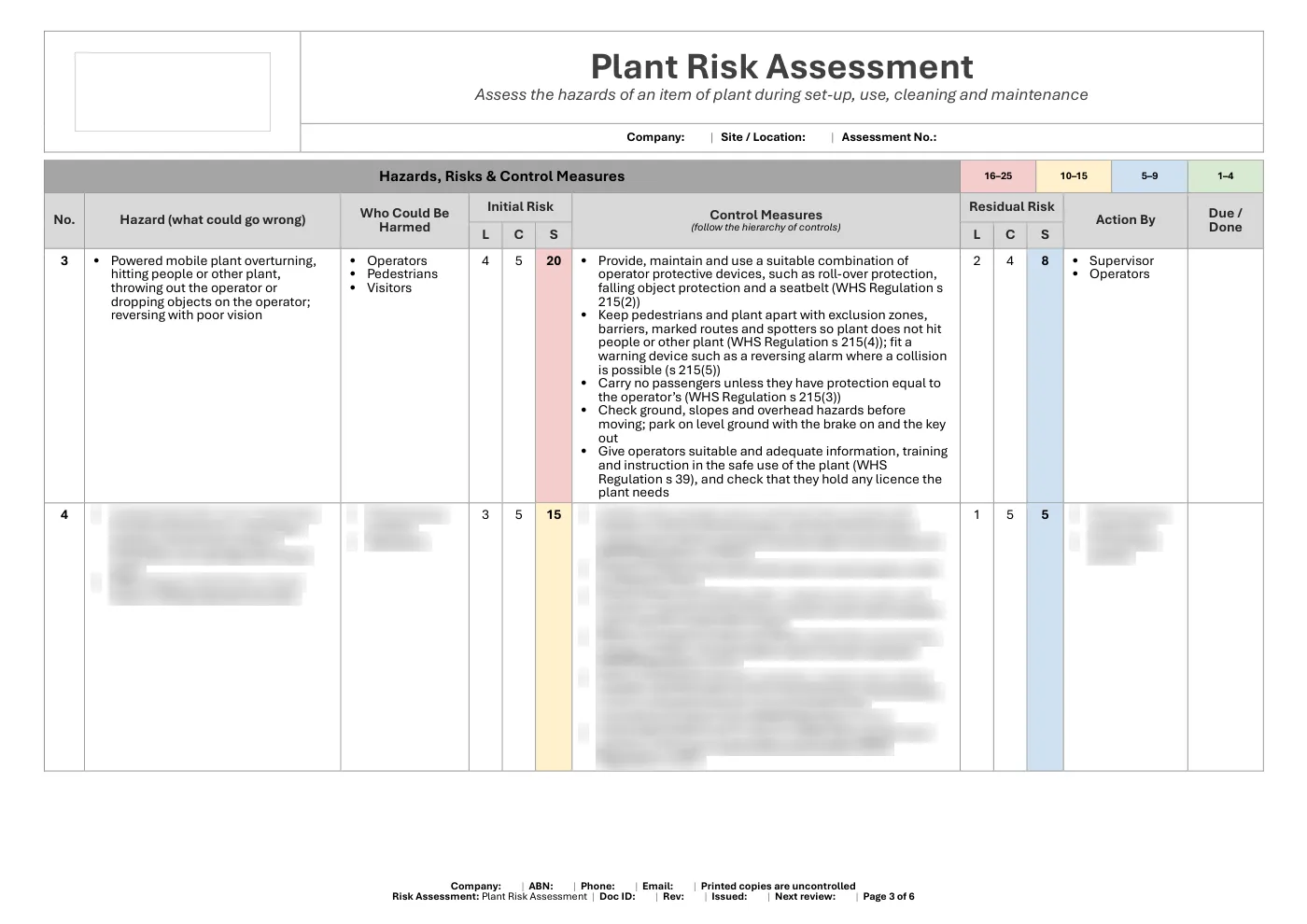
This plant risk assessment template is an editable Microsoft Word form for assessing a machine, vehicle or piece of equipment at a Queensland workplace. You work through each type of plant hazard, score the risk on a 5 x 5 matrix, record the controls and score it again, then sign it off and set a review date.
The person who manages or controls plant at a workplace has to manage its risks. This form works through the common plant hazard types one by one for a machine, vehicle or tool, so you can score each risk, record the controls and show they were reviewed.
What is a plant risk assessment?
In WHS law, plant means any machinery, equipment, appliance, container, implement or tool, its components and anything fitted or connected to it. That covers everything from a bench grinder or compressor to an excavator, forklift or crane. A plant risk assessment looks at what could go wrong with that plant, how likely it is and how bad it could be, and records the controls you will use.
When do you need a plant risk assessment in Queensland?
Under the Work Health and Safety Regulation 2011 (Qld), the person with management or control of plant at a workplace must manage its risks (section 203). That means following the risk management steps in sections 34 to 38: identify the hazards, eliminate the risks or minimise them using the hierarchy of control, and review the controls.
The law does not demand a written risk assessment for every tool. The Managing Risks of Plant in the Workplace Code of Practice 2021 says that where a hazard and its controls are well known, you can simply put the controls in place. A documented plant risk assessment is worth doing when:
- you bring in new, second-hand, hired or modified plant
- you are not sure how serious a risk is or whether your controls are working
- the plant is high risk, such as powered mobile plant, plant near overhead power lines or plant that needs a high risk work licence
- there has been an incident or near miss involving the plant
- a client or principal contractor asks for it before you start on site
How to complete a plant risk assessment
- Describe the plant and the task. Record the make, model and where and how it is used, and who is involved.
- Gather information. Read the manufacturer’s manual, maintenance and inspection records, and any past incidents. Talk to the operators.
- Work through each hazard type. Entanglement, crushing, cutting, striking, overturning, collisions, stored energy, electrical, heat, noise, vibration and ergonomics are all in the form.
- Score the risk on the 5 x 5 matrix before any controls.
- Choose controls starting at the top of the hierarchy: eliminate, substitute, isolate (such as guarding), engineering, then administrative controls and PPE.
- Score the risk again with the controls in place, and assign actions with names and dates.
- Sign it off and set a review date. Brief the operators and keep a copy with the plant records.
Inspection, maintenance and review of plant
Plant must be maintained and inspected (and tested where needed) by a competent person. Follow the manufacturer’s recommendations, or a competent person’s recommendations if there are none, and if neither is reasonably practicable, inspect it at least once a year (section 213). Review your controls, and the risk assessment, when a control is not working, before a change that could create a new risk, when a new hazard is found, after consultation shows a review is needed, or when a health and safety representative asks (section 38).
Plant templates that go with this assessment
- Plant and Equipment Register: keep track of every item, its inspections and servicing
- General Plant and Equipment Pre-Start Checklist: a daily check before use
- Plant and Equipment Maintenance Policy and Procedure
- Plant and Pedestrian Interaction Policy and Procedure
- Free risk assessment template for hazards that are not plant
More checklists for specific machines are in safety checklists.
What is included in our plant risk assessment form?
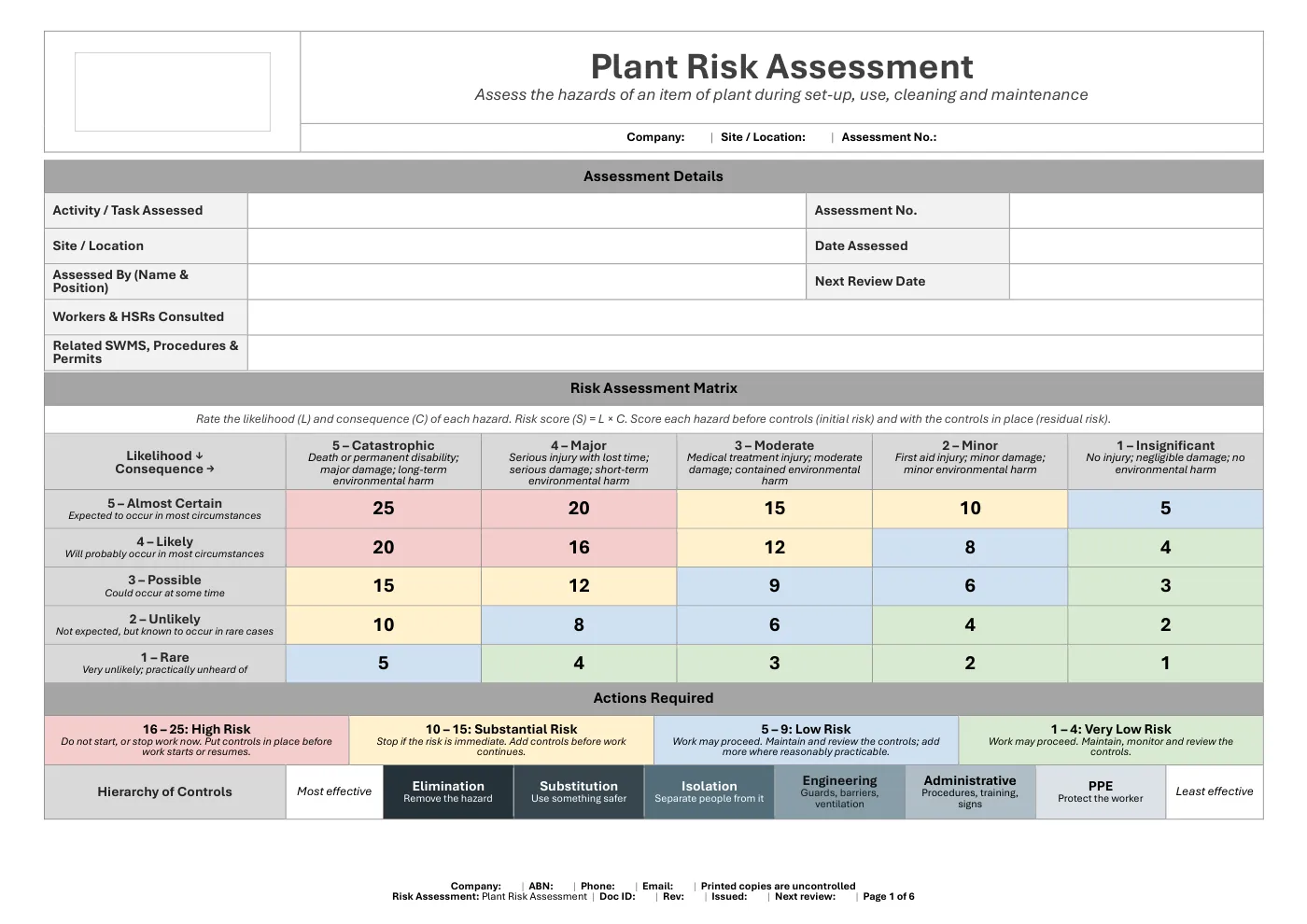
- Assessment details: the plant assessed, location, who assessed it, who was consulted and the related procedures and permits
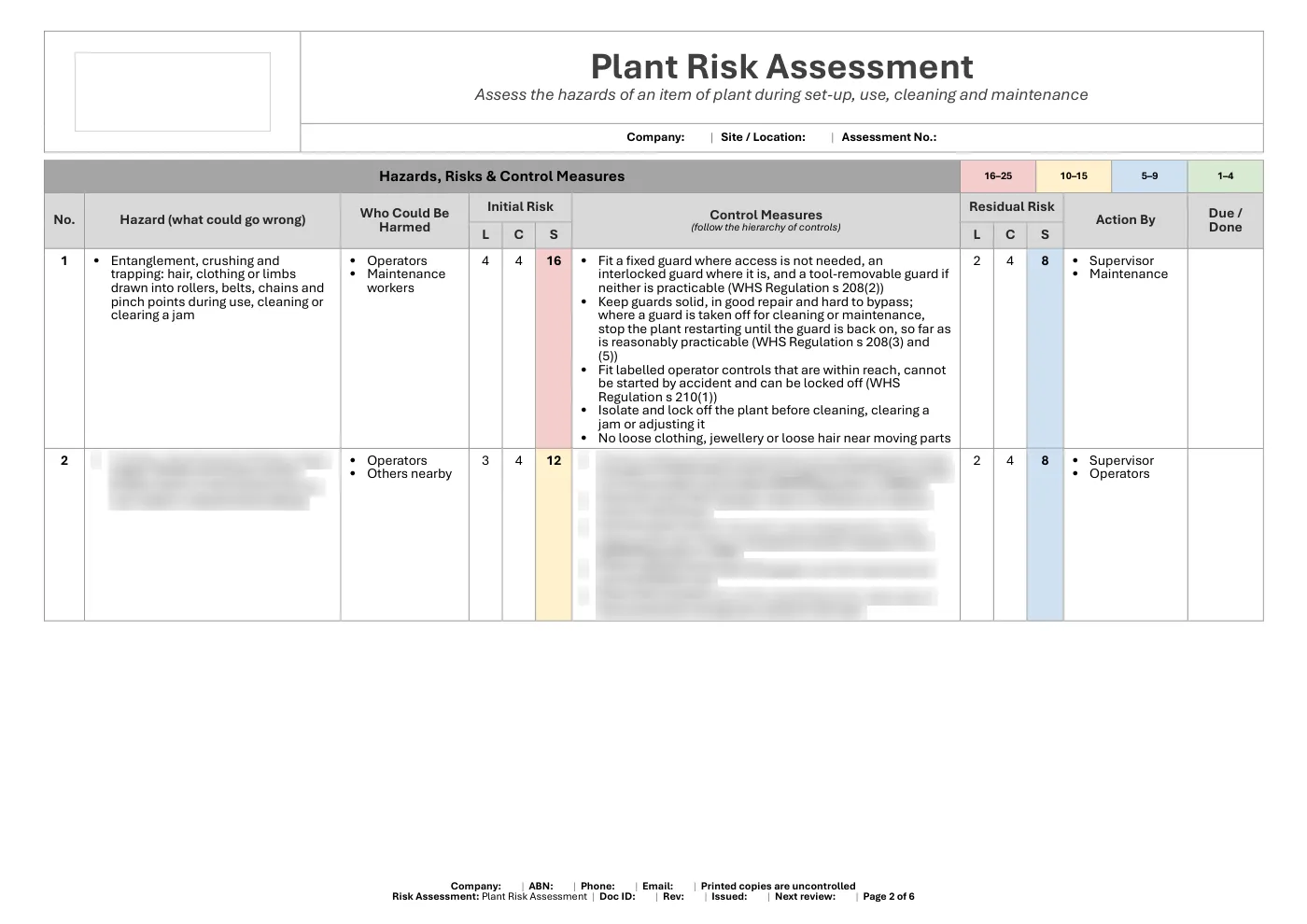
- Entanglement, crushing and trapping, and the guarding that controls them
- Cutting, shearing, striking and ejected parts
- Powered mobile plant: overturning, collisions, operator protection and reversing
- Unexpected start-up, stored energy, high-pressure fluids and emergency stops
- Electrical, fire, hot surfaces and exhaust fumes
- Falls, slips and trips around the plant, plus noise, vibration and operator ergonomics
- Five by five risk matrix with scores before and after the controls
- Blank rows for other hazards and review record and sign-off
What you get
- An editable Microsoft Word risk assessment (6 pages), A4 landscape
- Assessment details, a 5 x 5 risk matrix and the hierarchy of controls
- Worked hazard rows with initial and residual risk scores, plus blank rows
- Review record, sign-off and document control
- Business details typed once and filled in on every page, plus a space for your logo
Review it and adjust it to suit your business, your sites and the way your team works, and talk it through with your workers.
Plant risk assessment: frequently asked questions
What counts as plant under Queensland WHS law?
Plant includes any machinery, equipment, appliance, container, implement or tool, any component of those things, and anything fitted or connected to them. Examples range from power tools and compressors to forklifts, excavators, cranes and conveyors.
Is a plant risk assessment a legal requirement in Queensland?
The person with management or control of plant must manage its risks under section 203 of the WHS Regulation, using the risk management steps in sections 34 to 38. A written risk assessment is not required for every item, but it is the clearest way to show you have done this, and it is strongly recommended for new, hired, modified or high risk plant.
How often does plant need to be inspected?
Plant must be inspected and maintained by a competent person in line with the manufacturer's recommendations, or a competent person's recommendations if there are none. If neither is reasonably practicable, it must be inspected at least once a year (section 213 of the WHS Regulation).
When should a plant risk assessment be reviewed?
Review it when a control is not working, before a change that could create a new or different risk, when a new hazard is identified, when consultation shows a review is needed, or when a health and safety representative asks for one. Many businesses also set a regular review date and review after any incident.
Can one plant risk assessment cover several machines?
Use one assessment for each item of plant, or for a group of identical plant used the same way in the same conditions. If the plant, the task or the work environment differs, assess it separately.
What format is the plant risk assessment template?
It is an editable Microsoft Word document on A4 landscape pages. Your business details are typed once and fill in on every page, and there is a space for your logo.
This is general information, not legal advice. Check the current law or talk to Workplace Health and Safety Queensland for your situation.
Having trouble with your download? Contact us any time. Please read our Disclaimer before downloading.
How to use it
From download to site in three steps
Buy and download
Check out with card, Apple Pay or Google Pay. Your download buttons appear straight away and the links are emailed to you. Links work for 3 months, so save your copies.
Make it yours
Open it in Microsoft Word or Excel. Add your logo, business details, site and job information, and adjust it to how the work is done.
Brief your crew
Talk it through with the workers doing the job, have them sign on, and keep it on site. Review it whenever the job or conditions change.
What format is it?
Microsoft Word. Edit it in Word, or free in Word for the web, and add your own logo and business details.
How do I get it after I pay?
Your download buttons appear as soon as checkout finishes, and the links are emailed to you. You can re-download from your account at any time.
Is it compliant with Queensland law?
It's written around Queensland's Work Health and Safety Act 2011 and Regulation 2011. Tailor it to your site, consult your workers and review it whenever conditions change; no template can guarantee compliance on its own.
What if it isn't right for my job?
If it doesn't match its description or has a fault, tell us and we'll fix it. If you're still not happy, we'll refund you or give you store credit, your choice. Check the sample pages first, as we don't refund a change of mind.
Only logged in customers who have purchased this product may leave a review.
More templates like this
Critical Lift Permit
$14.99
Reviews