
Free Risk Assessment Template for Queensland
Free editable Word risk assessment template for Queensland workplaces: record each hazard, score the risk before and after controls on a five by five matrix and assign actions. Five worked hazards are filled in for you.
RG
Written by Ryan Graham, health and safety professional (16 years on Queensland sites)
Free
No payment needed · instant download
- Instant download · it appears as soon as you send the form
- Make it yours in minutes · edit in Microsoft Word and add your logo
- If it has a fault · tell us and we'll fix it
- No card needed · free to download, with no payment details asked for
About this template
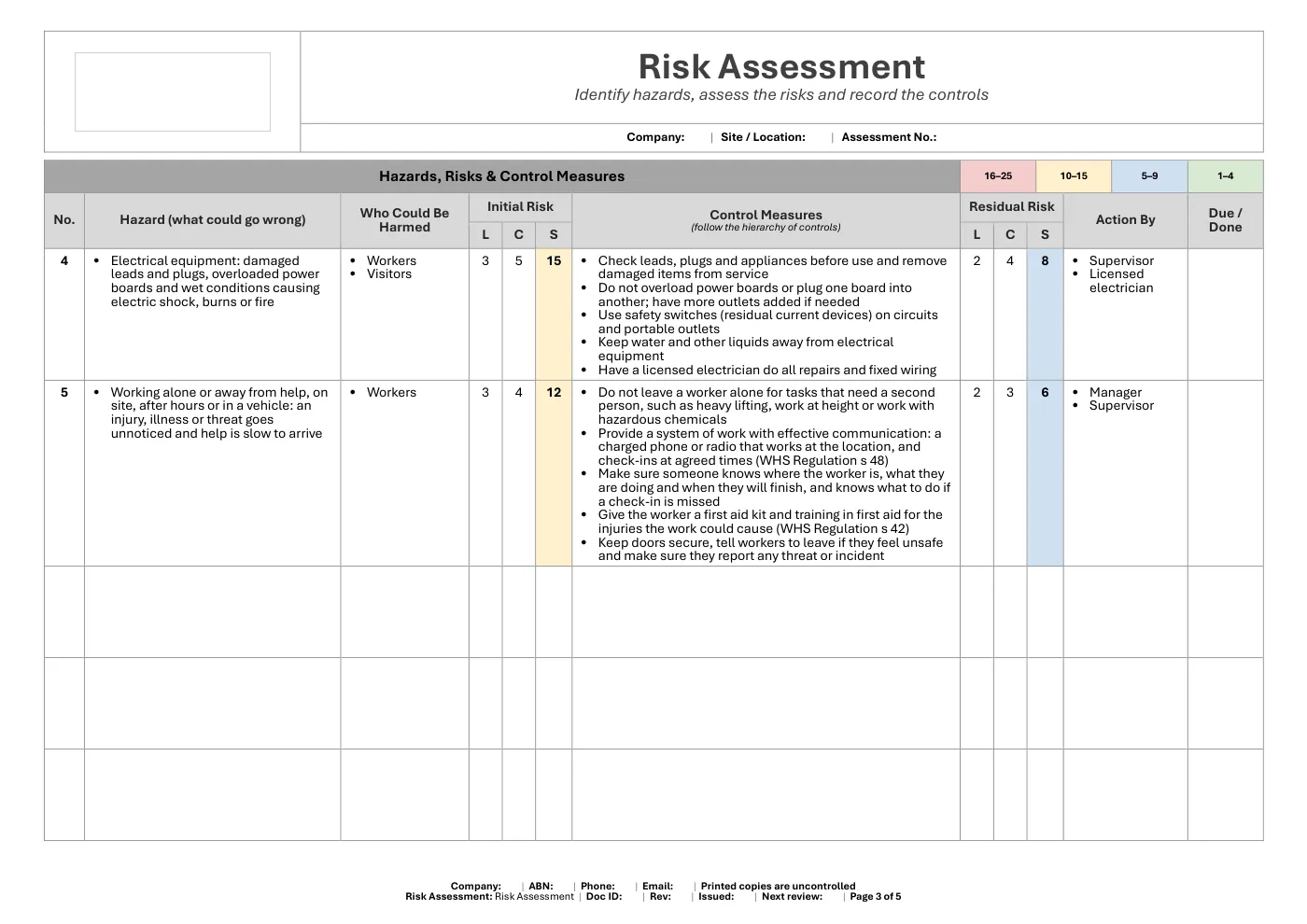
This free risk assessment template is an editable Microsoft Word form for recording the hazards in a task or workplace, scoring each risk on a 5 x 5 matrix before and after controls, and assigning who will act and by when. It suits almost any Queensland business. The controls are set out in the order the Work Health and Safety Regulation 2011 (Qld) uses, and five hazards are already worked through so you can see how each row is filled in.
Prefer a spreadsheet that does the scoring for you? See the Risk Assessment Template (Excel).
What is in the free risk assessment template
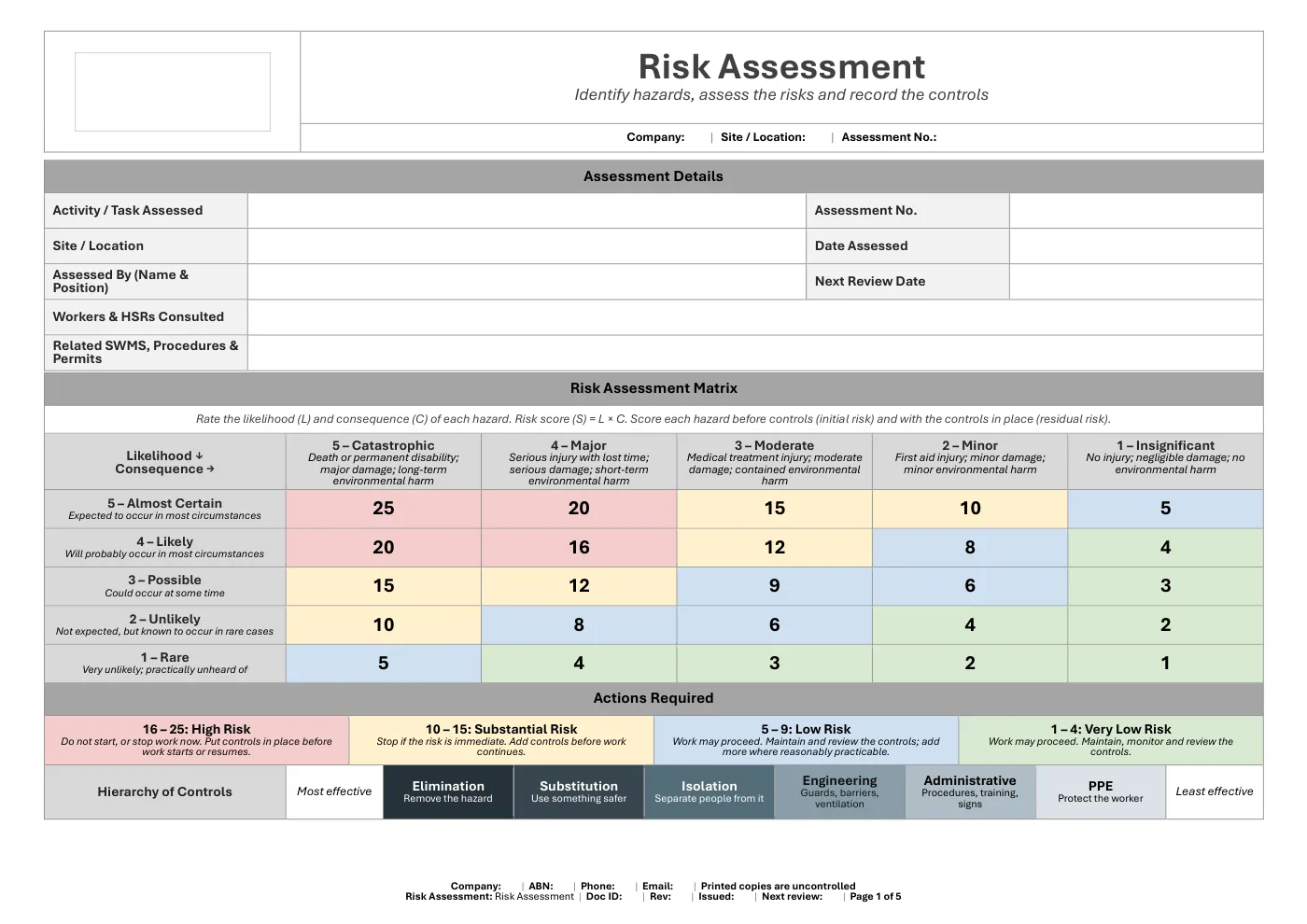
- Assessment details: the task, assessment number, site, date, assessor, next review date, who was consulted, and the related SWMS, procedures and permits
- 5 x 5 risk matrix: likelihood and consequence levels in plain words, with the action each score calls for
- Hierarchy of controls: from elimination down to PPE
- Hazard table: the hazard, who could be harmed, the risk before controls, the control measures, the risk after controls, who acts and the due date
- Five worked hazards: heat and sun, driving for work, hazardous chemicals, electrical equipment and working alone
- Blank rows for the rest of your hazards
- Review record, sign-off and document control for the assessor and the manager
It is an editable Microsoft Word file (5 pages), A4 landscape. Type your business details once and they fill in on every page, and there is a space for your logo.
A worked example: working in heat and sun
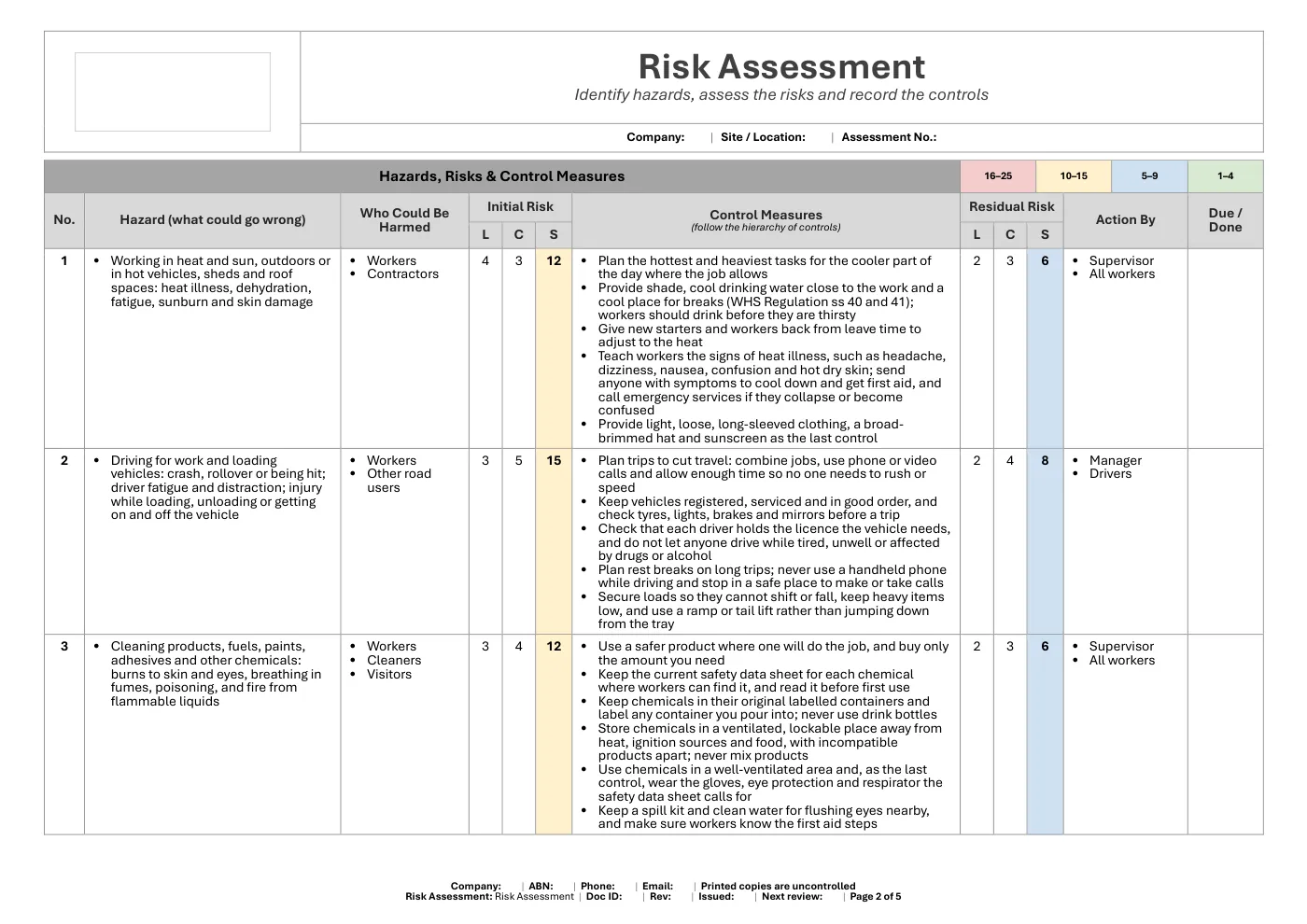
This is the first of the five hazards in the template. The risk is scored before controls, the controls are listed with PPE as the last control, and the risk is scored again with the controls in place.
- Hazard: working in heat and sun, outdoors or in hot vehicles, sheds and roof spaces: heat illness, dehydration, fatigue, sunburn and skin damage
- Who could be harmed: workers and contractors
- Risk before controls: likelihood 4 (likely) x consequence 3 (moderate) = 12, a substantial risk
- Controls: plan the hottest and heaviest tasks for the cooler part of the day; provide shade, cool drinking water and a cool place for breaks; give new starters time to adjust; teach the signs of heat illness; and provide light, loose, long-sleeved clothing, a broad-brimmed hat and sunscreen as the last control
- Risk after controls: likelihood 2 (unlikely) x consequence 3 (moderate) = 6, a low risk
- Who acts: supervisor and all workers
How the 5 x 5 risk matrix works
Rate how likely the harm is, from 1 (rare) to 5 (almost certain), and how serious it could be, from 1 (insignificant) to 5 (catastrophic). Multiply the two numbers to get the risk score. The template describes each level and sets out what each score calls for:
- 1 to 4, very low risk: work may proceed; maintain, monitor and review the controls
- 5 to 9, low risk: work may proceed; maintain and review the controls and add more where reasonably practicable
- 10 to 15, substantial risk: stop if the risk is immediate and add controls before work continues
- 16 to 25, high risk: do not start, or stop work now, and put controls in place before work starts or resumes
The matrix ranks risks so you know what to fix first. It does not decide what the law requires: where a regulation sets a specific control, you follow it (section 33 of the Work Health and Safety Regulation 2011 (Qld)). To go deeper, read how to use a 5×5 risk matrix, or use the Risk Assessment Matrix and Risk Rating Guide, an Excel matrix with a scoring calculator.
How to do a risk assessment in five steps
- Describe the task and talk to the people who do it. A business must consult the workers who are, or are likely to be, directly affected, so far as is reasonably practicable, when it identifies hazards and assesses risks (sections 47 and 49 of the Work Health and Safety Act 2011 (Qld)), and the people doing the job know how the work is really done, including cleaning, maintenance and what happens when something goes wrong.
- List the hazards. Walk the work area, read incident, injury and near miss records, and check manuals and safety data sheets. The Regulation requires you to identify reasonably foreseeable hazards (section 34), so give each one its own row.
- Score each risk. How likely is harm, and how serious could it be? Score it before controls (the initial risk).
- Choose controls in order. Eliminate the risk if that is reasonably practicable. If it is not, substitute, isolate or use engineering controls, then use administrative controls, and use PPE last (sections 35 and 36). Score the risk again with the controls in place.
- Record the actions, sign it off and review it. Name who will act and by when. Review the controls when one does not control the risk, before a change at the workplace that is likely to create a new or different risk that the control may not control, when a new hazard is found, when consultation shows a review is needed or when a health and safety representative requests a review (section 38).
The hierarchy of controls is explained in our guide to the hierarchy of controls, and the Hierarchy of Controls Risk Control Worksheet takes one hazard through every step. Still finding hazards? Start with how to identify hazards in the workplace.
When do you need a risk assessment in Queensland?
Every business must eliminate risks to health and safety so far as is reasonably practicable and, where it cannot, minimise them so far as is reasonably practicable (section 17 of the Work Health and Safety Act 2011 (Qld)). Section 18 says what reasonably practicable weighs up: how likely the harm is, how serious it could be, what you know or ought to know about the hazard and the ways to control it, whether those ways are available and suitable, and last of all the cost. The Regulation turns that into a process: identify hazards, eliminate or minimise the risks, keep the controls effective and review them (sections 34 to 38).
Those sections do not say every risk needs a written assessment, but the How to Manage Work Health and Safety Risks Code of Practice 2021 says a risk assessment should be done when:
- you are not sure how a hazard could result in injury or illness
- the work involves several hazards and it is not clear how they could combine to create new or greater risks
- changes at the workplace could affect how well your controls work
A business must follow a Queensland code of practice that applies to it, or manage the risk in a way that gives an equivalent or higher standard of health and safety (section 26A of the Work Health and Safety Act 2011 (Qld)). The code adds that a detailed assessment is not always needed: where a regulation requires a specific control, where a code or other guidance sets out a way to control the risk that suits your situation, or where well-known, effective controls used in your industry suit your workplace, you can put those controls in place without a detailed assessment.
Some activities do need a written risk assessment. These include entering or working in, on or near a confined space (section 66 of the Work Health and Safety Regulation 2011 (Qld)), general diving work (section 176) and electrical work on or near energised electrical equipment (section 199 of the Electrical Safety Regulation 2026 (Qld)). High risk construction work needs a safe work method statement before it starts (section 299 of the Work Health and Safety Regulation 2011 (Qld)), and a general risk assessment does not take its place. Use the free SWMS template for Queensland for that work.
Risk assessment, JSA, SWMS or hazard register?
They are different records for different jobs:
- Risk assessment: the hazards in a task, area or activity, who could be harmed, the risk scores and the controls. This template.
- JSA (job safety analysis) or JSEA (job safety and environmental analysis): the same thinking applied one job step at a time, usually by the supervisor and crew before a job starts. See what is a JSA and the JSA and JSEA Form Template (Job Safety Analysis).
- SWMS: the statement required before high risk construction work starts. See the difference between a SWMS and a JSA.
- Hazard register: a running list of the hazards across your workplace. Log them in the Free Hazard Register Template and let anyone report one with the Free Hazard Report Form Template.
- Risk register: the risks you are managing, scored and reviewed over time. See what a risk register is and what to include and the WHS Risk Register.
Risk assessments for specific hazards
For hazards with their own rules, use an assessment written for them:
- Plant Risk Assessment Template
- Confined Space Risk Assessment
- Risk Assessment for Manual Tasks
- Working at Heights Risk Assessment
- Chemical Risk Assessment Form
- Working Alone Risk Assessment
- Psychosocial Hazard Risk Assessment Template
Examples from the construction industry are in risk assessment examples for construction work, and when a risk assessment should be carried out has the triggers in more detail. Review the template, adjust it to suit your business, your sites and the way your team works, and talk it through with your workers.
Risk assessment template: frequently asked questions
What is a risk assessment?
A risk assessment is a structured look at a task or workplace to find the hazards, work out how likely and how serious the harm could be, and decide on controls that eliminate or reduce the risk. It is usually recorded on a form like this one and reviewed when things change.
What should a risk assessment template include?
Enough to show what you found and what you did about it: the task and site, the date and who assessed it, who was consulted, each hazard and who could be harmed, a risk score before controls, the controls in order of effectiveness, a risk score after controls, who will act and by when, and a review record with sign-off. This template has all of those, plus a 5 x 5 risk matrix and five worked hazards.
Is a risk assessment a legal requirement in Queensland?
Managing risk is. A business must eliminate risks so far as is reasonably practicable and otherwise minimise them (section 17 of the Work Health and Safety Act 2011 (Qld)), and the Work Health and Safety Regulation 2011 (Qld) requires it to identify hazards, control the risks, and keep the controls effective and reviewed (sections 34 to 38). Those sections do not say the assessment must be written down, but some activities need a written risk assessment, such as entering or working in, on or near a confined space (section 66) and general diving work (section 176). A written assessment is also the clearest record of what you did.
What is the difference between a risk assessment and a SWMS?
A risk assessment can cover any hazard, task or workplace. A safe work method statement (SWMS) must be prepared before high risk construction work starts (section 299 of the Work Health and Safety Regulation 2011 (Qld)). It identifies the high risk work, states the hazards and risks, describes the control measures, and says how they will be put in place, monitored and reviewed. A risk assessment does not take the place of a SWMS, and many businesses use both.
How do you score a risk on a 5 x 5 matrix?
Rate how likely the harm is from 1 (rare) to 5 (almost certain) and how serious it could be from 1 (insignificant) to 5 (catastrophic), then multiply the two numbers. Likelihood 4 and consequence 3, for example, scores 12. In this template 1 to 4 is a very low risk, 5 to 9 is low, 10 to 15 is substantial and 16 to 25 is high. Score the risk again once the controls are in place.
How often should a risk assessment be reviewed?
The controls must be reviewed, and changed if needed, when a control does not control the risk, before a change at the workplace that is likely to create a new or different risk that the control may not control, when a new hazard or risk is identified, when consultation shows a review is needed, and when a health and safety representative requests a review (section 38 of the Work Health and Safety Regulation 2011 (Qld)). The template has a next review date and a review record.
Who has to do the risk assessment?
The business carries the duty to manage risks, and it must consult the workers who are, or are likely to be, directly affected, so far as is reasonably practicable, when it identifies hazards and assesses risks (sections 47 and 49 of the Work Health and Safety Act 2011 (Qld)). Where the Regulation requires a written risk assessment, such as for a confined space or general diving work, a competent person must conduct it (sections 66 and 176 of the Work Health and Safety Regulation 2011 (Qld)). Otherwise, in practice, the supervisor or manager completes the form with the people who do the job, and a health and safety representative takes part if there is one.
Can I use this template for any industry?
Yes, for general workplace hazards in any Queensland business: add your own hazards in the blank rows. Where a hazard has its own rules or a more specific form, such as confined spaces, plant, manual tasks or work at heights, use the matching assessment listed on this page, and use a SWMS for high risk construction work.
Is this risk assessment template free?
Yes. Enter your first name and email address and the download button for the Word file appears straight away, with no card needed. You will also get our free safety newsletter, and you can unsubscribe at any time.
This page is general information about work health and safety in Queensland, not legal advice.
Having trouble with your download? Contact us any time. Please read our Disclaimer before downloading.
How to use it
From download to site in three steps
Fill in the form and download
Enter your name and email. Your download buttons appear straight away and the links are emailed to you.
Make it yours
Open it in Microsoft Word or Excel. Add your logo, business details, site and job information, and adjust it to how the work is done.
Brief your crew
Talk it through with the workers doing the job, have them sign on, and keep it on site. Review it whenever the job or conditions change.
What format is it?
Microsoft Word. Edit it in Word, or free in Word for the web, and add your own logo and business details.
How do I get it?
Fill in your name and email on this page. Your download buttons appear as soon as you send the form, and the links are emailed to you. You can download it again from your account at any time.
Is it compliant with Queensland law?
It's written around Queensland's Work Health and Safety Act 2011 and Regulation 2011. Tailor it to your site, consult your workers and review it whenever conditions change; no template can guarantee compliance on its own.
What if it isn't right for my job?
Check the sample pages first. If the template has a fault or doesn't match its description, tell us and we'll fix it. Every template is a starting point that you tailor to your own work.
Only logged in customers who have purchased this product may leave a review.
Reviews