
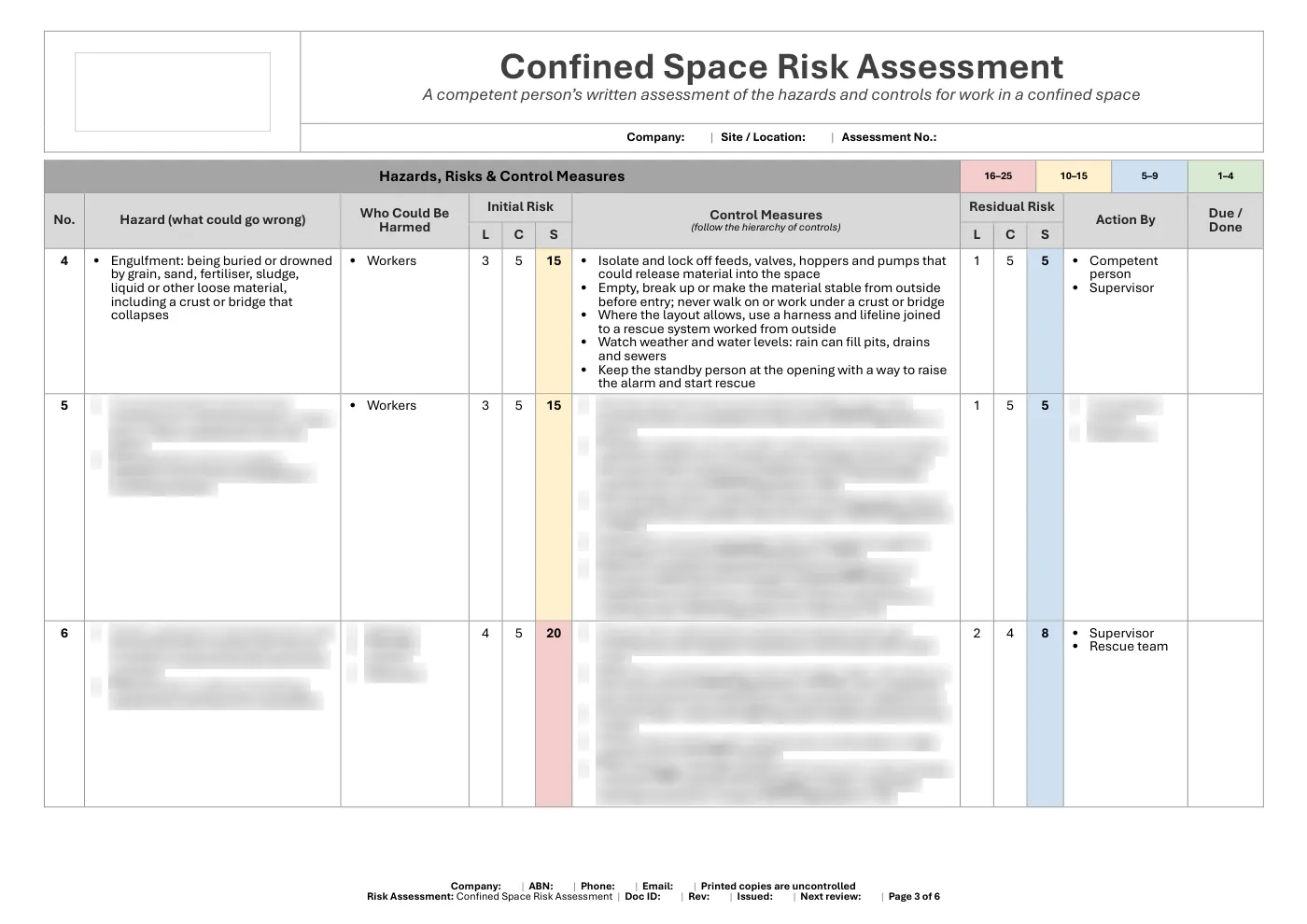
Confined Space Risk Assessment
Editable Word confined space risk assessment for Queensland: records a competent person’s findings on atmosphere, fire, engulfment, isolation, rescue and the permit, with scores and controls.
RG
Written by Ryan Graham, health and safety professional (16 years on Queensland sites)
$9.99 incl. GST
AUD · one-off purchase · instant download
- Instant download · your links arrive by email straight after checkout and work for 3 months, so save your copy
- Make it yours in minutes · edit in Microsoft Word and add your logo
- Quality guarantee · we'll fix any problem, then refund you or give store credit if you're still not happy
- Secure checkout · card, Apple Pay or Google Pay through Stripe
About this template
Work in a confined space needs a written risk assessment by a competent person before anyone enters, and a separate entry permit based on it. This form sets out the matters the WHS Regulation lists and leaves space for your own space and task, plus a review record and sign-off.
What is a confined space?
Under the Work Health and Safety Regulation 2011 (Qld), a confined space is an enclosed or partly enclosed space that is not designed or intended mainly to be occupied by people, is at normal atmospheric pressure while people are in it, and where there is a risk from an unsafe atmosphere (too little or too much oxygen, or harmful or flammable contaminants) or of being engulfed. Tanks, pits, silos, sewers, manholes, vats, ducts, wells and some roof and ceiling spaces can all be confined spaces. If you are unsure, the Confined Spaces Code of Practice 2021 explains how to decide.
Confined space rules in Queensland
- Written risk assessment by a competent person before work starts (section 66).
- Entry permit: no worker may be directed to enter until a competent person has completed a written confined space entry permit, with control measures based on the risk assessment (section 67).
- Signs at every entry while work is being prepared, carried out and finished (section 68).
- Continuous communication and a standby person monitoring conditions from outside the space (section 69).
- Emergency and rescue procedures set up before anyone enters, plus information, training and instruction for everyone involved.
- Records: keep the risk assessment until at least 28 days after the work is finished, and the entry permit until the work is finished. If a notifiable incident happens, keep both for at least 2 years (section 77).
How to use this confined space risk assessment
- Ask first whether the work can be done without entering the space at all.
- Have a competent person complete the assessment for the specific space and task, working through atmosphere, fire and explosion, engulfment, connected plant and services, entry and exit, rescue and the other hazards in the form.
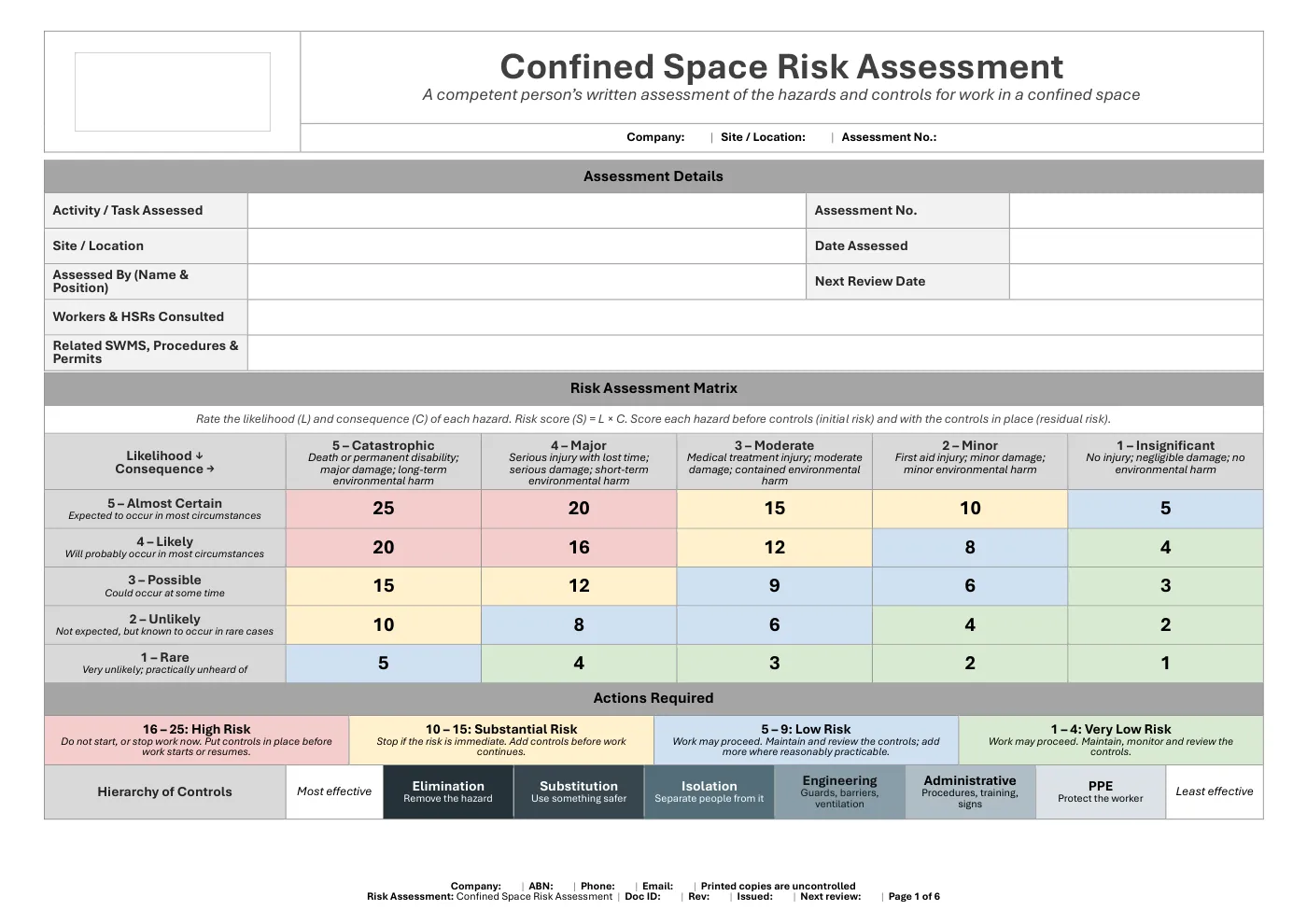
- Score each risk before and after the controls on the 5 x 5 matrix.
- Use the controls in your entry permit and rescue plan, and brief the entrants and standby person.
- Review it if the space, the task, the conditions or the people change, and keep the record for the required period.
Confined space templates that work together
- Confined Space Entry Permit
- Confined Space Emergency Rescue Plan
- Working in Confined Spaces Policy
- Confined Spaces SWMS and Welding in Confined Spaces SWMS
- All of them together in the Confined Spaces Bundle
For a plain-English overview, read how to stay safe when working in confined spaces.
What is included in our confined space risk assessment?
- Assessment details: the work, the space, who assessed it, who was consulted and the related permits and procedures
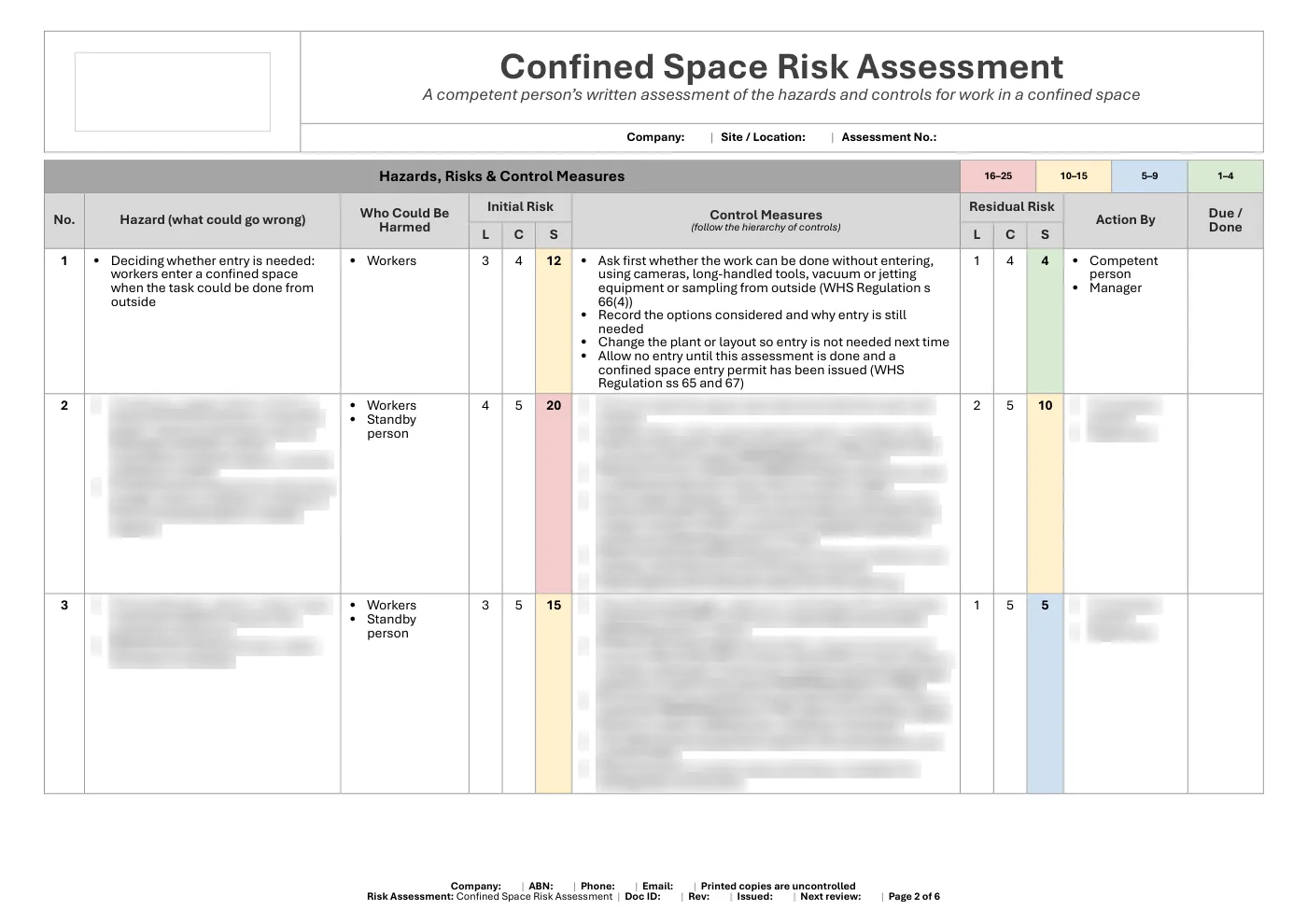
- Whether the work can be done without entering the space
- Atmosphere: oxygen, harmful contaminants and changes in them
- Fire and explosion: flammable gases, vapours and ignition sources
- Engulfment, connected plant and services, and isolation
- Entry and exit, communication, the standby person and emergency rescue
- Hot work, noise, heat, lighting and the demands of working in a tight space
- Permit, signs, training, review and record keeping
- Five by five risk matrix with scores before and after the controls
- Review record and sign-off for the assessor and the manager
What you get
- An editable Microsoft Word risk assessment (6 pages), A4 landscape
- Assessment details, a 5 x 5 risk matrix and the hierarchy of controls
- Worked hazard rows with initial and residual risk scores, plus blank rows
- Review record, sign-off and document control
- Business details typed once and filled in on every page, plus a space for your logo
Review it and adjust it to suit your business, your sites and the way your team works, and talk it through with your workers.
Confined space risk assessment: frequently asked questions
Is a confined space risk assessment a legal requirement in Queensland?
Yes. Section 66 of the WHS Regulation 2011 (Qld) requires the business to make sure a risk assessment is conducted by a competent person and recorded in writing before work in or near a confined space.
Who can complete a confined space risk assessment?
A competent person: someone with the knowledge and skills, gained through training, qualifications or experience, to assess the specific confined space and the work being done in it.
What is the difference between a confined space risk assessment and an entry permit?
The risk assessment identifies the hazards and decides the controls for the space and the task. The entry permit is the written authority for named people to enter for a set time, and its control measures must be based on that risk assessment.
How long do you need to keep a confined space risk assessment?
Keep it until at least 28 days after the work is completed. If a notifiable incident happens in connection with the work, keep it, and the entry permit, for at least 2 years after the incident.
Does a confined space always need a standby person?
Yes. A worker must not enter a confined space to work unless there is continuous communication with them from outside the space and a standby person monitoring the conditions, close to the space and, if practicable, watching the work.
What format is the confined space risk assessment?
It is an editable Microsoft Word document on A4 landscape pages. Your business details are typed once and fill in on every page, and there is a space for your logo.
This is general information, not legal advice. Check the current law or talk to Workplace Health and Safety Queensland for your situation.
Having trouble with your download? Contact us any time. Please read our Disclaimer before downloading.
How to use it
From download to site in three steps
Buy and download
Check out with card, Apple Pay or Google Pay. Your download buttons appear straight away and the links are emailed to you. Links work for 3 months, so save your copies.
Make it yours
Open it in Microsoft Word or Excel. Add your logo, business details, site and job information, and adjust it to how the work is done.
Brief your crew
Talk it through with the workers doing the job, have them sign on, and keep it on site. Review it whenever the job or conditions change.
What format is it?
Microsoft Word. Edit it in Word, or free in Word for the web, and add your own logo and business details.
How do I get it after I pay?
Your download buttons appear as soon as checkout finishes, and the links are emailed to you. You can re-download from your account at any time.
Is it compliant with Queensland law?
It's written around Queensland's Work Health and Safety Act 2011 and Regulation 2011. Tailor it to your site, consult your workers and review it whenever conditions change; no template can guarantee compliance on its own.
What if it isn't right for my job?
If it doesn't match its description or has a fault, tell us and we'll fix it. If you're still not happy, we'll refund you or give you store credit, your choice. Check the sample pages first, as we don't refund a change of mind.
Only logged in customers who have purchased this product may leave a review.
More templates like this
Crane Lift Plan
$19.99
Reviews