
Psychosocial Hazard Risk Assessment Template
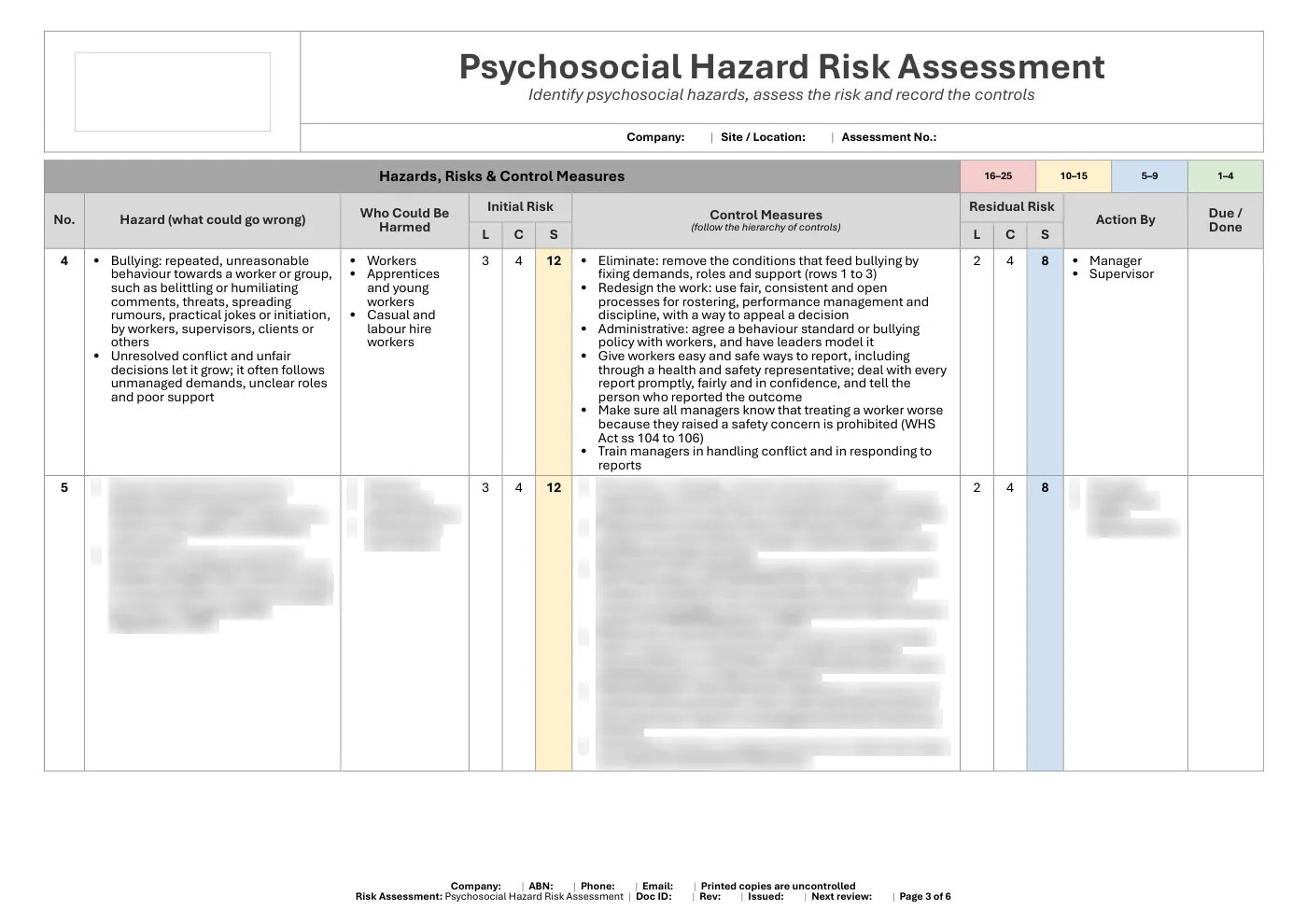
Editable Word psychosocial hazard risk assessment for Queensland: worked rows for job demands, job control, support, bullying, harassment, violence, isolation and trauma, with scores before and after controls.
RG
Written by Ryan Graham, health and safety professional (16 years on Queensland sites)
$14.99 incl. GST
AUD · one-off purchase · instant download
- Instant download · your links arrive by email straight after checkout and work for 3 months, so save your copy
- Your business name and logo · we fill them into every document for A$29 (free on orders of A$500 or more), or edit it yourself in Microsoft Word
- Quality guarantee · we'll fix any problem, then refund you or give store credit if you're still not happy
- Secure checkout · card, Apple Pay or Google Pay through Stripe
About this template
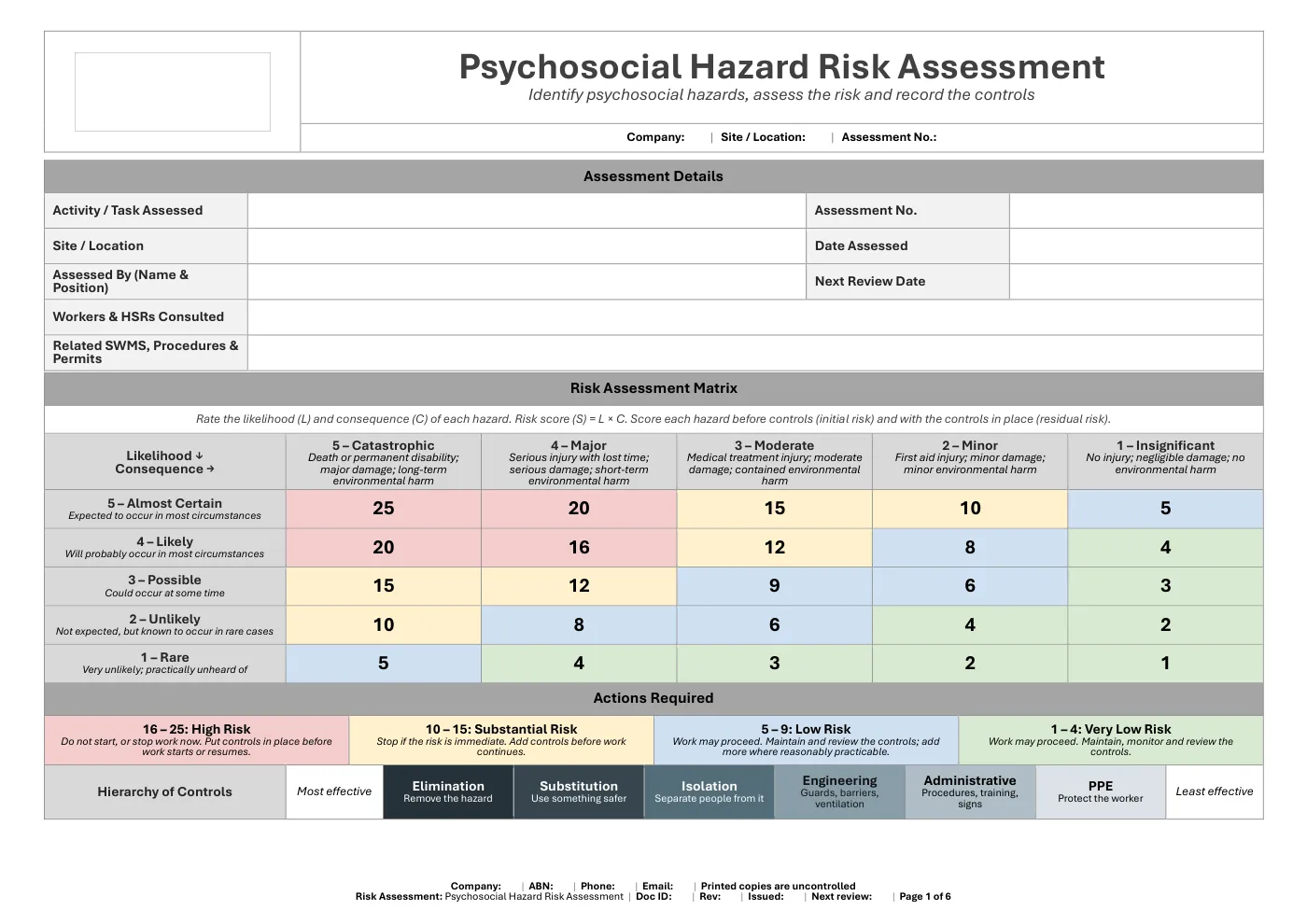
A psychosocial risk is managed like any other work health and safety risk, and the Queensland psychosocial code explains how. This assessment gives worked examples of the main hazards in the standard five by five layout, with blank rows for your own workplace and a place to record who was consulted.
Psychosocial risk and Queensland law
A psychosocial hazard is a hazard from the design or management of work, the work environment, plant, or workplace interactions or behaviours that may cause psychological harm (section 55A of the WHS Regulation 2011 (Qld)). Every business must manage psychosocial risks the same way as other WHS risks: identify the hazards, eliminate the risks so far as is reasonably practicable or minimise them, and review the controls (section 55C). This includes the risk of sexual harassment and sex or gender-based harassment.
When choosing controls, the business must consider things such as how long, how often and how severely people are exposed, how hazards interact or combine, the design of the work and job demands, and how work is managed, organised and supported (section 55D). The Managing the risk of psychosocial hazards at work Code of Practice 2022 explains how to do this.
Common psychosocial hazards
The Queensland code lists common psychosocial hazards, including:
- high or low job demands, low job control and poor support
- low role clarity and poorly managed organisational change
- low reward and recognition, and poor organisational justice
- poor workplace relationships, including interpersonal conflict
- remote or isolated work and poor environmental conditions
- traumatic events, violence and aggression, bullying and harassment
How to do a psychosocial risk assessment
- Consult your workers and health and safety representatives: surveys, team meetings and one-on-one conversations show where the pressure points are.
- Look at the evidence: workload, overtime, leave, complaints, incident reports and turnover.
- Rate each hazard on the 5 x 5 matrix, thinking about how long, how often and how intensely people are exposed and how hazards combine.
- Fix the work, not the worker: start with controls that change the design and management of work, then add training, support and other measures.
- Review the controls regularly and after a complaint, incident or change.
Pair it with our Psychosocial Hazard Management Policy & Procedure, and read our guide to psychosocial hazards at work in Queensland.
What is included in our psychosocial hazard risk assessment?
- Assessment details, including the workers and health and safety representatives consulted
- Five by five risk matrix and the hierarchy of controls
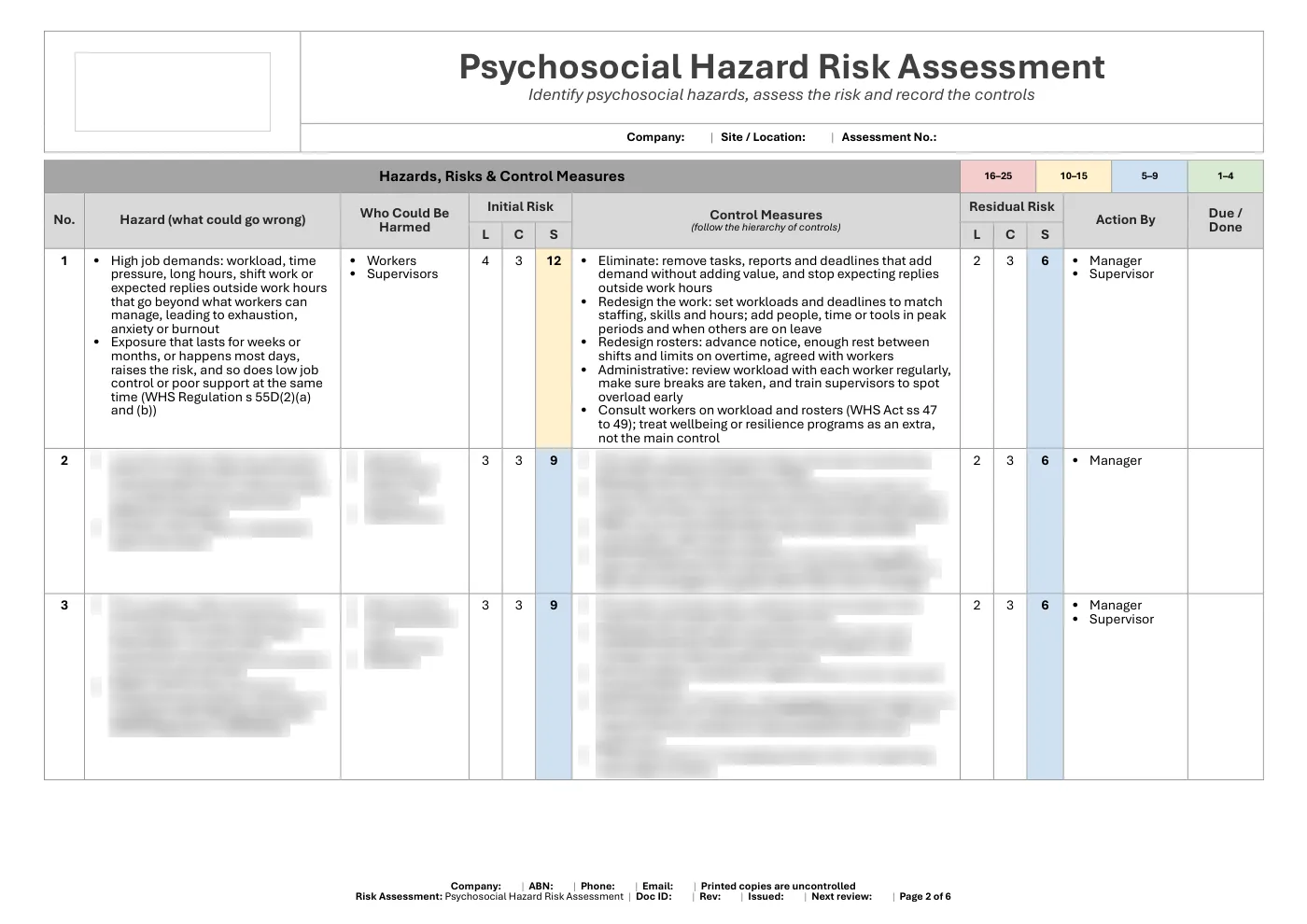
- Worked rows for high job demands, low job control and poor support
- Worked rows for bullying, and for sexual harassment and sex or gender-based harassment
- Worked rows for violence and aggression, remote or isolated work, and traumatic events
- Hazards written to show how long, frequent or combined exposure raises the risk
- Initial and residual risk scores for every hazard
- Controls ordered from eliminating the hazard to personal protective equipment
- Blank rows for your own hazards
- Review record and sign-off
What you get
- An editable Microsoft Word risk assessment (6 pages), A4 landscape
- Assessment details, a 5 x 5 risk matrix and the hierarchy of controls
- Worked hazard rows with initial and residual risk scores, plus blank rows
- Review record, sign-off and document control
- Business details typed once and filled in on every page, plus a space for your logo
Review it and adjust it to suit your business, your sites and the way your team works, and talk it through with your workers.
Psychosocial risk assessment: frequently asked questions
Do Queensland businesses have to assess psychosocial risks?
Yes. The WHS Regulation 2011 (Qld) requires every business to manage psychosocial risks like any other WHS risk, supported by the Managing the risk of psychosocial hazards at work Code of Practice 2022. A risk assessment is the usual way to identify the hazards and decide the controls.
What is a psychosocial hazard?
A hazard arising from the design or management of work, the work environment, plant, or workplace interactions or behaviours that may cause psychological harm, such as high job demands, poor support, bullying, harassment, or violence and aggression.
What are examples of psychosocial hazards?
High or low job demands, low job control, poor support, low role clarity, poor change management, low reward and recognition, poor organisational justice, interpersonal conflict, remote or isolated work, poor environmental conditions, traumatic events, violence and aggression, bullying and harassment.
How do you control psychosocial risks?
Start by changing how work is designed and managed: workloads, staffing, rosters, role clarity, support and how conflict and complaints are handled. Add training, information and support services as further layers, and review the controls with your workers.
Does this cover sexual harassment?
Yes. The assessment includes worked rows for sexual harassment and sex or gender-based harassment. In Queensland a business that identifies these risks must also prepare a written prevention plan (section 55H of the WHS Regulation).
What format is the psychosocial risk assessment?
An editable Microsoft Word document, A4 landscape, with a 5 x 5 risk matrix, worked hazard rows with initial and residual scores, blank rows for your own hazards, and a review record and sign-off.
This page is general information about work health and safety in Queensland, not legal advice.
Having trouble with your download? Contact us any time. Please read our Disclaimer before downloading.
How to use it
From download to site in three steps
Buy and download
Check out with card, Apple Pay or Google Pay. Your download buttons appear straight away and the links are emailed to you. Links work for 3 months, so save your copies.
Make it yours
Add your logo and business details in Word or Excel, or tick branding at checkout (A$29) and we add them. Then add your site and job details.
Brief your crew
Talk it through with the workers doing the job, have them sign on, and keep it on site. Review it whenever the job or conditions change.
What format is it?
Microsoft Word. Edit it in Word, or free in Word for the web, and add your own logo and business details. Or let us do it: tick "Add my business name and logo to every document" at checkout (A$29, free on orders of A$500 or more) and fill in a short form after payment.
How do I get it after I pay?
Your download buttons appear as soon as checkout finishes, and the links are emailed to you. You can re-download from your account at any time.
Is it compliant with Queensland law?
It's written around Queensland's Work Health and Safety Act 2011 and Regulation 2011. Tailor it to your site, consult your workers and review it whenever conditions change; no template can guarantee compliance on its own.
What if it isn't right for my job?
If it doesn't match its description or has a fault, tell us and we'll fix it. If you're still not happy, we'll refund you or give you store credit, your choice. Check the sample pages first, as we don't refund a change of mind.
Only logged in customers who have purchased this product may leave a review.
Reviews