

Working On or Near Energised Electrical Equipment SWMS
Licensed electrical workers testing, fault finding or working near exposed energised low voltage parts in Queensland, with isolation and lock-out as the default. An editable Word SWMS template for Queensland.
RG
Written by Ryan Graham, health and safety professional (16 years on Queensland sites)
$49.99 incl. GST
AUD · one-off purchase · instant download
- Instant download · your links arrive by email straight after checkout and work for 3 months, so save your copy
- Your business name and logo · we fill them into every document for A$29 (free on orders of A$500 or more), or edit it yourself in Microsoft Word
- Quality guarantee · we'll fix any problem, then refund you or give store credit if you're still not happy
- Secure checkout · card, Apple Pay or Google Pay through Stripe
About this template
For licensed electrical workers and electrical contractors who must test, fault find or work near exposed energised low voltage equipment. It follows the work from deciding whether energised work is allowed, through the recorded risk assessment and authorisation, set-up, isolation and lock-out, testing for dead, and energised testing and work with a safety observer, to restoring supply, handover and emergency response. It does not cover high voltage work or live line work.
The Electrical Safety Regulation 2026 (ss 199 and 200) requires a safe work method statement before electrical work on or near energised electrical equipment starts; this document follows the headings in s 200, but it must be completed for the actual job alongside the competent person’s recorded risk assessment.
New to SWMS? Read What is a safe work method statement?
What is covered in our working on or near energised electrical equipment SWMS?
After the standard pre-start checks, the job steps run from “Decide whether energised work is allowed and plan to work dead” to “Respond to electric shock, arc flash or fire”. The hazards and controls include:
- Working live when the job could be done dead
- Missed sources of supply
- Wrong or incomplete isolation
- Supply switched back on during work
- Equipment assumed dead without a test
- Contact with exposed live parts through probes, tools or the body
- Arc flash and arc blast burns
- Shock paths through damp floors, metal ladders and jewellery
- Dropped tools shorting live parts
- Unauthorised people entering the work area
- Exposed conductors left unfinished
- Electric shock, burns and fire emergencies
High risk construction work
These high risk construction work items (WHS Regulation 2011 (Qld) s 291) are already ticked because they are part of this work. Tick any others that apply to your job:
- Is carried out on or near energised electrical installations or services
Licences, training and competency
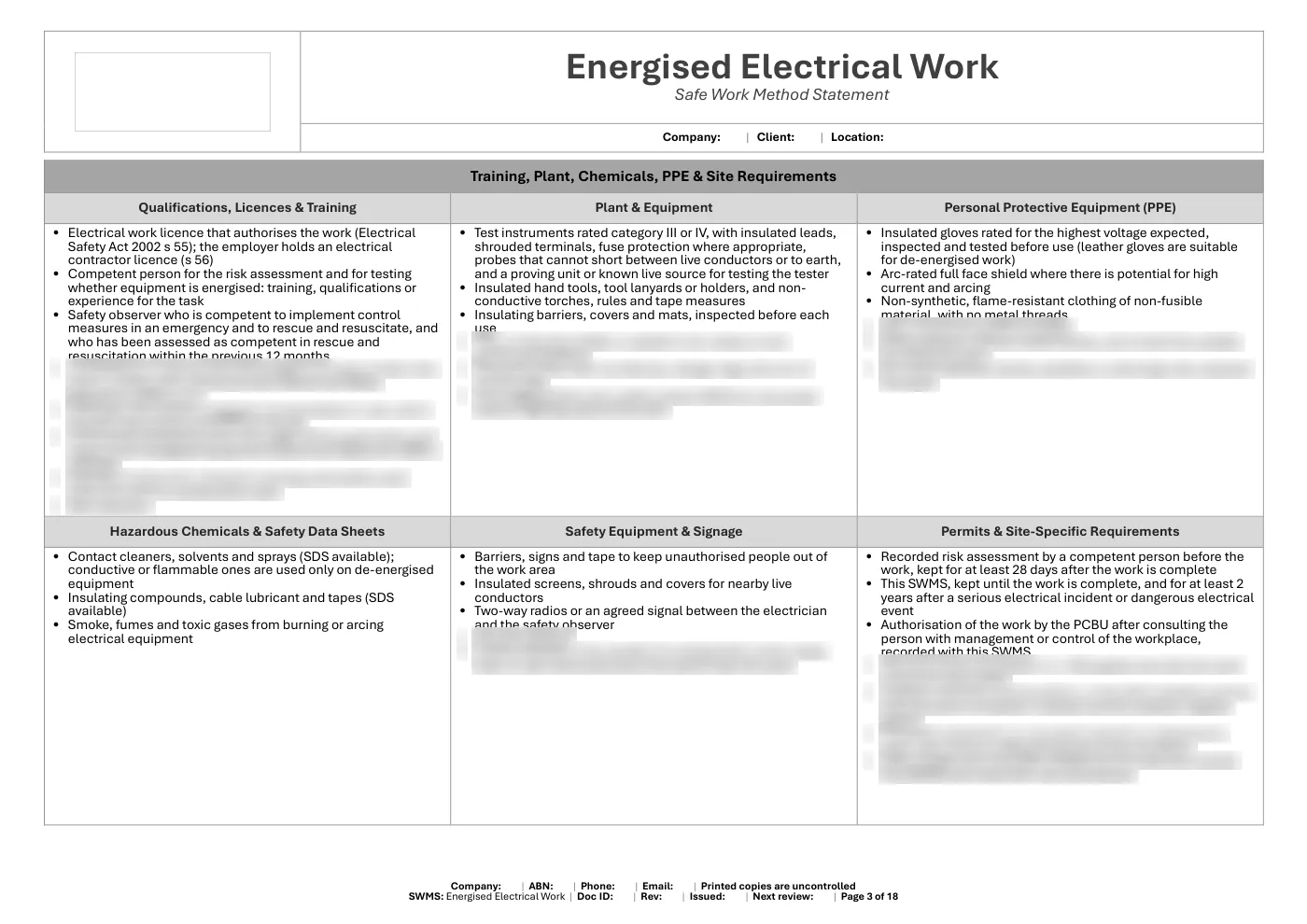
- Electrical work licence that authorises the work (Electrical Safety Act 2002 s 55); the employer holds an electrical contractor licence (s 56)
- Competent person for the risk assessment and for testing whether equipment is energised: training, qualifications or experience for the task
- Safety observer who is competent to implement control measures in an emergency and to rescue and resuscitate, and who has been assessed as competent in rescue and resuscitation within the previous 12 months
- Competence in rescue and resuscitation for every worker who does, or helps with, electrical work (Electrical Safety Regulation 2026 s 211)
- Training in the isolation and lock-out procedure in use, and in the test instruments and PPE for the job
- Unlicensed assistants work only under direct supervision and never touch energised equipment (Electrical Safety Act 2002 s 18(2)(g))
- General construction induction training card (white card) when the work is construction work
- Site induction
Legislation and codes of practice referenced
- Work Health and Safety Act 2011 (Qld)
- Work Health and Safety Regulation 2011 (Qld)
- Electrical Safety Act 2002 (Qld)
- Electrical Safety Regulation 2026 (Qld): part 8, division 3 (electrical work on or near energised electrical equipment), ss 193 to 204
- Electrical Safety Regulation 2026 (Qld): ss 207 and 208 (testing and certificate of testing and safety) and s 211 (rescue and resuscitation training)
- Electrical Safety Regulation 2026 (Qld): ss 292 and 296 (serious electrical incidents and dangerous electrical events)
- Electrical Safety Code of Practice 2021 – Managing electrical risks in the workplace
- How to Manage Work Health and Safety Risks Code of Practice 2021
- Managing the Risk of Falls at Workplaces Code of Practice 2021
- First Aid in the Workplace Code of Practice 2021
- How to Manage and Control Asbestos in the Workplace Code of Practice 2021
- AS/NZS 3000 (Electrical installations, known as the Australian/New Zealand Wiring Rules), as named in the Electrical Safety Regulation 2026
- AS 1319 (Safety signs for the occupational environment), as named in the Electrical Safety Regulation 2026 s 198
- AS/NZS 4836 (Safe working on or near low-voltage and extra-low voltage electrical installations and equipment), as named in the Electrical Safety Code of Practice 2021
What you get
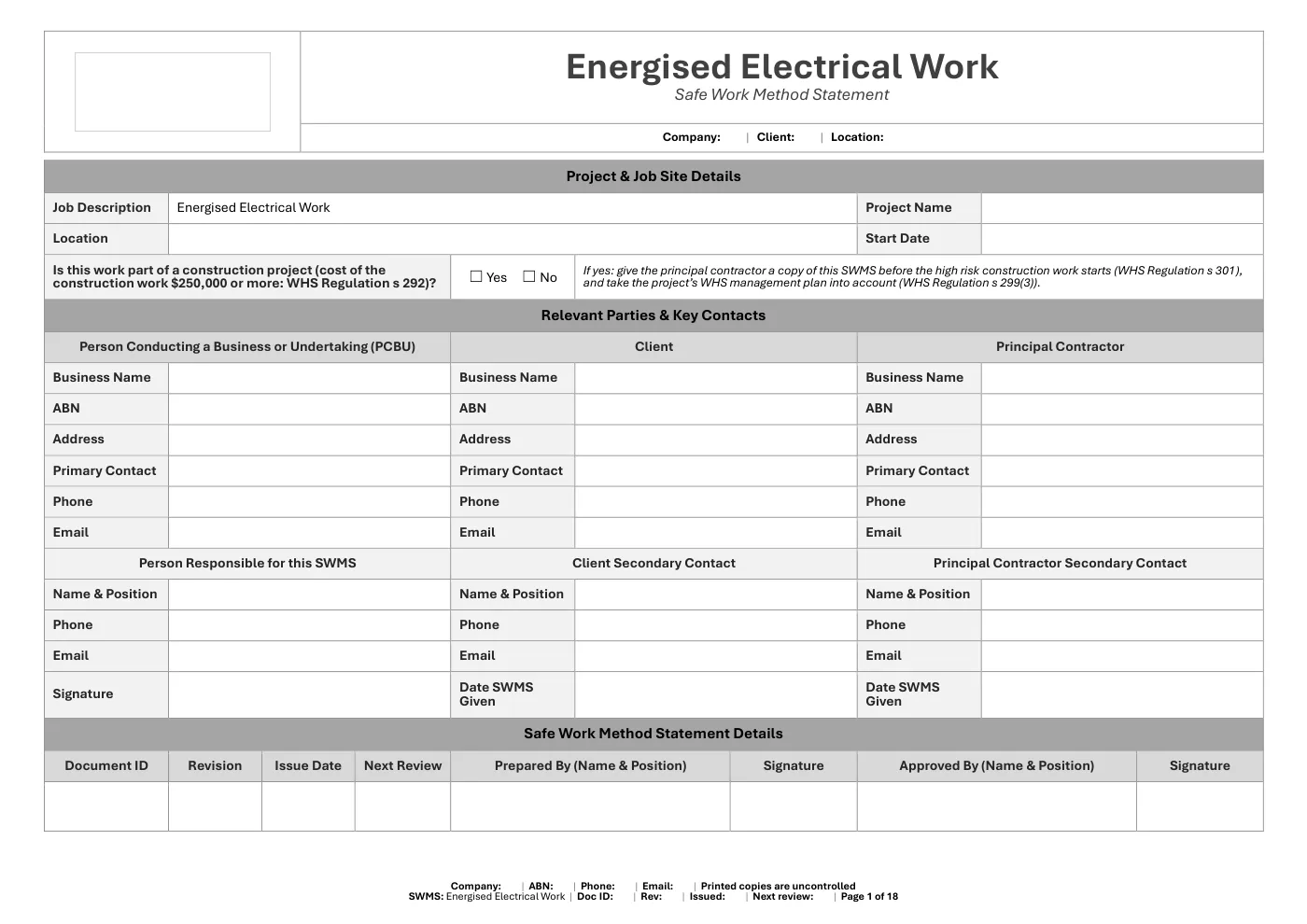
- An editable Microsoft Word document (18 pages), laid out on A4 landscape pages. Type your business, client and job details once and they fill in on every page, with a space for your logo
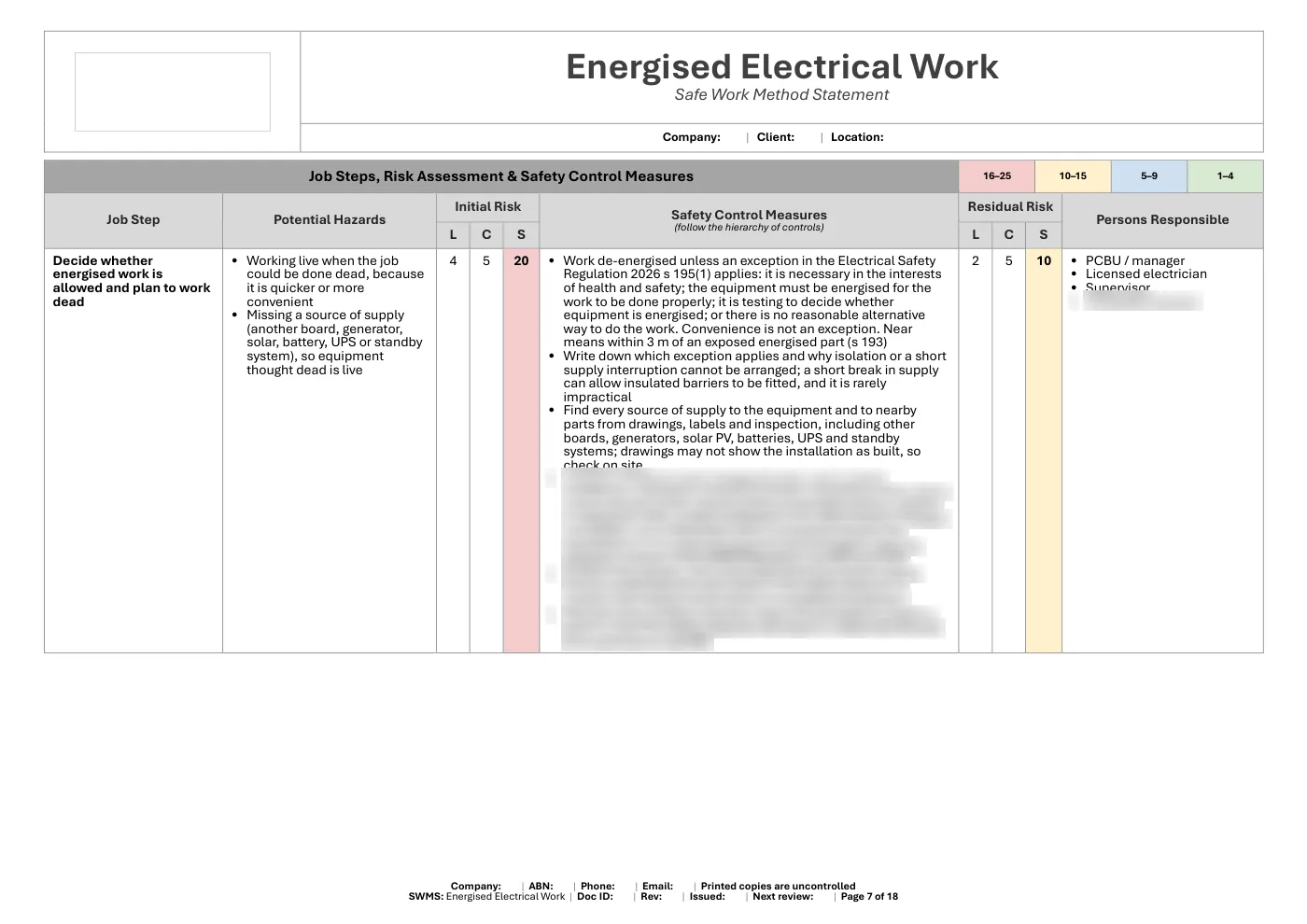
- 10 job steps for this work, each with its hazards, controls, initial and residual risk scores and the person responsible
- PPE listed for this job: insulated gloves rated for the highest voltage expected, inspected and tested before use (leather gloves are suitable for de-energised work)
- Emergency arrangements for: electric shock or arc flash, electrical fire and serious electrical incident or dangerous electrical event
- Plus the parts every Work Safety QLD SWMS shares, from the s 291 checklist to the worker sign-on sheet (see the layout in our free SWMS template)
Adjust it for your site, plant and crew, and talk it through with your workers before work starts.
Checked against the Queensland laws and codes of practice listed above. Last reviewed October 2026.
Having trouble with your download? Contact us any time. Please read our Disclaimer before downloading.
How to use it
From download to site in three steps
Buy and download
Check out with card, Apple Pay or Google Pay. Your download buttons appear straight away and the links are emailed to you. Links work for 3 months, so save your copies.
Make it yours
Add your logo and business details in Word or Excel, or tick branding at checkout (A$29) and we add them. Then add your site and job details.
Brief your crew
Talk it through with the workers doing the job, have them sign on, and keep it on site. Review it whenever the job or conditions change.
What format is it?
Microsoft Word. Edit it in Word, or free in Word for the web, and add your own logo and business details. Or let us do it: tick "Add my business name and logo to every document" at checkout (A$29, free on orders of A$500 or more) and fill in a short form after payment.
How do I get it after I pay?
Your download buttons appear as soon as checkout finishes, and the links are emailed to you. You can re-download from your account at any time.
Is it compliant with Queensland law?
It's written around Queensland's Work Health and Safety Act 2011 and Regulation 2011. Tailor it to your site, consult your workers and review it whenever conditions change; no template can guarantee compliance on its own.
What if it isn't right for my job?
If it doesn't match its description or has a fault, tell us and we'll fix it. If you're still not happy, we'll refund you or give you store credit, your choice. Check the sample pages first, as we don't refund a change of mind.
Only logged in customers who have purchased this product may leave a review.
Reviews