
Working Near Overhead Power Lines SWMS
Editable Word SWMS template for construction work near overhead power lines in Queensland: exclusion zones, safety observers, plant, scaffolds, long materials, vehicles and contact emergencies.
RG
Written by Ryan Graham, health and safety professional (16 years on Queensland sites)
$49.99 incl. GST
AUD · one-off purchase · instant download
- Instant download · your links arrive by email straight after checkout
- Make it yours in minutes · edit in Microsoft Word or Excel and add your logo
- Quality guarantee · we'll fix it or refund you if it isn't as described
- Secure checkout · card, Apple Pay or Google Pay through Stripe
Bundles
Bundles that include this template
About this template
Suits builders, scaffolders, concreters, crane, EWP and excavator operators, painters and other contractors who work, move plant or drive vehicles near overhead electric lines. It follows the work from finding the lines and asking the electricity entity to switch them off or move them, through exclusion zones, safety observers, plant, scaffolds, long materials and vehicles, to the response if a line is touched. It does not cover live-line work by electrical workers.
Learn More: What Is A Safe Work Method Statement?
Have you ever been asked to provide a SWMS on a project in Queensland? Read our guide to what a Safe Work Method Statement is and when you need one.
What Is Covered In Our Working Near Overhead Power Lines SWMS?
The job steps run in the order the work is done, from pre-start checks to finishing up. The hazards and controls include:
- Plant, booms and loads entering an exclusion zone
- Lines that are hard to see or that sag and sway
- Unknown line voltage and unchecked insulation
- Scaffold parts, ladders and long materials touching a line
- Tippers, trucks and tall loads travelling under lines
- Work that cannot avoid an exclusion zone
- Safety observers who are untrained or distracted
- Wind, storms, poor light and moved markers
- Flashover without direct contact
- Step and touch voltages around contacted plant
- Rescuers approaching a live line too soon
- Electrical fire and burns after contact
High Risk Construction Work
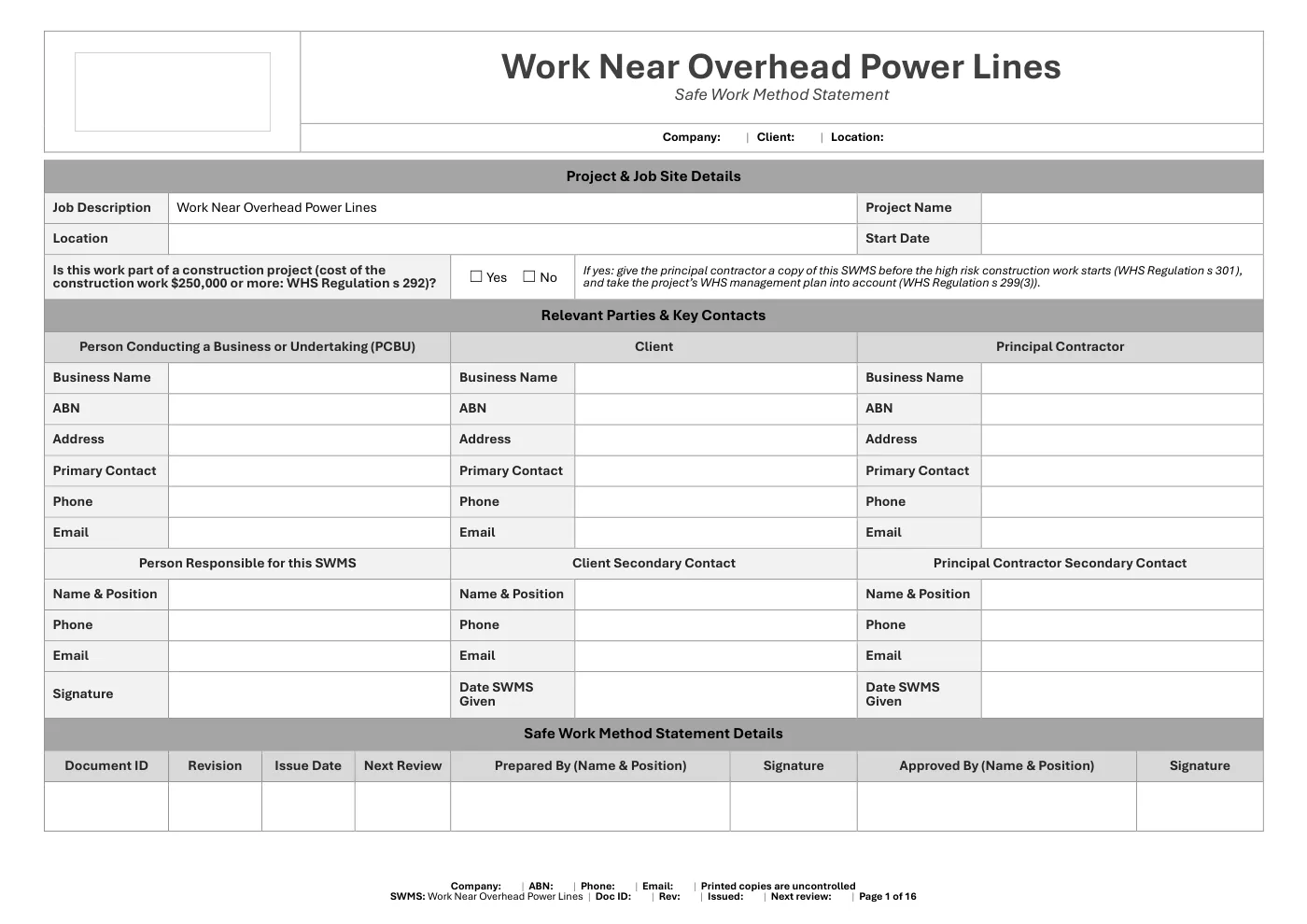
These high risk construction work items (WHS Regulation 2011 (Qld) s 291) are already ticked because they are part of this work. Tick any others that apply to your job:
- Is carried out on or near energised electrical installations or services
- Is carried out in an area at a workplace in which there is any movement of powered mobile plant
Licences, Training and Competency
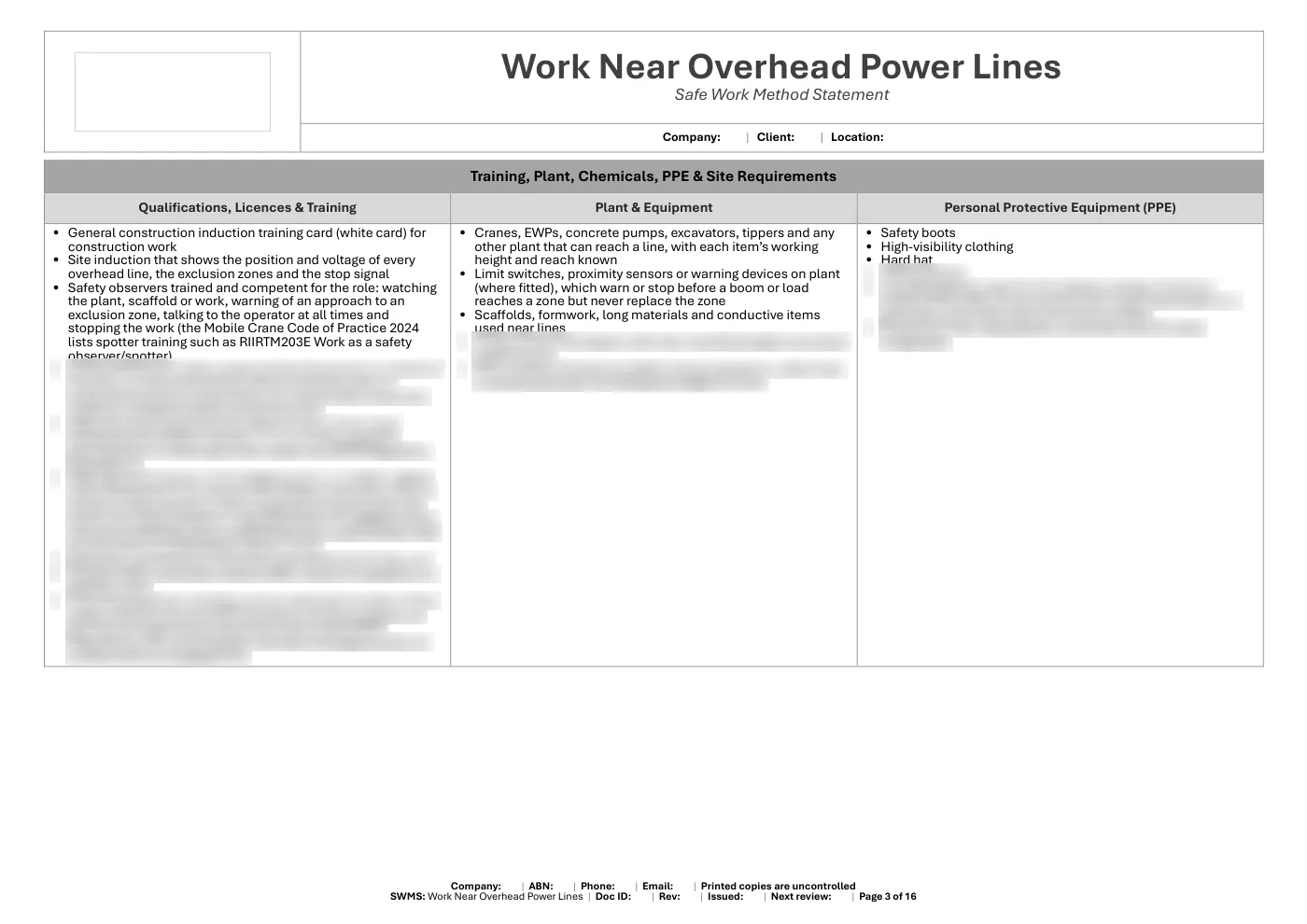
- General construction induction training card (white card) for construction work
- Site induction that shows the position and voltage of every overhead line, the exclusion zones and the stop signal
- Safety observers trained and competent for the role: watching the plant, scaffold or work, warning of an approach to an exclusion zone, talking to the operator at all times and stopping the work (the Mobile Crane Code of Practice 2024 lists spotter training such as RIIRTM203E Work as a safety observer/spotter)
- Authorised person status (approved by the person in control of the line), or instructed person status (working under an authorised person’s supervision), for anyone who must work inside an untrained-person exclusion zone
- High risk work licence for the class of crane, boom-type elevating work platform (boom 11 m or more), concrete placing boom or other plant that needs one (WHS Regulation Schedule 3)
- High risk work licence in the dogging class, or a higher rigging class (Schedule 3), for anyone who slings a load near a line or directs a plant operator in the movement of a load when the load is out of the operator’s view (Schedule 19, dogging work); licensed scaffolder where scaffolding work could involve a fall of more than 4 m (Schedule 3 items 1 to 3)
- Operators competent on the plant and attachments they use
- Trained traffic controllers where traffic control is needed on or beside a road
- First aid equipment, facilities and an adequate number of first aiders with first aid and CPR training (or access to them), as the first aid assessment shows the work needs (WHS Regulation s 42), and training in the site’s emergency plan for contact with an energised line
Legislation and Codes of Practice Referenced
- Work Health and Safety Act 2011 (Qld)
- Work Health and Safety Regulation 2011 (Qld)
- Electrical Safety Act 2002 (Qld)
- Electrical Safety Regulation 2026 (Qld): ss 10 to 13 and schedule 2 (exclusion zones for overhead electric lines)
- Electrical Safety Regulation 2026 (Qld): ss 292 and 296 (serious electrical incidents and dangerous electrical events)
- Electrical Safety Code of Practice 2020 – Working near overhead and underground electric lines
- Electrical Safety Code of Practice 2021 – Managing electrical risks in the workplace
- Mobile Crane Code of Practice 2024
- Tower Crane Code of Practice 2017
- Concrete Pumping Code of Practice 2019
- Scaffolding Code of Practice 2021
- Managing Risks of Plant in the Workplace Code of Practice 2021
- Managing the Risk of Falls at Workplaces Code of Practice 2021
- Traffic Management for Construction or Maintenance Work Code of Practice 2008
- How to Manage Work Health and Safety Risks Code of Practice 2021
- First Aid in the Workplace Code of Practice 2021
- Safe Work Australia model Code of Practice: Elevating work platforms (guidance)
What You Get
- An editable Microsoft Word document (16 pages), laid out on A4 landscape pages
- Business, client, job and document details typed once and filled in on every page, plus a space for your logo
- The high risk construction work checklist, worded as WHS Regulation s 291, and the construction project question (s 292)
- A worker and health and safety representative consultation record
- Qualifications, plant, PPE, hazardous chemicals, safety equipment, permits, references and emergency arrangements filled in for this work
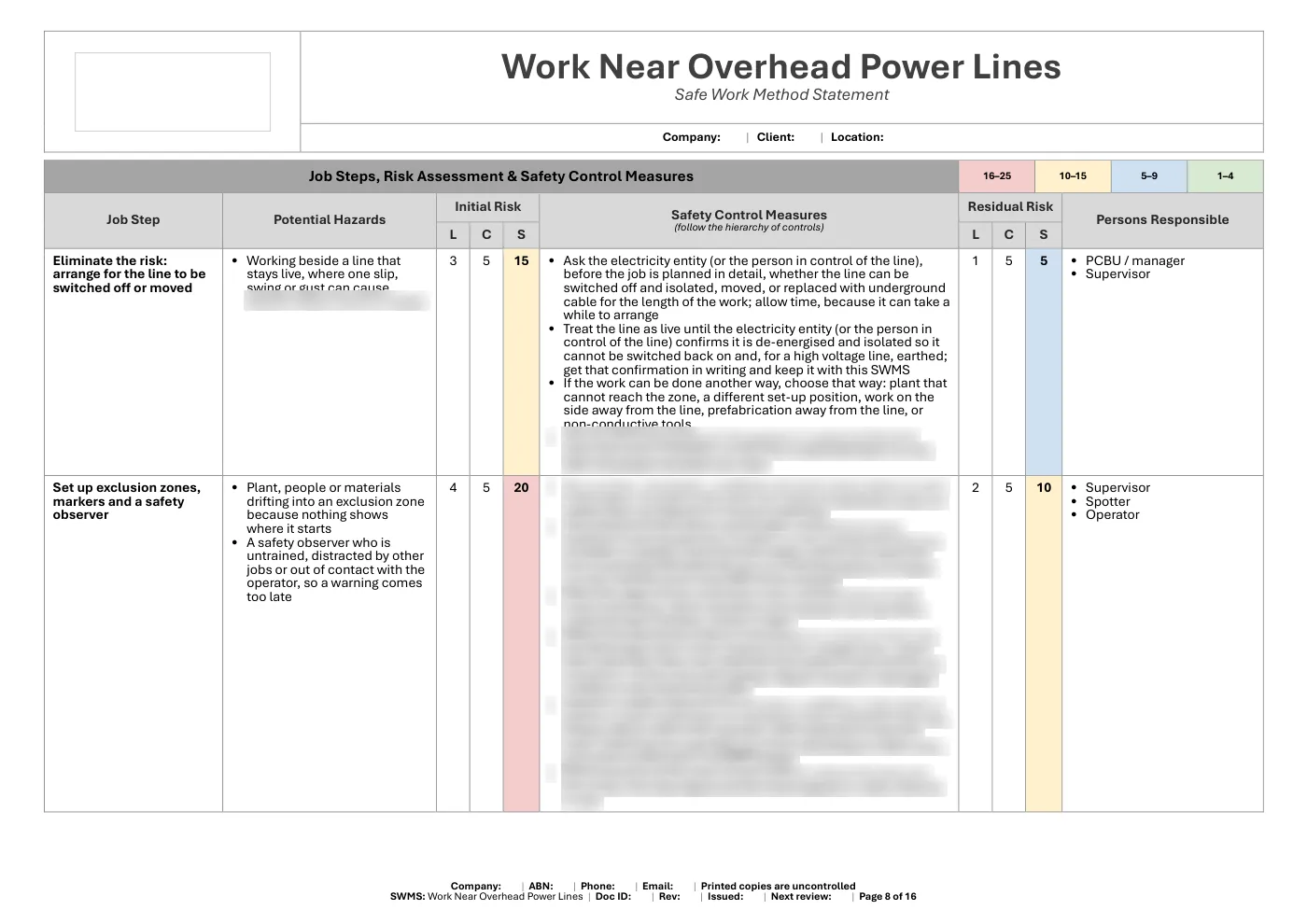
- A 5 x 5 risk matrix, and job steps with initial and residual risk scores and the people responsible
- Implementing, monitoring and review requirements, an additional controls log, revision history and a worker sign-on sheet
Review and adjust it for your site, your plant and the way your crew does the job, and talk it through with your workers before work starts. If you have any trouble downloading this SWMS, you can contact us at any time. Please make sure you read our Disclaimer before downloading this SWMS.
How to use it
From download to site in three steps
Buy and download
Check out with card, Apple Pay or Google Pay. Your download buttons appear straight away and the links are emailed to you.
Make it yours
Open it in Microsoft Word or Excel. Add your logo, business details, site and job information, and adjust it to how the work is done.
Brief your crew
Talk it through with the workers doing the job, have them sign on, and keep it on site. Review it whenever the job or conditions change.
What format is it?
Microsoft Word (registers are Excel). Edit it in Word or Excel, or free in Word and Excel for the web, and add your own logo and business details.
How do I get it after I pay?
Your download buttons appear as soon as checkout finishes, and the links are emailed to you. You can re-download from your account at any time.
Is it compliant with Queensland law?
It's written around Queensland's Work Health and Safety Act 2011 and Regulation 2011. Tailor it to your site, consult your workers and review it whenever conditions change; no template can guarantee compliance on its own.
What if it isn't right for my job?
If it doesn't match its description or has a fault, we'll fix it, and if we can't, we'll refund you (or give you store credit if you'd prefer). Check the sample pages first, as we don't refund a change of mind.
Reviews
More templates
Reviews