
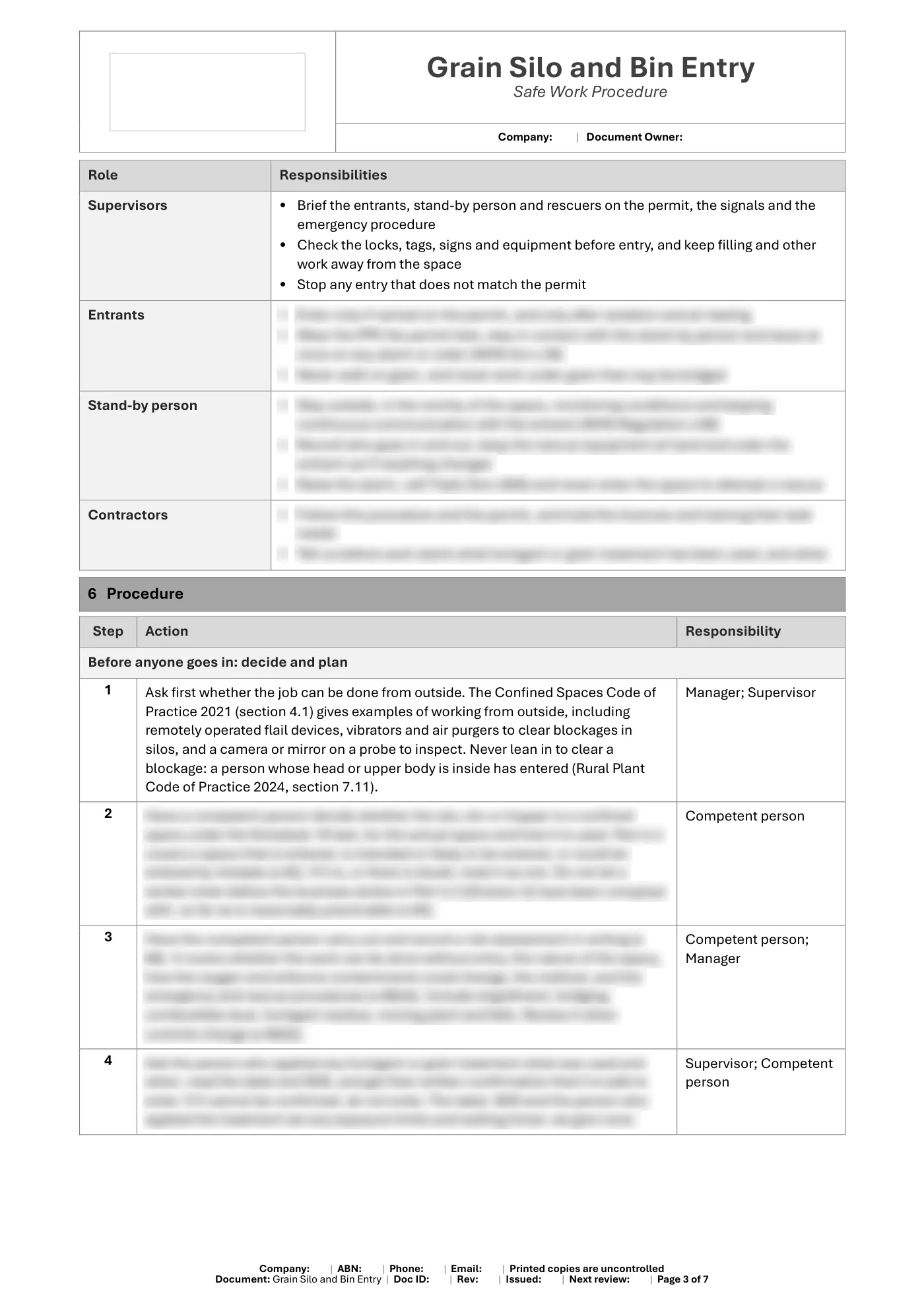
Grain Silo and Bin Entry Safe Work Procedure
Editable Word grain silo and bin entry safe work procedure for Queensland: avoid entry, permit, isolation, air testing, engulfment and bridging, stand-by person and rescue from outside.
RG
Written by Ryan Graham, health and safety professional (16 years on Queensland sites)
$14.99 incl. GST
AUD · one-off purchase · instant download
- Instant download · your links arrive by email straight after checkout and work for 3 months, so save your copy
- Make it yours in minutes · edit in Microsoft Word and add your logo
- Quality guarantee · we'll fix any problem, then refund you or give store credit if you're still not happy
- Secure checkout · card, Apple Pay or Google Pay through Stripe
Save with a bundle
About this template
Suits farms, grain depots, feed mills and seed or stockfeed stores where people clear blockages, inspect or clean silos, field bins and hoppers. It follows the confined space rules in Part 4.3 of the Regulation and adds the grain hazards: engulfment, bridging, low oxygen, fumigant residue and dust explosion.
What Is Included In Our Grain Silo and Bin Entry Safe Work Procedure?
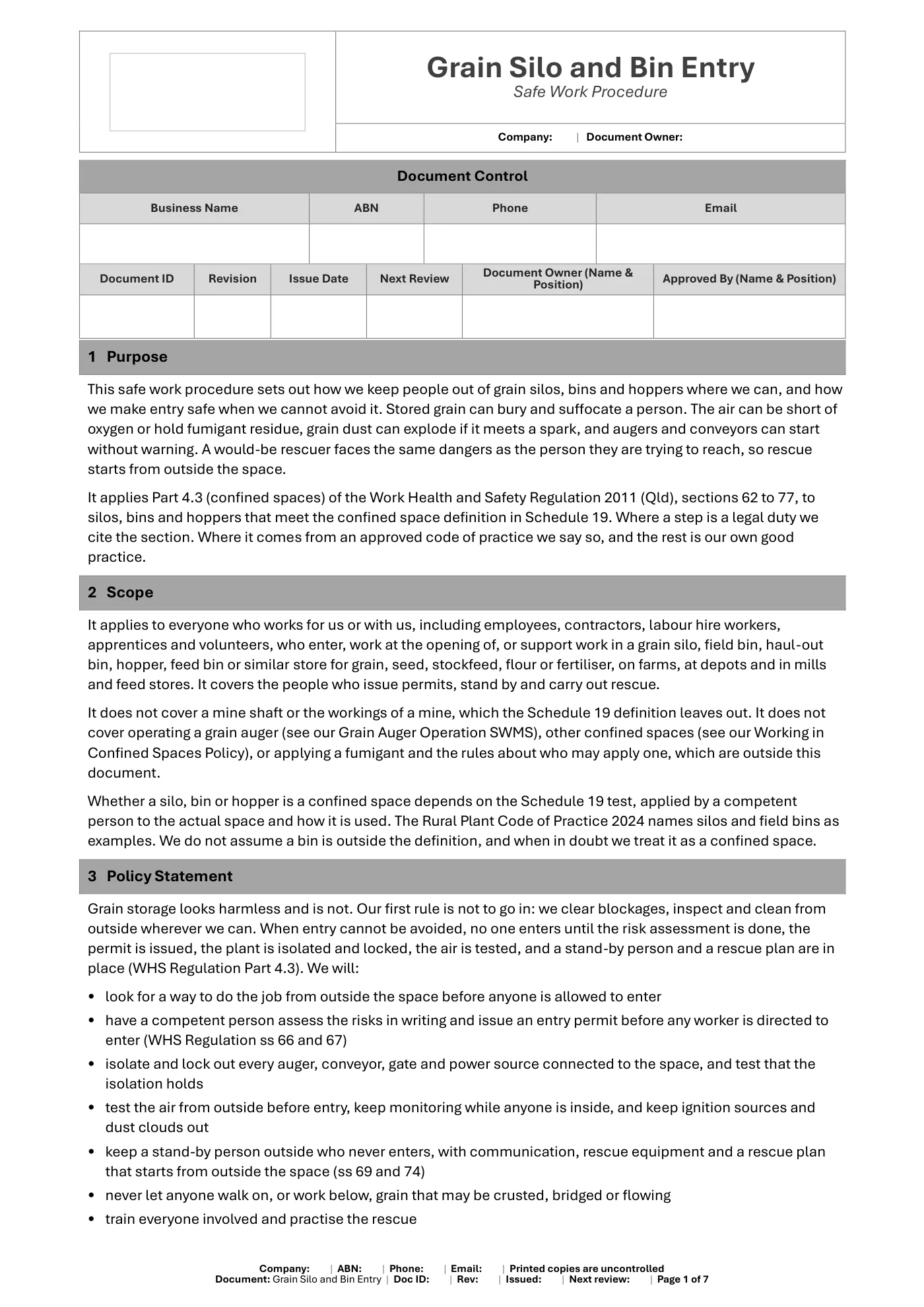
- Safe work procedure with an approval sign-off
- Avoid entry first: clearing and inspecting from outside
- The Schedule 19 confined space test, applied by a competent person
- Risk assessment, entry permit and signs (WHS Regulation Part 4.3)
- Isolation and lock out, tag out, test out of augers, conveyors and gates
- Air testing, oxygen, flammable gas, combustible dust and ignition sources
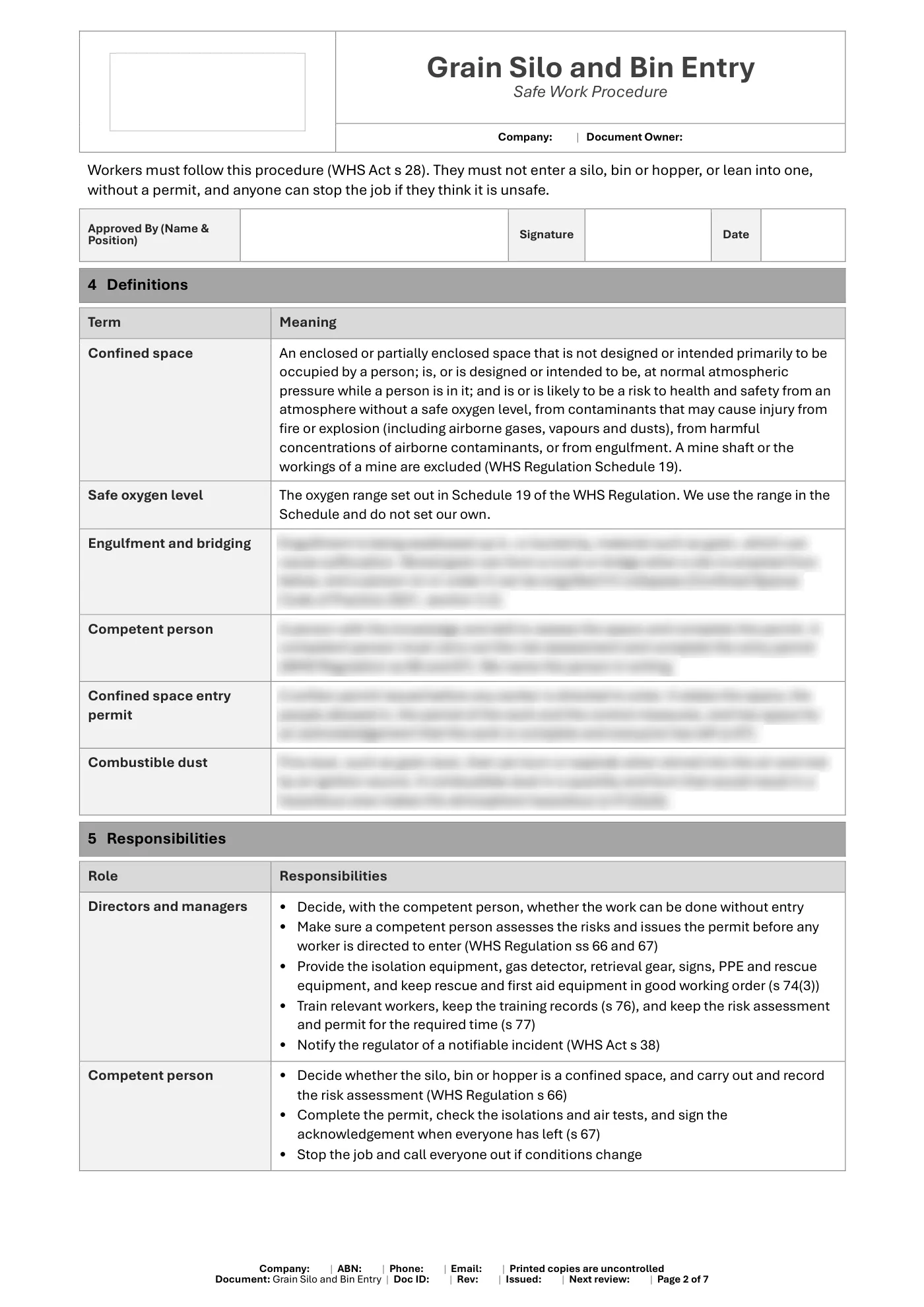
- Engulfment and bridging: never walk on or work under grain
- Fumigant and grain treatment checks before entry
- Stand-by person, retrieval gear and rescue from outside
- Records, training and review
Legislation and Codes of Practice Referenced
- Work Health and Safety Act 2011 (Qld): s 19 (primary duty of care), s 26A (approved codes of practice), s 28 (duties of workers), ss 35 to 39 (notifiable incidents), ss 47 and 49 (consultation)
- Work Health and Safety Regulation 2011 (Qld): Part 4.3 (confined spaces), ss 62 to 77, and Schedule 19 (confined space, safe oxygen level); ss 38 (review of control measures), 43 (emergency plans), 44 to 46 (personal protective equipment), 51 and 52 (hazardous atmospheres, ignition sources), 60 (hazardous manual tasks), 78 to 80 (falls), 208, 210 and 213 (plant)
- Electrical Safety Act 2002 (Qld): s 55 (electrical work needs a licence)
- Confined Spaces Code of Practice 2021 (Qld), an approved code of practice: sections 3.2, 3.4, 4.1 and 4.6. Under s 26A of the WHS Act a business must follow an approved code or manage the risk in a way that gives an equivalent or higher standard
- Rural Plant Code of Practice 2024 (Qld), an approved code of practice: section 7.11 (confined spaces) and section 8.2 (isolating energy sources)
- Managing Risks of Hazardous Chemicals in the Workplace Code of Practice 2021 (Qld), an approved code of practice: section 3.4 and appendix I (fire and explosion, including dust)
- Electrical Safety Code of Practice 2020 – Electrical equipment rural industry (Qld), made under s 44 of the Electrical Safety Act 2002: sections 7.1 and 7.2 (hazardous areas). A court may rely on a code made under s 44 in deciding what is reasonably practicable (s 45 of that Act)
- The rules for applying a fumigant, and chemical user rules for grain treatments, are not covered by this document and no sections are cited. The Chemical Usage (Agricultural and Veterinary) Control Act 1988 (Qld) may apply where a fumigant or treatment was applied. Follow the label and SDS and get advice
- This document is general information for Queensland workplaces and is not legal advice
What You Get
- An editable Microsoft Word document (7 pages), A4 portrait
- Business details and document control typed once and filled in on every page, plus a space for your logo
- Purpose, scope and a policy statement with an approval sign-off
- Definitions, and responsibilities for each role
- A step-by-step procedure that says who does what
- Records, training, monitoring and review, related documents and a revision history
Review it and adjust it to suit your business, your sites and the way your team works, and talk it through with your workers. If you have any trouble downloading this template, you can contact us at any time. Please make sure you read our Disclaimer before downloading.
Having trouble with your download? Contact us any time. Please read our Disclaimer before downloading.
How to use it
From download to site in three steps
Buy and download
Check out with card, Apple Pay or Google Pay. Your download buttons appear straight away and the links are emailed to you. Links work for 3 months, so save your copies.
Make it yours
Open it in Microsoft Word or Excel. Add your logo, business details, site and job information, and adjust it to how the work is done.
Brief your crew
Talk it through with the workers doing the job, have them sign on, and keep it on site. Review it whenever the job or conditions change.
What format is it?
Microsoft Word. Edit it in Word, or free in Word for the web, and add your own logo and business details.
How do I get it after I pay?
Your download buttons appear as soon as checkout finishes, and the links are emailed to you. You can re-download from your account at any time.
Is it compliant with Queensland law?
It's written around Queensland's Work Health and Safety Act 2011 and Regulation 2011. Tailor it to your site, consult your workers and review it whenever conditions change; no template can guarantee compliance on its own.
What if it isn't right for my job?
If it doesn't match its description or has a fault, tell us and we'll fix it. If you're still not happy, we'll refund you or give you store credit, your choice. Check the sample pages first, as we don't refund a change of mind.
Reviews