
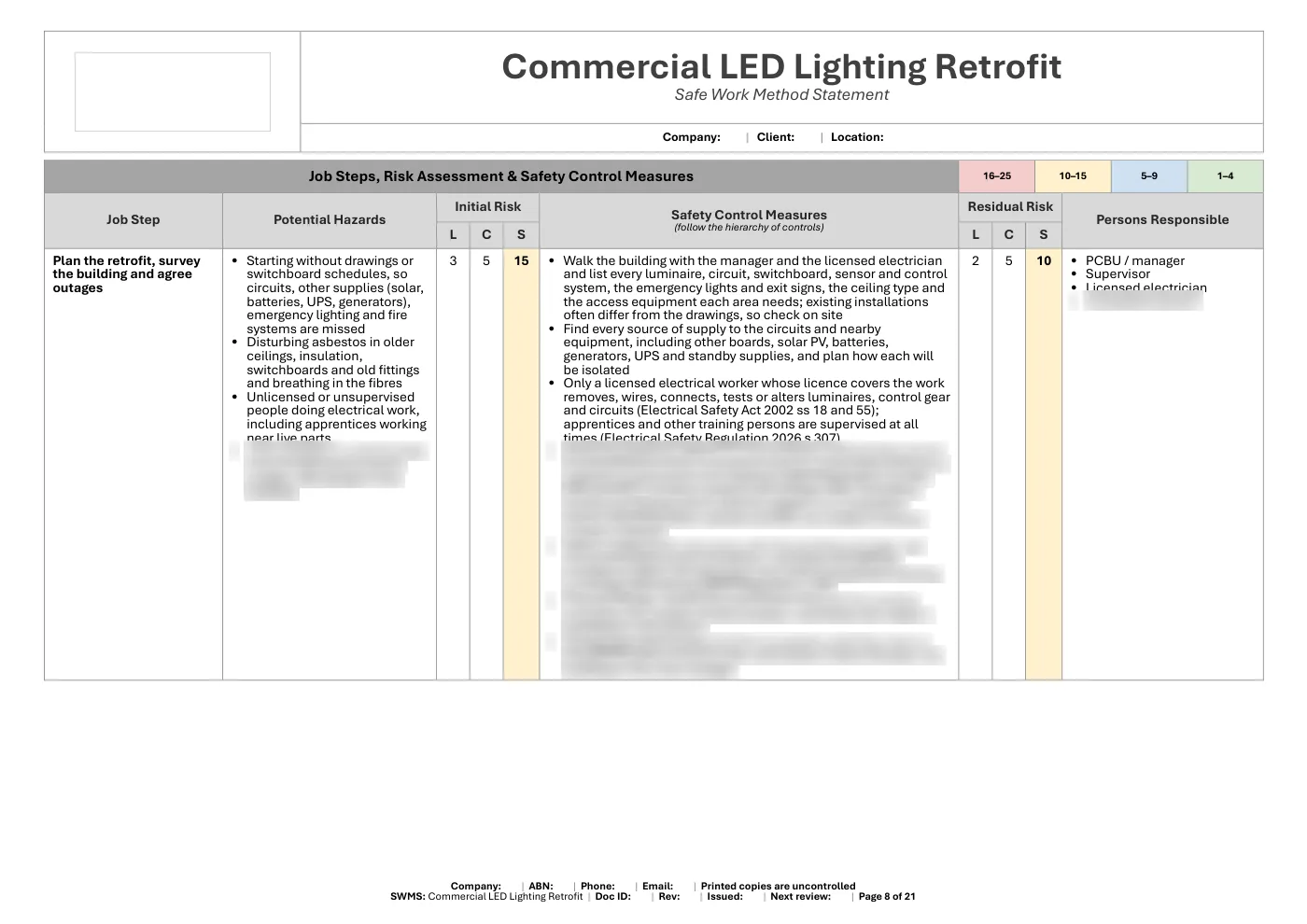
Commercial LED Lighting Retrofit SWMS
Commercial LED lighting retrofits in Queensland: isolation, ladders and platforms, ceiling openings, high-bay fittings, testing and handover by licensed electricians. An editable Word SWMS template.
RG
Written by Ryan Graham, health and safety professional (16 years on Queensland sites)
$49.99 incl. GST
AUD · one-off purchase · instant download
- Instant download · your links arrive by email straight after checkout and work for 3 months, so save your copy
- Your business name and logo · we fill them into every document for A$29 (free on orders of A$500 or more), or edit it yourself in Microsoft Word
- Quality guarantee · we'll fix any problem, then refund you or give store credit if you're still not happy
- Secure checkout · card, Apple Pay or Google Pay through Stripe
About this template
Suits licensed electrical contractors and their crews who replace light fittings and retrofit LED lighting in offices, shops, warehouses and other commercial buildings. It follows the job from planning and isolation through removing old fittings, fixing and wiring new ones, testing and energising to waste disposal and handover. Elevating work platform operation and entering the ceiling space are covered by separate SWMS.
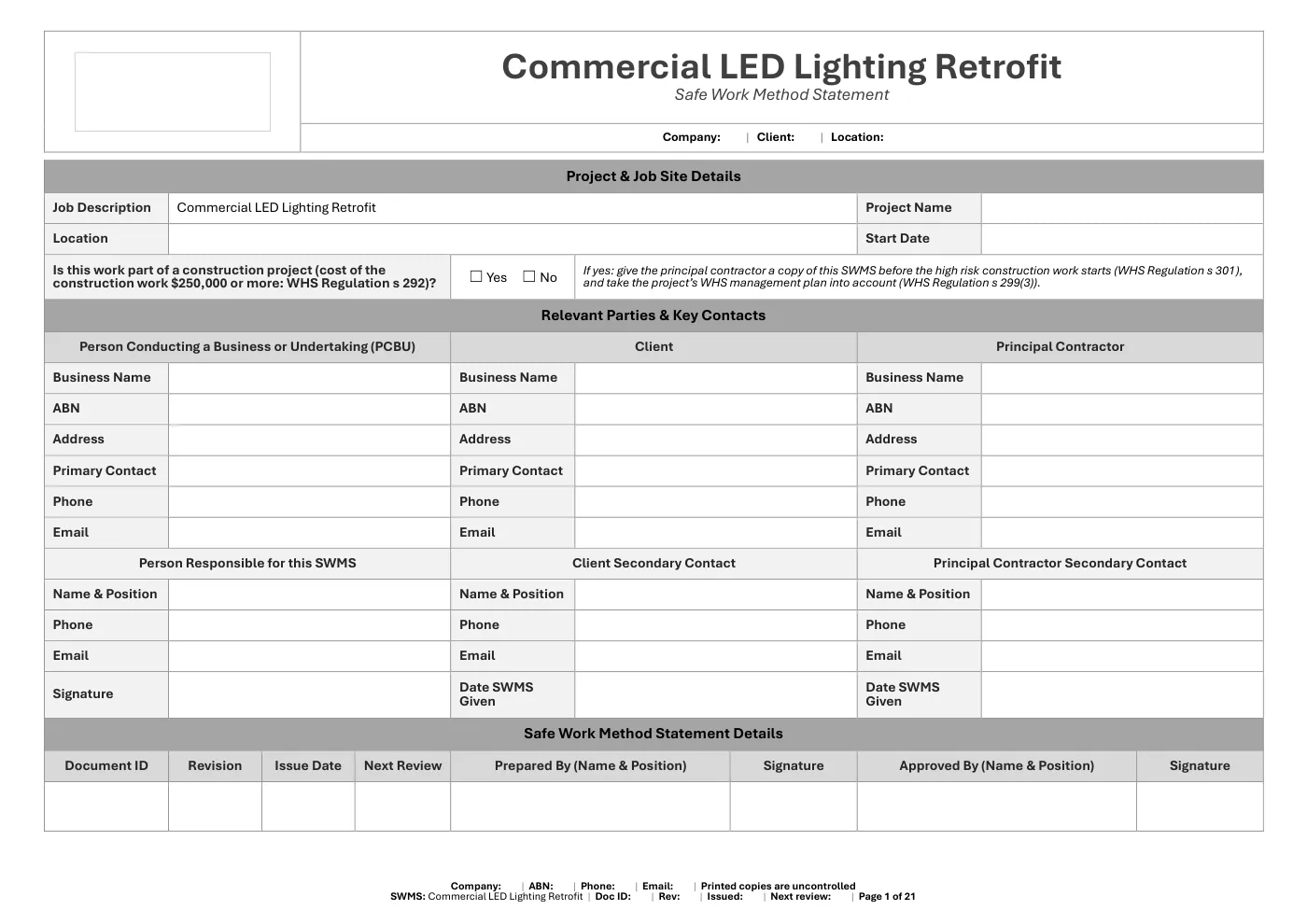
A SWMS is legally required when the work is high risk construction work, such as a fall of more than 2 metres or work on or near energised electrical installations (WHS Regulation sections 291 and 299), which are the two items ticked on the form, and energised electrical work needs its own electrical SWMS under the Electrical Safety Regulation 2026; for smaller jobs this document works as a written safe work procedure or task risk assessment. You can also tick asbestos disturbance, powered mobile plant, or the contaminated atmosphere item when drilling concrete or masonry creates silica dust, because the approved Queensland silica code treats construction work with a risk of silica exposure as work in an area that may have a contaminated atmosphere (s 291(l)).
New to SWMS? Read What is a safe work method statement?
What is covered in our commercial LED lighting retrofit SWMS?
After the standard pre-start checks, the job steps run from “Plan the retrofit, survey the building and agree outages” to “Clean up, dispose of waste and hand over”. The hazards and controls include:
- Circuits still live after isolation
- Missed supplies such as solar, batteries and UPS
- Falls from ladders, platforms and elevating work platforms
- Falling through ceiling lining
- Lamps, diffusers and fittings dropping on people below
- Asbestos in older ceilings and fittings
- Hot lamps, broken tubes and old ballasts
- Heavy high-bay fittings
- Silica dust from drilling concrete
- Forklifts and plant near the work area
- Dark exits and disabled emergency lighting
- Faulty connections causing shock or fire later
- Unlicensed people doing electrical work
- Lamp and control gear waste
High risk construction work
These high risk construction work items (WHS Regulation 2011 (Qld) s 291) are already ticked because they are part of this work. Tick any others that apply to your job:
- Involves a risk of a person falling more than 2m
- Is carried out on or near energised electrical installations or services
Licences, training and competency
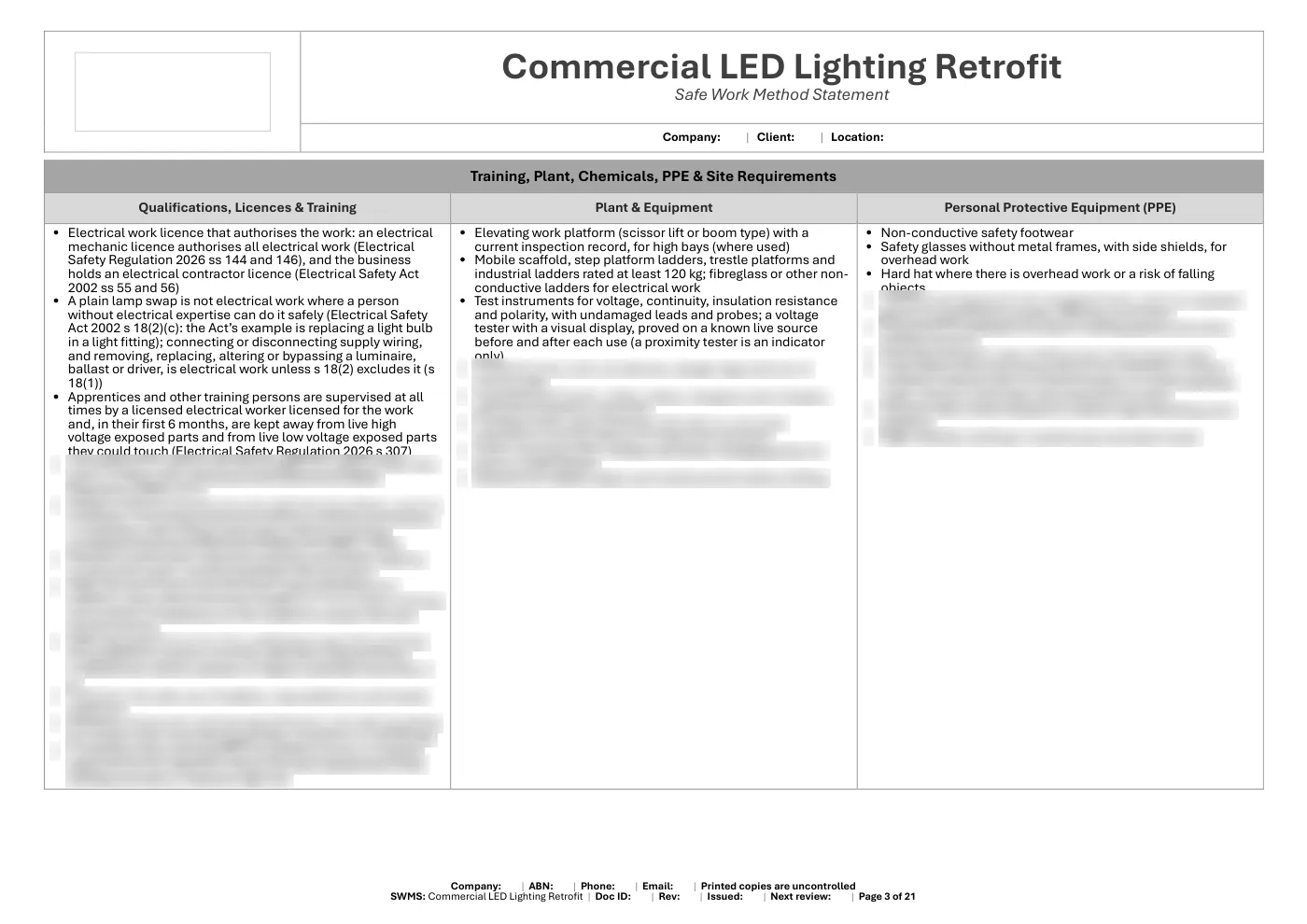
- Electrical work licence that authorises the work: an electrical mechanic licence authorises all electrical work (Electrical Safety Regulation 2026 ss 144 and 146), and the business holds an electrical contractor licence (Electrical Safety Act 2002 ss 55 and 56)
- A plain lamp swap is not electrical work where a person without electrical expertise can do it safely (Electrical Safety Act 2002 s 18(2)(c): the Act’s example is replacing a light bulb in a light fitting); connecting or disconnecting supply wiring, and removing, replacing, altering or bypassing a luminaire, ballast or driver, is electrical work unless s 18(2) excludes it (s 18(1))
- Apprentices and other training persons are supervised at all times by a licensed electrical worker licensed for the work and, in their first 6 months, are kept away from live high voltage exposed parts and from live low voltage exposed parts they could touch (Electrical Safety Regulation 2026 s 307)
- Competence in rescue and resuscitation for every worker who does, or helps with, electrical work (Electrical Safety Regulation 2026 s 211)
- Helpers without a licence do only what the Act allows, such as locating or mounting equipment without making connections, or assisting under direct supervision without touching energised equipment (Electrical Safety Act 2002 s 18(2))
- General construction induction training card (white card) for construction work, and the building’s site induction
- High risk work licence for the boom-type elevating work platform class where the boom length is 11 m or more; training and verified competency on the model for scissor lifts and shorter booms
- High risk work licence for the scaffolding class that matches the scaffold for anyone erecting, altering or dismantling a scaffold from which a person or object could fall more than 4 m
- Training in the safe use of ladders, step platforms and trestle platforms
- Asbestos awareness training (identification and safe handling) for workers who may disturb ceilings, insulation or old fittings
- Crystalline silica training (VET accredited course or training approved by the regulator) where the dust assessment finds drilling concrete or masonry high risk
Legislation and codes of practice referenced
- Work Health and Safety Act 2011 (Qld)
- Work Health and Safety Regulation 2011 (Qld)
- Electrical Safety Act 2002 (Qld): electrical work and licensing (ss 18, 55 and 56)
- Electrical Safety Regulation 2026 (Qld): licences (ss 144 and 146), energised work and isolation (ss 195 to 204), testing and certificates (ss 207 and 208), rescue training (s 211), training persons (s 307)
- Electrical Safety Code of Practice 2021 – Managing electrical risks in the workplace
- How to Manage Work Health and Safety Risks Code of Practice 2021
- Managing the Risk of Falls at Workplaces Code of Practice 2021
- Scaffolding Code of Practice 2021 (mobile scaffold)
- Managing Risks of Plant in the Workplace Code of Practice 2021
- Hazardous Manual Tasks Code of Practice 2021
- How to Manage and Control Asbestos in the Workplace Code of Practice 2021
- Managing respirable crystalline silica dust exposure in construction and manufacturing of construction elements Code of Practice 2022
- Managing Noise and Preventing Hearing Loss at Work Code of Practice 2021
- Managing Risks of Hazardous Chemicals in the Workplace Code of Practice 2021
- Managing the Work Environment and Facilities Code of Practice 2021
- First Aid in the Workplace Code of Practice 2021
- Work Health and Safety Consultation, Co-operation and Co-ordination Code of Practice 2021
- Building Fire Safety Regulation 2008 (Qld): evacuation routes and fire safety installations (ss 7 and 54)
- Safe Work Australia model Code of Practice: Elevating work platforms (guidance)
- Safe Work Australia model Code of Practice: Managing the risks of biological hazards at work (guidance)
What you get
- An editable Microsoft Word document (21 pages), laid out on A4 landscape pages. Type your business, client and job details once and they fill in on every page, with a space for your logo
- 11 job steps for this work, each with its hazards, controls, initial and residual risk scores and the person responsible
- PPE listed for this job: non-conductive safety footwear; safety glasses without metal frames, with side shields, for overhead work; hard hat where there is overhead work or a risk of falling objects
- Emergency arrangements for: electric shock or arc flash and suspected asbestos disturbed
- Plus the parts every Work Safety QLD SWMS shares, from the s 291 checklist to the worker sign-on sheet (see the layout in our free SWMS template)
Adjust it for your site, plant and crew, and talk it through with your workers before work starts.
Checked against the Queensland laws and codes of practice listed above. Last reviewed October 2026.
Having trouble with your download? Contact us any time. Please read our Disclaimer before downloading.
How to use it
From download to site in three steps
Buy and download
Check out with card, Apple Pay or Google Pay. Your download buttons appear straight away and the links are emailed to you. Links work for 3 months, so save your copies.
Make it yours
Add your logo and business details in Word or Excel, or tick branding at checkout (A$29) and we add them. Then add your site and job details.
Brief your crew
Talk it through with the workers doing the job, have them sign on, and keep it on site. Review it whenever the job or conditions change.
What format is it?
Microsoft Word. Edit it in Word, or free in Word for the web, and add your own logo and business details. Or let us do it: tick "Add my business name and logo to every document" at checkout (A$29, free on orders of A$500 or more) and fill in a short form after payment.
How do I get it after I pay?
Your download buttons appear as soon as checkout finishes, and the links are emailed to you. You can re-download from your account at any time.
Is it compliant with Queensland law?
It's written around Queensland's Work Health and Safety Act 2011 and Regulation 2011. Tailor it to your site, consult your workers and review it whenever conditions change; no template can guarantee compliance on its own.
What if it isn't right for my job?
If it doesn't match its description or has a fault, tell us and we'll fix it. If you're still not happy, we'll refund you or give you store credit, your choice. Check the sample pages first, as we don't refund a change of mind.
Only logged in customers who have purchased this product may leave a review.
Reviews