
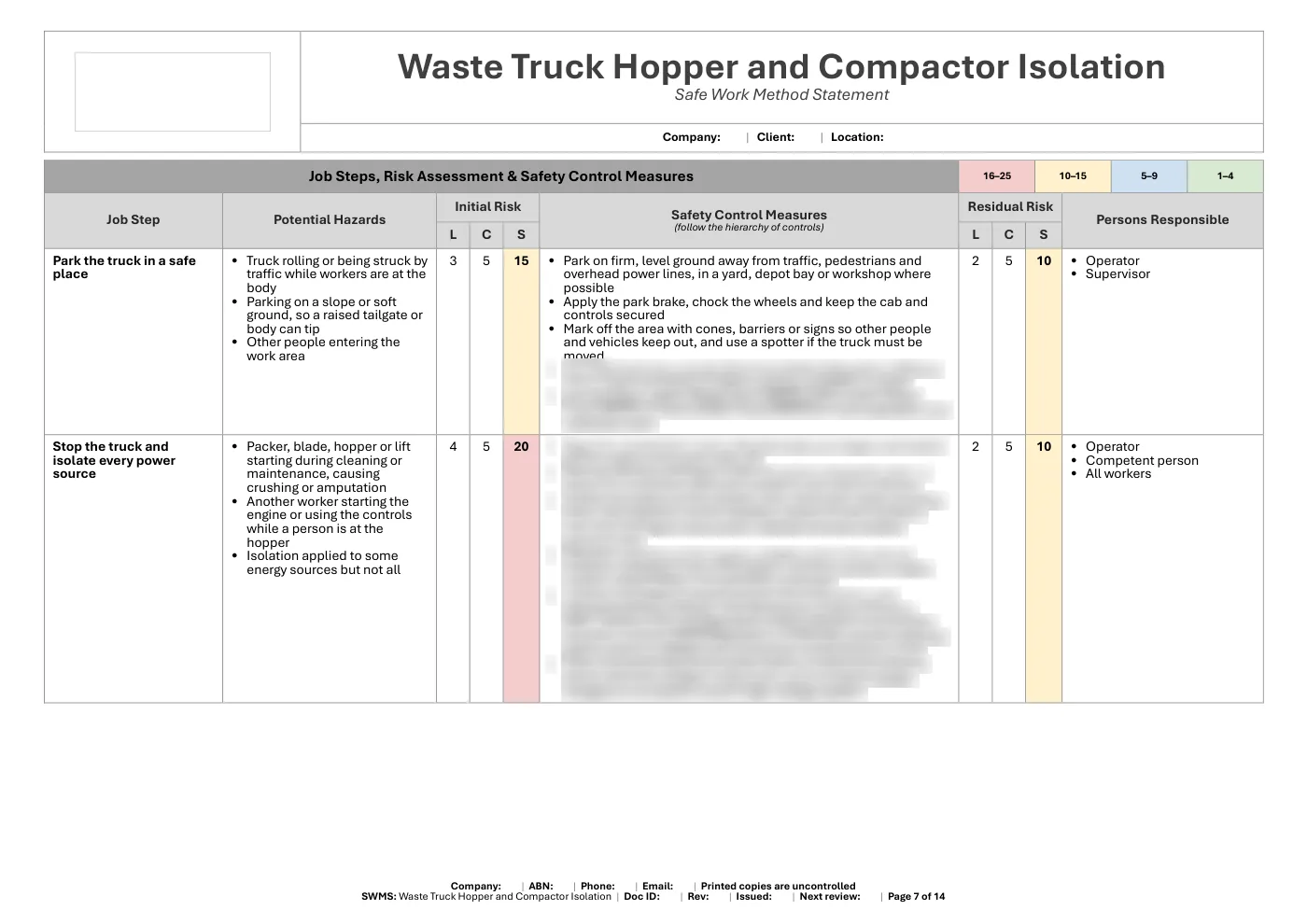
Waste Truck Hopper and Compactor Isolation SWMS
Isolating waste truck hoppers and compactors in Queensland: crush hazards, stored energy, lock-out and blockages. An editable Word SWMS template.
RG
Written by Ryan Graham, health and safety professional (16 years on Queensland sites)
$39.99 incl. GST
AUD · one-off purchase · instant download
- Instant download · your links arrive by email straight after checkout and work for 3 months, so save your copy
- Your business name and logo · we fill them into every document for A$29 (free on orders of A$500 or more), or edit it yourself in Microsoft Word
- Quality guarantee · we'll fix any problem, then refund you or give store credit if you're still not happy
- Secure checkout · card, Apple Pay or Google Pay through Stripe
About this template
Suits waste collection businesses, depots and workshops that clean, unblock or repair truck hoppers, packers and compactors. It covers planning, parking, isolating the power, releasing stored energy, proving the isolation, clearing blockages, repairs, wash-down, restart and incident response. Truck operation has its own SWMS.
Isolating a waste truck is not high risk construction work by itself, so no item is pre-ticked and a SWMS is required by law only for high risk construction work (WHS Regulation s 299); this document works as a written safe work procedure or task risk assessment that you tailor to your depot. If the work is part of construction work, tick the reg 291 items that apply.
New to SWMS? Read What Is A Safe Work Method Statement?
What Is Covered In Our Waste Truck Hopper and Compactor Isolation SWMS?
After the standard pre-start checks, the job steps run from “Plan the isolation and agree the method” to “Respond to a trapped person, hydraulic failure or fire”. The hazards and controls include:
- Packer or hopper moving during cleaning
- Crush and amputation at the compactor
- Hydraulic pressure release
- Tailgate or blade dropping under gravity
- Incomplete or unproved isolation
- Sharps and hazardous items in waste
- Falls from the hopper edge
- Hot work and fire in residue
- Leachate and biological hazards
- High-pressure wash-down injuries
- Hydraulic oil injection
- Restarting with a person still inside
High Risk Construction Work
None of the high risk construction work items (WHS Regulation 2011 (Qld) s 291) are pre-ticked, because this job is not high risk construction work by itself. Tick any that apply on your site.
Licences, Training and Competency
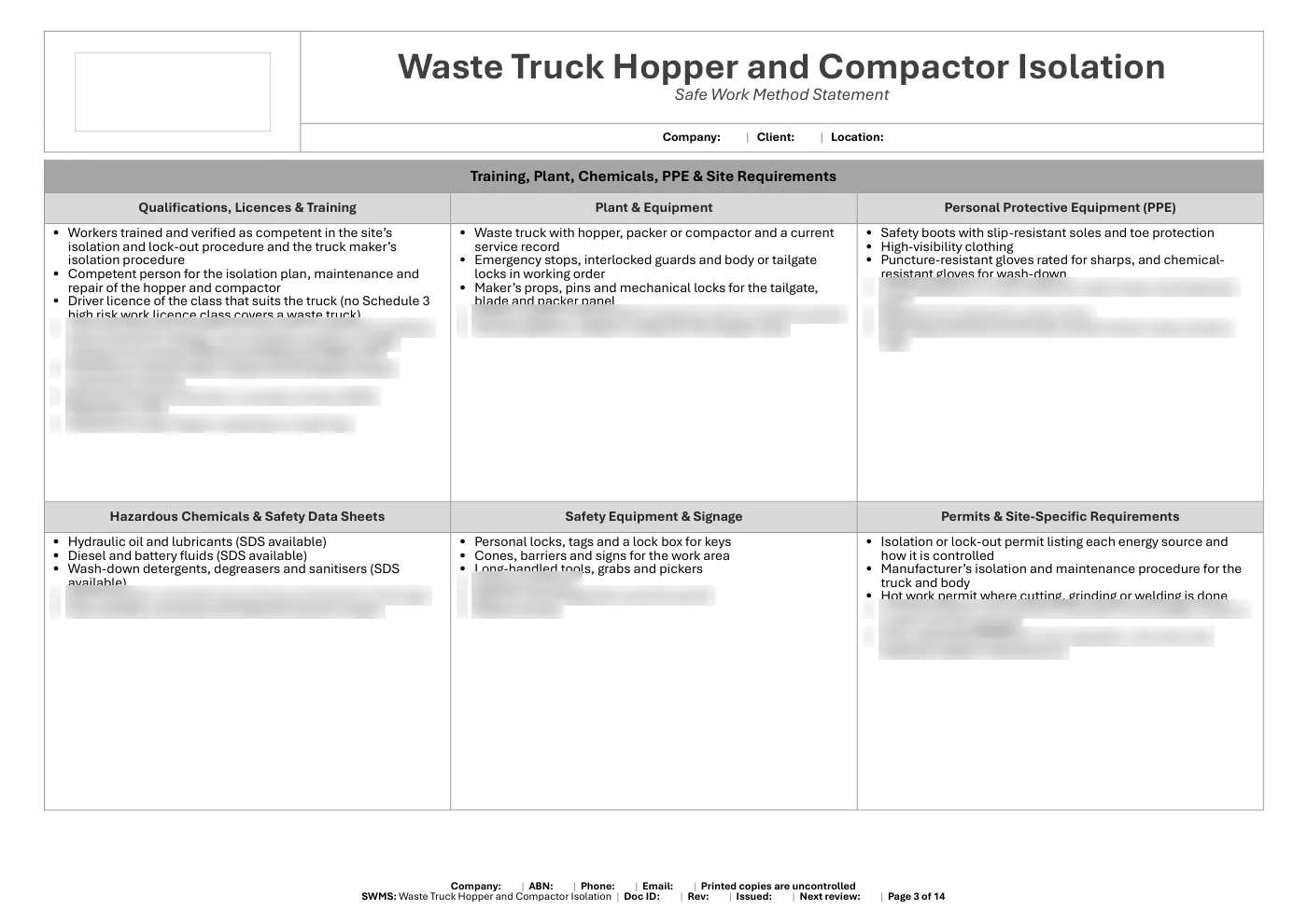
- Workers trained and verified as competent in the site’s isolation and lock-out procedure and the truck maker’s isolation procedure
- Competent person for the isolation plan, maintenance and repair of the hopper and compactor
- Driver licence of the class that suits the truck (no Schedule 3 high risk work licence class covers a waste truck)
- Licensed electrical worker for any work on electrical systems above extra low voltage, such as depot supply or a high-voltage truck system (Electrical Safety Act 2002 s 55)
- Hazardous manual tasks, sharps and biological hazard awareness training
- Workers trained in first aid, or access to them (WHS Regulation s 42)
- Induction to each depot, workshop or wash bay
Legislation and Codes of Practice Referenced
- Work Health and Safety Act 2011 (Qld)
- Work Health and Safety Regulation 2011 (Qld)
- WHS Regulation 2011 (Qld) ss 205 to 213 (plant: alteration, use, not in use, guarding, heat, operational controls, emergency stops, maintenance and inspection) and ss 78 and 79 (falls), Schedule 19 (meaning of confined space) and ss 62 to 77 (confined spaces)
- WHS Regulation 2011 (Qld) ss 52 and 53 (ignition sources and flammable material), s 60 (hazardous manual tasks), ss 56 and 57 (noise) and s 351 (hazardous chemicals)
- Managing Risks of Plant in the Workplace Code of Practice 2021
- Managing the Risk of Falls at Workplaces Code of Practice 2021
- Hazardous Manual Tasks Code of Practice 2021
- Confined Spaces Code of Practice 2021
- Managing Risks of Hazardous Chemicals in the Workplace Code of Practice 2021
- Managing Noise and Preventing Hearing Loss at Work Code of Practice 2021
- Managing the Work Environment and Facilities Code of Practice 2021
- First Aid in the Workplace Code of Practice 2021
- How to Manage Work Health and Safety Risks Code of Practice 2021
- Safe Work Australia model Code of Practice: Managing the risks of biological hazards at work (model code, not approved in Queensland; guidance only)
- Electrical Safety Act 2002 (Qld): s 55 (only licensed electrical workers do electrical work)
- Electrical Safety Regulation 2026 (Qld): ss 10 to 13 and schedule 2 (exclusion zones for overhead electric lines)
What You Get
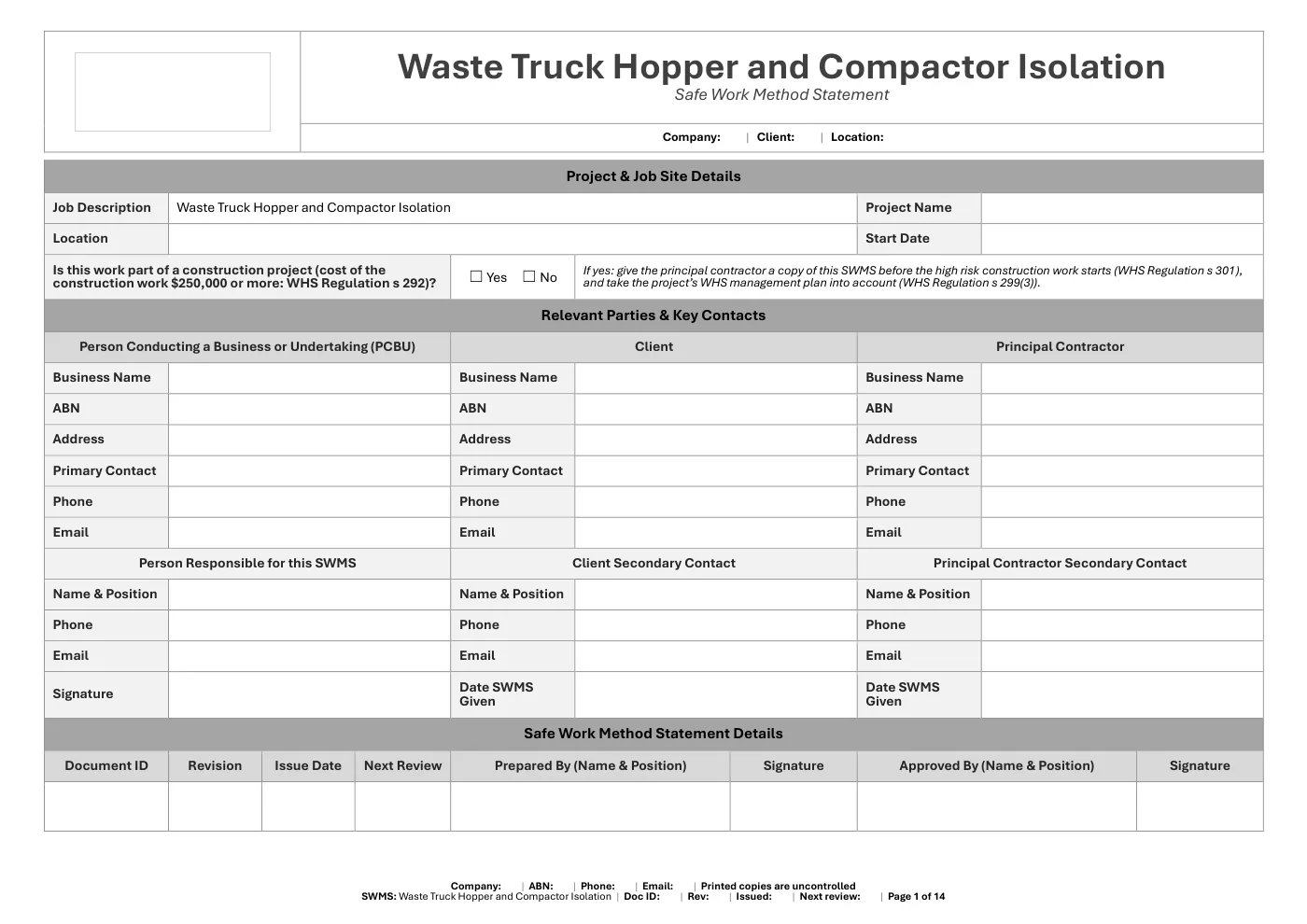
- An editable Microsoft Word document (14 A4 landscape pages). Type your business, client and job details once and they fill in on every page, with a space for your logo
- 10 job steps for this work, each with its hazards, controls, initial and residual risk scores and the person responsible
- PPE listed for this job: safety boots with slip-resistant soles and toe protection; high-visibility clothing; puncture-resistant gloves rated for sharps, and chemical-resistant gloves for wash-down
- Emergency arrangements for: person caught in the hopper or packer, hydraulic hose burst or oil injection and fire in the load or on the truck
- Plus the parts every Work Safety QLD SWMS shares, from the s 291 checklist to the worker sign-on sheet (see the layout in our free SWMS template)
Adjust it for your site, plant and crew, and talk it through with your workers before work starts. Please make sure you read our Disclaimer before downloading this SWMS.
Checked against the Queensland laws and codes of practice listed above. Last reviewed November 2026.
Having trouble with your download? Contact us any time. Please read our Disclaimer before downloading.
How to use it
From download to site in three steps
Buy and download
Check out with card, Apple Pay or Google Pay. Your download buttons appear straight away and the links are emailed to you. Links work for 3 months, so save your copies.
Make it yours
Add your logo and business details in Word or Excel, or tick branding at checkout (A$29) and we add them. Then add your site and job details.
Brief your crew
Talk it through with the workers doing the job, have them sign on, and keep it on site. Review it whenever the job or conditions change.
What format is it?
Microsoft Word. Edit it in Word, or free in Word for the web, and add your own logo and business details. Or let us do it: tick "Add my business name and logo to every document" at checkout (A$29, free on orders of A$500 or more) and fill in a short form after payment.
How do I get it after I pay?
Your download buttons appear as soon as checkout finishes, and the links are emailed to you. You can re-download from your account at any time.
Is it compliant with Queensland law?
It's written around Queensland's Work Health and Safety Act 2011 and Regulation 2011. Tailor it to your site, consult your workers and review it whenever conditions change; no template can guarantee compliance on its own.
What if it isn't right for my job?
If it doesn't match its description or has a fault, tell us and we'll fix it. If you're still not happy, we'll refund you or give you store credit, your choice. Check the sample pages first, as we don't refund a change of mind.
Only logged in customers who have purchased this product may leave a review.
Reviews