Suits clinical waste contractors and the drivers and collectors who pick up sharps containers, bins and boxes from hospitals, clinics, laboratories and surgeries. It follows the run in order, from planning and vehicle checks to inspecting containers, moving and loading them, spills and loose sharps, driving, unloading, cleaning and reporting exposures. Waste compaction trucks need a separate SWMS.
Clinical waste collection is not high risk construction work, so WHS Regulation s 299 requires a SWMS only if the work is part of high risk construction work. Otherwise the document works as a written safe work procedure and task risk assessment, and no high risk construction work item is pre-ticked. If the collection is part of construction work, tick the items that apply, such as work beside a traffic corridor (s 291(n)) or in an area with powered mobile plant movement (s 291(o)).
New to SWMS? Read What Is A Safe Work Method Statement?
What Is Covered In Our Clinical Waste Collection SWMS?
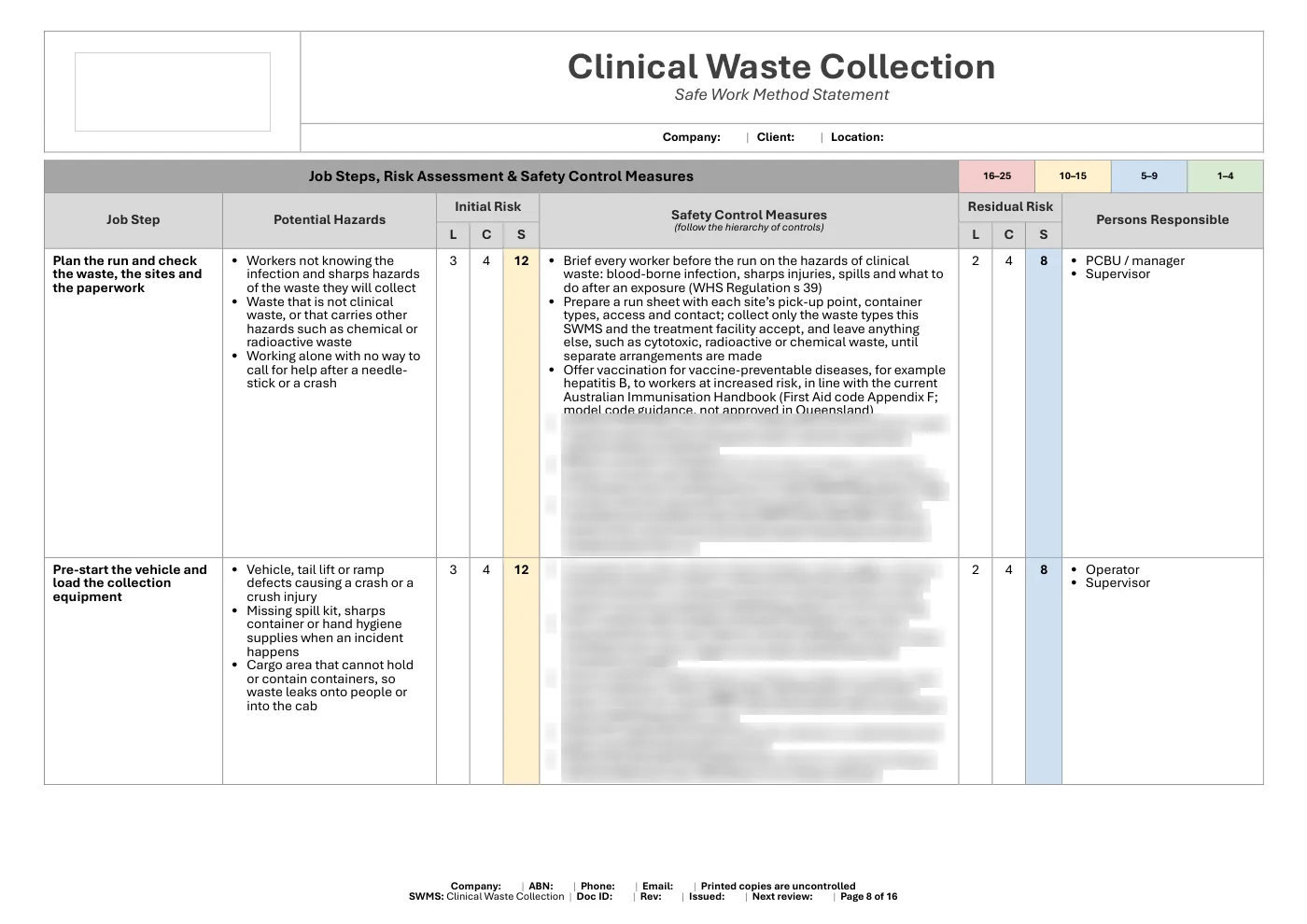
After the standard pre-start checks, the job steps run from “Plan the run and check the waste, the sites and the paperwork” to “Remove PPE, wash and report exposures”. The hazards and controls include:
- Needle-stick and sharps injuries
- Contact with blood and infectious material
- Leaking, overfilled or damaged containers
- Spills and loose sharps in the vehicle
- Strains from heavy bins and boxes
- Crush injuries from trolleys and the tail lift
- Containers shifting or falling during transport
- Collisions when reversing at loading docks
- Driver fatigue and road crashes
- Chemical splashes from disinfectants
- Contamination spread by used PPE
- Unreported exposures and later illness
High Risk Construction Work
None of the high risk construction work items (WHS Regulation 2011 (Qld) s 291) are pre-ticked, because this job is not high risk construction work by itself. Tick any that apply on your site.
Licences, Training and Competency
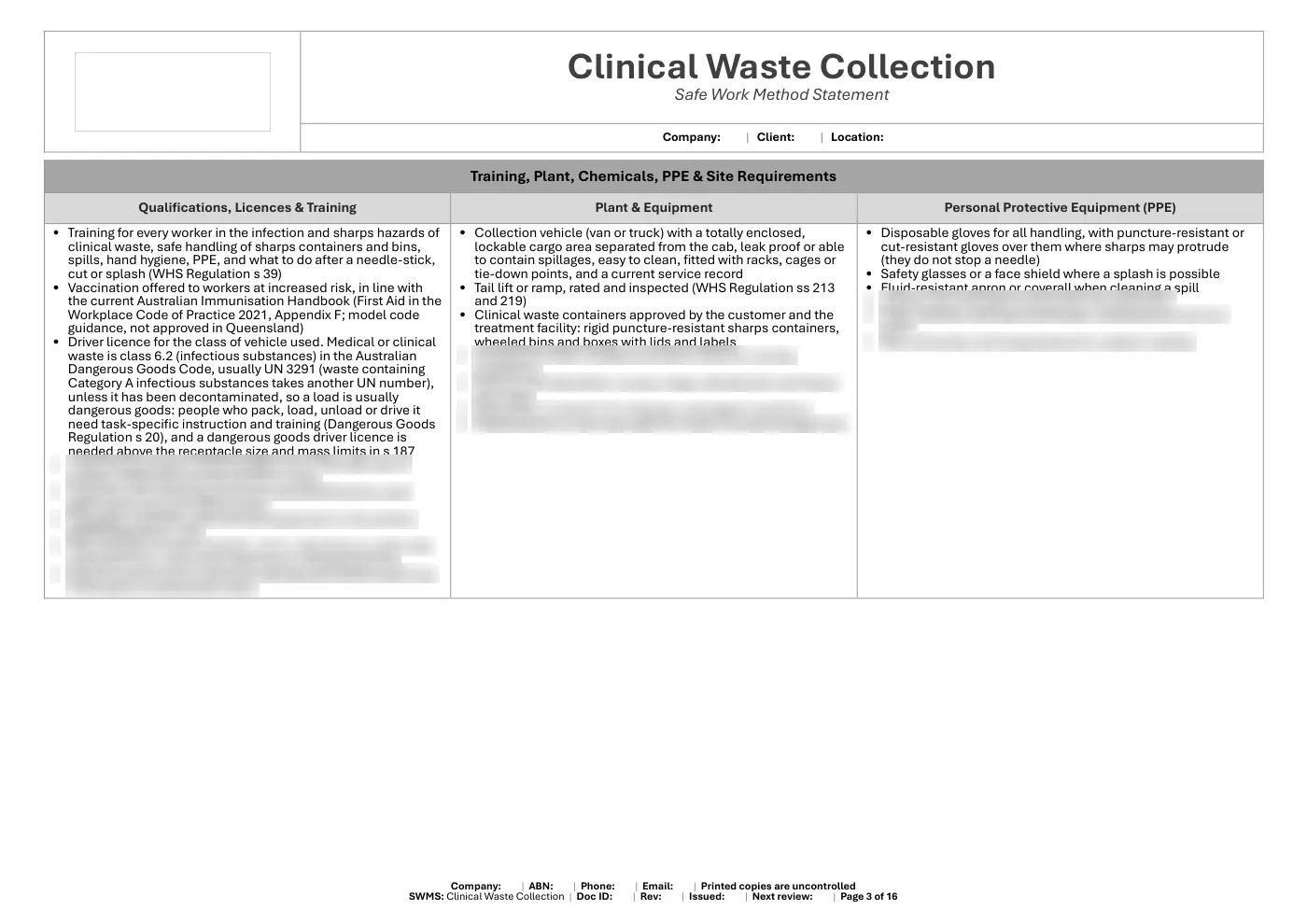
- Training for every worker in the infection and sharps hazards of clinical waste, safe handling of sharps containers and bins, spills, hand hygiene, PPE, and what to do after a needle-stick, cut or splash (WHS Regulation s 39)
- Vaccination offered to workers at increased risk, in line with the current Australian Immunisation Handbook (First Aid in the Workplace Code of Practice 2021, Appendix F; model code guidance, not approved in Queensland)
- Driver licence for the class of vehicle used. Medical or clinical waste is class 6.2 (infectious substances) in the Australian Dangerous Goods Code, usually UN 3291 (waste containing Category A infectious substances takes another UN number), unless it has been decontaminated, so a load is usually dangerous goods: people who pack, load, unload or drive it need task-specific instruction and training (Dangerous Goods Regulation s 20), and a dangerous goods driver licence is needed above the receptacle size and mass limits in s 187
- Training in hazardous manual tasks and in the safe use of trolleys, lifting aids and the tail lift or ramp
- Training in the cleaning chemicals and disinfectants used (SDS read) and in the PPE chosen
- First aider available, with first aid equipment in the vehicle (WHS Regulation s 42)
- Site induction at each hospital, clinic, laboratory or other site collected from, and at the treatment or disposal facility
- General construction induction training card (white card) only if the work is construction work
Legislation and Codes of Practice Referenced
- Work Health and Safety Act 2011 (Qld)
- Work Health and Safety Regulation 2011 (Qld)
- WHS Act 2011 (Qld) ss 35, 36 and 38: notifiable incidents, serious injury or illness (including medical treatment within 48 hours of exposure to a substance) and the duty to notify
- WHS Regulation 2011 (Qld) s 699: prescribed serious illnesses (infections from work with microorganisms or contact with human blood or body substances)
- WHS Regulation 2011 (Qld) ss 39, 42, 44 and 48: information and training, first aid, personal protective equipment, remote or isolated work
- WHS Regulation 2011 (Qld) s 60: managing risks of hazardous manual tasks
- WHS Regulation 2011 (Qld) ss 213, 214 and 219: maintenance of plant, powered mobile plant, plant that lifts (vehicle and tail lift)
- WHS Regulation 2011 (Qld) ss 344, 346 and 351: safety data sheets, the hazardous chemicals register and managing hazardous chemical risks (cleaning products)
- Transport Operations (Road Use Management – Dangerous Goods) Regulation 2018 (Qld), applying where the load is dangerous goods: s 20 (task-specific instruction and training, including packing, loading, unloading and driving) and s 187 (drivers must be licensed above the receptacle and mass limits in the section)
- Australian Dangerous Goods Code (ADG Code), as applied by the Dangerous Goods Regulation: medical or clinical waste is class 6.2, usually UN 3291, with waste containing Category A infectious substances assigned to another UN number (section 2.6.3.5); the Australian packing instruction P62A covers UN 3291 packagings and a dedicated clinical waste vehicle body
- Heavy Vehicle National Law (Queensland), applied by the Heavy Vehicle National Law Act 2012 (Qld): s 6 (heavy vehicle means a vehicle with a GVM or ATM of more than 4.5 t), s 26C (primary duty of each party in the chain of responsibility), s 96 (compliance with mass requirements), s 110 (national regulations may prescribe loading requirements), s 111 (compliance with the loading requirements) and s 228 (duty of driver to avoid driving while fatigued or unfit to drive)
- First Aid in the Workplace Code of Practice 2021 (Appendix F: standard precautions for infection control, sharps and spills)
- Hazardous Manual Tasks Code of Practice 2021
- Managing Risks of Hazardous Chemicals in the Workplace Code of Practice 2021
- Managing Risks of Plant in the Workplace Code of Practice 2021
- Managing the Work Environment and Facilities Code of Practice 2021
- How to Manage Work Health and Safety Risks Code of Practice 2021
- Safe Work Australia model Code of Practice: Managing the risks of biological hazards at work (model code, not approved in Queensland; guidance only; its Appendix D covers clinical waste)
- AS 4031 and AS/NZS 4261 (sharps containers), as named in the First Aid in the Workplace Code of Practice 2021
What You Get
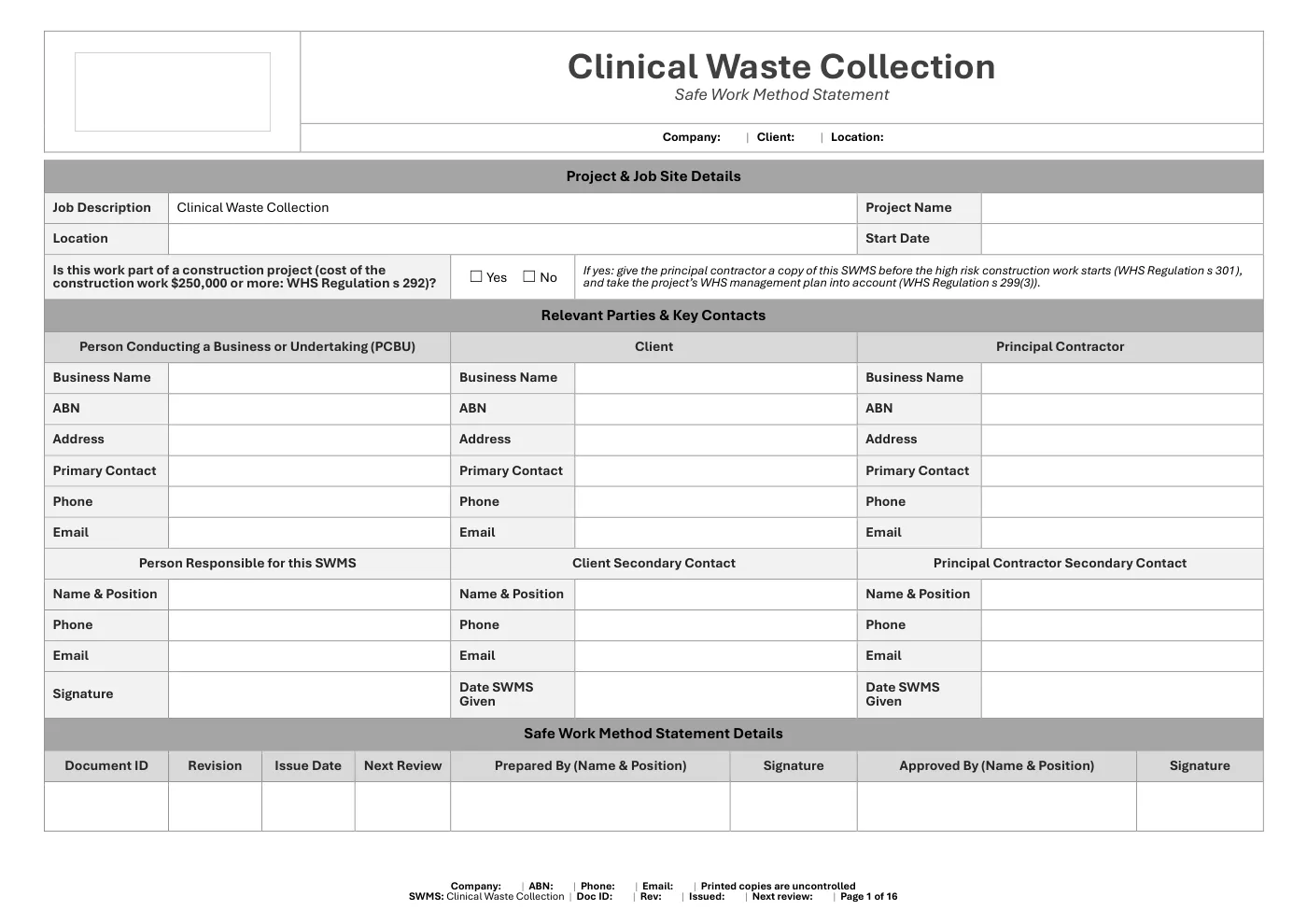
- An editable Microsoft Word document (16 A4 landscape pages). Type your business, client and job details once and they fill in on every page, with a space for your logo
- 11 job steps for this work, each with its hazards, controls, initial and residual risk scores and the person responsible
- PPE listed for this job: disposable gloves for all handling, with puncture-resistant or cut-resistant gloves over them where sharps may protrude (they do not stop a needle)
- Emergency arrangements for: needle-stick, cut or splash to the eyes, mouth or broken skin, large spill or leaking load and vehicle crash or fire with waste on board
- Plus the parts every Work Safety QLD SWMS shares, from the s 291 checklist to the worker sign-on sheet (see the layout in our free SWMS template)
Adjust it for your site, plant and crew, and talk it through with your workers before work starts. Please make sure you read our Disclaimer before downloading this SWMS.
Checked against the Queensland laws and codes of practice listed above. Last reviewed November 2026.

Reviews