Vehicle-Mounted Camera and Process Trailer SWMS
Vehicle-mounted camera rigs and process trailers in Queensland: rigging, towing, roads and traffic, and moving shots. An editable Word SWMS template.
RG
Written by Ryan Graham, health and safety professional (16 years on Queensland sites)
$39.99 incl. GST
AUD · one-off purchase · instant download
- Instant download · your links arrive by email straight after checkout and work for 3 months, so save your copy
- Make it yours in minutes · edit in Microsoft Word and add your logo
- Quality guarantee · we'll fix any problem, then refund you or give store credit if you're still not happy
- Secure checkout · card, Apple Pay or Google Pay through Stripe
About this template
Suits camera car and grip crews, film and television vehicle suppliers, production companies and content crews that fit camera arms or pods to vehicles, tow picture vehicles on process trailers or film from moving vehicles. It follows the job in order: planning and permits, vehicle and trailer checks, rigging the mount, loading the picture vehicle, towing, filming on or beside roads, operating the rig, power and fuel, weather and fatigue, and de-rigging. Traffic control, crowd control and film production in general need their own SWMS.
Operating camera rigs and process trailers is not high risk construction work by itself, so no item is pre-ticked and a SWMS is required by law only for high risk construction work (WHS Regulation s 299). If the filming is on a construction site or is part of construction work, tick the reg 291 items that apply (for example reg 291(n) for a road in use by traffic and reg 291(o) for movement of powered mobile plant). Road permits, traffic management plans and driver licence rules come from the road authority and police and are not written into this template; otherwise it works as a written safe work procedure and task risk assessment that you tailor to your rig.
New to SWMS? Read What Is A Safe Work Method Statement?
What Is Covered In Our Vehicle-Mounted Camera and Process Trailer SWMS?
After the standard pre-start checks, the job steps run from “Plan the shoot, the route and the permits” to “De-rig, unload and pack up”. The hazards and controls include:
- Camera arm, mount or pod coming loose from the vehicle
- Falls and dropped objects while rigging on a vehicle
- Picture vehicle shifting or falling off the process trailer
- Trailer sway, jackknife and long braking distances
- Winch rope, chain and strap failure
- Filming beside or among live traffic
- Crew thrown from exposed rig positions
- Rig swinging into people, signs and overhead structures
- Overhead power lines along the route
- Generator, battery and fuel fires, and carbon monoxide
- Heat, weather and fatigue on long shoot days
- Onlookers and cast entering the set
High Risk Construction Work
None of the high risk construction work items (WHS Regulation 2011 (Qld) s 291) are pre-ticked, because this job is not high risk construction work by itself. Tick any that apply on your site.
Licences, Training and Competency
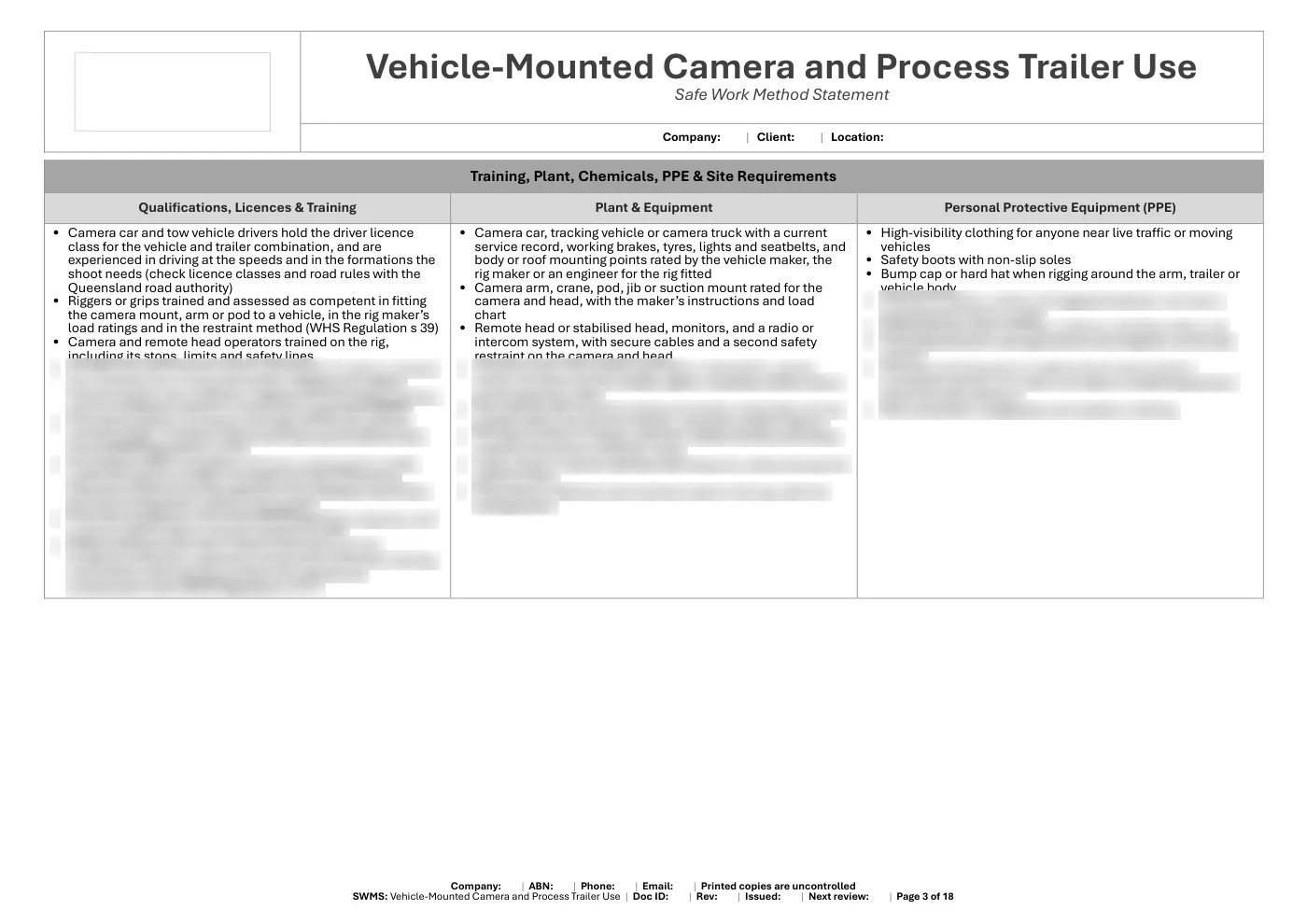
- Camera car and tow vehicle drivers hold the driver licence class for the vehicle and trailer combination, and are experienced in driving at the speeds and in the formations the shoot needs (check licence classes and road rules with the Queensland road authority)
- Riggers or grips trained and assessed as competent in fitting the camera mount, arm or pod to a vehicle, in the rig maker’s load ratings and in the restraint method (WHS Regulation s 39)
- Camera and remote head operators trained on the rig, including its stops, limits and safety lines
- No high risk work licence class in Schedule 3 covers a camera rig, a camera car or a process trailer; dogging and rigging licences apply only to lifting or rigging work Schedule 3 covers, such as slinging a load for a crane (use a separate SWMS)
- Competent person to inspect and sign off the tow vehicle, process trailer, coupling, chains and rig mounts before each shoot (WHS Regulation s 213)
- Accredited traffic controllers wherever people direct traffic under the permit or traffic management plan (Transport Operations (Road Use Management-Accreditation and Other Provisions) Regulation 2015 ss 54 and 55)
- First aid provided as s 42 of the WHS Regulation requires, and a way to call for help at remote locations (s 48)
- Safety briefing at the start of each shoot day, and the location’s induction; a general construction induction training card (white card) only for a worker who carries out construction work (WHS Regulation s 317)
Legislation and Codes of Practice Referenced
- Work Health and Safety Act 2011 (Qld)
- Work Health and Safety Regulation 2011 (Qld)
- Work Health and Safety Act 2011 (Qld) ss 16 and 46: more than one duty holder, consult, cooperate and coordinate
- Work Health and Safety Regulation 2011 (Qld) ss 205, 206 and 213: plant alterations, proper use of plant and maintenance and inspection
- Work Health and Safety Regulation 2011 (Qld) ss 214 and 215: powered mobile plant, collisions with people and things, and riders needing protection equal to the operator’s
- Work Health and Safety Regulation 2011 (Qld) s 78 (managing the risk of a fall), s 54 (falling objects), s 60 (hazardous manual tasks) and ss 56 and 57 (noise)
- Work Health and Safety Regulation 2011 (Qld) s 42 (first aid) and s 48 (remote or isolated work)
- Work Health and Safety Regulation 2011 (Qld) ss 52 and 53: ignition sources and flammable material
- Heavy Vehicle National Law (Queensland), applied by the Heavy Vehicle National Law Act 2012 (Qld): s 6 (heavy vehicle means a vehicle with a GVM or ATM of more than 4.5 t), s 26C (primary duty of each party in the chain of responsibility), s 96 (compliance with mass requirements), s 110 (national regulations may prescribe loading requirements), s 111 (compliance with the loading requirements) and s 228 (duty of driver to avoid driving while fatigued or unfit to drive)
- A car or ute towing a light process trailer is not usually a heavy vehicle: the Heavy Vehicle National Law line above applies only where the tow vehicle or the trailer has a GVM or ATM of more than 4.5 t, or the combination includes such a vehicle (HVNL s 6(1) and (2))
- Transport Operations (Road Use Management-Accreditation and Other Provisions) Regulation 2015 (Qld): ss 54 and 55 (traffic controllers)
- Managing Risks of Plant in the Workplace Code of Practice 2021
- Hazardous Manual Tasks Code of Practice 2021
- Managing the Risk of Falls at Workplaces Code of Practice 2021
- Managing Noise and Preventing Hearing Loss at Work Code of Practice 2021
- Managing the Work Environment and Facilities Code of Practice 2021 (outdoor work, remote or isolated work)
- First Aid in the Workplace Code of Practice 2021
- Work Health and Safety Consultation, Co-operation and Co-ordination Code of Practice 2021
- How to Manage Work Health and Safety Risks Code of Practice 2021
- Managing Risks of Hazardous Chemicals in the Workplace Code of Practice 2021
- Electrical Safety Act 2002 (Qld): s 55 (electrical work licence)
- Electrical Safety Regulation 2026 (Qld): overhead power line exclusion zones in sections 10 to 13 and schedule 2
- Safe Work Australia model Code of Practice: Managing the risk of fatigue at work (model code, not approved in Queensland; guidance only)
What You Get
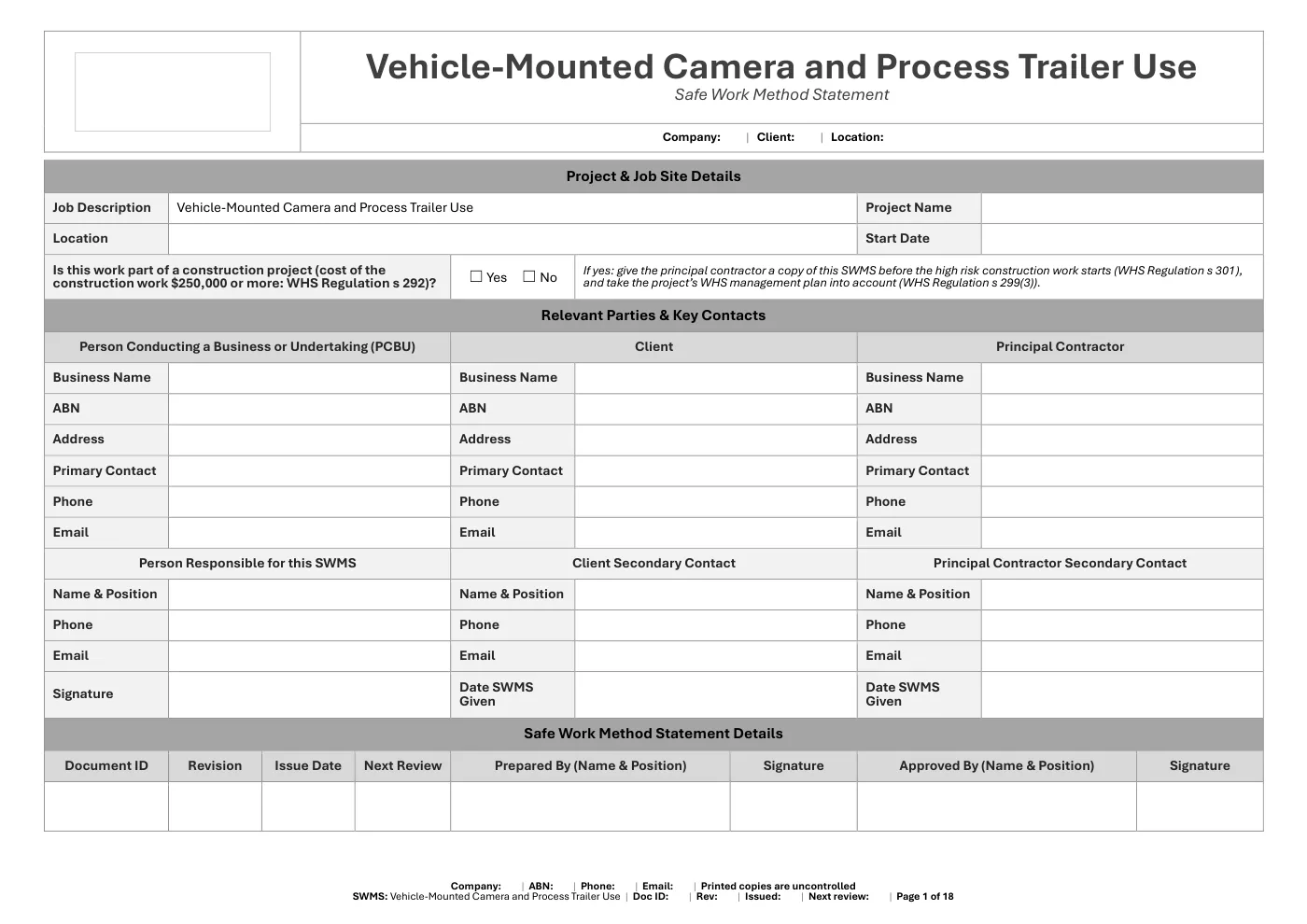
- An editable Microsoft Word document (18 A4 landscape pages). Type your business, client and job details once and they fill in on every page, with a space for your logo
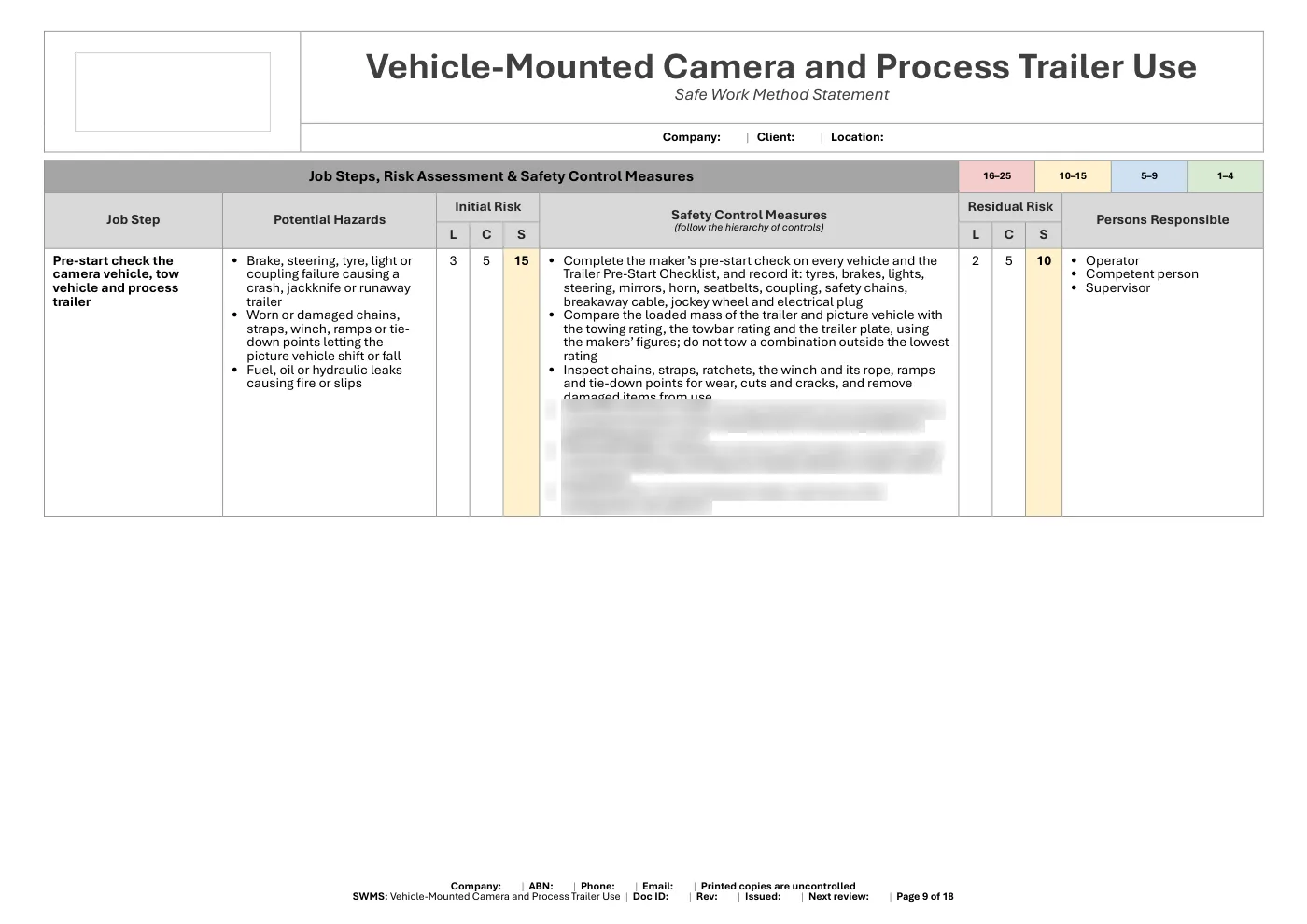
- 10 job steps for this work, each with its hazards, controls, initial and residual risk scores and the person responsible
- PPE listed for this job: high-visibility clothing for anyone near live traffic or moving vehicles; safety boots with non-slip soles; bump cap or hard hat when rigging around the arm, trailer or vehicle body
- Emergency arrangements for: crash, roll-over or a person thrown from a rig, trailer sway, tow failure or the picture vehicle coming loose and power line contact
- Plus the parts every Work Safety QLD SWMS shares, from the s 291 checklist to the worker sign-on sheet (see the layout in our free SWMS template)
Adjust it for your site, plant and crew, and talk it through with your workers before work starts. Please make sure you read our Disclaimer before downloading this SWMS.
Checked against the Queensland laws and codes of practice listed above. Last reviewed November 2026.
Having trouble with your download? Contact us any time. Please read our Disclaimer before downloading.
How to use it
From download to site in three steps
Buy and download
Check out with card, Apple Pay or Google Pay. Your download buttons appear straight away and the links are emailed to you. Links work for 3 months, so save your copies.
Make it yours
Open it in Microsoft Word or Excel. Add your logo, business details, site and job information, and adjust it to how the work is done.
Brief your crew
Talk it through with the workers doing the job, have them sign on, and keep it on site. Review it whenever the job or conditions change.
What format is it?
Microsoft Word. Edit it in Word, or free in Word for the web, and add your own logo and business details.
How do I get it after I pay?
Your download buttons appear as soon as checkout finishes, and the links are emailed to you. You can re-download from your account at any time.
Is it compliant with Queensland law?
It's written around Queensland's Work Health and Safety Act 2011 and Regulation 2011. Tailor it to your site, consult your workers and review it whenever conditions change; no template can guarantee compliance on its own.
What if it isn't right for my job?
If it doesn't match its description or has a fault, tell us and we'll fix it. If you're still not happy, we'll refund you or give you store credit, your choice. Check the sample pages first, as we don't refund a change of mind.
More templates like this
$49.99

Water Blaster SWMS
$39.99


Reviews