
Driving Vehicles SWMS
Editable Word SWMS template for driving light and heavy vehicles for work in Queensland: trip planning, load restraint, towing, fatigue, speed, distraction, reversing, breakdowns and long-distance travel.
RG
Written by Ryan Graham, health and safety professional (16 years on Queensland sites)
$39.99 incl. GST
AUD · one-off purchase · instant download
- Instant download · your links arrive by email straight after checkout
- Make it yours in minutes · edit in Microsoft Word or Excel and add your logo
- Quality guarantee · we'll fix it or refund you if it isn't as described
- Secure checkout · card, Apple Pay or Google Pay through Stripe
Bundles
Bundles that include this template
About this template
Suits trade, delivery and service businesses, site supervisors and fleet managers whose workers drive utes, vans and trucks to and between jobs. It follows the trip from planning and the vehicle check through loading, towing, driving, fatigue and weather to reversing on site, roadside breakdowns, crashes and parking. Traffic management and traffic control at worksites need their own SWMS.
Driving is not high risk construction work by itself, so no item is ticked and WHS Regulation s 299 does not require a SWMS for it; the Work Health and Safety Act (s 19) and, for heavy vehicles, the Heavy Vehicle National Law (s 26C) still require the risks to be managed, so this document works as a written safe work procedure or driving risk assessment, and as a SWMS when the driving is part of high risk construction work, such as moving vehicles in an area where powered mobile plant works (s 291), which you can tick on the form.
Learn More: What Is A Safe Work Method Statement?
Have you ever been asked to provide a SWMS on a project in Queensland? Read our guide to what a Safe Work Method Statement is and when you need one.
What Is Covered In Our Driving Vehicles SWMS?
The job steps run in the order the work is done, from pre-start checks to finishing up. The hazards and controls include:
- Fatigue and microsleeps on long drives
- Speed, tailgating and late braking
- Distraction from phones and screens
- Loads shifting or falling onto the road
- Overloaded vehicles and trailers
- Trailers detaching or swaying when towing
- Pedestrians struck by reversing vehicles
- Raised tipper bodies and cranes near power lines
- Floodwater, storms, smoke and unsealed roads
- Being struck by traffic at a roadside breakdown
- Crashes, vehicle fires and the response afterwards
- Remote travel with no phone coverage
- Fuel, gas cylinders and chemicals in the vehicle
High Risk Construction Work
No high risk construction work items (WHS Regulation 2011 (Qld) s 291) are pre-ticked, because this work is not high risk construction work by itself. Tick the items that apply to your job, such as a fall risk of more than 2 metres or work where powered mobile plant is moving.
Licences, Training and Competency
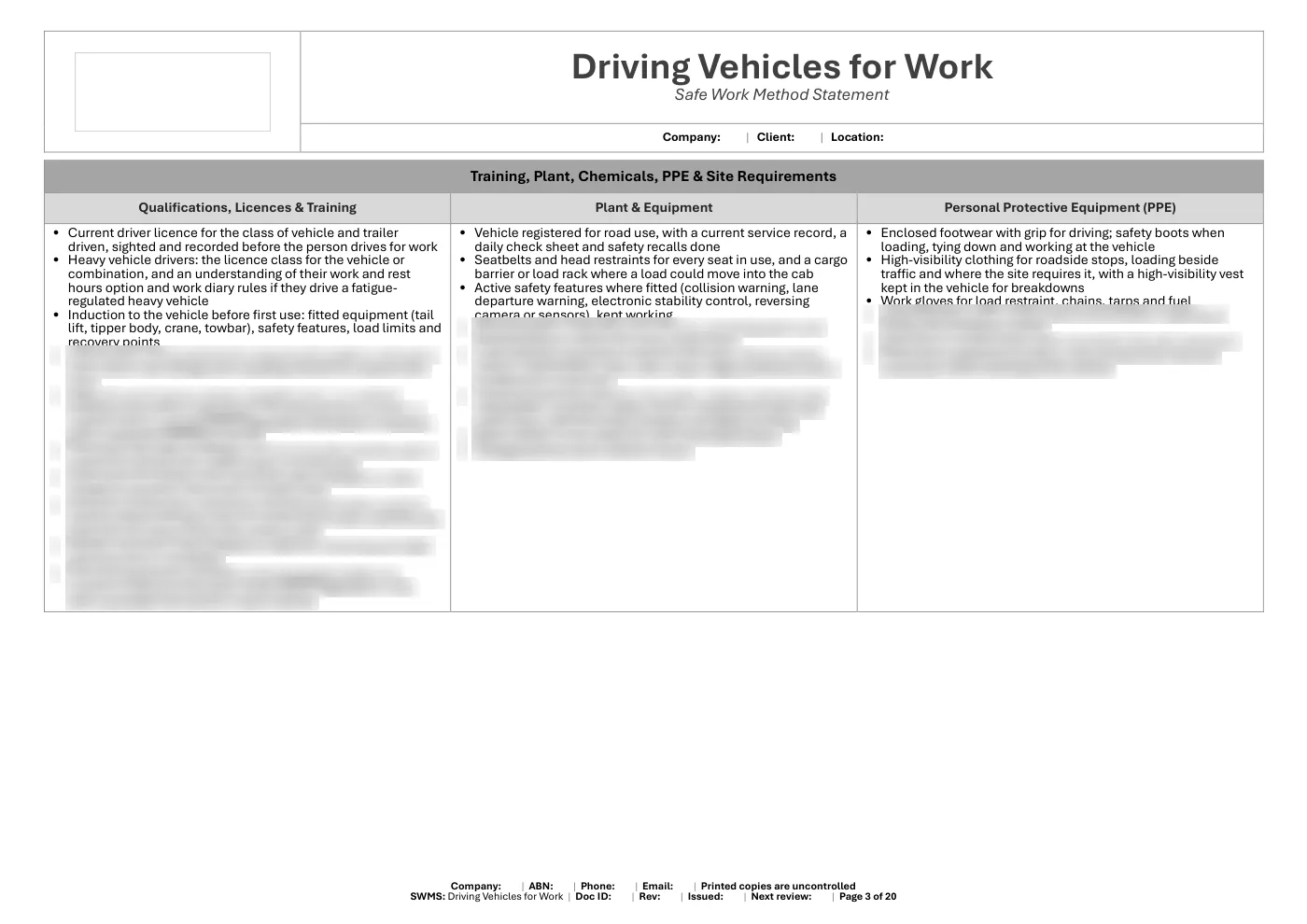
- Current driver licence for the class of vehicle and trailer driven, sighted and recorded before the person drives for work
- Heavy vehicle drivers: the licence class for the vehicle or combination, and an understanding of their work and rest hours option and work diary rules if they drive a fatigue-regulated heavy vehicle
- Induction to the vehicle before first use: fitted equipment (tail lift, tipper body, crane, towbar), safety features, load limits and recovery points
- Instruction in load restraint for anyone who loads or secures a load, and in tow ratings and coupling checks for anyone who tows
- High risk work licence where a forklift truck, or a vehicle loading crane with a capacity of 10 metre tonnes or more, is used to load or unload (WHS Regulation Schedule 3 classes), with a separate SWMS for the lift
- Training in the signs of fatigue, the journey plan and the call-in system for drivers who make long or remote trips
- Instruction for drivers who carry fuel, gas cylinders or other dangerous goods in the tools-of-trade rules
- General construction induction training card (white card) for anyone whose driving is part of construction work, and the site induction for every driver who enters a site
- Spotter trained in hand signals or radio for reversing and tight manoeuvres on worksites
- First aid equipment, facilities and trained first aiders (or access to them) as the work needs (WHS Regulation s 42), with a portable first aid kit in each vehicle
Legislation and Codes of Practice Referenced
- Work Health and Safety Act 2011 (Qld)
- Work Health and Safety Regulation 2011 (Qld)
- Work Health and Safety Act 2011 (Qld): s 8 (a vehicle can be a workplace) and schedule 1 (the Act does not limit the Heavy Vehicle National Law or the Transport Operations (Road Use Management) Act 1995)
- Work Health and Safety Regulation 2011 (Qld): s 48 (remote or isolated work), s 213 (maintenance and inspection) and ss 214 and 215 (powered mobile plant)
- Heavy Vehicle National Law Act 2012 (Qld) (Heavy Vehicle National Law): chain of responsibility (ss 26A to 26E), unsafe vehicles (s 89), mass (s 96), loading (s 111), coupling (s 185) and driver fatigue (ss 223 to 228, 243 and 293)
- Transport Operations (Road Use Management) Act 1995 (Qld): ss 146 and 150 (regulations about driver behaviour, loading and securing loads, and driver testing and licensing)
- Transport Operations (Road Use Management – Road Rules) Regulation 2009 (Qld) and the Queensland driver licensing rules: named generally and not reproduced here
- Transport Operations (Road Use Management – Dangerous Goods) Regulation 2018 (Qld): s 6 (tools of trade)
- Petroleum and Gas (Safety) Regulation 2018 (Qld): ss 140 to 144 (fuel gas cylinders in enclosed vehicles)
- Electrical Safety Act 2002 (Qld)
- Electrical Safety Regulation 2026 (Qld): overhead power line exclusion zones in schedule 2 (raised tipper bodies, cranes and tail lifts)
- Electrical Safety Code of Practice 2020 – Working near overhead and underground electric lines
- Managing Risks of Plant in the Workplace Code of Practice 2021
- Hazardous Manual Tasks Code of Practice 2021
- Managing the Work Environment and Facilities Code of Practice 2021 (remote or isolated work, s 4.2)
- Managing Risks of Hazardous Chemicals in the Workplace Code of Practice 2021
- First Aid in the Workplace Code of Practice 2021
- How to Manage Work Health and Safety Risks Code of Practice 2021
- Safe Work Australia model Code of Practice: Managing the risk of fatigue at work (guidance)
What You Get
- An editable Microsoft Word document (20 pages), laid out on A4 landscape pages
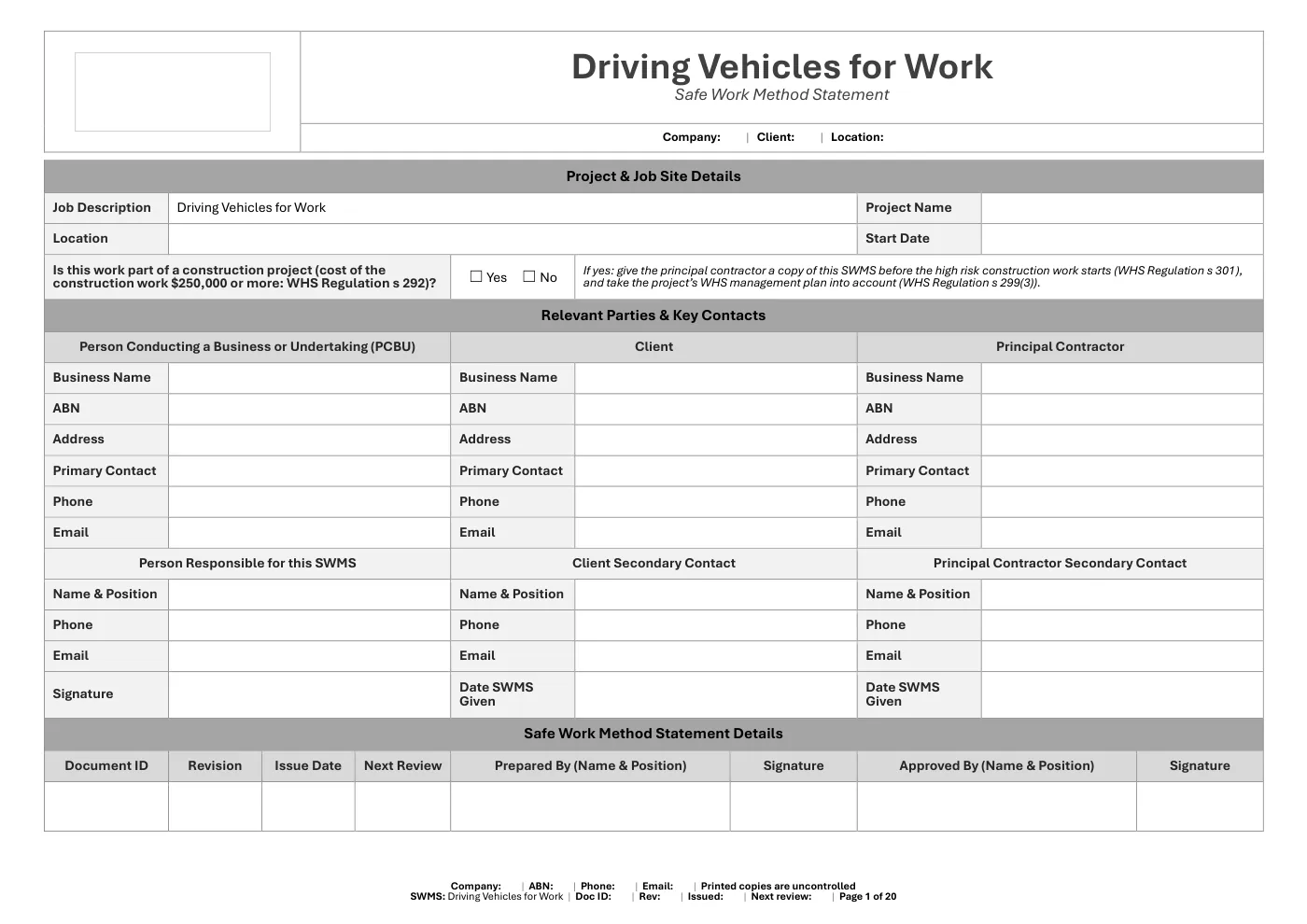
- Business, client, job and document details typed once and filled in on every page, plus a space for your logo
- The high risk construction work checklist, worded as WHS Regulation s 291, and the construction project question (s 292)
- A worker and health and safety representative consultation record
- Qualifications, plant, PPE, hazardous chemicals, safety equipment, permits, references and emergency arrangements filled in for this work
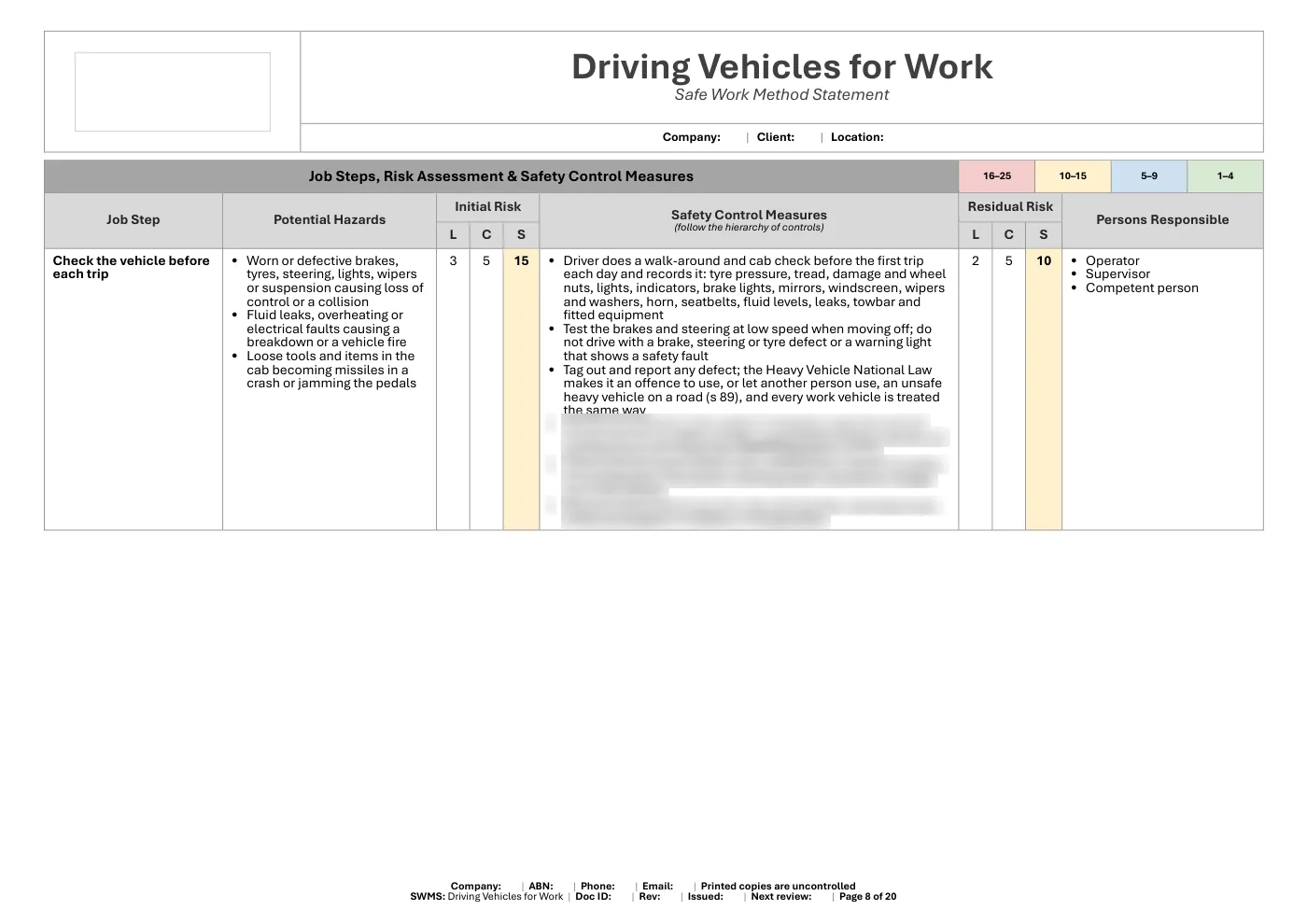
- A 5 x 5 risk matrix, and job steps with initial and residual risk scores and the people responsible
- Implementing, monitoring and review requirements, an additional controls log, revision history and a worker sign-on sheet
Review and adjust it for your site, your plant and the way your crew does the job, and talk it through with your workers before work starts. If you have any trouble downloading this SWMS, you can contact us at any time. Please make sure you read our Disclaimer before downloading this SWMS.
How to use it
From download to site in three steps
Buy and download
Check out with card, Apple Pay or Google Pay. Your download buttons appear straight away and the links are emailed to you.
Make it yours
Open it in Microsoft Word or Excel. Add your logo, business details, site and job information, and adjust it to how the work is done.
Brief your crew
Talk it through with the workers doing the job, have them sign on, and keep it on site. Review it whenever the job or conditions change.
What format is it?
Microsoft Word (registers are Excel). Edit it in Word or Excel, or free in Word and Excel for the web, and add your own logo and business details.
How do I get it after I pay?
Your download buttons appear as soon as checkout finishes, and the links are emailed to you. You can re-download from your account at any time.
Is it compliant with Queensland law?
It's written around Queensland's Work Health and Safety Act 2011 and Regulation 2011. Tailor it to your site, consult your workers and review it whenever conditions change; no template can guarantee compliance on its own.
What if it isn't right for my job?
If it doesn't match its description or has a fault, we'll fix it, and if we can't, we'll refund you (or give you store credit if you'd prefer). Check the sample pages first, as we don't refund a change of mind.
Reviews
Reviews