
Safe Operation of Compressor SWMS
Operating a portable air compressor, air hoses and air tools on Queensland worksites: positioning, power, hose whip, noise, receiver checks and maintenance. An editable Word SWMS template.
RG
Written by Ryan Graham, health and safety professional (16 years on Queensland sites)
$39.99 incl. GST
AUD · one-off purchase · instant download
- Instant download · your links arrive by email straight after checkout and work for 3 months, so save your copy
- Make it yours in minutes · edit in Microsoft Word and add your logo
- Quality guarantee · we'll fix any problem, then refund you or give store credit if you're still not happy
- Secure checkout · card, Apple Pay or Google Pay through Stripe
About this template
For tradespeople, labourers and site crews who run a petrol, diesel or electric air compressor to power air tools. It covers setting up and positioning the unit, connecting power, laying out hoses, running the compressor, compressed air use, shut-down and maintenance.
A SWMS is legally required under the WHS Regulation (s 299) only when the compressor is used as part of high risk construction work, such as work with a fall risk over 2 metres; otherwise this document works as a written safe work procedure or task risk assessment.
New to SWMS? Read What is a safe work method statement?
What is covered in our safe operation of compressor SWMS?
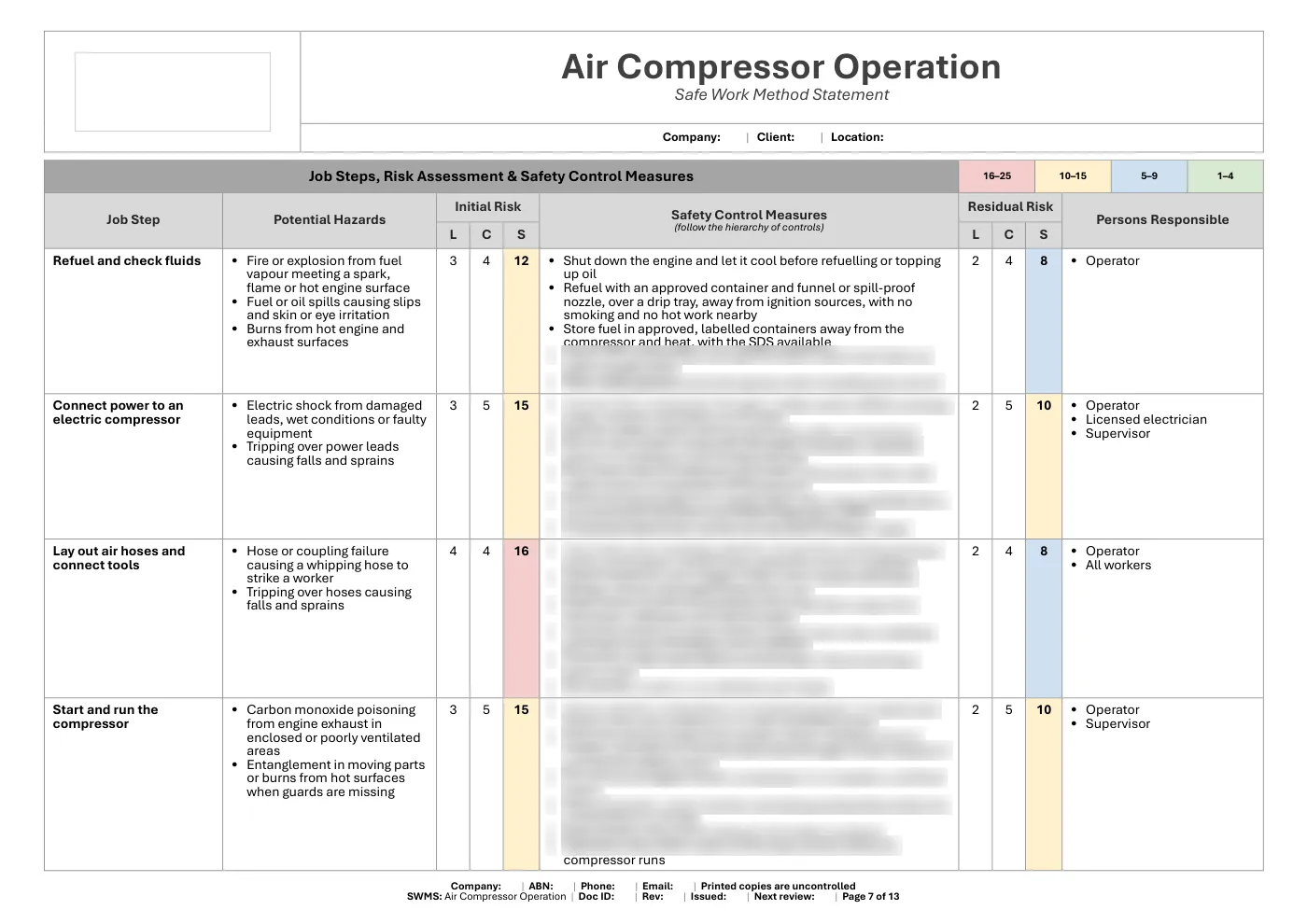
After the standard pre-start checks, the job steps run from “Move and position the compressor” to “Maintenance and repair”. The hazards and controls include:
- Hose whip from a burst hose or coupling
- Compressed air forced into the skin or eyes
- Air receiver failing from over-pressure or corrosion
- Engine exhaust and carbon monoxide
- Electric shock from leads and wet conditions
- Hearing loss from compressor and air tool noise
- Fuel fire and refuelling spills
- Strains and crush injuries moving the compressor
- Trips over hoses and leads
- Stored pressure released during maintenance
- Dust stirred up by air tools and blowing down
High risk construction work
None of the high risk construction work items (WHS Regulation 2011 (Qld) s 291) are pre-ticked, because this job is not high risk construction work by itself. Tick any that apply on your site.
Licences, training and competency
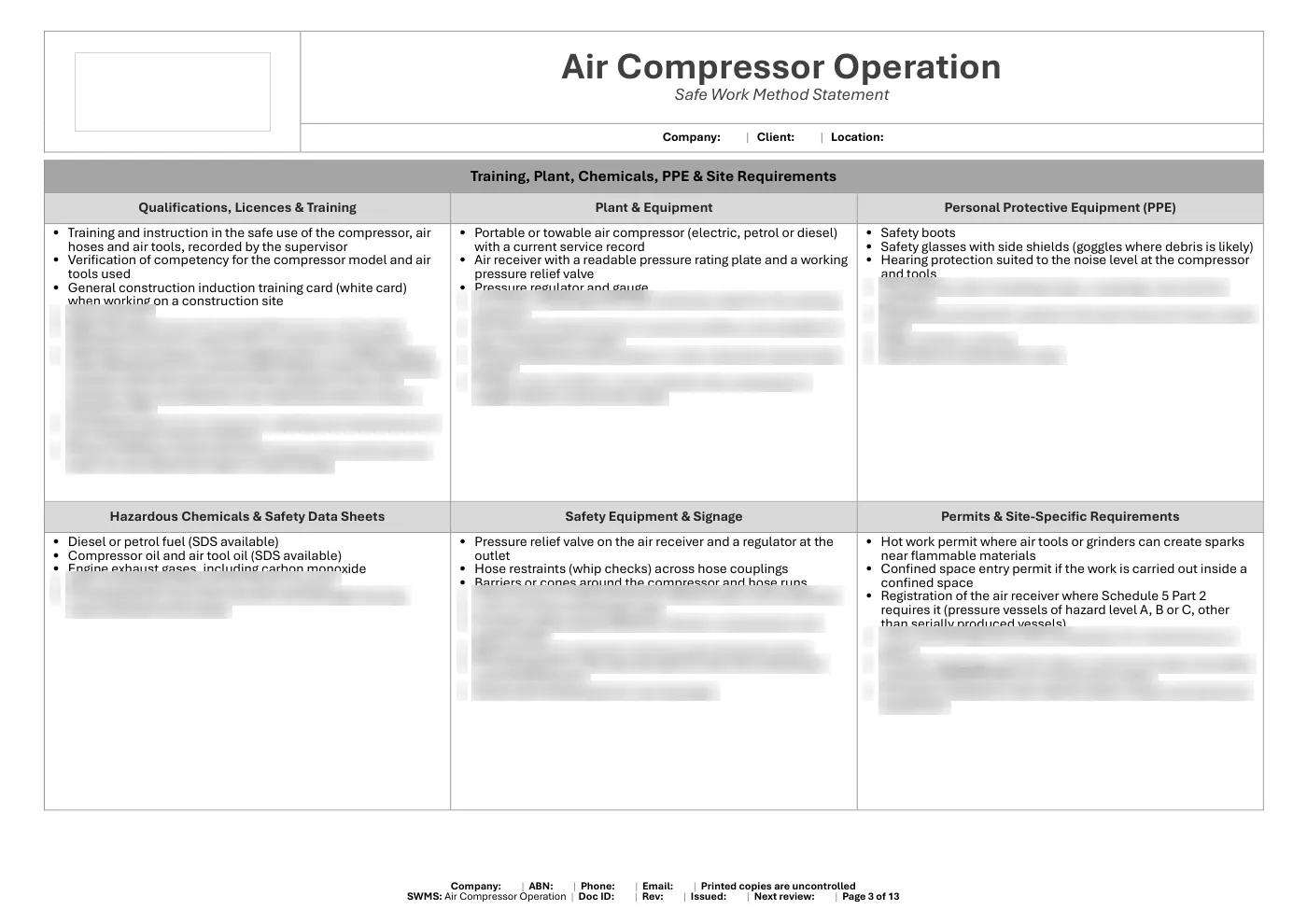
- Training and instruction in the safe use of the compressor, air hoses and air tools, recorded by the supervisor
- Verification of competency for the compressor model and air tools used
- General construction induction training card (white card) when working on a construction site
- Site induction
- High risk work licence for the forklift truck or crane class (Schedule 3) if one is used to lift or move the compressor
- High risk work licence in the dogging class, or a higher rigging class (Schedule 3), for anyone who slings a load or directs the operator when the load is out of the operator’s view; the operator does not sling their own load (only where a load is slung for a lift)
- Competent person for inspection, testing and maintenance of the compressor and air receiver
- Person holding an electrical work licence that authorises the work, for any electrical repair or fault finding
Legislation and codes of practice referenced
- Work Health and Safety Act 2011 (Qld)
- Work Health and Safety Regulation 2011 (Qld)
- Work Health and Safety Regulation 2011 (Qld): ss 36 and 44 (control measures, PPE)
- Work Health and Safety Regulation 2011 (Qld): ss 56 to 58 (noise exposure standard, audiometric testing)
- Work Health and Safety Regulation 2011 (Qld): s 60 (hazardous manual tasks)
- Work Health and Safety Regulation 2011 (Qld): ss 203 to 213 (plant), s 224 (pressure equipment), Schedule 5 (registration)
- Work Health and Safety Regulation 2011 (Qld): s 446 (no compressed air on asbestos)
- Managing Risks of Plant in the Workplace Code of Practice 2021
- Managing Noise and Preventing Hearing Loss at Work Code of Practice 2021
- Hazardous Manual Tasks Code of Practice 2021
- Managing Risks of Hazardous Chemicals in the Workplace Code of Practice 2021
- How to Manage Work Health and Safety Risks Code of Practice 2021
- Confined Spaces Code of Practice 2021
- First Aid in the Workplace Code of Practice 2021
- Work Health and Safety Consultation, Co-operation and Co-ordination Code of Practice 2021
- Electrical Safety Act 2002 (Qld)
- Electrical Safety Regulation 2026 (Qld): ss 10 to 13 and Schedule 2 (overhead lines), ss 17, 18 and 140
- Electrical Safety Code of Practice 2021 – Managing electrical risks in the workplace
- AS 4343:2014 (Pressure equipment: Hazard levels), as named in WHS Regulation Schedule 5
- AS/NZS 3012 Electrical installations – Construction and demolition sites (named in the Electrical Safety Regulation 2026)
What you get
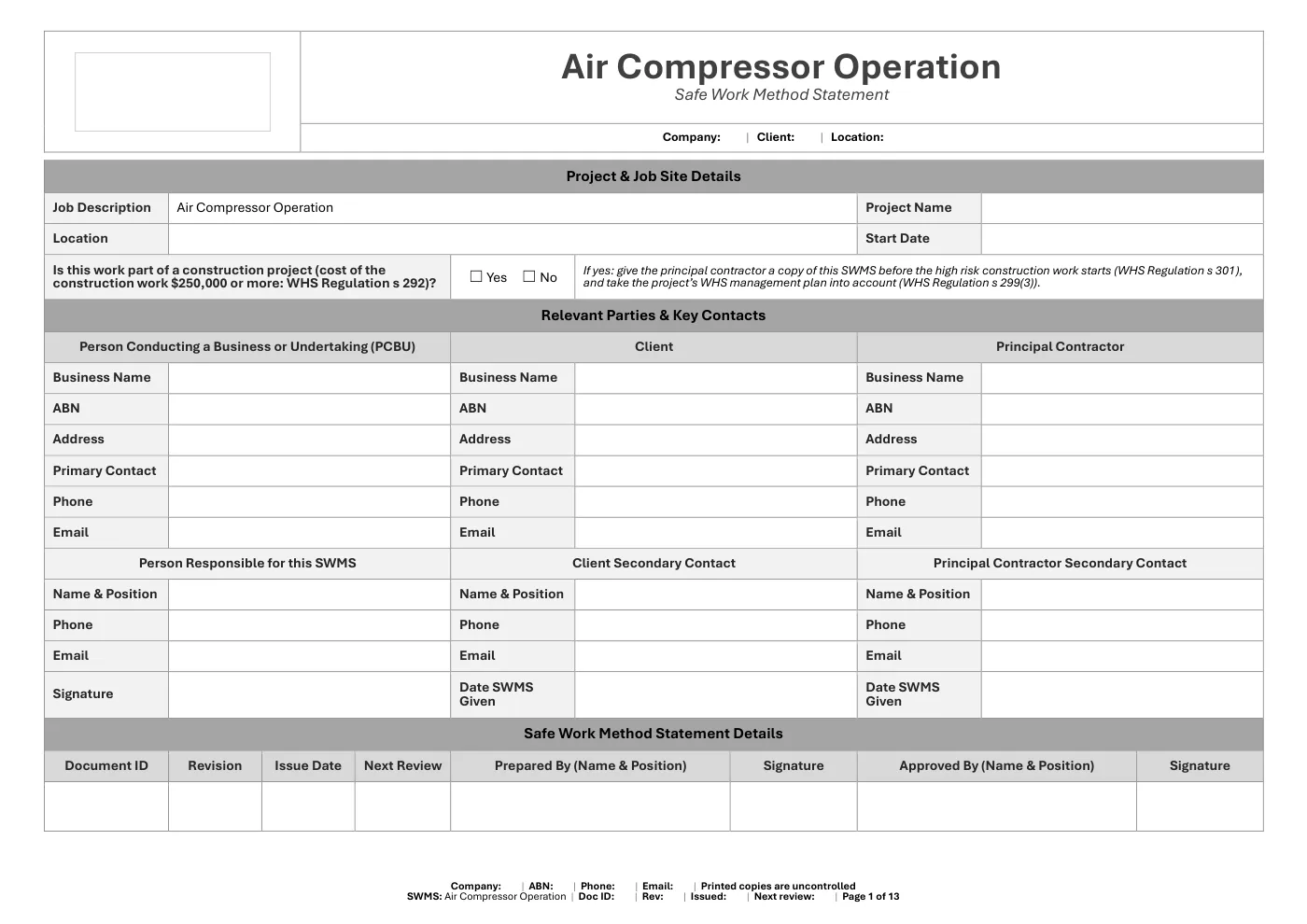
- An editable Microsoft Word document (13 pages), laid out on A4 landscape pages. Type your business, client and job details once and they fill in on every page, with a space for your logo
- 10 job steps for this work, each with its hazards, controls, initial and residual risk scores and the person responsible
- PPE listed for this job: safety boots; safety glasses with side shields (goggles where debris is likely); hearing protection suited to the noise level at the compressor and tools
- Emergency arrangements for: hose or coupling failure, air forced into the skin or a wound and compressor or fuel fire
- Plus the parts every Work Safety QLD SWMS shares, from the s 291 checklist to the worker sign-on sheet (see the layout in our free SWMS template)
Adjust it for your site, plant and crew, and talk it through with your workers before work starts.
Checked against the Queensland laws and codes of practice listed above. Last reviewed November 2026.
Having trouble with your download? Contact us any time. Please read our Disclaimer before downloading.
How to use it
From download to site in three steps
Buy and download
Check out with card, Apple Pay or Google Pay. Your download buttons appear straight away and the links are emailed to you. Links work for 3 months, so save your copies.
Make it yours
Open it in Microsoft Word or Excel. Add your logo, business details, site and job information, and adjust it to how the work is done.
Brief your crew
Talk it through with the workers doing the job, have them sign on, and keep it on site. Review it whenever the job or conditions change.
What format is it?
Microsoft Word. Edit it in Word, or free in Word for the web, and add your own logo and business details.
How do I get it after I pay?
Your download buttons appear as soon as checkout finishes, and the links are emailed to you. You can re-download from your account at any time.
Is it compliant with Queensland law?
It's written around Queensland's Work Health and Safety Act 2011 and Regulation 2011. Tailor it to your site, consult your workers and review it whenever conditions change; no template can guarantee compliance on its own.
What if it isn't right for my job?
If it doesn't match its description or has a fault, tell us and we'll fix it. If you're still not happy, we'll refund you or give you store credit, your choice. Check the sample pages first, as we don't refund a change of mind.
Only logged in customers who have purchased this product may leave a review.
Reviews