Skip to content

Refrigeration and Refrigerant Handling SWMS

Installing, servicing and decommissioning commercial refrigeration in Queensland, covering refrigerant handling, cool rooms, pressure testing and brazing. An editable Word SWMS template for Queensland.

RG

Written by Ryan Graham, health and safety professional (16 years on Queensland sites)

$49.99 incl. GST

AUD · one-off purchase · instant download

  • Instant download · your links arrive by email straight after checkout and work for 3 months, so save your copy
  • Make it yours in minutes · edit in Microsoft Word and add your logo
  • Quality guarantee · we'll fix any problem, then refund you or give store credit if you're still not happy
  • Secure checkout · card, Apple Pay or Google Pay through Stripe

About this template

Suits refrigeration mechanics and contractors who install, service and decommission commercial refrigeration plant, including cool rooms and freezers. It follows the job in order, from identifying the refrigerant and isolating the plant to brazing, pressure testing, charging, recovering refrigerant and handing over. Hot work other than brazing refrigerant pipework needs its own SWMS.

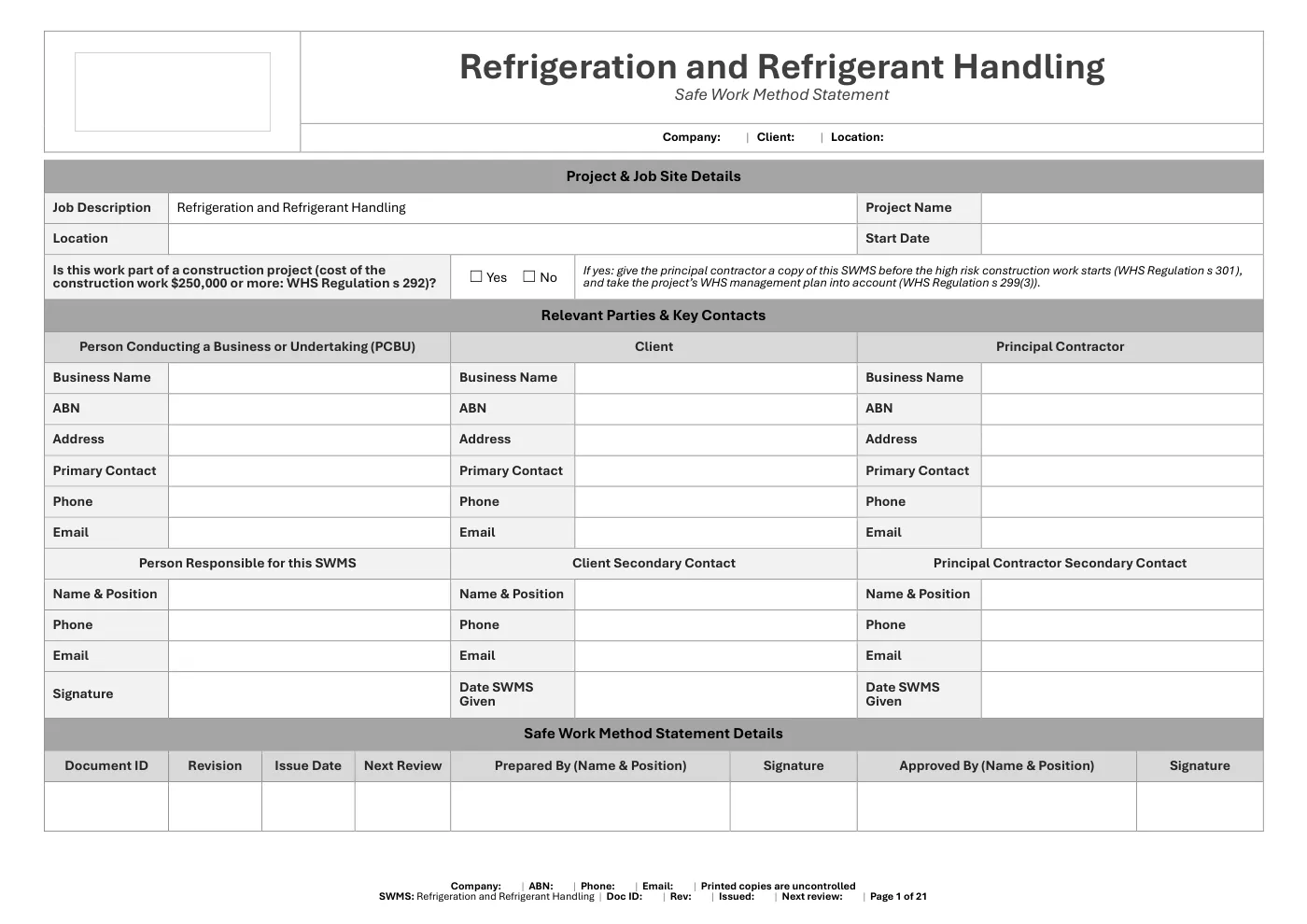
Work on or near refrigerant lines is high risk construction work when it is construction work (WHS Regulation ss 289 and 291(j)), which is the item ticked on the form, and minor testing, maintenance or repair work is not construction work, in which case this document works as a written safe work procedure and task risk assessment; you can also tick artificial extremes of temperature for work inside an operating cool room or freezer, which the Safe Work Australia model code gives as an example (guidance only, not Queensland law), and items such as confined space, energised electrical installations or a flammable atmosphere where the job involves them.

New to SWMS? Read What is a safe work method statement?

What is covered in our refrigeration and refrigerant handling SWMS?

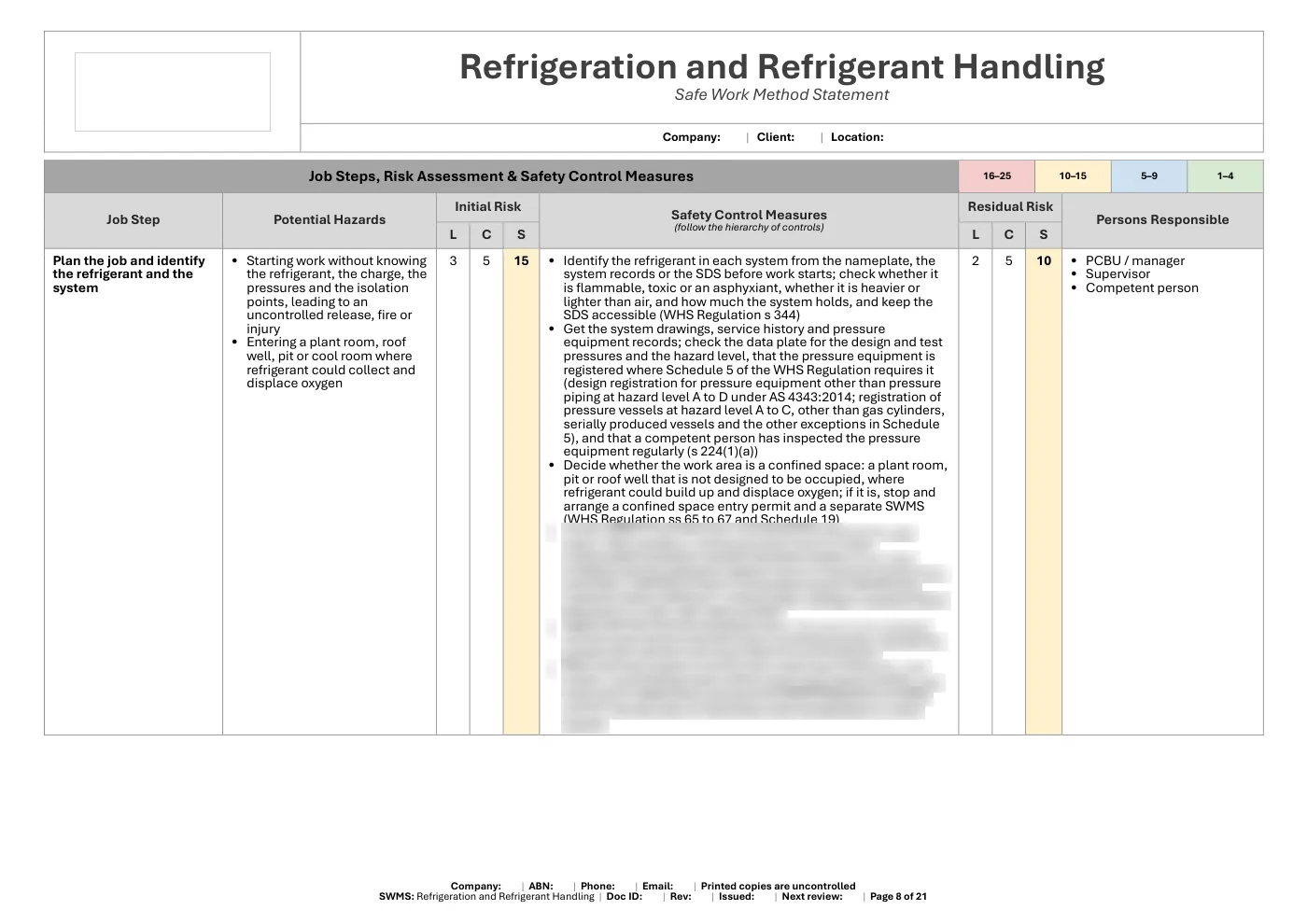
After the standard pre-start checks, the job steps run from “Plan the job and identify the refrigerant and the system” to “Pack up and hand over”. The hazards and controls include:

  • Refrigerant leaks and oxygen displacement
  • Fire and explosion from flammable refrigerants
  • Cold burns from liquid refrigerant
  • Being shut in or chilled in a cool room or freezer
  • Stored pressure and over-pressurised pipework
  • Brazing fire, burns and fumes
  • Electric shock and unexpected equipment start-up
  • Rotating fans and hot or very cold surfaces on a running system
  • Gas cylinder handling and transport
  • Heavy compressors and condensing units
  • Refrigerant building up in plant rooms and pits
  • Overfilled recovery cylinders
  • Releasing refrigerant during decommissioning

High risk construction work

These high risk construction work items (WHS Regulation 2011 (Qld) s 291) are already ticked because they are part of this work. Tick any others that apply to your job:

  • Is carried out on or near chemical, fuel or refrigerant lines

Licences, training and competency

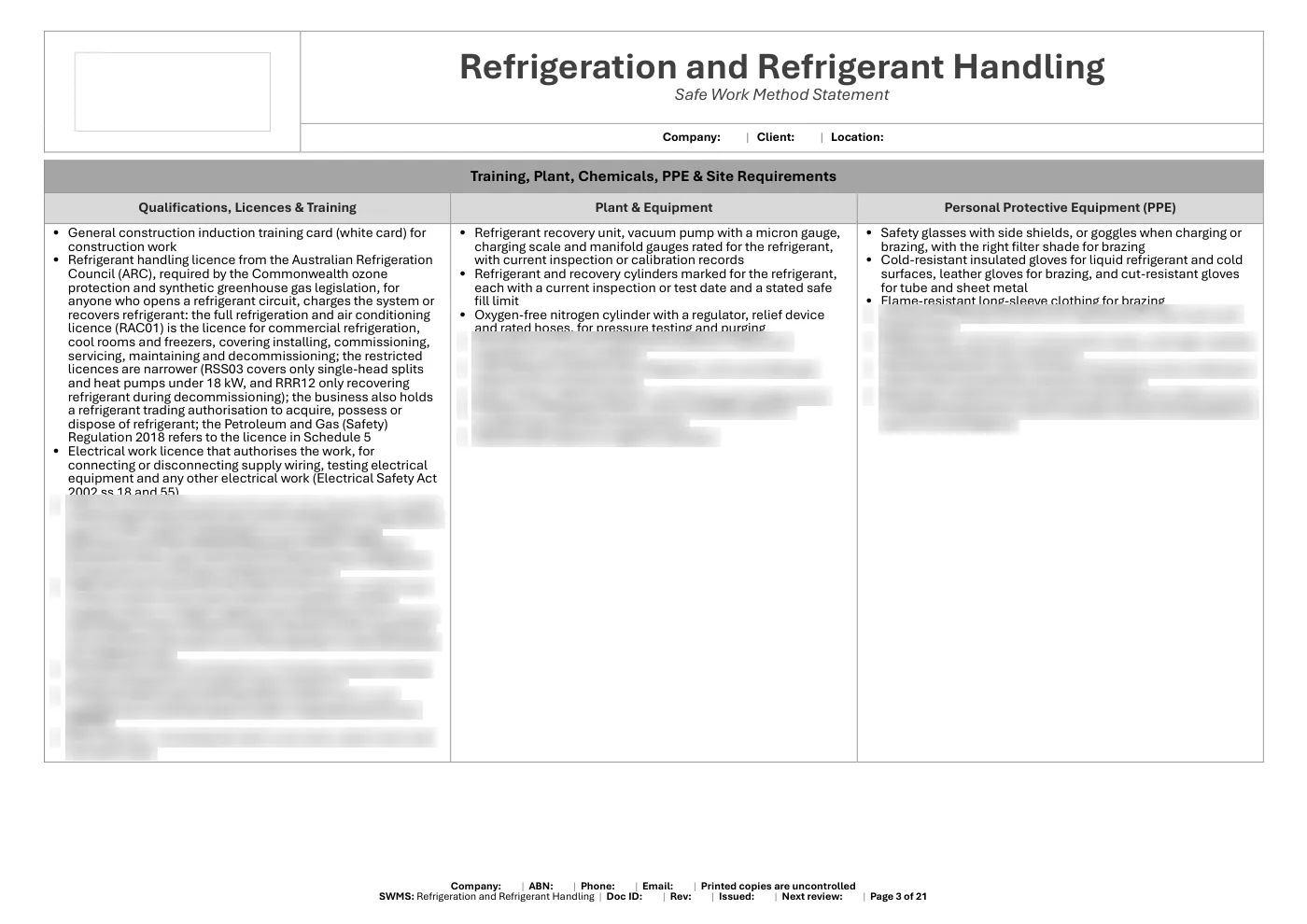
  • General construction induction training card (white card) for construction work
  • Refrigerant handling licence from the Australian Refrigeration Council (ARC), required by the Commonwealth ozone protection and synthetic greenhouse gas legislation, for anyone who opens a refrigerant circuit, charges the system or recovers refrigerant: the full refrigeration and air conditioning licence (RAC01) is the licence for commercial refrigeration, cool rooms and freezers, covering installing, commissioning, servicing, maintaining and decommissioning; the restricted licences are narrower (RSS03 covers only single-head splits and heat pumps under 18 kW, and RRR12 only recovering refrigerant during decommissioning); the business also holds a refrigerant trading authorisation to acquire, possess or dispose of refrigerant; the Petroleum and Gas (Safety) Regulation 2018 refers to the licence in Schedule 5
  • Electrical work licence that authorises the work, for connecting or disconnecting supply wiring, testing electrical equipment and any other electrical work (Electrical Safety Act 2002 ss 18 and 55)
  • Gas work licence that allows the work, for anyone who installs a flammable hydrocarbon gas as the refrigerant in a gas device (type A or B) used for refrigeration or air conditioning (Petroleum and Gas (Safety) Regulation 2018 s 135(2)(a)); Schedule 5 lists a gas work licence (hydrocarbon refrigerant) for gas work on a fuel gas refrigeration device
  • High risk work licence for the class of any crane, forklift truck or hoist used to move plant where one applies, and the dogging class or a higher rigging class (Schedule 3) for anyone who slings a load or directs a plant operator in the movement of a load when the load is out of the operator’s view (Schedule 19, dogging work)
  • Training and verified competency in brazing, pressure testing and the refrigerant and system type worked on
  • Confined space entry training where a plant room or pit qualifies as a confined space (under a separate permit and SWMS)
  • Site induction, including the site’s cool room, plant room and hot work rules

Legislation and codes of practice referenced

  • Work Health and Safety Act 2011 (Qld)
  • Work Health and Safety Regulation 2011 (Qld)
  • Managing Risks of Hazardous Chemicals in the Workplace Code of Practice 2021
  • Managing Risks of Plant in the Workplace Code of Practice 2021
  • Welding Processes Code of Practice 2021 (brazing is an allied process: fire precautions and gas cylinders)
  • Confined Spaces Code of Practice 2021
  • Managing the Work Environment and Facilities Code of Practice 2021
  • Hazardous Manual Tasks Code of Practice 2021
  • First Aid in the Workplace Code of Practice 2021
  • How to Manage Work Health and Safety Risks Code of Practice 2021
  • How to Manage and Control Asbestos in the Workplace Code of Practice 2021 (older buildings)
  • Electrical Safety Act 2002 (Qld)
  • Electrical Safety Regulation 2026 (Qld): working on or near energised electrical equipment (ss 195 to 204)
  • Electrical Safety Code of Practice 2021 – Managing electrical risks in the workplace
  • Petroleum and Gas (Production and Safety) Act 2004 (Qld): gas work licences for gas devices (type A) and fuel gas refrigeration devices (ss 724 to 726)
  • Petroleum and Gas (Safety) Regulation 2018 (Qld): flammable hydrocarbon gas used for refrigeration or air conditioning (ss 134 to 136) and gas work licences (Schedule 5)
  • Transport Operations (Road Use Management – Dangerous Goods) Regulation 2018 (Qld): tools of trade (s 6)
  • Ozone Protection and Synthetic Greenhouse Gas Management Act 1989 (Cth) and Regulations 1995 (Cth): refrigerant handling licences and refrigerant trading authorisations, administered by the Australian Refrigeration Council
  • AS/NZS 5149.2 Refrigerating systems and heat pumps – Safety and environmental requirements, Part 2: Design, construction, testing, marking and documentation (named in the Petroleum and Gas (Safety) Regulation 2018)
  • AS 4343:2014 Pressure equipment – Hazard levels (named in Schedule 5 of the WHS Regulation)
  • AS 1674.1 Safety in welding and allied processes – Fire precautions (named in the Welding Processes Code)

What you get

  • An editable Microsoft Word document (21 pages), laid out on A4 landscape pages. Type your business, client and job details once and they fill in on every page, with a space for your logo
  • 11 job steps for this work, each with its hazards, controls, initial and residual risk scores and the person responsible
  • PPE listed for this job: safety glasses with side shields, or goggles when charging or brazing, with the right filter shade for brazing
  • Emergency arrangements for: refrigerant release in a plant room, pit or cool room, person shut in a cool room or freezer and liquid refrigerant on skin or in the eyes (cold burn)
  • Plus the parts every Work Safety QLD SWMS shares, from the s 291 checklist to the worker sign-on sheet (see the layout in our free SWMS template)

Adjust it for your site, plant and crew, and talk it through with your workers before work starts.

Checked against the Queensland laws and codes of practice listed above. Last reviewed November 2026.

Having trouble with your download? Contact us any time. Please read our Disclaimer before downloading.

How to use it

From download to site in three steps

Buy and download

Check out with card, Apple Pay or Google Pay. Your download buttons appear straight away and the links are emailed to you. Links work for 3 months, so save your copies.

Make it yours

Open it in Microsoft Word or Excel. Add your logo, business details, site and job information, and adjust it to how the work is done.

Brief your crew

Talk it through with the workers doing the job, have them sign on, and keep it on site. Review it whenever the job or conditions change.

FAQ

Before you buy

Something else? Ask us and a real person will reply.

What format is it?

Microsoft Word. Edit it in Word, or free in Word for the web, and add your own logo and business details.

How do I get it after I pay?

Your download buttons appear as soon as checkout finishes, and the links are emailed to you. You can re-download from your account at any time.

Is it compliant with Queensland law?

It's written around Queensland's Work Health and Safety Act 2011 and Regulation 2011. Tailor it to your site, consult your workers and review it whenever conditions change; no template can guarantee compliance on its own.

What if it isn't right for my job?

If it doesn't match its description or has a fault, tell us and we'll fix it. If you're still not happy, we'll refund you or give you store credit, your choice. Check the sample pages first, as we don't refund a change of mind.
Reviews

Be the first to review “Refrigeration and Refrigerant Handling SWMS”

Your email address will not be published. Required fields are marked *

Bought or downloaded this template from us? Leave an honest review, good or bad, and we'll email you a code for a free template of your choice (single templates, not packs). One per order.

More templates like this