For air conditioning and mechanical contractors, electrical contractors and builders who install commercial rooftop package units. It follows the job from the roof survey and site set-up through roof access and edge protection, isolating and removing the old unit, the crane lift, fixing the unit and connecting services, to commissioning and handover. It does not cover split-system and ducted residential installation (the Air Conditioning Installation SWMS covers that) or crane operation (the Franna Crane SWMS (Non-Slewing Crane) and the Slew Crane SWMS cover that).
Falls of more than 2 metres, and the crane and delivery vehicles that move in the work area, are part of every rooftop unit installation, so items 0 and 14 are ticked. Item 10 (WHS Regulation s 291(k)) is not ticked because the licensed electrician isolates and proves the unit dead before connecting the supply; tick it when work is on or near energised switchboards, overhead lines or supply that cannot be isolated. Tick item 9 (s 291(j)) when you connect or work near refrigerant, fuel gas or chemical lines, item 3 if asbestos may be disturbed, and item 13 if the work is beside a road in use.
New to SWMS? Read What Is A Safe Work Method Statement?
What Is Covered In Our Rooftop Air Conditioning Unit Installation SWMS?
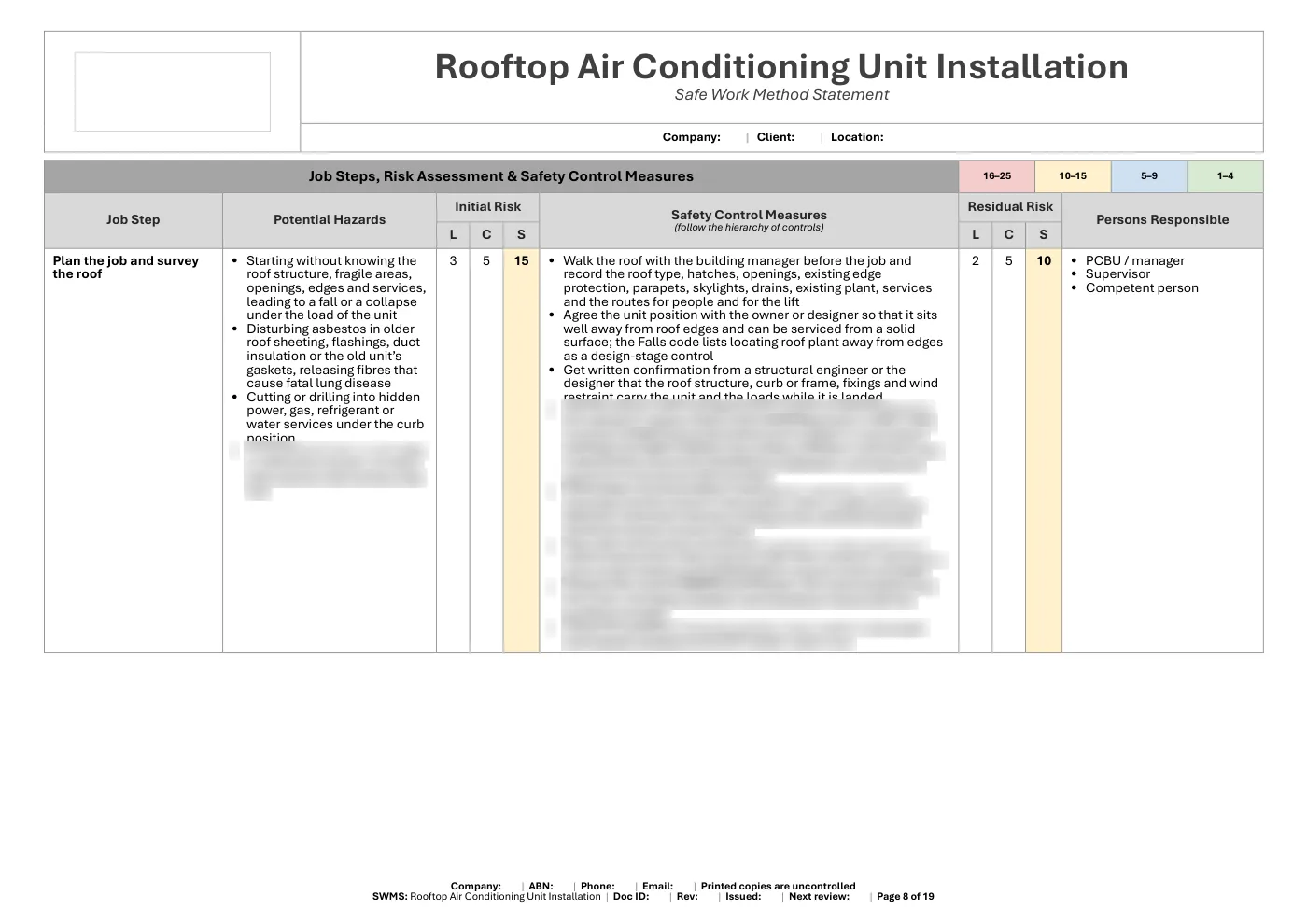
After the standard pre-start checks, the job steps run from “Plan the job and survey the roof” to “Clean up, remove waste and hand over”. The hazards and controls include:
- Falls from roof edges, hatches and ladders
- Falling through fragile sheeting and openings
- Unit dropped or swinging during the crane lift
- Crane contact with overhead power lines
- Crane overturning on weak ground
- Electric shock while isolating and connecting
- Gas and refrigerant releases
- Fire and burns from brazing
- Asbestos in old roofing and units
- Silica dust from cutting and coring
- Crush injuries landing the unit on the curb
- Heat, wind and lightning on the roof
High Risk Construction Work
These high risk construction work items (WHS Regulation 2011 (Qld) s 291) are already ticked because they are part of this work. Tick any others that apply to your job:
- Involves a risk of a person falling more than 2m
- Is carried out in an area at a workplace in which there is any movement of powered mobile plant
Licences, Training and Competency
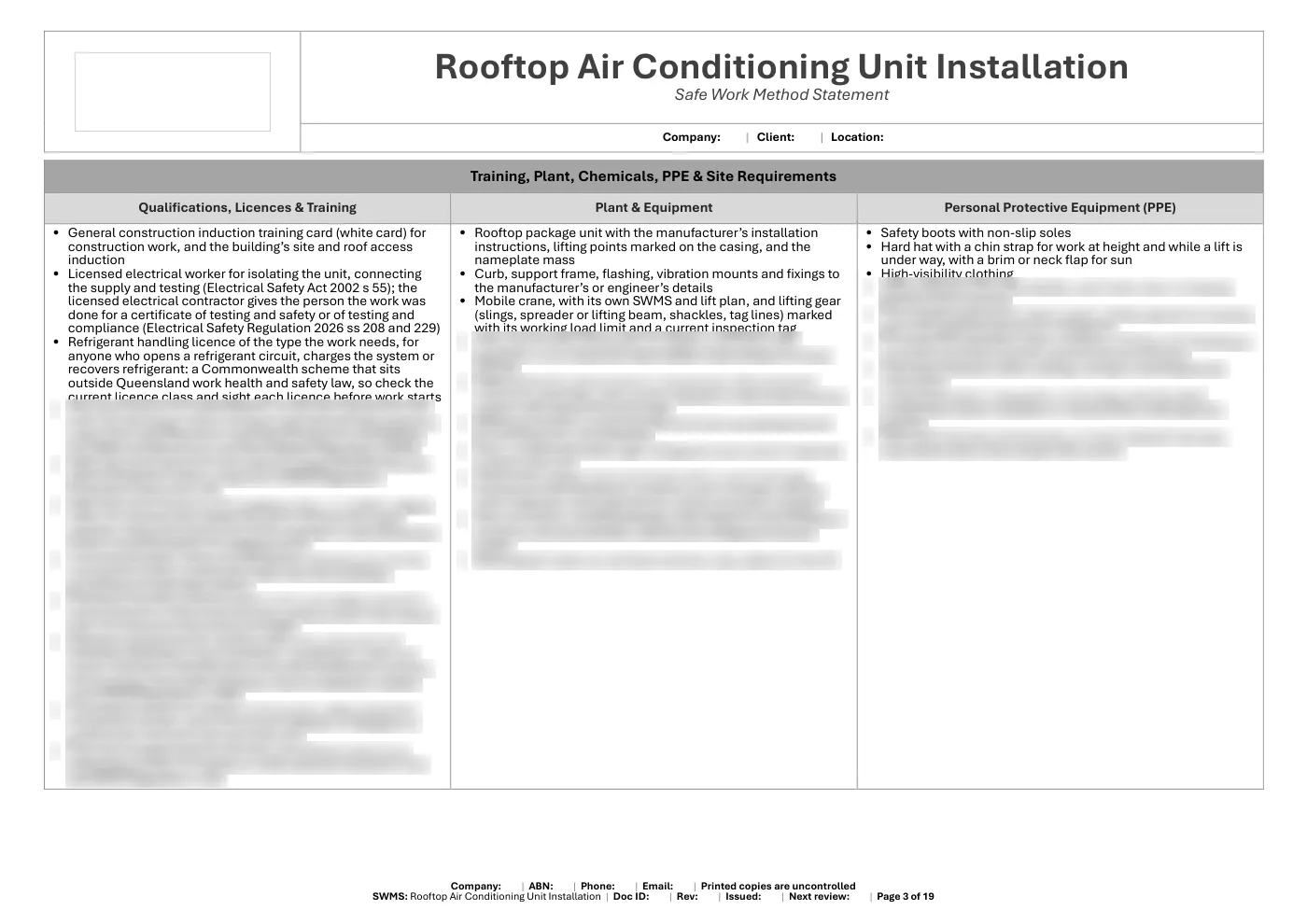
- General construction induction training card (white card) for construction work, and the building’s site and roof access induction
- Licensed electrical worker for isolating the unit, connecting the supply and testing (Electrical Safety Act 2002 s 55); the licensed electrical contractor gives the person the work was done for a certificate of testing and safety or of testing and compliance (Electrical Safety Regulation 2026 ss 208 and 229)
- Refrigerant handling licence of the type the work needs, for anyone who opens a refrigerant circuit, charges the system or recovers refrigerant: a Commonwealth scheme that sits outside Queensland work health and safety law, so check the current licence class and sight each licence before work starts
- Gas work licence or authorisation, as the law requires for the work, for the person who connects and tests the gas supply to a gas-fired unit (Petroleum and Gas (Production and Safety) Act 2004 and Petroleum and Gas (Safety) Regulation 2018)
- High risk work licence for the class of crane that lifts the unit, where Schedule 3 sets a class for it (WHS Regulation Schedule 3 items 8 to 18)
- High risk work licence in the dogging class, or a higher rigging class, for anyone who slings the unit or directs the crane operator when the load is out of the operator’s view (Schedule 3 item 4 and Schedule 19, dogging work)
- Licensed plumber, where plumbing law requires one, for the connection of the condensate drain into the building’s plumbing and drainage system
- Training in the fall controls used on the roof (edge protection, travel restraint or fall arrest harness system) and in the rescue plan, for everyone who works at height
- Asbestos awareness for workers who may meet old roof sheeting, flashing or duct insulation: recognise it, stop and report; training in identification and safe handling for workers the business reasonably believes may do asbestos-related work (WHS Regulation s 445)
- Competent person to inspect roof access, edge protection and anchor points, and a structural engineer or designer to confirm the roof and curb carry the unit
- First aid arrangements for the site, including access to an adequate number of workers or other persons trained in first aid (WHS Regulation s 42)
Legislation and Codes of Practice Referenced
- Work Health and Safety Act 2011 (Qld)
- Work Health and Safety Regulation 2011 (Qld)
- Work Health and Safety Regulation 2011 (Qld) ss 78 to 80 and 306C to 306M: managing the risk of a fall, edge protection, fall protection covers, travel restraint, fall arrest harness systems and ladders
- Work Health and Safety Regulation 2011 (Qld) ss 54 and 55, and ss 315B to 315M where they apply: falling objects, including s 315L (load lifted over an adjoining area) and s 315M (closing an adjoining area)
- Work Health and Safety Regulation 2011 (Qld) s 219, Schedule 3 and Schedule 19: plant that lifts loads, high risk work licences and dogging work
- Work Health and Safety Regulation 2011 (Qld) ss 422, 425, 445, 450 and 451: asbestos identification, register, training and refurbishment
- Work Health and Safety Regulation 2011 (Qld) ss 53 and 355: flammable and combustible substances (including gas cylinders) kept to the lowest practicable quantity, and ignition sources kept out of a hazardous area, for brazing
- Managing the Risk of Falls at Workplaces Code of Practice 2021
- Mobile Crane Code of Practice 2024
- Managing Risks of Plant in the Workplace Code of Practice 2021
- Hazardous Manual Tasks Code of Practice 2021
- Managing Risks of Hazardous Chemicals in the Workplace Code of Practice 2021
- Welding Processes Code of Practice 2021 (brazing is an allied hot work process)
- Managing respirable crystalline silica dust exposure in construction and manufacturing of construction elements Code of Practice 2022
- How to Manage and Control Asbestos in the Workplace Code of Practice 2021
- Managing the Work Environment and Facilities Code of Practice 2021
- First Aid in the Workplace Code of Practice 2021
- How to Manage Work Health and Safety Risks Code of Practice 2021
- Electrical Safety Act 2002 (Qld)
- Electrical Safety Regulation 2026 (Qld): overhead power line exclusion zones (ss 10 to 13 and schedule 2), energised electrical work and isolation (ss 193 to 204), and certificates (ss 208 and 229)
- Electrical Safety Code of Practice 2020 – Working near overhead and underground electric lines (distances come from the 2026 Regulation)
- Petroleum and Gas (Production and Safety) Act 2004 (Qld) and Petroleum and Gas (Safety) Regulation 2018 (Qld): gas work licensing
- Plumbing and Drainage Act 2018 (Qld): ss 56 to 58 (a licence is needed to carry out, supervise or direct plumbing or drainage work, with exemptions that include unregulated work)
- Refrigerant handling licences are a Commonwealth scheme (the Petroleum and Gas (Safety) Regulation 2018 sch 5 s 1 refers to it): outside Queensland law and not held in the library, so check the current Commonwealth requirements
What You Get
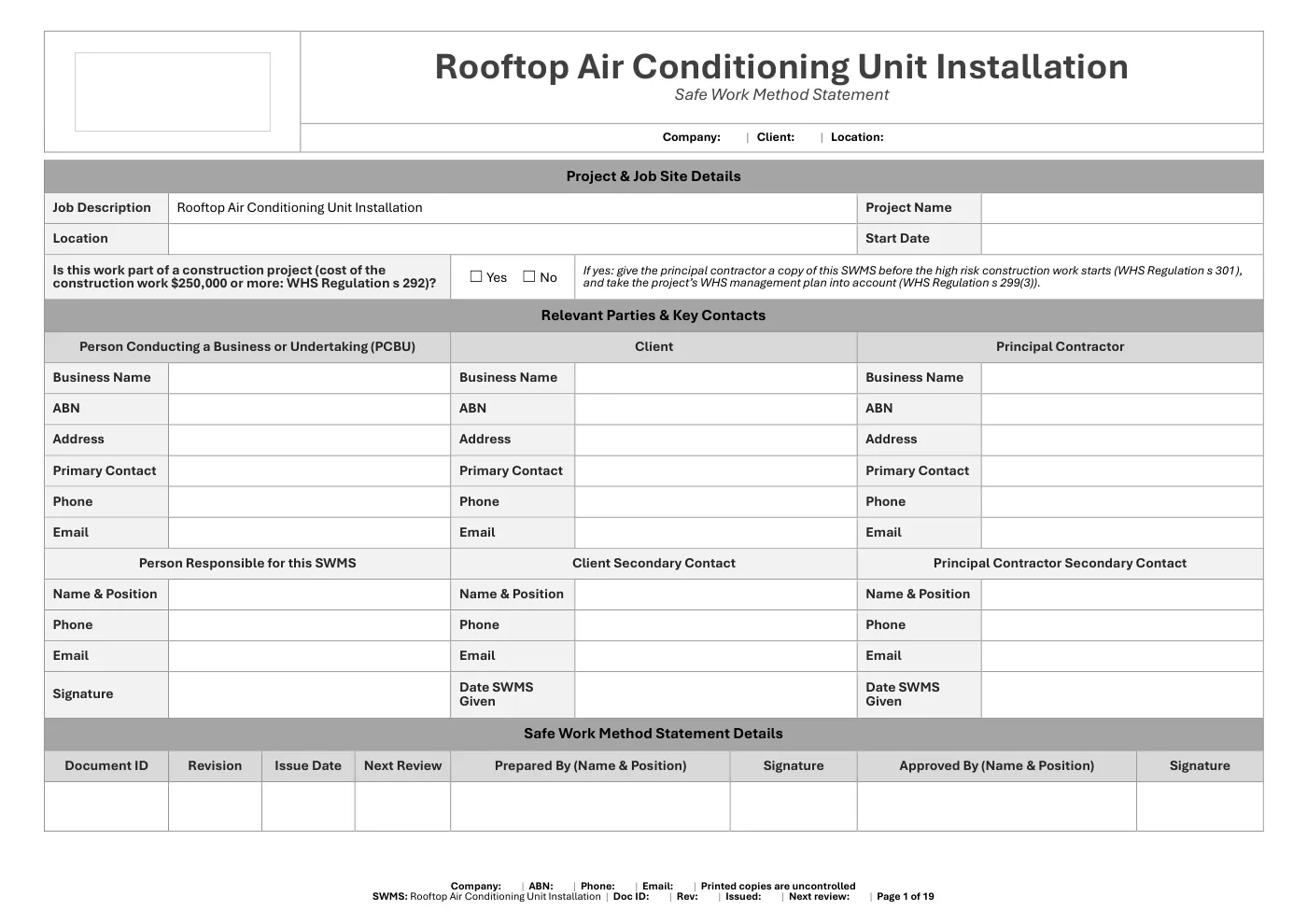
- An editable Microsoft Word document (19 A4 landscape pages). Type your business, client and job details once and they fill in on every page, with a space for your logo
- 11 job steps for this work, each with its hazards, controls, initial and residual risk scores and the person responsible
- PPE listed for this job: safety boots with non-slip soles; hard hat with a chin strap for work at height and while a lift is under way, with a brim or neck flap for sun; high-visibility clothing
- Emergency arrangements for: fall from the roof or a ladder, crane or load contacts a power line and gas smell, refrigerant release or fire at the brazing area
- Plus the parts every Work Safety QLD SWMS shares, from the s 291 checklist to the worker sign-on sheet (see the layout in our free SWMS template)
Adjust it for your site, plant and crew, and talk it through with your workers before work starts. Please make sure you read our Disclaimer before downloading this SWMS.
Checked against the Queensland laws and codes of practice listed above. Last reviewed November 2026.

Reviews