
Powerline Corridor Vegetation Clearing SWMS
Clearing vegetation in power line corridors in Queensland: exclusion zones, authorised persons, safety observers, EWPs and emergency response. An editable Word SWMS template.
RG
Written by Ryan Graham, health and safety professional (16 years on Queensland sites)
$49.99 incl. GST
AUD · one-off purchase · instant download
- Instant download · your links arrive by email straight after checkout and work for 3 months, so save your copy
- Your business name and logo · we fill them into every document for A$29 (free on orders of A$500 or more), or edit it yourself in Microsoft Word
- Quality guarantee · we'll fix any problem, then refund you or give store credit if you're still not happy
- Secure checkout · card, Apple Pay or Google Pay through Stripe
About this template
Suits utility vegetation crews, tree contractors and their supervisors clearing trees and growth around overhead lines. It follows the job from the electricity entity’s requirements and the risk assessment, through zones, safety observers, tree grouping, cutting, EWP work, chipping and the emergency steps for a line contact. Tree felling, chainsaw handling and general work near overhead lines have their own SWMS.
Clearing vegetation to keep a power line clear is treated here as construction work in connection with maintaining a structure (poles, towers and lines, WHS Regulation s 289); that reading is arguable and depends on the job, and the energised electrical services item (item 10) is pre-ticked because the work is always on or near live lines. Tick the falls item (item 0) if anyone works more than 2 m above the ground, for example climbing or in an EWP basket, tick the powered mobile plant item (item 14) if plant moves in the work area, and tick the road in use item if the work is beside a road. If your clearing is not connected to the construction or maintenance of a line, a SWMS is not required by law (WHS Regulation s 299) but still works as a written safe work procedure and risk assessment.
New to SWMS? Read What Is A Safe Work Method Statement?
What Is Covered In Our Powerline Corridor Vegetation Clearing SWMS?
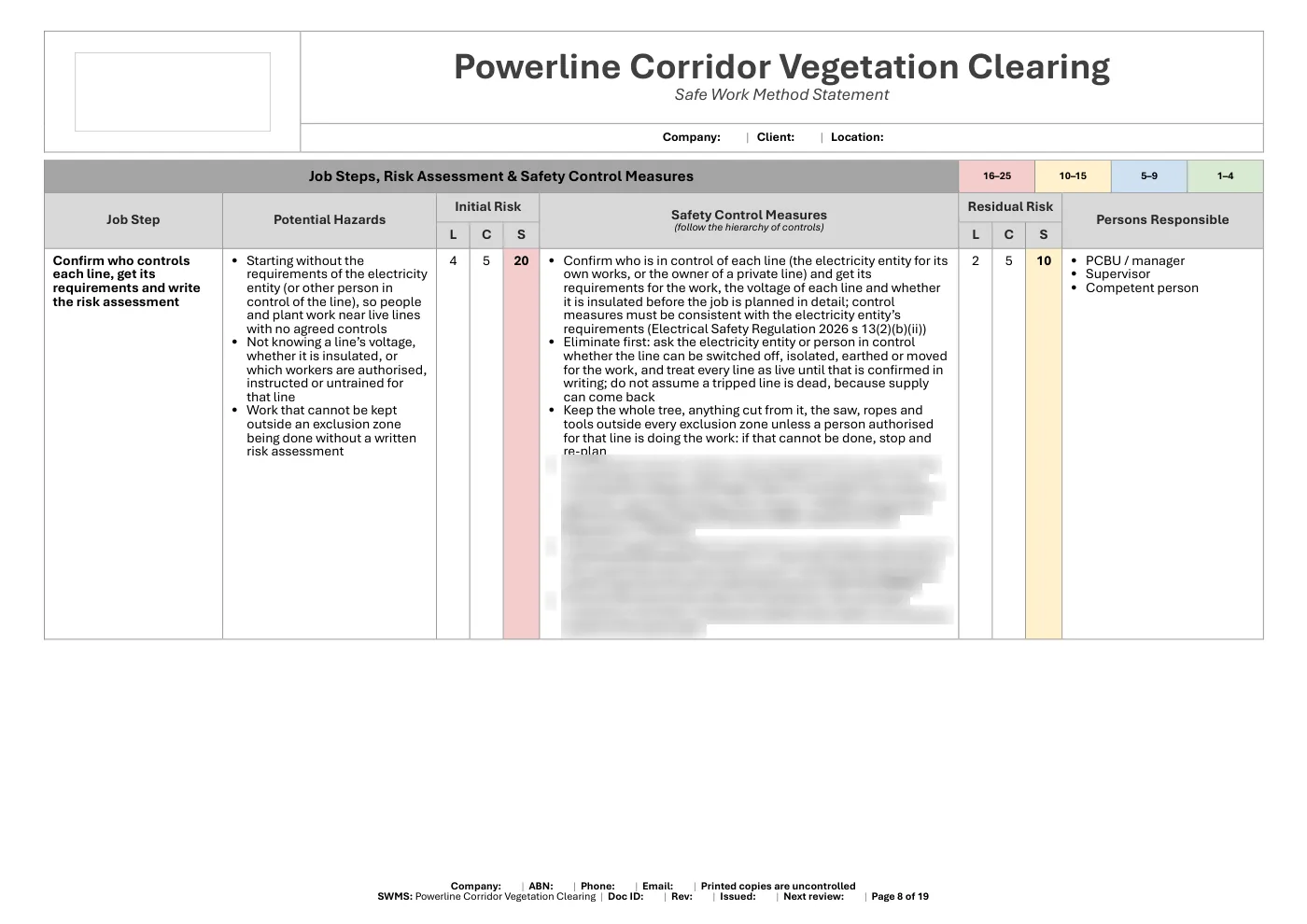
After the standard pre-start checks, the job steps run from “Confirm who controls each line, get its requirements and write the risk assessment” to “Pack up, reinstate and hand the corridor back”. The hazards and controls include:
- Entering an exclusion zone around an overhead line
- Authorised, instructed and untrained persons
- Safety observers for EWPs and plant
- Trees, limbs, saws and ropes near live lines
- Hazard trees and wind moving trees into zones
- Falls from EWP baskets and tree climbing
- Access tracks and plant rollover
- Chipping, mulching and handling cut material
- Fire, heat, wildlife and remote work
- Line contact and fallen line emergency response
High Risk Construction Work
These high risk construction work items (WHS Regulation 2011 (Qld) s 291) are already ticked because they are part of this work. Tick any others that apply to your job:
- Is carried out on or near energised electrical installations or services
Licences, Training and Competency
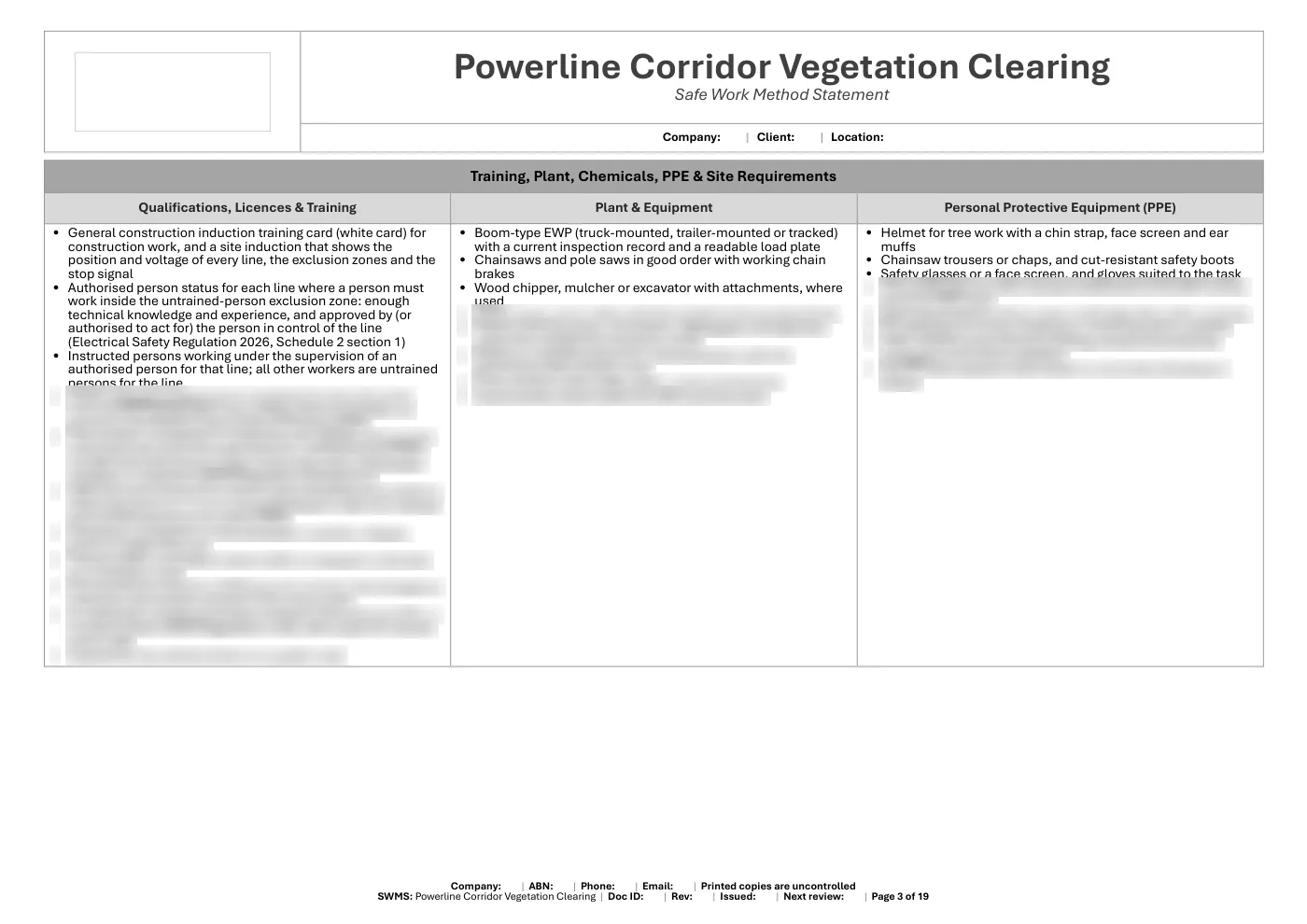
- General construction induction training card (white card) for construction work, and a site induction that shows the position and voltage of every line, the exclusion zones and the stop signal
- Authorised person status for each line where a person must work inside the untrained-person exclusion zone: enough technical knowledge and experience, and approved by (or authorised to act for) the person in control of the line (Electrical Safety Regulation 2026, Schedule 2 section 1)
- Instructed persons working under the supervision of an authorised person for that line; all other workers are untrained persons for the line
- Safety observers trained and competent for the role (units such as RIIRTM203E Work as a safety observer/spotter, as named in the Mobile Crane Code of Practice 2024)
- Tree workers competent in chainsaw use, felling, rope access and aerial rescue for the tasks they do, verified by the PCBU; no high risk work licence class covers tree work, chainsaws, chippers or mulchers (WHS Regulation Schedule 3)
- High risk work licence for a boom-type elevating work platform where the boom is 11 m or more (Schedule 3, item 21); trained and verified operators for other EWPs
- Operators competent on the excavator, mulcher, chipper, truck or loader they use
- Trained traffic controllers where traffic is stopped or directed on or beside a road
- Ground person trained in EWP ground controls and emergency lowering, and workers trained in the rescue plan
- An adequate number of workers trained in first aid and CPR, or access to them (WHS Regulation s 42), with a plan for remote work (s 48)
- Licence for any vehicle driven on a public road
Legislation and Codes of Practice Referenced
- Work Health and Safety Act 2011 (Qld)
- Work Health and Safety Regulation 2011 (Qld)
- Electrical Safety Act 2002 (Qld)
- Electrical Safety Regulation 2026 (Qld): ss 10 to 13 and schedule 2 (exclusion zones for overhead electric lines)
- Electrical Safety Regulation 2026 (Qld): s 23 (trimming of trees near a private overhead line) and s 265 (trimming of trees near an overhead line of an electricity entity)
- Electrical Safety Regulation 2026 (Qld): ss 14 and 15 (underground electric lines)
- Electrical Safety Regulation 2026 (Qld): ss 292 and 296 (serious electrical incidents and dangerous electrical events)
- Electrical Safety Code of Practice 2020 – Working near overhead and underground electric lines (chapter 6, clearing vegetation near overhead electric lines; distances come from the 2026 Regulation)
- Electrical Safety Code of Practice 2021 – Managing electrical risks in the workplace
- Forest Harvesting Code of Practice 2007 (felling, hung-up trees and power lines; written for forest harvesting and used here as good practice)
- Managing Risks of Plant in the Workplace Code of Practice 2021
- Managing the Risk of Falls at Workplaces Code of Practice 2021
- Hazardous Manual Tasks Code of Practice 2021
- Managing Noise and Preventing Hearing Loss at Work Code of Practice 2021
- Managing the Work Environment and Facilities Code of Practice 2021
- Managing Risks of Hazardous Chemicals in the Workplace Code of Practice 2021
- Traffic Management for Construction or Maintenance Work Code of Practice 2008
- First Aid in the Workplace Code of Practice 2021
- How to Manage Work Health and Safety Risks Code of Practice 2021
- Mobile Crane Code of Practice 2024 (safety observer training named in section 9.1.2)
- Safe Work Australia model Code of Practice: Elevating work platforms (guidance)
- Safe Work Australia model Code of Practice: Managing the risks of biological hazards at work (guidance)
- Safe Work Australia model Code of Practice: Managing the risk of fatigue at work (guidance)
What You Get
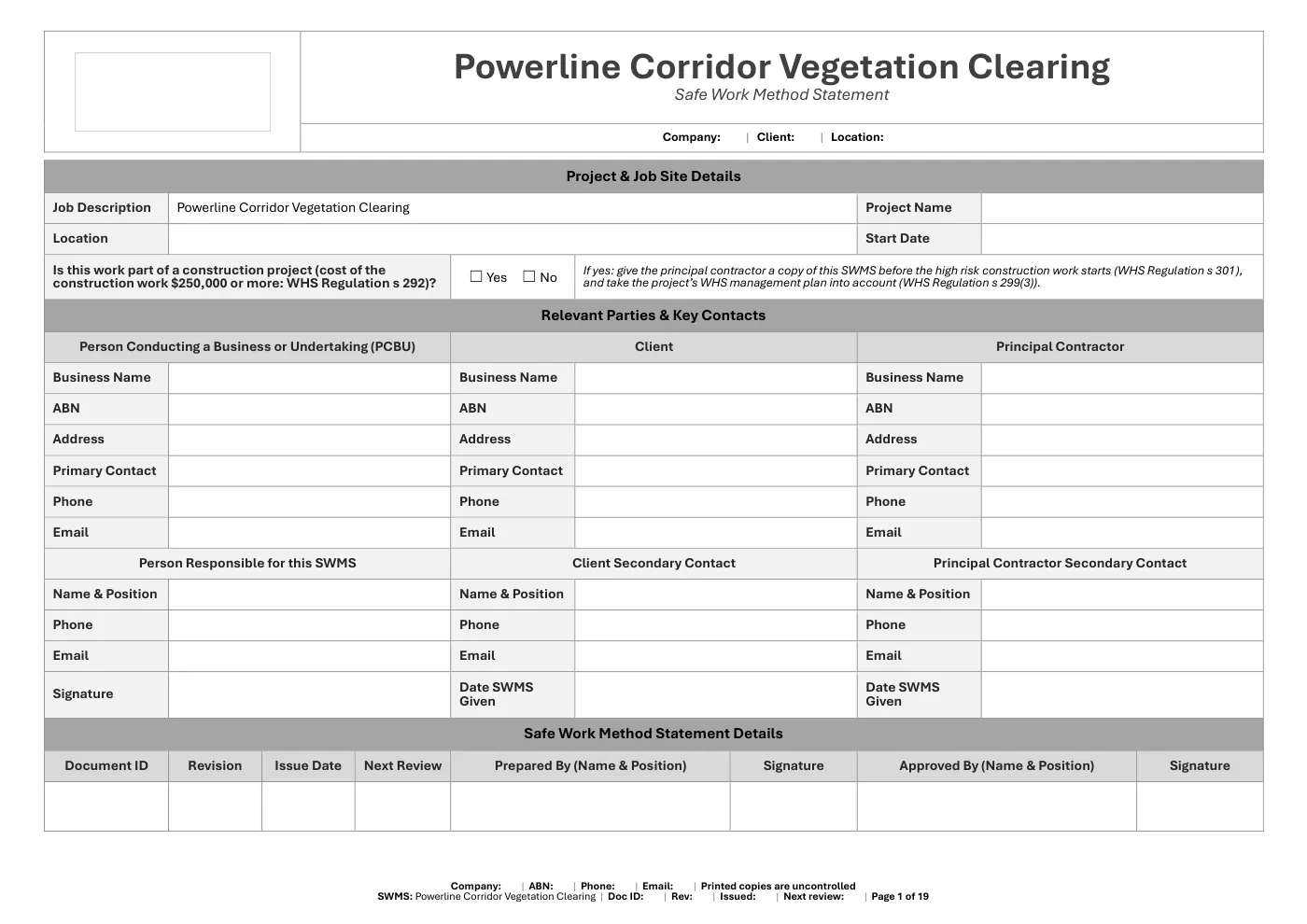
- An editable Microsoft Word document (19 A4 landscape pages). Type your business, client and job details once and they fill in on every page, with a space for your logo
- 11 job steps for this work, each with its hazards, controls, initial and residual risk scores and the person responsible
- PPE listed for this job: helmet for tree work with a chin strap, face screen and ear muffs; chainsaw trousers or chaps, and cut-resistant safety boots; safety glasses or a face screen, and gloves suited to the task
- Emergency arrangements for: plant, tree, limb or person touches or comes near a line, fallen or damaged line and climber or EWP worker injured or stuck aloft
- Plus the parts every Work Safety QLD SWMS shares, from the s 291 checklist to the worker sign-on sheet (see the layout in our free SWMS template)
Adjust it for your site, plant and crew, and talk it through with your workers before work starts. Please make sure you read our Disclaimer before downloading this SWMS.
Checked against the Queensland laws and codes of practice listed above. Last reviewed November 2026.
Having trouble with your download? Contact us any time. Please read our Disclaimer before downloading.
How to use it
From download to site in three steps
Buy and download
Check out with card, Apple Pay or Google Pay. Your download buttons appear straight away and the links are emailed to you. Links work for 3 months, so save your copies.
Make it yours
Add your logo and business details in Word or Excel, or tick branding at checkout (A$29) and we add them. Then add your site and job details.
Brief your crew
Talk it through with the workers doing the job, have them sign on, and keep it on site. Review it whenever the job or conditions change.
What format is it?
Microsoft Word. Edit it in Word, or free in Word for the web, and add your own logo and business details. Or let us do it: tick "Add my business name and logo to every document" at checkout (A$29, free on orders of A$500 or more) and fill in a short form after payment.
How do I get it after I pay?
Your download buttons appear as soon as checkout finishes, and the links are emailed to you. You can re-download from your account at any time.
Is it compliant with Queensland law?
It's written around Queensland's Work Health and Safety Act 2011 and Regulation 2011. Tailor it to your site, consult your workers and review it whenever conditions change; no template can guarantee compliance on its own.
What if it isn't right for my job?
If it doesn't match its description or has a fault, tell us and we'll fix it. If you're still not happy, we'll refund you or give you store credit, your choice. Check the sample pages first, as we don't refund a change of mind.
Only logged in customers who have purchased this product may leave a review.
Reviews