Skip to content

Storm Damage Tree Clearing SWMS

Clearing storm-damaged trees in Queensland: trees under tension, hung-up trees, power lines, unstable ground, traffic and emergency response. An editable Word SWMS template.

RG

Written by Ryan Graham, health and safety professional (16 years on Queensland sites)

$39.99 incl. GST

AUD · one-off purchase · instant download

  • Instant download · your links arrive by email straight after checkout and work for 3 months, so save your copy
  • Make it yours in minutes · edit in Microsoft Word and add your logo
  • Quality guarantee · we'll fix any problem, then refund you or give store credit if you're still not happy
  • Secure checkout · card, Apple Pay or Google Pay through Stripe

About this template

Suits arborists, tree crews, landscapers and property maintenance teams who clear fallen and damaged trees after storms and cyclones. It follows the work from assessing the ground and structures, through downed power lines, work zones and traffic, hung-up and leaning trees and the release of trees under tension, to cutting up, removing timber and handing the site back. Roof make-safe, climbing, elevated work platforms and crane-assisted removal need their own SWMS.

Clearing storm-damaged trees is not high risk construction work by itself. A SWMS is legally required under WHS Regulation s 299 only for high risk construction work, such as clearing that is part of repairing a structure or preparing a site. If that applies, tick the items that fit your job: work on or near energised electrical installations or services such as downed lines, work beside a road in use, a fall of more than 2 metres, or movement of powered mobile plant. Otherwise it works as a written safe work procedure and task risk assessment.

New to SWMS? Read What Is A Safe Work Method Statement?

What Is Covered In Our Storm Damage Tree Clearing SWMS?

After the standard pre-start checks, the job steps run from “Assess the site, ground, damaged structures and weather before any cut” to “Make the site safe and hand it back”. The hazards and controls include:

  • Contact with fallen and tangled power lines
  • Trees and limbs under tension springing back
  • Root plates dropping back into the hole
  • Hung-up trees releasing without warning
  • Dead limbs and dry stags falling during cuts
  • Unstable and flooded ground
  • Damaged structures shifting when load is cut away
  • Traffic and the public near blocked roads
  • Chainsaw kickback and pinched bars
  • Logs rolling and plant moving timber
  • Floodwater, mould and sharp debris
  • Heat, noise and fatigue on long recovery shifts
  • Injured worker unable to call for help

High Risk Construction Work

None of the high risk construction work items (WHS Regulation 2011 (Qld) s 291) are pre-ticked, because this job is not high risk construction work by itself. Tick any that apply on your site.

Licences, Training and Competency

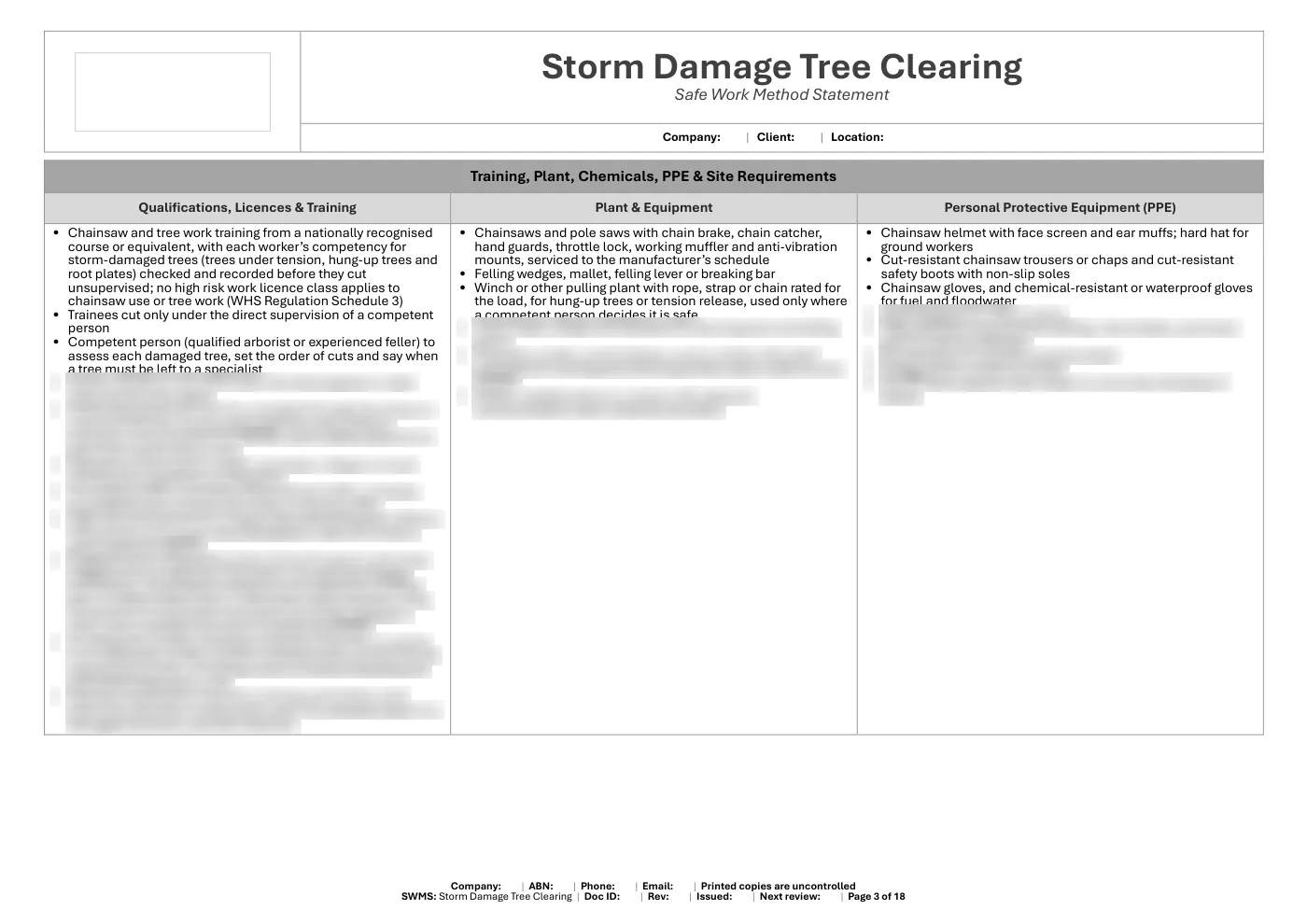
  • Chainsaw and tree work training from a nationally recognised course or equivalent, with each worker’s competency for storm-damaged trees (trees under tension, hung-up trees and root plates) checked and recorded before they cut unsupervised; no high risk work licence class applies to chainsaw use or tree work (WHS Regulation Schedule 3)
  • Trainees cut only under the direct supervision of a competent person
  • Competent person (qualified arborist or experienced feller) to assess each damaged tree, set the order of cuts and say when a tree must be left to a specialist
  • Spotter briefed on the work zone, the hand signals or radio calls and the stop signal
  • Authorised person for the line, arranged through the person in control of the line, for any work that has to go inside an exclusion zone (outside this SWMS), and a safety observer for plant that could enter a zone
  • Operators of any winch, loader, excavator, chipper or truck trained and competent on that plant
  • Accredited traffic controllers (Queensland traffic controller accreditation) for anyone who stops or directs traffic
  • High risk work licence for a boom-type elevating work platform with a boom of 11 m or more (Schedule 3, item 21) if one is used (separate SWMS)
  • Dogging licence (Schedule 3 item 4) for the person who does dogging work as defined in Schedule 19: applying slinging techniques, including the selection and inspection of lifting gear, to safely sling a load, or directing a plant operator in the movement of a load when the load is out of the operator’s view; crane-assisted removal is outside this SWMS
  • An adequate number of workers trained in first aid, or access to an adequate number of other trained people, as the first aid assessment shows, including control of severe bleeding and CPR (WHS Regulation s 42)
  • General construction induction training card (white card) when the clearing is construction work, for example repair of a damaged structure, and site induction

Legislation and Codes of Practice Referenced

  • Work Health and Safety Act 2011 (Qld)
  • Work Health and Safety Regulation 2011 (Qld)
  • Forest Harvesting Code of Practice 2007 (felling zone, hung-up trees and chainsaw features; written for forest harvesting and used here as good practice for tree work)
  • How to Manage Work Health and Safety Risks Code of Practice 2021
  • Managing Risks of Plant in the Workplace Code of Practice 2021
  • Hazardous Manual Tasks Code of Practice 2021
  • Managing Noise and Preventing Hearing Loss at Work Code of Practice 2021
  • Managing the Work Environment and Facilities Code of Practice 2021 (heat, UV and remote or isolated work)
  • First Aid in the Workplace Code of Practice 2021
  • Managing Risks of Hazardous Chemicals in the Workplace Code of Practice 2021
  • Traffic Management for Construction or Maintenance Work Code of Practice 2008 (work beside a road)
  • Electrical Safety Act 2002 (Qld)
  • Electrical Safety Regulation 2026 (Qld): overhead power line exclusion zones (ss 10 to 13 and schedule 2)
  • Electrical Safety Regulation 2026 (Qld): s 23 (trimming of trees near a private overhead line), s 265 (trimming of trees near an overhead line of an electricity entity), s 292 (serious electrical incidents and dangerous electrical events) and s 296 (preserving the site)
  • Electrical Safety Code of Practice 2020 – Working near overhead and underground electric lines (chapter 6, clearing vegetation near lines; distances come from the 2026 Regulation)
  • Transport Operations (Road Use Management – Accreditation and Other Provisions) Regulation 2015 (Qld): traffic controllers
  • AS 2727 Chainsaws – Guide to safe working practices, and AS 2726 Chainsaws – Safety requirements – Part 1: Chainsaws for general use (both named in the Forest Harvesting Code of Practice 2007)
  • Safe Work Australia model Code of Practice: Managing the risks of biological hazards at work (model code, not approved in Queensland; guidance only)
  • Safe Work Australia model Code of Practice: Managing the risk of fatigue at work (model code, not approved in Queensland; guidance only)

What You Get

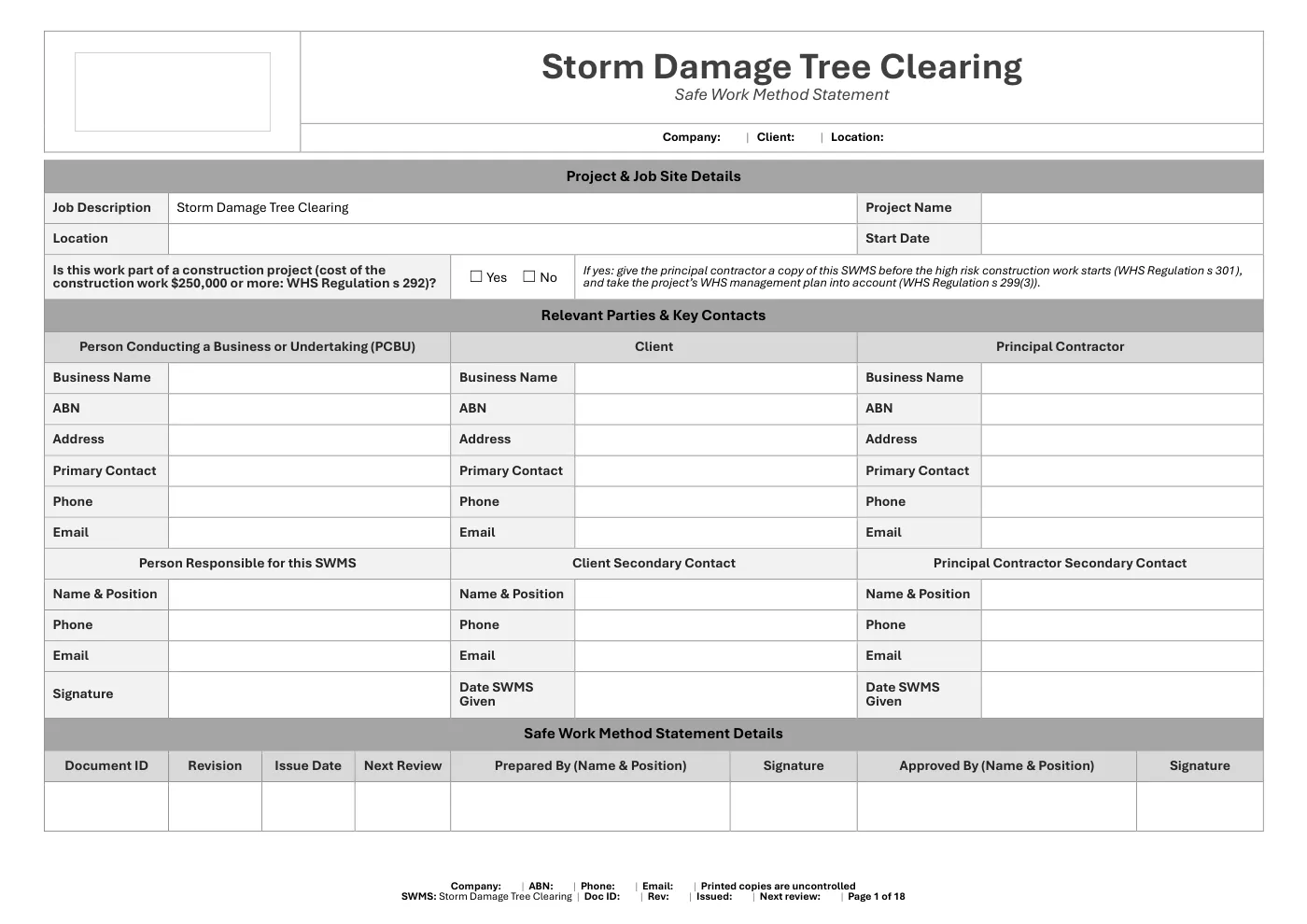
  • An editable Microsoft Word document (18 A4 landscape pages). Type your business, client and job details once and they fill in on every page, with a space for your logo
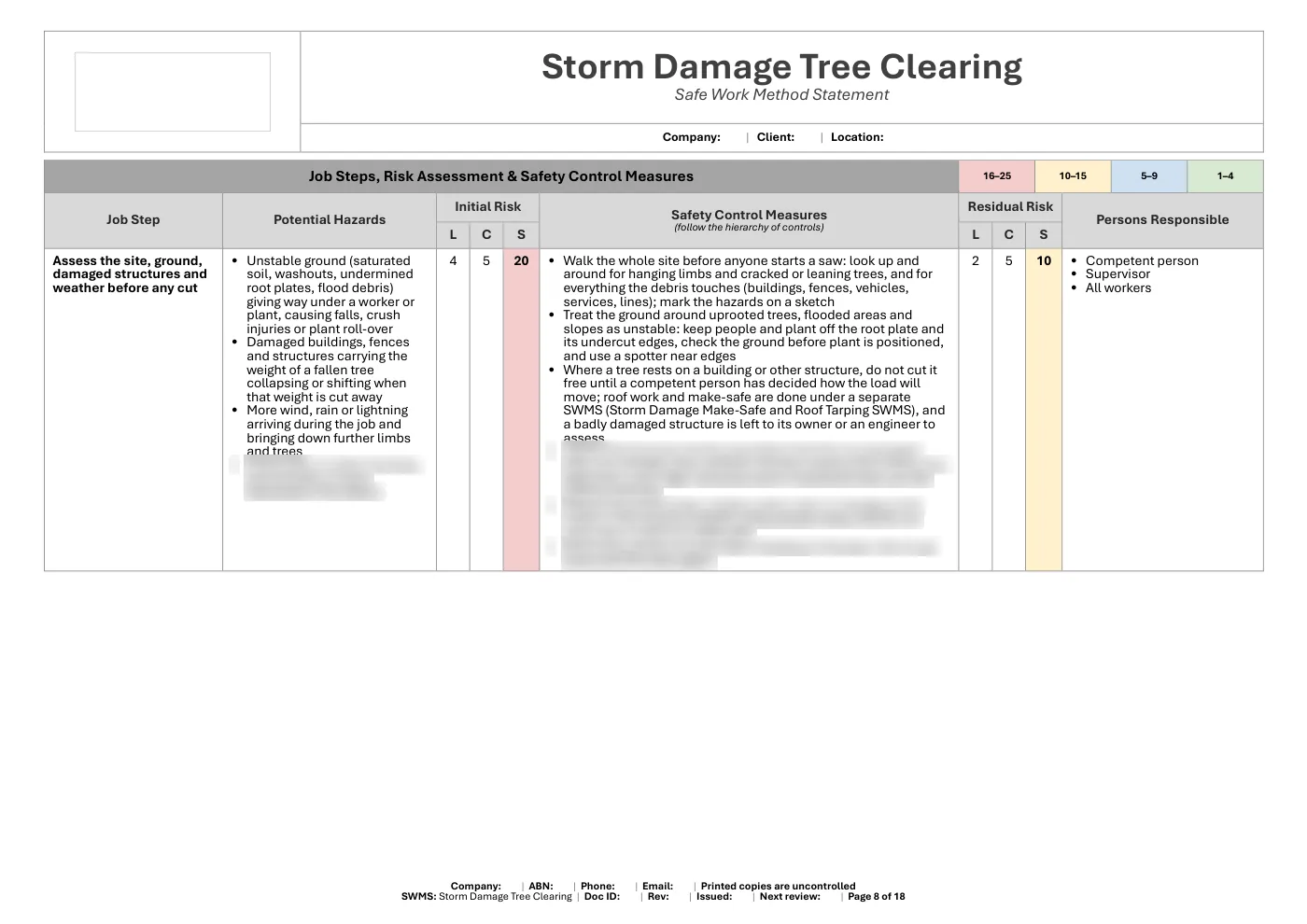
  • 9 job steps for this work, each with its hazards, controls, initial and residual risk scores and the person responsible
  • PPE listed for this job: chainsaw helmet with face screen and ear muffs; hard hat for ground workers; cut-resistant chainsaw trousers or chaps and cut-resistant safety boots with non-slip soles
  • Emergency arrangements for: plant, tree, limb or person touches or comes near a line, person trapped under or struck by a tree, limb or root plate and chainsaw laceration or severe bleeding
  • Plus the parts every Work Safety QLD SWMS shares, from the s 291 checklist to the worker sign-on sheet (see the layout in our free SWMS template)

Adjust it for your site, plant and crew, and talk it through with your workers before work starts. Please make sure you read our Disclaimer before downloading this SWMS.

Checked against the Queensland laws and codes of practice listed above. Last reviewed November 2026.

Having trouble with your download? Contact us any time. Please read our Disclaimer before downloading.

How to use it

From download to site in three steps

Buy and download

Check out with card, Apple Pay or Google Pay. Your download buttons appear straight away and the links are emailed to you. Links work for 3 months, so save your copies.

Make it yours

Open it in Microsoft Word or Excel. Add your logo, business details, site and job information, and adjust it to how the work is done.

Brief your crew

Talk it through with the workers doing the job, have them sign on, and keep it on site. Review it whenever the job or conditions change.

FAQ

Before you buy

Something else? Ask us and a real person will reply.

What format is it?

Microsoft Word. Edit it in Word, or free in Word for the web, and add your own logo and business details.

How do I get it after I pay?

Your download buttons appear as soon as checkout finishes, and the links are emailed to you. You can re-download from your account at any time.

Is it compliant with Queensland law?

It's written around Queensland's Work Health and Safety Act 2011 and Regulation 2011. Tailor it to your site, consult your workers and review it whenever conditions change; no template can guarantee compliance on its own.

What if it isn't right for my job?

If it doesn't match its description or has a fault, tell us and we'll fix it. If you're still not happy, we'll refund you or give you store credit, your choice. Check the sample pages first, as we don't refund a change of mind.
Reviews

Be the first to review “Storm Damage Tree Clearing SWMS”

Your email address will not be published. Required fields are marked *

Bought or downloaded this template from us? Leave an honest review, good or bad, and we'll email you a code for a free template of your choice (single templates, not packs). One per order.

More templates like this