
Painting SWMS
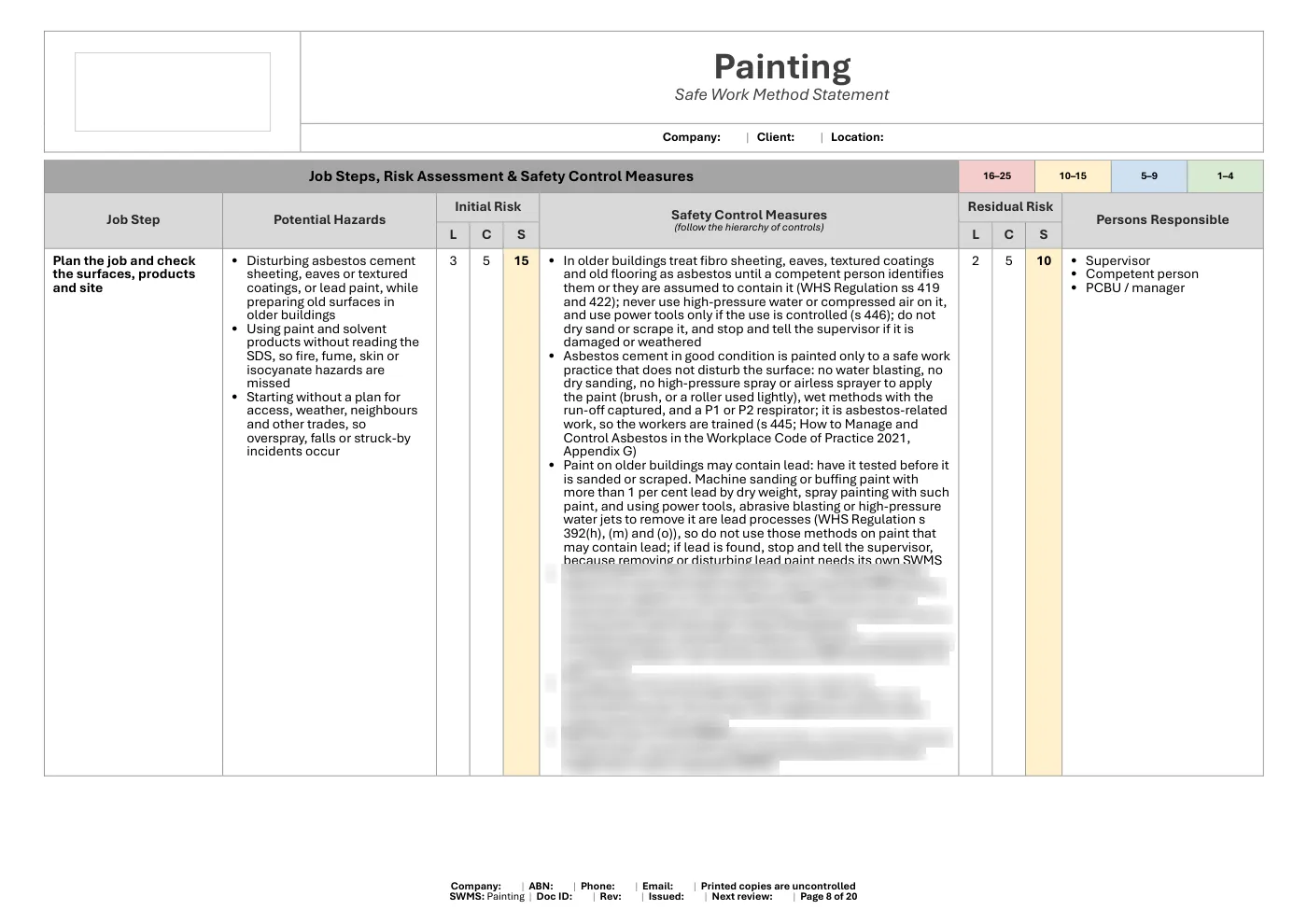
Interior and exterior painting in Queensland with brushes, rollers and airless spray: preparation, ladders, low-level scaffolds, chemicals, spraying and clean-up. An editable Word SWMS template.
RG
Written by Ryan Graham, health and safety professional (16 years on Queensland sites)
$39.99 incl. GST
AUD · one-off purchase · instant download
- Instant download · your links arrive by email straight after checkout and work for 3 months, so save your copy
- Your business name and logo · we fill them into every document for A$29 (free on orders of A$500 or more), or edit it yourself in Microsoft Word
- Quality guarantee · we'll fix any problem, then refund you or give store credit if you're still not happy
- Secure checkout · card, Apple Pay or Google Pay through Stripe
About this template
Suits painting contractors, builders and maintenance crews who paint houses, units and commercial buildings inside and out. It covers checking old surfaces for asbestos and lead, access by ladders, trestle platforms and low-level scaffolds, preparing surfaces, handling paints and solvents, brush, roller and airless spray application, heat and sun, and clean-up. Roof painting, removal of lead paint and spray booth work need separate SWMS.
A SWMS is legally required when the painting is high risk construction work, such as work with a risk of a person falling more than 2 metres, work likely to disturb asbestos, or work in an area that may have a flammable atmosphere (WHS Regulation sections 291 and 299); otherwise this document works as a written safe work procedure or task risk assessment. You can tick the contaminated or flammable atmosphere item (s 291(l)) when you spray flammable paint in an enclosed area, and also when sanding or grinding masonry or render creates silica dust, because the approved Queensland silica code treats construction work with a risk of silica exposure as work in an area that may have a contaminated atmosphere.
New to SWMS? Read What is a safe work method statement?
What is covered in our painting SWMS?
After the standard pre-start checks, the job steps run from “Plan the job and check the surfaces, products and site” to “Finish, pack up and leave the work safe”. The hazards and controls include:
- Falls from ladders, trestle platforms and low-level scaffolds
- Asbestos cement sheeting and textured coatings in older buildings
- Lead paint dust from sanding and scraping
- Solvent, isocyanate and paint mist exposure
- Paint injected into the skin by airless spray guns
- Fire and static discharge with flammable paints
- Overspray and spray drift reaching other people
- Sanding dust, including silica from fillers and render
- Contact with overhead power lines and live fittings
- Strains from overhead rolling and awkward positions
- Heat illness and sun exposure
- Spills, oily rags and waste paint
- Noise from spray pumps and sanders
High risk construction work
None of the high risk construction work items (WHS Regulation 2011 (Qld) s 291) are pre-ticked, because this job is not high risk construction work by itself. Tick any that apply on your site.
Licences, training and competency
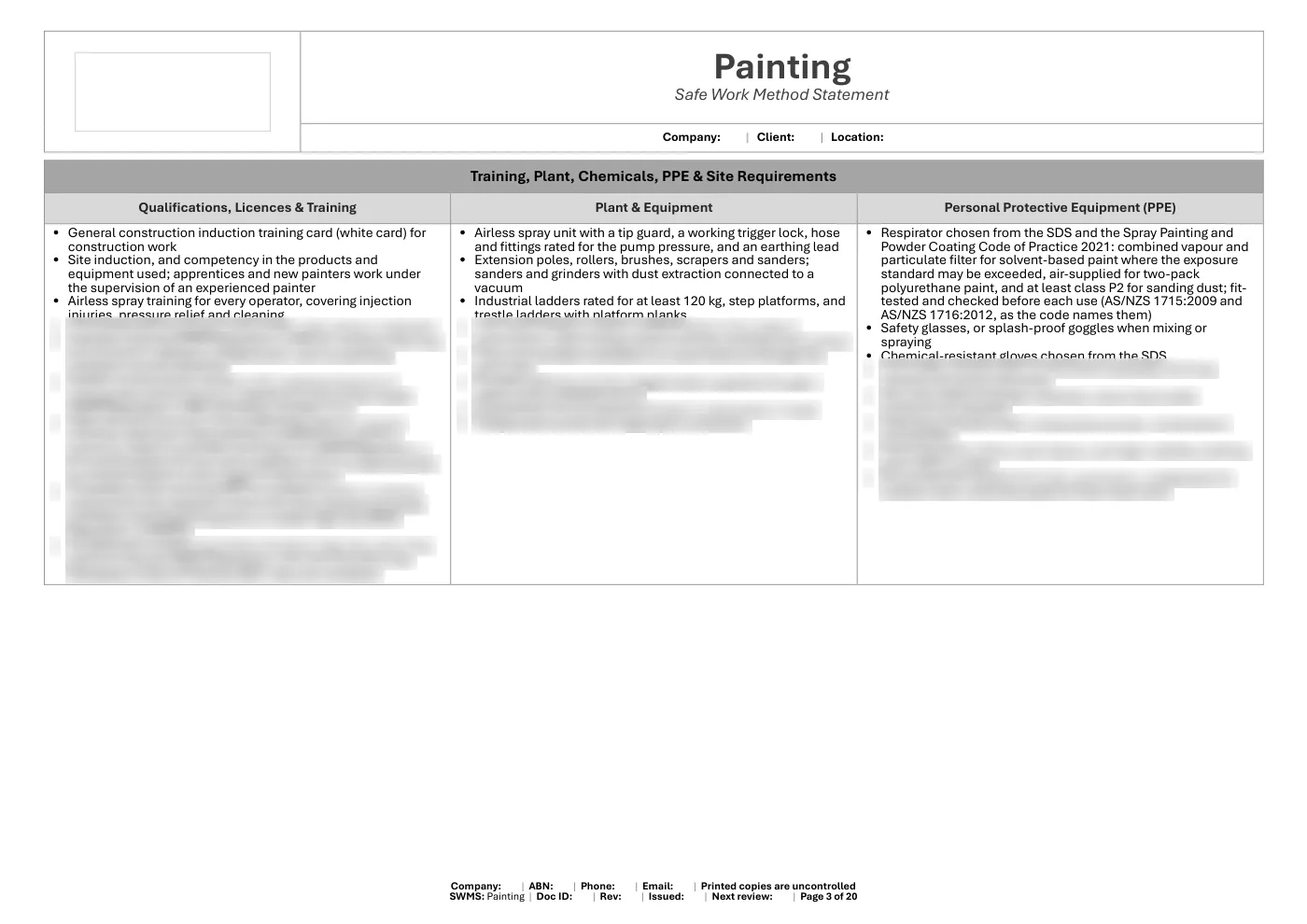
- General construction induction training card (white card) for construction work
- Site induction, and competency in the products and equipment used; apprentices and new painters work under the supervision of an experienced painter
- Airless spray training for every operator, covering injection injuries, pressure relief and cleaning
- Fit-testing and training for every worker who wears a respirator
- Asbestos training (WHS Regulation s 445) for workers who may be involved in asbestos-related work, such as painting asbestos cement sheeting
- Health monitoring for workers with ongoing exposure to isocyanates where there is a significant risk to their health (WHS Regulation s 368, Schedule 14 table 14.1)
- High risk work licence in the scaffolding class for anyone erecting, altering or dismantling a scaffold from which a person or object could fall more than 4 m (WHS Regulation s 81 and Schedule 3); low-level scaffolds of 4 m or less are built by trained workers to the maker’s instructions
- Crystalline silica training (VET accredited course or training approved by the regulator) where the dust assessment finds sanding or grinding of masonry or render high risk (WHS Regulation s 529CD)
- An adequate number of workers trained in first aid, and a first aid kit on the job (WHS Regulation s 42; the First Aid in the Workplace Code of Practice 2021 sets out numbers)
Legislation and codes of practice referenced
- Work Health and Safety Act 2011 (Qld)
- Work Health and Safety Regulation 2011 (Qld)
- Work Health and Safety Regulation 2011 (Qld): ss 78, 79 and 306A to 306O (falls, ladders and trestle platforms in construction work)
- Work Health and Safety Regulation 2011 (Qld): chapter 7 (hazardous chemicals) ss 342, 344, 346, 351, 357, 359, 368 and 382 and schedules 10 and 14, and s 392 (lead process)
- Work Health and Safety Regulation 2011 (Qld): chapter 8 (asbestos) ss 419, 422, 445 and 446, and chapter 8A (crystalline silica) ss 529A to 529CD
- Spray Painting and Powder Coating Code of Practice 2021
- Managing Risks of Hazardous Chemicals in the Workplace Code of Practice 2021
- Labelling of Workplace Hazardous Chemicals Code of Practice 2021
- How to Manage and Control Asbestos in the Workplace Code of Practice 2021
- Managing the Risk of Falls at Workplaces Code of Practice 2021
- Scaffolding Code of Practice 2021 (mobile and tower scaffolds)
- Hazardous Manual Tasks Code of Practice 2021
- Managing Noise and Preventing Hearing Loss at Work Code of Practice 2021
- Managing respirable crystalline silica dust exposure in construction and manufacturing of construction elements Code of Practice 2022
- Managing the Work Environment and Facilities Code of Practice 2021
- First Aid in the Workplace Code of Practice 2021
- How to Manage Work Health and Safety Risks Code of Practice 2021
- Electrical Safety Act 2002 (Qld)
- Electrical Safety Regulation 2026 (Qld): ss 17, 18 and 140 (unsafe equipment, flexible cables, construction work) and the overhead power line exclusion zones in schedule 2
What you get
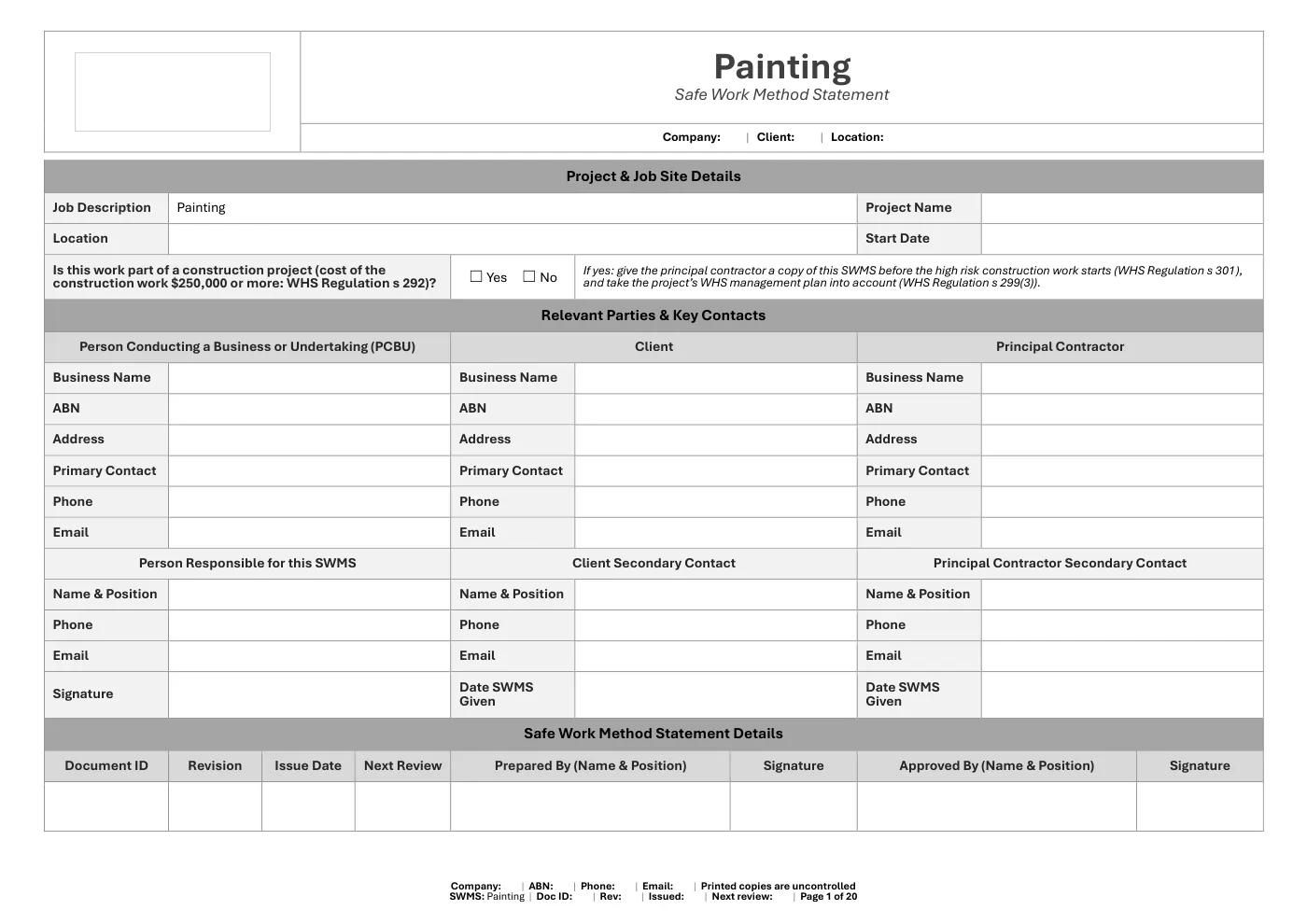
- An editable Microsoft Word document (20 pages), laid out on A4 landscape pages. Type your business, client and job details once and they fill in on every page, with a space for your logo
- 11 job steps for this work, each with its hazards, controls, initial and residual risk scores and the person responsible
- PPE listed for this job: respirator chosen from the SDS and the Spray Painting and Powder Coating Code of Practice 2021: combined vapour and particulate filter for solvent-based paint where the exposure standard may be exceeded, air-supplied for two-pack polyurethane paint, and at least class P2 for sanding dust; fit-tested and checked before each use (AS/NZS 1715:2009 and AS/NZS 1716:2012, as the code names them)
- Emergency arrangements for: paint injected into the skin by a spray gun, solvent fire and fall from a ladder or scaffold
- Plus the parts every Work Safety QLD SWMS shares, from the s 291 checklist to the worker sign-on sheet (see the layout in our free SWMS template)
Adjust it for your site, plant and crew, and talk it through with your workers before work starts.
Checked against the Queensland laws and codes of practice listed above. Last reviewed October 2026.
Having trouble with your download? Contact us any time. Please read our Disclaimer before downloading.
How to use it
From download to site in three steps
Buy and download
Check out with card, Apple Pay or Google Pay. Your download buttons appear straight away and the links are emailed to you. Links work for 3 months, so save your copies.
Make it yours
Add your logo and business details in Word or Excel, or tick branding at checkout (A$29) and we add them. Then add your site and job details.
Brief your crew
Talk it through with the workers doing the job, have them sign on, and keep it on site. Review it whenever the job or conditions change.
What format is it?
Microsoft Word. Edit it in Word, or free in Word for the web, and add your own logo and business details. Or let us do it: tick "Add my business name and logo to every document" at checkout (A$29, free on orders of A$500 or more) and fill in a short form after payment.
How do I get it after I pay?
Your download buttons appear as soon as checkout finishes, and the links are emailed to you. You can re-download from your account at any time.
Is it compliant with Queensland law?
It's written around Queensland's Work Health and Safety Act 2011 and Regulation 2011. Tailor it to your site, consult your workers and review it whenever conditions change; no template can guarantee compliance on its own.
What if it isn't right for my job?
If it doesn't match its description or has a fault, tell us and we'll fix it. If you're still not happy, we'll refund you or give you store credit, your choice. Check the sample pages first, as we don't refund a change of mind.
Only logged in customers who have purchased this product may leave a review.
More templates like this
Powder Coating SWMS
$39.99
Lead Paint Removal SWMS
$39.99
Reviews