
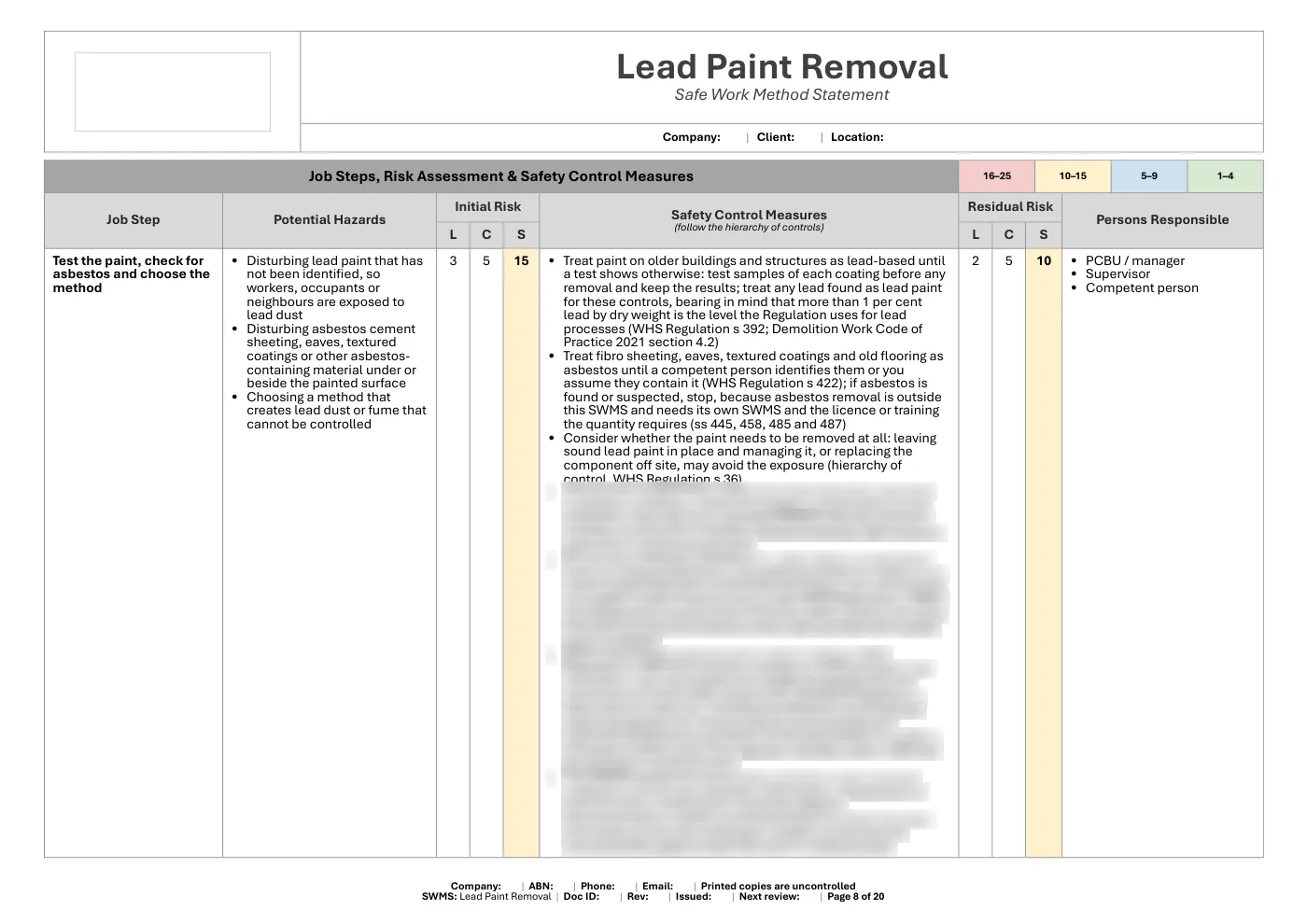
Lead Paint Removal SWMS
Removing lead-based paint by wet scraping, chemical strippers and low-dust methods in Queensland, with lead risk work, health monitoring and disposal. An editable Word SWMS template for Queensland.
RG
Written by Ryan Graham, health and safety professional (16 years on Queensland sites)
$39.99 incl. GST
AUD · one-off purchase · instant download
- Instant download · your links arrive by email straight after checkout and work for 3 months, so save your copy
- Your business name and logo · we fill them into every document for A$29 (free on orders of A$500 or more), or edit it yourself in Microsoft Word
- Quality guarantee · we'll fix any problem, then refund you or give store credit if you're still not happy
- Secure checkout · card, Apple Pay or Google Pay through Stripe
About this template
Suits painters, renovators, building maintenance crews and property managers who remove lead-based paint from older buildings and structures. It covers testing the paint, the lead duties in the WHS Regulation (lead risk work, notification and health monitoring), containment, wet and chemical removal methods, cleaning, decontamination and waste. General painting is covered by a separate SWMS, and dry sanding, burning off, abrasive blasting and asbestos removal are outside it.
Lead paint removal is not high risk construction work by itself, so no item is pre-ticked; tick the items the job meets, such as a fall of more than 2 metres, disturbing asbestos or a contaminated atmosphere (for example silica dust from sanding masonry), when a SWMS is legally required (WHS Regulation sections 291 and 299); the lead duties in chapter 7 part 7.2 apply by law to lead processes such as machine sanding and power-tool removal, and this SWMS also applies them to wet scraping and chemical stripping.
New to SWMS? Read What is a safe work method statement?
What is covered in our lead paint removal SWMS?
After the standard pre-start checks, the job steps run from “Test the paint, check for asbestos and choose the method” to “Monitor blood lead levels, act on results and review the controls”. The hazards and controls include:
- Lead dust and chips released during removal
- Lead carried home on skin, clothing and tools
- Rising blood lead levels and lead poisoning
- Lower blood lead limits for females of reproductive capacity
- Asbestos under or beside painted surfaces
- Chemical burns and fumes from paint strippers
- Fire from flammable strippers
- Contamination of occupants, neighbours and clean areas
- Falls from ladders and platforms
- Contact with overhead service lines
- Heat illness in coveralls and respirators
- Lead waste and contaminated wash water
- Noise from power tools
High risk construction work
None of the high risk construction work items (WHS Regulation 2011 (Qld) s 291) are pre-ticked, because this job is not high risk construction work by itself. Tick any that apply on your site.
Licences, training and competency
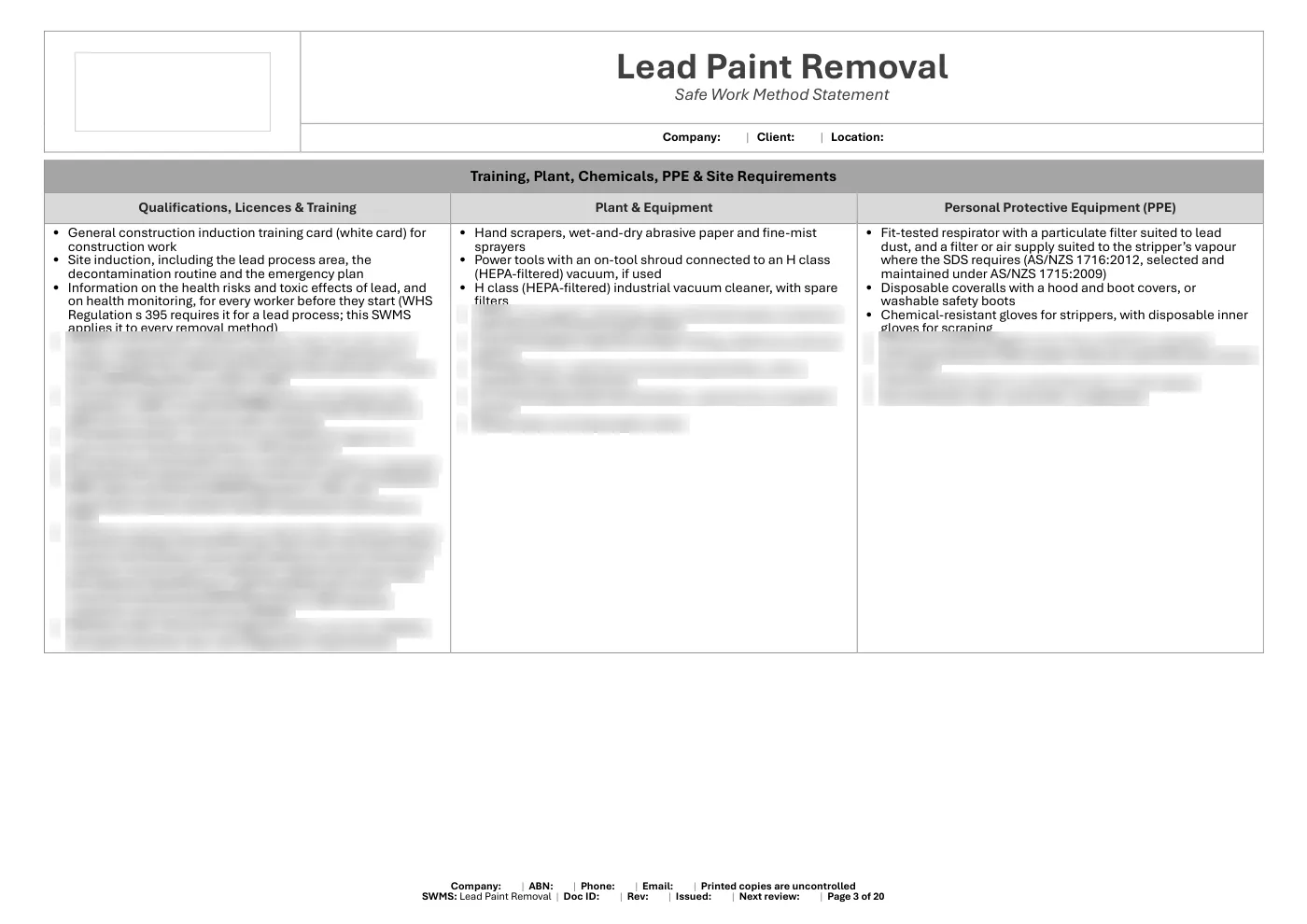
- General construction induction training card (white card) for construction work
- Site induction, including the lead process area, the decontamination routine and the emergency plan
- Information on the health risks and toxic effects of lead, and on health monitoring, for every worker before they start (WHS Regulation s 395 requires it for a lead process; this SWMS applies it to every removal method)
- Health monitoring for workers who do lead risk work, by or under a registered medical practitioner with experience in health monitoring, before the first lead risk work and 1 month later (WHS Regulation ss 405 to 408)
- Competent person to identify lead paint and asbestos (for asbestos, s 422), to help the PCBU assess lead risk work (s 402) and to inspect the area after cleaning
- Competent person, such as an occupational hygienist, to carry out air monitoring where s 50 requires it
- Fit-testing and training for every worker who wears a respirator
- Training in the stripper products and tools used, including the SDS, spills and first aid (WHS Regulation s 39), with supervision where workers handle hazardous chemicals (s 379)
- Asbestos awareness so crews recognise fibro sheeting, eaves, textured coatings and old flooring, stop work and report them; workers the business reasonably believes may be involved in asbestos removal work or asbestos-related work also need the asbestos identification, safe handling and control measures training that WHS Regulation s 445 requires (asbestos work is outside this SWMS)
- Workers under 18 are not assigned to this work (this SWMS’s own good-practice rule, not a Regulation requirement)
Legislation and codes of practice referenced
- Work Health and Safety Act 2011 (Qld)
- Work Health and Safety Regulation 2011 (Qld)
- Work Health and Safety Regulation 2011 (Qld): chapter 7 part 7.2 (lead), ss 392 to 418, and schedule 14 table 14.2
- Work Health and Safety Regulation 2011 (Qld): chapter 7 part 7.1 (hazardous chemicals), ss 341 to 346, 351 and 354 to 362, and ss 49 and 50 (airborne contaminants)
- Work Health and Safety Regulation 2011 (Qld): chapter 8 (asbestos), ss 419, 422, 445, 446, 458 and 485 to 487
- Work Health and Safety Regulation 2011 (Qld): ss 78, 79 and 306K to 306M (falls and ladders)
- Managing Risks of Hazardous Chemicals in the Workplace Code of Practice 2021
- Labelling of Workplace Hazardous Chemicals Code of Practice 2021
- Demolition Work Code of Practice 2021 (section 4.2, lead in paint and plumbing)
- Spray Painting and Powder Coating Code of Practice 2021 (section 3.1, lead; respirator standards)
- Welding Processes Code of Practice 2021 (section 3.8, lead)
- How to Manage and Control Asbestos in the Workplace Code of Practice 2021
- Managing the Risk of Falls at Workplaces Code of Practice 2021
- Hazardous Manual Tasks Code of Practice 2021
- Managing Noise and Preventing Hearing Loss at Work Code of Practice 2021
- Managing the Work Environment and Facilities Code of Practice 2021
- Children and Young Workers Code of Practice 2006 (section 3.3.1, lead and young workers)
- First Aid in the Workplace Code of Practice 2021
- How to Manage Work Health and Safety Risks Code of Practice 2021
- Electrical Safety Act 2002 (Qld)
- Electrical Safety Regulation 2026 (Qld): s 140 and the overhead line exclusion zones in schedule 2
- Electrical Safety Code of Practice 2020 – Working near overhead and underground electric lines (distances come from the 2026 Regulation)
- AS/NZS 1716:2012 and AS/NZS 1715:2009 (respiratory protective devices and their selection, use and maintenance, as named in the Spray Painting and Powder Coating Code of Practice 2021)
What you get
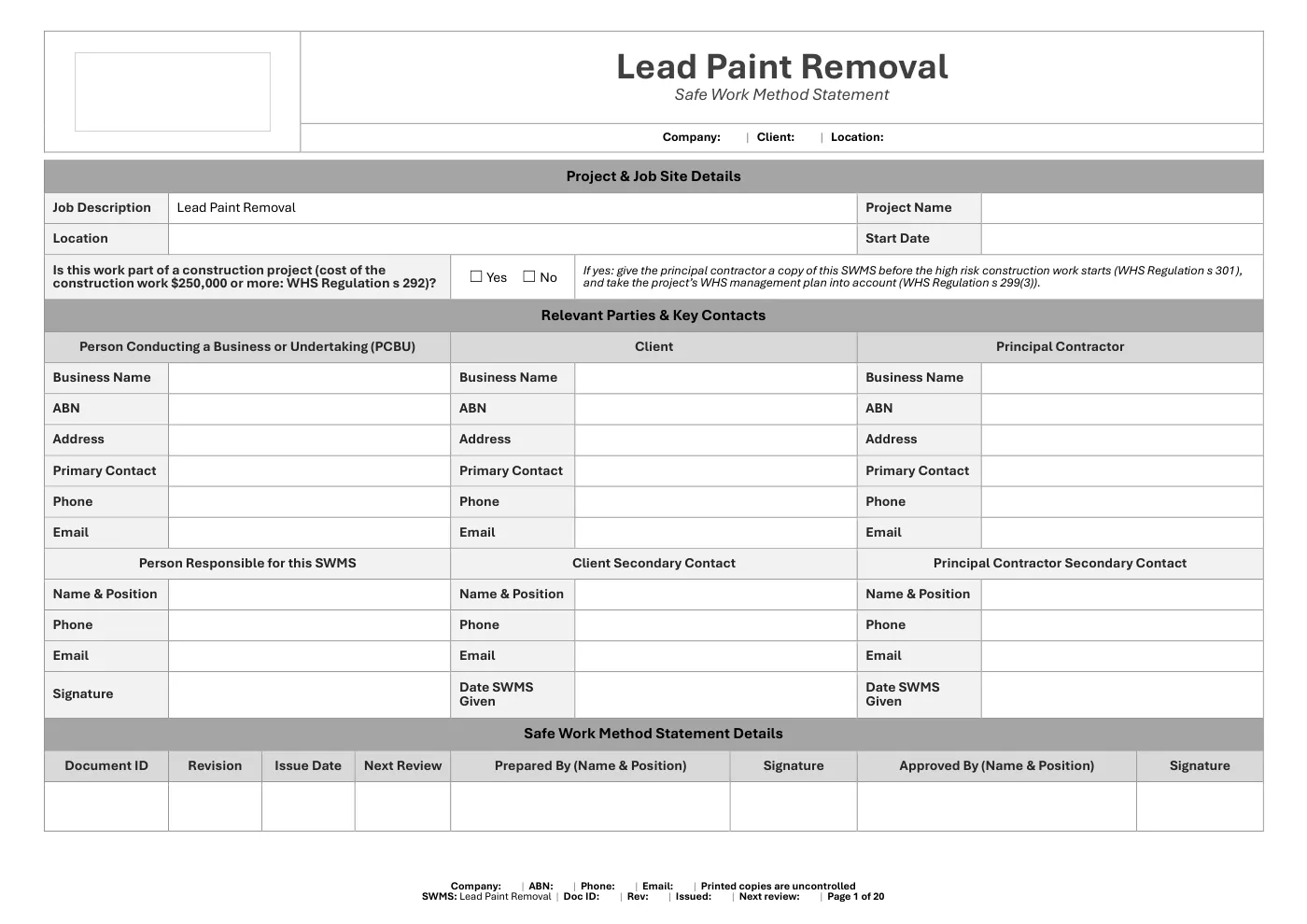
- An editable Microsoft Word document (20 pages), laid out on A4 landscape pages. Type your business, client and job details once and they fill in on every page, with a space for your logo
- 11 job steps for this work, each with its hazards, controls, initial and residual risk scores and the person responsible
- PPE listed for this job: fit-tested respirator with a particulate filter suited to lead dust, and a filter or air supply suited to the stripper’s vapour where the SDS requires (AS/NZS 1716:2012, selected and maintained under AS/NZS 1715:2009)
- Emergency arrangements for: stripper in the eyes or on skin and lead dust or chips released outside the lead process area
- Plus the parts every Work Safety QLD SWMS shares, from the s 291 checklist to the worker sign-on sheet (see the layout in our free SWMS template)
Adjust it for your site, plant and crew, and talk it through with your workers before work starts.
Checked against the Queensland laws and codes of practice listed above. Last reviewed October 2026.
Having trouble with your download? Contact us any time. Please read our Disclaimer before downloading.
How to use it
From download to site in three steps
Buy and download
Check out with card, Apple Pay or Google Pay. Your download buttons appear straight away and the links are emailed to you. Links work for 3 months, so save your copies.
Make it yours
Add your logo and business details in Word or Excel, or tick branding at checkout (A$29) and we add them. Then add your site and job details.
Brief your crew
Talk it through with the workers doing the job, have them sign on, and keep it on site. Review it whenever the job or conditions change.
What format is it?
Microsoft Word. Edit it in Word, or free in Word for the web, and add your own logo and business details. Or let us do it: tick "Add my business name and logo to every document" at checkout (A$29, free on orders of A$500 or more) and fill in a short form after payment.
How do I get it after I pay?
Your download buttons appear as soon as checkout finishes, and the links are emailed to you. You can re-download from your account at any time.
Is it compliant with Queensland law?
It's written around Queensland's Work Health and Safety Act 2011 and Regulation 2011. Tailor it to your site, consult your workers and review it whenever conditions change; no template can guarantee compliance on its own.
What if it isn't right for my job?
If it doesn't match its description or has a fault, tell us and we'll fix it. If you're still not happy, we'll refund you or give you store credit, your choice. Check the sample pages first, as we don't refund a change of mind.
Only logged in customers who have purchased this product may leave a review.
More templates like this
Powder Coating SWMS
$39.99
Reviews