
Fire Sprinkler System Installation SWMS
Installing fire sprinkler systems in Queensland: overhead pipework, EWP use, hot work, valve sets and pressure testing. Tailor it to your job. An editable Word SWMS template.
RG
Written by Ryan Graham, health and safety professional (16 years on Queensland sites)
$49.99 incl. GST
AUD · one-off purchase · instant download
- Instant download · your links arrive by email straight after checkout and work for 3 months, so save your copy
- Your business name and logo · we fill them into every document for A$29 (free on orders of A$500 or more), or edit it yourself in Microsoft Word
- Quality guarantee · we'll fix any problem, then refund you or give store credit if you're still not happy
- Secure checkout · card, Apple Pay or Google Pay through Stripe
About this template
For fire protection contractors, plumbers and builders installing fire sprinkler systems in buildings. It follows the job in order, from checking the building and the licences for the work through overhead drilling, pipework, valve sets and sprinkler heads, to live tie-ins and the pressure test. Hydrants and hose reels, final testing and commissioning, EWP operation and welding are not covered.
Sprinkler installation is high risk construction work when a person could fall more than 2 metres (WHS Regulation s 291(a)), so that item is ticked; you can also tick powered mobile plant when EWPs or forklifts move in the work area, a contaminated or flammable atmosphere where drilling or cutting creates silica dust or flammable vapour, and asbestos if materials may be disturbed.
New to SWMS? Read What is a safe work method statement?
What is covered in our fire sprinkler system installation SWMS?
After the standard pre-start checks, the job steps run from “Plan the job, check the building and agree the live system arrangements” to “Clean up, leave the system safe and hand over”. The hazards and controls include:
- Falls from EWPs, ladders and platforms
- Tools and pipe falling onto people below
- Asbestos in older ceilings and linings
- Silica dust from drilling concrete soffits
- Sparks from cutting and grinding near combustibles
- Entanglement in pipe threading and grooving machines
- Heavy pipe and valve sets, and strains
- Crush hazards between the platform and overhead pipework
- Pressure test failures and sudden release of stored pressure
- Water escaping from live tie-ins and tests
- Fire protection out of service during tie-ins
- Electric shock when wiring switches and controls
- Noise, vibration and overhead drilling
High risk construction work
These high risk construction work items (WHS Regulation 2011 (Qld) s 291) are already ticked because they are part of this work. Tick any others that apply to your job:
- Involves a risk of a person falling more than 2m
Licences, training and competency
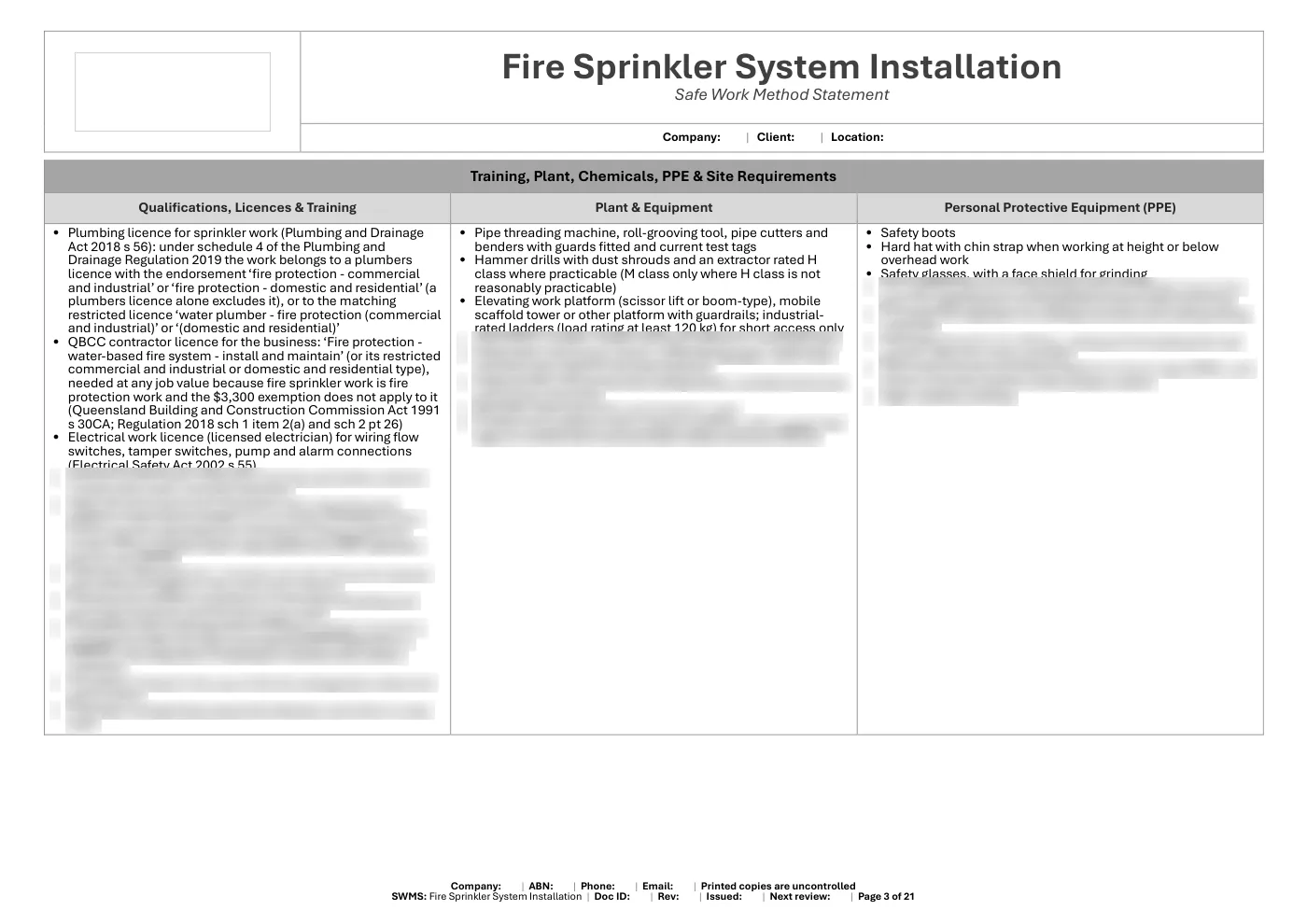
- Plumbing licence for sprinkler work (Plumbing and Drainage Act 2018 s 56): under schedule 4 of the Plumbing and Drainage Regulation 2019 the work belongs to a plumbers licence with the endorsement ‘fire protection – commercial and industrial’ or ‘fire protection – domestic and residential’ (a plumbers licence alone excludes it), or to the matching restricted licence ‘water plumber – fire protection (commercial and industrial)’ or ‘(domestic and residential)’
- QBCC contractor licence for the business: ‘Fire protection – water-based fire system – install and maintain’ (or its restricted commercial and industrial or domestic and residential type), needed at any job value because fire sprinkler work is fire protection work and the $3,300 exemption does not apply to it (Queensland Building and Construction Commission Act 1991 s 30CA; Regulation 2018 sch 1 item 2(a) and sch 2 pt 26)
- Electrical work licence (licensed electrician) for wiring flow switches, tamper switches, pump and alarm connections (Electrical Safety Act 2002 s 55)
- General construction induction training card (white card) for construction work, and site induction
- High risk work licence for the boom-type elevating work platform class (boom length 11 m or more, Schedule 3 item 21) for anyone operating one; Schedule 3 has no class for scissor lifts or shorter boom-type platforms; EWP operation has its own SWMS
- Training in fall protection, harness use and rescue for anyone who works at height or may carry out a rescue
- Training and verified competency in the pipe threading and grooving machines and the test pump used
- Crystalline silica training where drilling or coring concrete is assessed as high risk silica processing (WHS Regulation s 529CD), and respirator fit testing for workers who need a respirator
- Fire watch trained in the use of the fire extinguisher where hot work is done
- Training in recognising suspected asbestos and when to stop work
Legislation and codes of practice referenced
- Work Health and Safety Act 2011 (Qld)
- Work Health and Safety Regulation 2011 (Qld)
- Managing the Risk of Falls at Workplaces Code of Practice 2021
- Managing Risks of Plant in the Workplace Code of Practice 2021
- Hazardous Manual Tasks Code of Practice 2021
- Managing respirable crystalline silica dust exposure in construction and manufacturing of construction elements Code of Practice 2022
- How to Manage and Control Asbestos in the Workplace Code of Practice 2021
- Managing Noise and Preventing Hearing Loss at Work Code of Practice 2021
- Managing Risks of Hazardous Chemicals in the Workplace Code of Practice 2021
- Welding Processes Code of Practice 2021 (fire and explosion and hot work controls, used as guidance for cutting and grinding sparks)
- AS 1674.1 Safety in welding and allied processes – Fire precautions (named in the Welding Processes Code of Practice 2021 for hot work permits)
- Managing the Work Environment and Facilities Code of Practice 2021
- How to Manage Work Health and Safety Risks Code of Practice 2021
- First Aid in the Workplace Code of Practice 2021
- Electrical Safety Act 2002 (Qld)
- Electrical Safety Regulation 2026 (Qld): construction electrical equipment (s 140)
- Electrical Safety Code of Practice 2021 – Managing electrical risks in the workplace
- Plumbing and Drainage Act 2018 (Qld) and Plumbing and Drainage Regulation 2019 (Qld): licence needed for plumbing work (Act s 56), scope of the fire protection licences and endorsements (Regulation schedule 4), the QBCC licences linked to them (schedule 9) and fire service products (Regulation s 99)
- Queensland Building and Construction Commission Act 1991 (Qld) s 30CA and Queensland Building and Construction Commission Regulation 2018 (Qld) sch 2 pt 26: fire protection licences for sprinkler work
- AS 2118.1:2017 and the other standards in the AS 2118 series (Automatic fire sprinkler systems), as named in s 99 of the Plumbing and Drainage Regulation 2019
- Safe Work Australia model Code of Practice: Elevating work platforms (guidance)
What you get
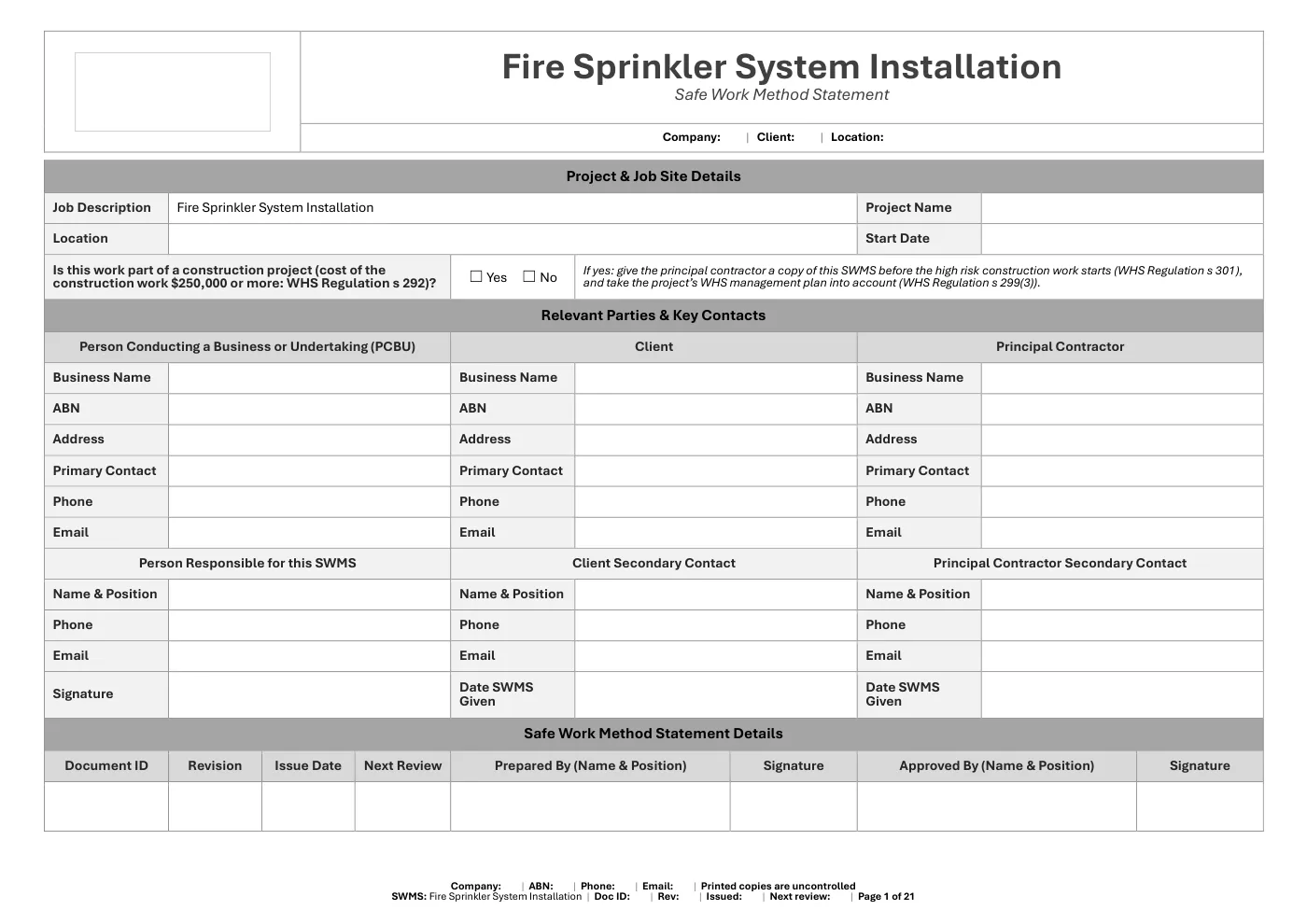
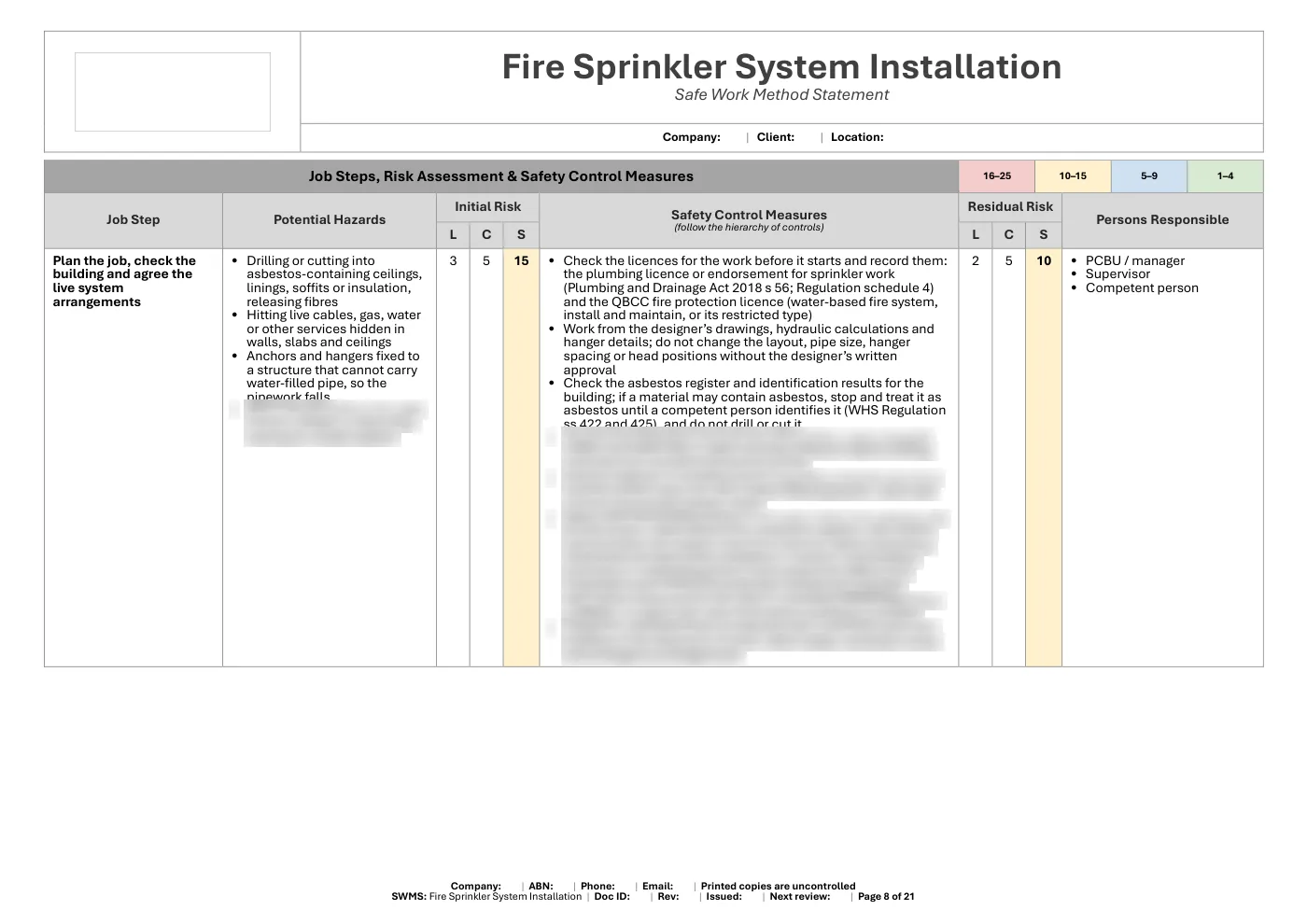
- An editable Microsoft Word document (21 pages), laid out on A4 landscape pages. Type your business, client and job details once and they fill in on every page, with a space for your logo
- 11 job steps for this work, each with its hazards, controls, initial and residual risk scores and the person responsible
- PPE listed for this job: safety boots; hard hat with chin strap when working at height or below overhead work; safety glasses, with a face shield for grinding
- Emergency arrangements for: burst pipe or fitting during a pressure test, fall from the platform, or a person hanging in a harness and fire from hot work
- Plus the parts every Work Safety QLD SWMS shares, from the s 291 checklist to the worker sign-on sheet (see the layout in our free SWMS template)
Adjust it for your site, plant and crew, and talk it through with your workers before work starts.
Checked against the Queensland laws and codes of practice listed above. Last reviewed October 2026.
Having trouble with your download? Contact us any time. Please read our Disclaimer before downloading.
How to use it
From download to site in three steps
Buy and download
Check out with card, Apple Pay or Google Pay. Your download buttons appear straight away and the links are emailed to you. Links work for 3 months, so save your copies.
Make it yours
Add your logo and business details in Word or Excel, or tick branding at checkout (A$29) and we add them. Then add your site and job details.
Brief your crew
Talk it through with the workers doing the job, have them sign on, and keep it on site. Review it whenever the job or conditions change.
What format is it?
Microsoft Word. Edit it in Word, or free in Word for the web, and add your own logo and business details. Or let us do it: tick "Add my business name and logo to every document" at checkout (A$29, free on orders of A$500 or more) and fill in a short form after payment.
How do I get it after I pay?
Your download buttons appear as soon as checkout finishes, and the links are emailed to you. You can re-download from your account at any time.
Is it compliant with Queensland law?
It's written around Queensland's Work Health and Safety Act 2011 and Regulation 2011. Tailor it to your site, consult your workers and review it whenever conditions change; no template can guarantee compliance on its own.
What if it isn't right for my job?
If it doesn't match its description or has a fault, tell us and we'll fix it. If you're still not happy, we'll refund you or give you store credit, your choice. Check the sample pages first, as we don't refund a change of mind.
Only logged in customers who have purchased this product may leave a review.
Reviews