
Home EV Charger Installation SWMS
Editable Word SWMS template for home EV charger installation in Queensland: switchboard isolation, cable runs through ceilings and walls, drilling, ladders and commissioning.
RG
Written by Ryan Graham, health and safety professional (16 years on Queensland sites)
$49.99 incl. GST
AUD · one-off purchase · instant download
- Instant download · your links arrive by email straight after checkout
- Make it yours in minutes · edit in Microsoft Word or Excel and add your logo
- Quality guarantee · we'll fix it or refund you if it isn't as described
- Secure checkout · card, Apple Pay or Google Pay through Stripe
About this template
For licensed electricians and electrical contractors who install fixed, wall-mounted electric vehicle chargers in houses, units and garages. It follows the job from the home inspection and load check through isolating and proving the switchboard dead, drilling and fixing, running cable through ceilings and walls, and terminating and testing to commissioning, certificates and handover. Commercial charging stations, domestic switchboard upgrades and live electrical work need their own SWMS.
Installing a fixed home EV charger is construction work on or near energised electrical installations or services, which is high risk construction work (WHS Regulation ss 289 and 291(k)), so that item is ticked and s 299 requires a SWMS before the work starts. Live work and live testing need their own electrical SWMS and recorded risk assessment under the Electrical Safety Regulation 2026 (ss 199 to 204). You can also tick a fall risk of more than 2 metres, asbestos disturbance when a board or lining may contain asbestos, or the contaminated atmosphere item when drilling brick or concrete creates silica dust, as the Queensland silica code advises.
Learn More: What Is A Safe Work Method Statement?
Have you ever been asked to provide a SWMS on a project in Queensland? Read our guide to what a Safe Work Method Statement is and when you need one.
What Is Covered In Our Home EV Charger Installation SWMS?
The job steps run in the order the work is done, from pre-start checks to finishing up. The hazards and controls include:
- Circuits still live after isolation
- Missed supplies such as solar and batteries
- Live service line and meter side of the board
- Asbestos in older boards, linings and eaves
- Drilling into hidden cables and pipes
- Silica dust from drilling masonry
- Falls through ceilings and from ladders
- Heat, insulation fibres and stings in roof spaces
- Cable run where it can overheat or be damaged
- Wrong connections and a missing safety switch
- Energising with an undetected fault
- Vehicle and charging cable hazards during the test charge
- Missing test results, certificates and notices
- Electric shock, arc flash and electrical fire
High Risk Construction Work
These high risk construction work items (WHS Regulation 2011 (Qld) s 291) are already ticked because they are part of this work. Tick any others that apply to your job:
- Is carried out on or near energised electrical installations or services
Licences, Training and Competency
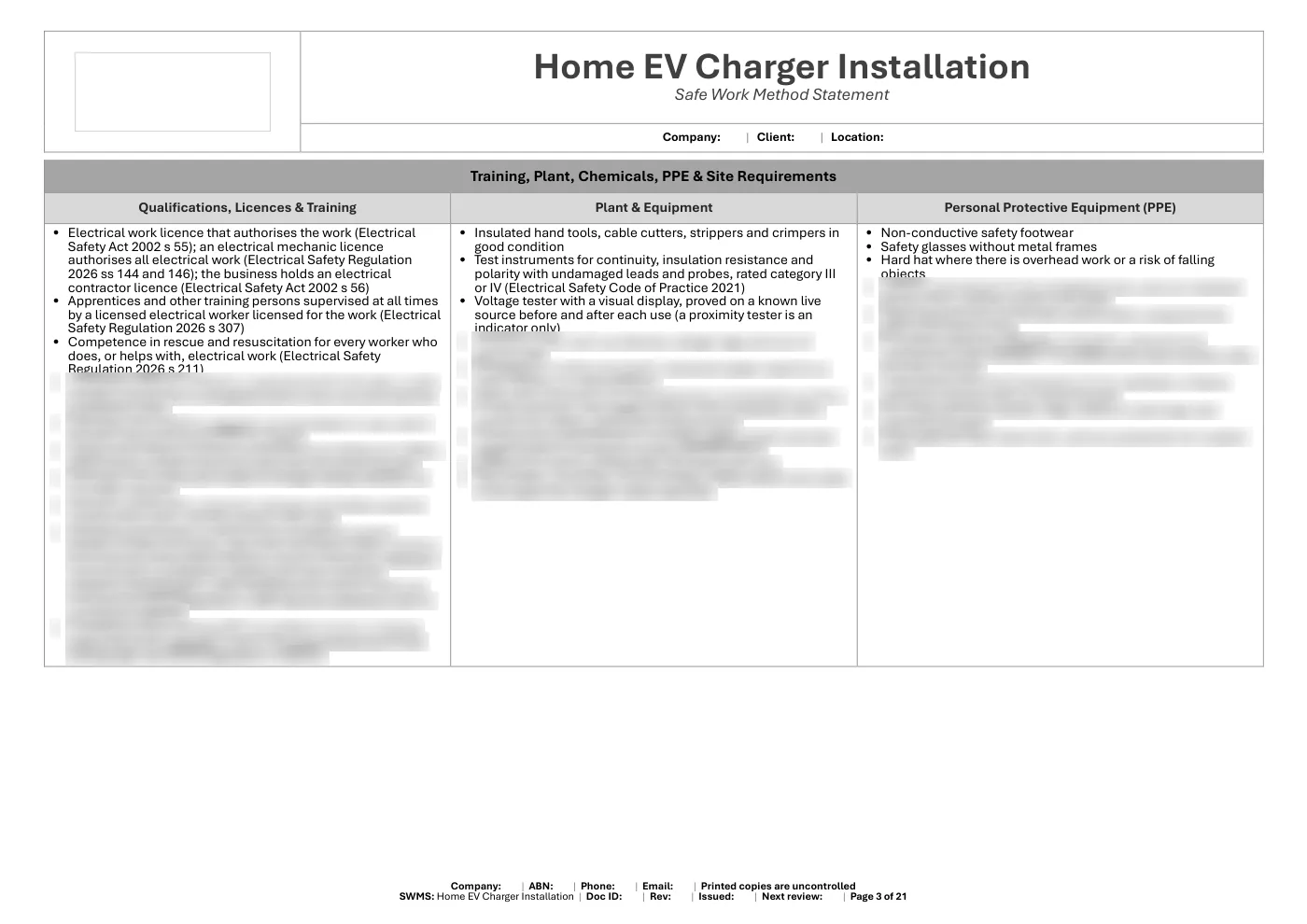
- Electrical work licence that authorises the work (Electrical Safety Act 2002 s 55); an electrical mechanic licence authorises all electrical work (Electrical Safety Regulation 2026 ss 144 and 146); the business holds an electrical contractor licence (Electrical Safety Act 2002 s 56)
- Apprentices and other training persons supervised at all times by a licensed electrical worker licensed for the work (Electrical Safety Regulation 2026 s 307)
- Competence in rescue and resuscitation for every worker who does, or helps with, electrical work (Electrical Safety Regulation 2026 s 211)
- Competent person, trained or experienced for the task, to test whether equipment is energised and to carry out and read the installation tests
- Training in the isolation and lock-out procedure in use, and in the test instruments and PPE for the job
- Unlicensed helpers limited to what Electrical Safety Act 2002 s 18(2) leaves outside electrical work (see the planning step)
- Training in the make and model of charger being installed, as its maker requires
- General construction induction training card (white card) for construction work, and the owner’s site rules
- Asbestos awareness so electricians recognise suspect boards, linings and eaves, stop work and report them; workers the business reasonably believes may be involved in asbestos removal work or asbestos-related work also need the asbestos identification, safe handling and control measures training that WHS Regulation s 445 requires (asbestos work is outside this SWMS)
- Crystalline silica training (VET accredited course or training approved by the regulator) where the dust assessment finds drilling high risk (WHS Regulation s 529CD)
Legislation and Codes of Practice Referenced
- Work Health and Safety Act 2011 (Qld)
- Work Health and Safety Regulation 2011 (Qld)
- Work Health and Safety Regulation 2011 (Qld): ss 78, 79, 306C, 306D and 306K to 306M (falls and ladders in construction work)
- Work Health and Safety Regulation 2011 (Qld): ss 419, 422 and 445 (asbestos) and ss 529A to 529CD (crystalline silica)
- Electrical Safety Act 2002 (Qld)
- Electrical Safety Regulation 2026 (Qld): ss 191, 192 and 140 (wiring rules, AS/NZS 3012), ss 17 and 18 (unsafe equipment, flexible cables) and s 30 (safety switches in domestic residences)
- Electrical Safety Regulation 2026 (Qld): ss 193 to 204 (energised work and lock-out), ss 31 to 36 (roof spaces), s 211 (rescue and resuscitation training) and s 307 (training persons)
- Electrical Safety Regulation 2026 (Qld): ss 207, 208, 210, 217 to 219, 223, 228, 229, 233 and 234 (testing, serious defects, connection, certificates and notices)
- Electrical Safety Regulation 2026 (Qld): ss 292 and 296 (serious electrical incidents and dangerous electrical events)
- Electrical Safety Code of Practice 2021 – Managing electrical risks in the workplace
- How to Manage Work Health and Safety Risks Code of Practice 2021
- Managing the Risk of Falls at Workplaces Code of Practice 2021
- Hazardous Manual Tasks Code of Practice 2021
- How to Manage and Control Asbestos in the Workplace Code of Practice 2021
- Managing respirable crystalline silica dust exposure in construction and manufacturing of construction elements Code of Practice 2022
- Managing Noise and Preventing Hearing Loss at Work Code of Practice 2021
- Managing Risks of Hazardous Chemicals in the Workplace Code of Practice 2021
- First Aid in the Workplace Code of Practice 2021
- AS/NZS 3000 (Electrical installations (known as the Australian/New Zealand Wiring Rules)) and AS/NZS 3012 (Electrical installations – Construction and demolition sites), as named in the Electrical Safety Regulation 2026
- AS/NZS 3017 (Electrical installations – Verification by inspection and testing), as named in the Electrical Safety Code of Practice 2021
What You Get
- An editable Microsoft Word document (21 pages), laid out on A4 landscape pages
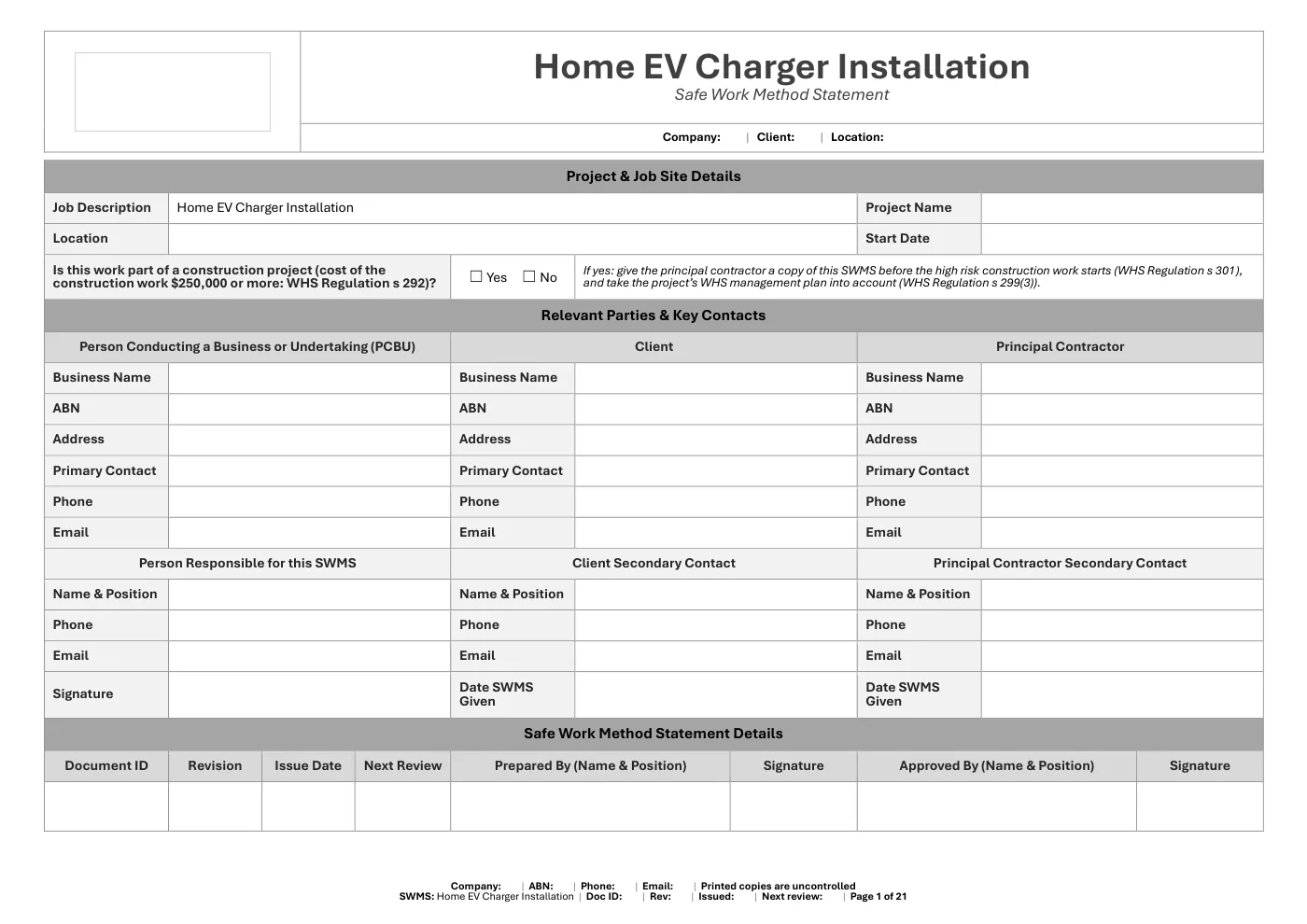
- Business, client, job and document details typed once and filled in on every page, plus a space for your logo
- The high risk construction work checklist, worded as WHS Regulation s 291, and the construction project question (s 292)
- A worker and health and safety representative consultation record
- Qualifications, plant, PPE, hazardous chemicals, safety equipment, permits, references and emergency arrangements filled in for this work
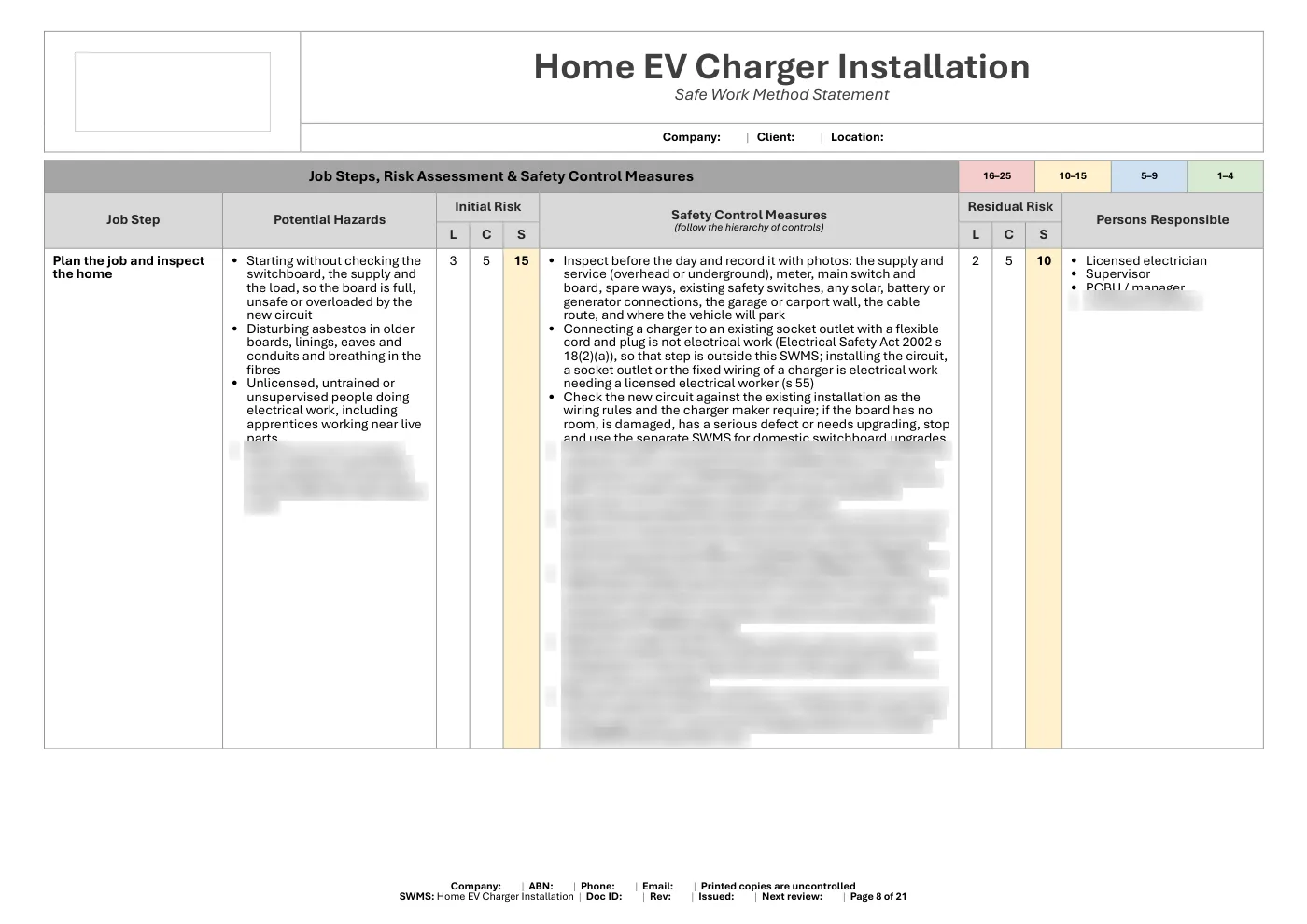
- A 5 x 5 risk matrix, and job steps with initial and residual risk scores and the people responsible
- Implementing, monitoring and review requirements, an additional controls log, revision history and a worker sign-on sheet
Review and adjust it for your site, your plant and the way your crew does the job, and talk it through with your workers before work starts. If you have any trouble downloading this SWMS, you can contact us at any time. Please make sure you read our Disclaimer before downloading this SWMS.
How to use it
From download to site in three steps
Buy and download
Check out with card, Apple Pay or Google Pay. Your download buttons appear straight away and the links are emailed to you.
Make it yours
Open it in Microsoft Word or Excel. Add your logo, business details, site and job information, and adjust it to how the work is done.
Brief your crew
Talk it through with the workers doing the job, have them sign on, and keep it on site. Review it whenever the job or conditions change.
What format is it?
Microsoft Word (registers are Excel). Edit it in Word or Excel, or free in Word and Excel for the web, and add your own logo and business details.
How do I get it after I pay?
Your download buttons appear as soon as checkout finishes, and the links are emailed to you. You can re-download from your account at any time.
Is it compliant with Queensland law?
It's written around Queensland's Work Health and Safety Act 2011 and Regulation 2011. Tailor it to your site, consult your workers and review it whenever conditions change; no template can guarantee compliance on its own.
What if it isn't right for my job?
If it doesn't match its description or has a fault, we'll fix it, and if we can't, we'll refund you (or give you store credit if you'd prefer). Check the sample pages first, as we don't refund a change of mind.
Reviews
Reviews