Suits farm and contract ground crews who support aerial spraying. It covers ground crew duties for aerial spraying: airstrip marshalling, chemical mixing and loading, refuelling and working around aircraft. Ground-boom spraying has the Boom Spray Operation SWMS, and aircraft operations and pilot duties sit with the aircraft operator.
Ground crew work for aerial spraying is not high risk construction work by itself, so no item is pre-ticked and a SWMS is required by law only for high risk construction work (WHS Regulation s 299); this document works as a written safe work procedure or task risk assessment that you tailor to the property and the aircraft operator’s procedures. If the work is part of construction work, such as building or repairing the airstrip, tick the reg 291 items that apply, for example movement of powered mobile plant.
New to SWMS? Read What Is A Safe Work Method Statement?
What Is Covered In Our Aerial Spraying Ground Crew and Airstrip SWMS?
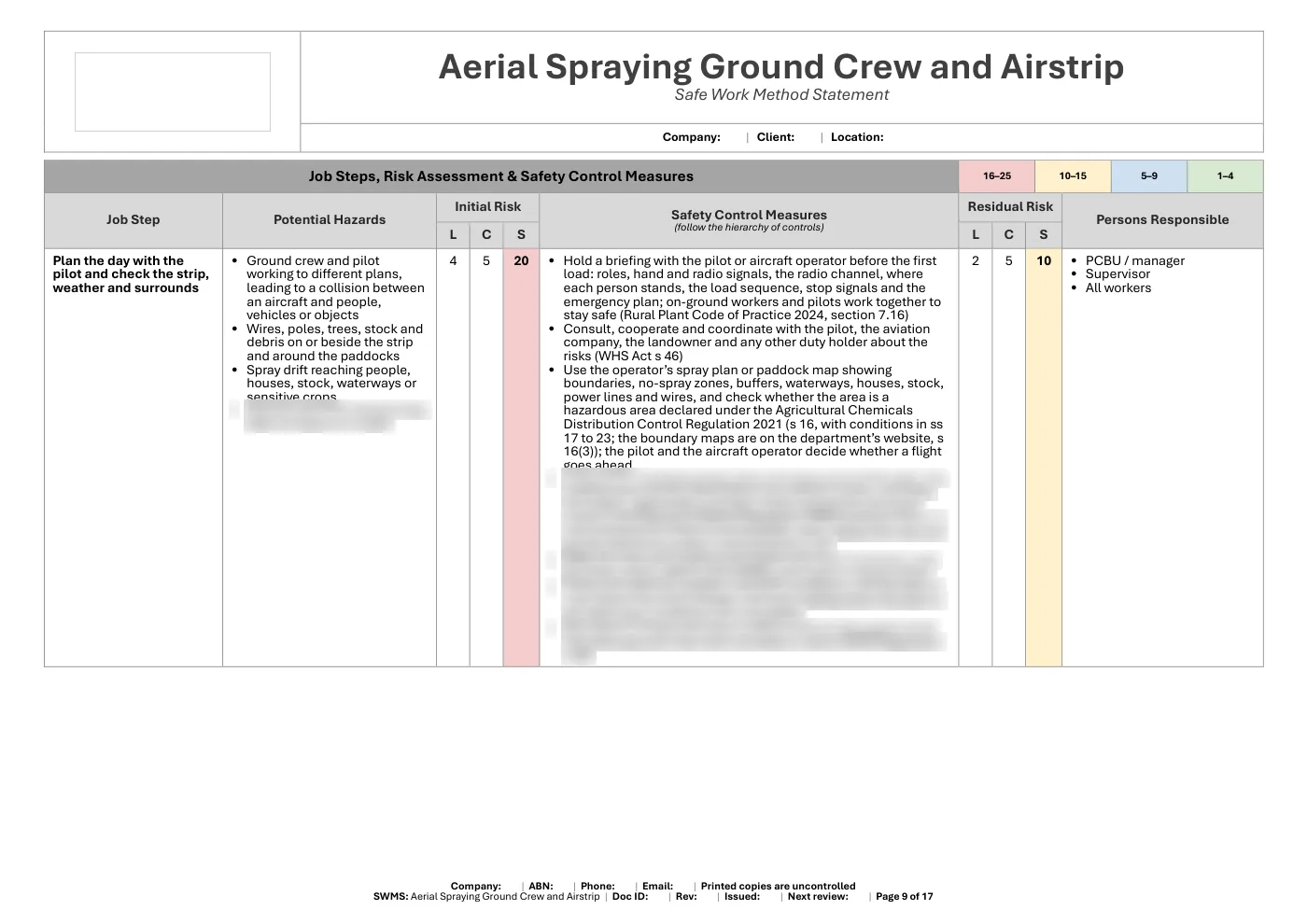
After the standard pre-start checks, the job steps run from “Plan the day with the pilot and check the strip, weather and surrounds” to “Finish the day: secure chemicals and fuel, and record the work”. The hazards and controls include:
- Being struck by an aircraft, propeller or vehicle
- Prop wash and flying grit
- Chemical splashes and concentrate on skin
- Breathing in chemical dust and vapour
- Spills at the mixing and loading point
- Aviation fuel fire and static
- Refuelling spills and fuel vapour
- Spray drift onto people and animals
- Contaminated wash water
- Noise from engines and pumps
- Heat and fatigue in chemical PPE
- Working alone in remote locations
High Risk Construction Work
None of the high risk construction work items (WHS Regulation 2011 (Qld) s 291) are pre-ticked, because this job is not high risk construction work by itself. Tick any that apply on your site.
Licences, Training and Competency
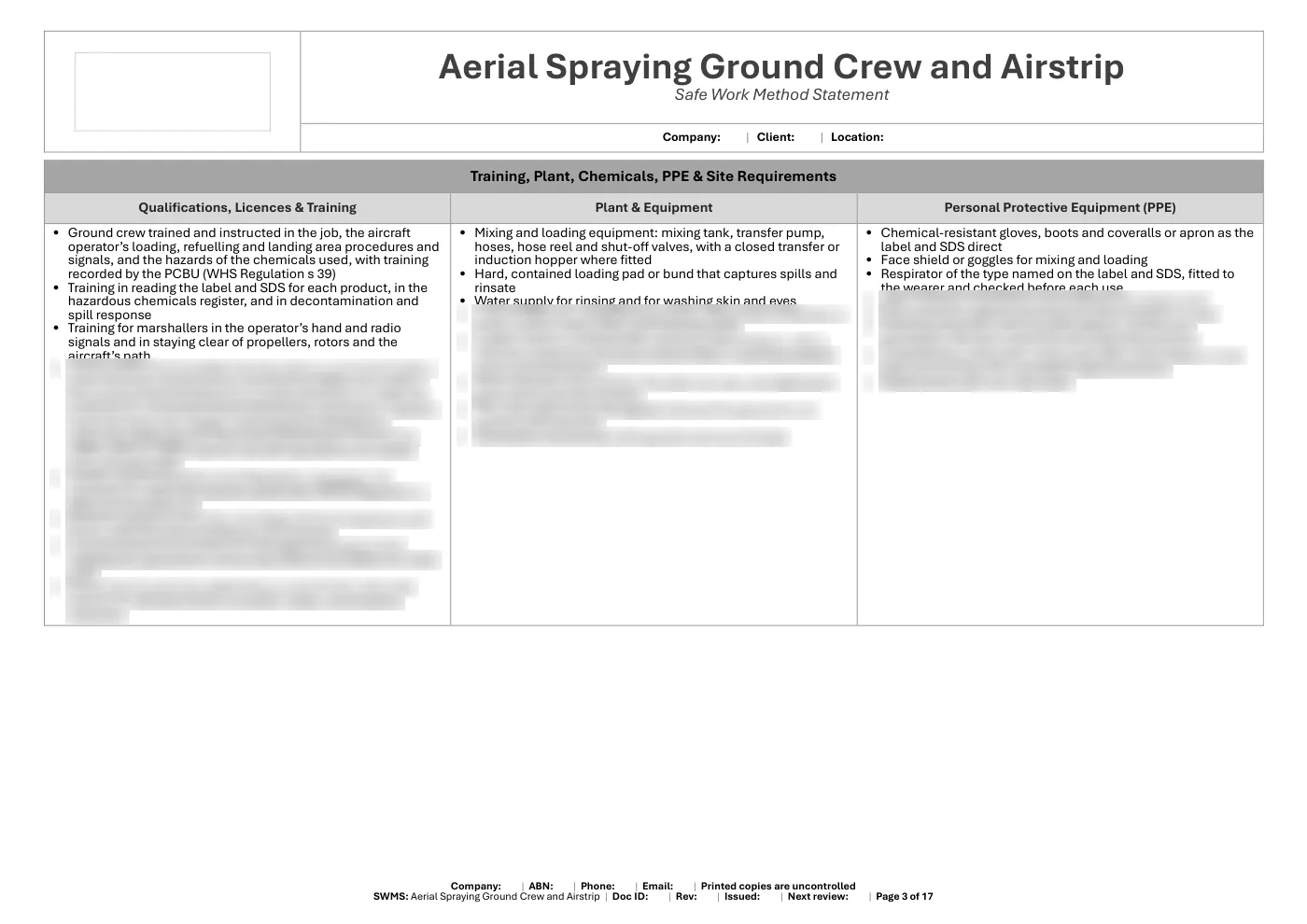
- Ground crew trained and instructed in the job, the aircraft operator’s loading, refuelling and landing area procedures and signals, and the hazards of the chemicals used, with training recorded by the PCBU (WHS Regulation s 39)
- Training in reading the label and SDS for each product, in the hazardous chemicals register, and in decontamination and spill response
- Training for marshallers in the operator’s hand and radio signals and in staying clear of propellers, rotors and the aircraft’s path
- Check before the first flight that the pilot in command holds a pilot chemical rating licence and that the flights are made in the course of the business of, or at the direction or under the authority of, a licensed aerial distribution contractor: a person must not carry out, cause or permit aerial distribution otherwise (Agricultural Chemicals Distribution Control Act 1966 s 39(1)); CASA rules for aircraft operations are stated here only generally
- Health monitoring where the Regulation requires it, for example for organophosphate pesticides (WHS Regulation s 368 and Schedule 14)
- Workers trained in first aid, including chemical exposure and burns, with first aid provided as s 42 requires
- Licensed electrical worker for fixed electrical work at the loading site, generators and pumps (Electrical Safety Act 2002 s 55)
- Driver licence and any registration or permit the road rules require for vehicles driven on public roads, and property induction
Legislation and Codes of Practice Referenced
- Work Health and Safety Act 2011 (Qld)
- Work Health and Safety Regulation 2011 (Qld)
- Work Health and Safety Act 2011 (Qld) s 46 (consulting, cooperating and coordinating with other duty holders)
- Work Health and Safety Regulation 2011 (Qld): Part 7.1 hazardous chemicals, ss 341, 342, 344, 346, 351, 357, 359, 360 and 368
- Work Health and Safety Regulation 2011 (Qld): ss 52 and 53 (ignition sources and flammable material), s 355 (fire and explosion), s 48 (remote or isolated work), ss 56 to 58 (noise), s 60 (hazardous manual tasks)
- Chemical Usage (Agricultural and Veterinary) Control Act 1988 (Qld): s 7 (unlabelled containers), s 10 (disposal of chemicals and packages), s 11B (reuse of chemical packages) and s 13(1) (a registered agricultural chemical product must be used only in a way stated on the approved label, unless a permit or regulation authorises another use)
- Agricultural Chemicals Distribution Control Act 1966 (Qld): s 6B (loss or damage includes drift) and s 39(1) (no person may carry out, cause or permit aerial distribution unless the pilot in command holds a pilot chemical rating licence and the work is done for or under a licensed aerial distribution contractor)
- Agricultural Chemicals Distribution Control Regulation 2021 (Qld): ss 14 and 15 (duties on the pilot in command: nozzle cut-off; no distribution if damage or injury to a crop or stock) and ss 16 to 23 (hazardous areas and their conditions)
- Civil Aviation Safety Regulations 1998 (Cth) Part 137 (aerial application operations other than rotorcraft, so aeroplanes only): duties of the operator of the aeroplane in reg 137.110 (procedures and equipment for the safety of persons at a landing area, including loading and unloading and any necessary lighting) and reg 137.115 (refuelling safety procedures), and of the pilot in command in reg 137.195 (supervising the loading); they are not ground crew duties, and the crew follow the operator’s procedures and the pilot’s signals
- Electrical Safety Regulation 2026 (Qld): overhead power line exclusion zones in sections 10 to 13 and schedule 2
- Rural Plant Code of Practice 2024 (agricultural aviation activities, section 7.16; chemical systems, section 7.12; remote or isolated work, Appendix 11)
- Managing Risks of Hazardous Chemicals in the Workplace Code of Practice 2021
- Labelling of Workplace Hazardous Chemicals Code of Practice 2021
- Preparation of Safety Data Sheets for Hazardous Chemicals Code of Practice 2021
- Managing Risks of Plant in the Workplace Code of Practice 2021
- Managing Noise and Preventing Hearing Loss at Work Code of Practice 2021
- First Aid in the Workplace Code of Practice 2021
- How to Manage Work Health and Safety Risks Code of Practice 2021
- Transport Operations (Road Use Management – Dangerous Goods) Regulation 2018 (Qld): carrying fuel and chemicals on public roads (stated generally)
- Safe Work Australia model Code of Practice: Managing the risk of fatigue at work (model code, not approved in Queensland; guidance only)
What You Get
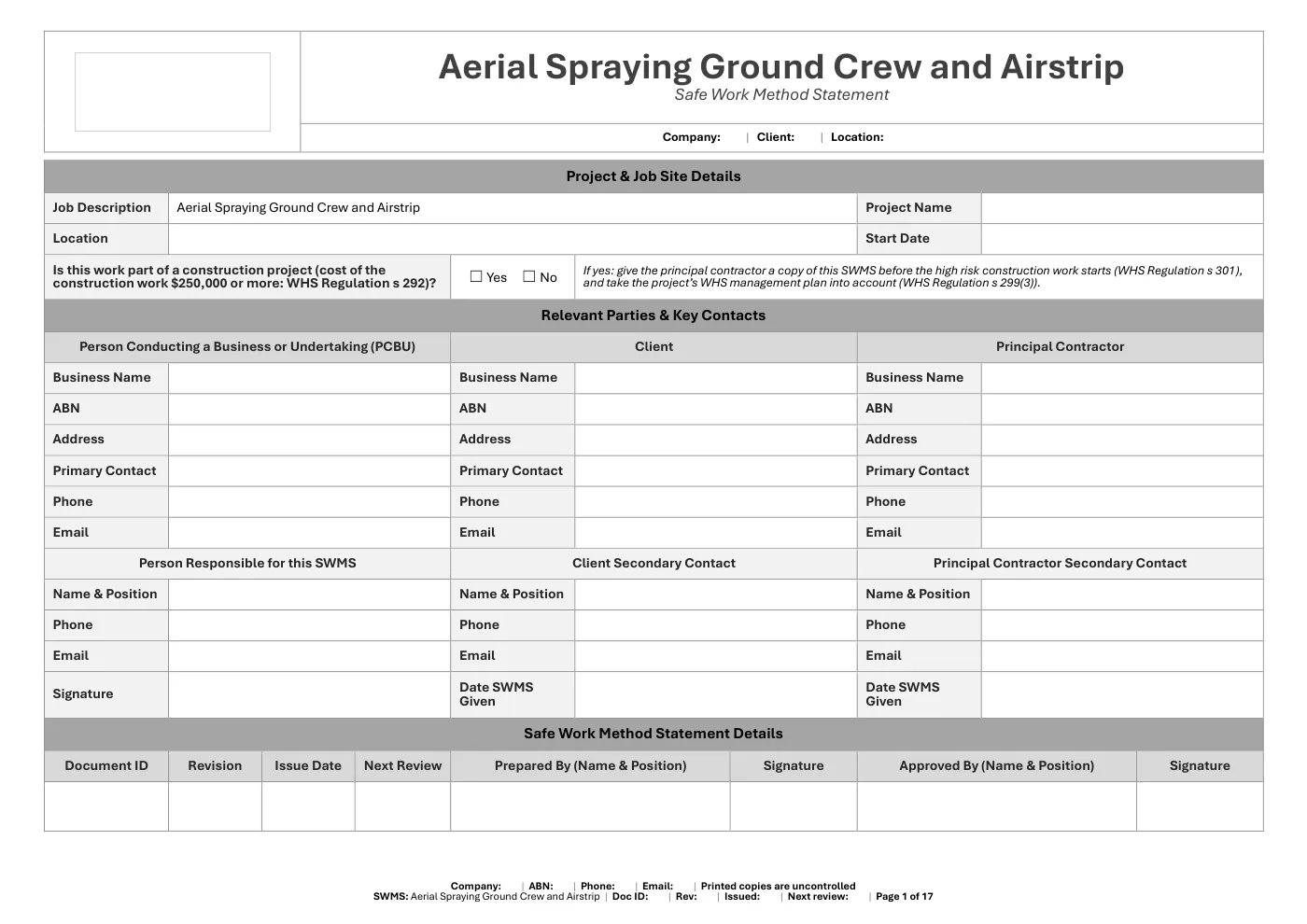
- An editable Microsoft Word document (17 A4 landscape pages). Type your business, client and job details once and they fill in on every page, with a space for your logo
- 10 job steps for this work, each with its hazards, controls, initial and residual risk scores and the person responsible
- PPE listed for this job: chemical-resistant gloves, boots and coveralls or apron as the label and SDS direct; face shield or goggles for mixing and loading
- Emergency arrangements for: aircraft crash, fire or collision on or near the strip, person struck by an aircraft, propeller or vehicle and chemical on skin or in eyes
- Plus the parts every Work Safety QLD SWMS shares, from the s 291 checklist to the worker sign-on sheet (see the layout in our free SWMS template)
Adjust it for your site, plant and crew, and talk it through with your workers before work starts. Please make sure you read our Disclaimer before downloading this SWMS.
Checked against the Queensland laws and codes of practice listed above. Last reviewed November 2026.

Reviews