
Blast Hole Drilling SWMS
Editable Word SWMS template for drilling blast holes with surface drill rigs on Queensland sites: dust, noise, rotating steel, collapsed holes and highwall edges. Charging and firing are not covered.
RG
Written by Ryan Graham, health and safety professional (16 years on Queensland sites)
$49.99 incl. GST
AUD · one-off purchase · instant download
- Instant download · your links arrive by email straight after checkout
- Make it yours in minutes · edit in Microsoft Word or Excel and add your logo
- Quality guarantee · we'll fix it or refund you if it isn't as described
- Secure checkout · card, Apple Pay or Google Pay through Stripe
About this template
For drilling contractors, civil and earthworks crews and principal contractors who drill blast holes with surface drill rigs for rock excavation. It follows the job from the drill plan, the ground checks and the exclusion zone through the rig check, tramming, drilling and rod handling to dust, noise, blocked holes and the handover to the blast crew. It does not cover charging, priming or firing explosives, which need a separate SWMS and the licences and notices the explosives laws require.
Drilling blast holes for rock excavation on a construction site is high risk construction work because powered mobile plant moves in the work area and a person could fall more than 2 metres at a highwall crest (WHS Regulation ss 289, 291(a) and 291(o)), so those two items are ticked and a SWMS is required before the work starts (s 299); you can also tick the explosives item if holes in or beside the drilling area are charged or may hold explosive, and the contaminated atmosphere item if the drilling creates silica dust, as the Queensland silica code advises. The WHS Act does not apply to a mine to which the Mining and Quarrying Safety and Health Act 1999 applies (WHS Act schedule 1, part 2, division 1, section 2(1)(b)), and a quarry is a mine under that Act (s 9(1)(f)), so at a mine or quarry use the site’s own safety and health management system (s 55 of that Act).
Learn More: What Is A Safe Work Method Statement?
Have you ever been asked to provide a SWMS on a project in Queensland? Read our guide to what a Safe Work Method Statement is and when you need one.
What Is Covered In Our Blast Hole Drilling SWMS?
The job steps run in the order the work is done, from pre-start checks to finishing up. The hazards and controls include:
- Drilling into explosive left in old holes or sockets
- Rig tip-over or sliding on benches and slopes
- Rig or person falling over a highwall crest
- Rock falling from the highwall above the pattern
- Clothing and limbs caught in rotating steel
- Crushed hands when handling rods and bits
- Respirable crystalline silica and rock dust
- Noise from the rig and compressor
- Collapsed, blocked and open holes
- Contact with overhead power lines by the mast
- Drilling into underground services
- People struck by the tramming rig
- Hose whip and hydraulic or air failure
- Heat, fatigue, lightning and fuel fires
High Risk Construction Work
These high risk construction work items (WHS Regulation 2011 (Qld) s 291) are already ticked because they are part of this work. Tick any others that apply to your job:
- Involves a risk of a person falling more than 2m
- Is carried out in an area at a workplace in which there is any movement of powered mobile plant
Licences, Training and Competency
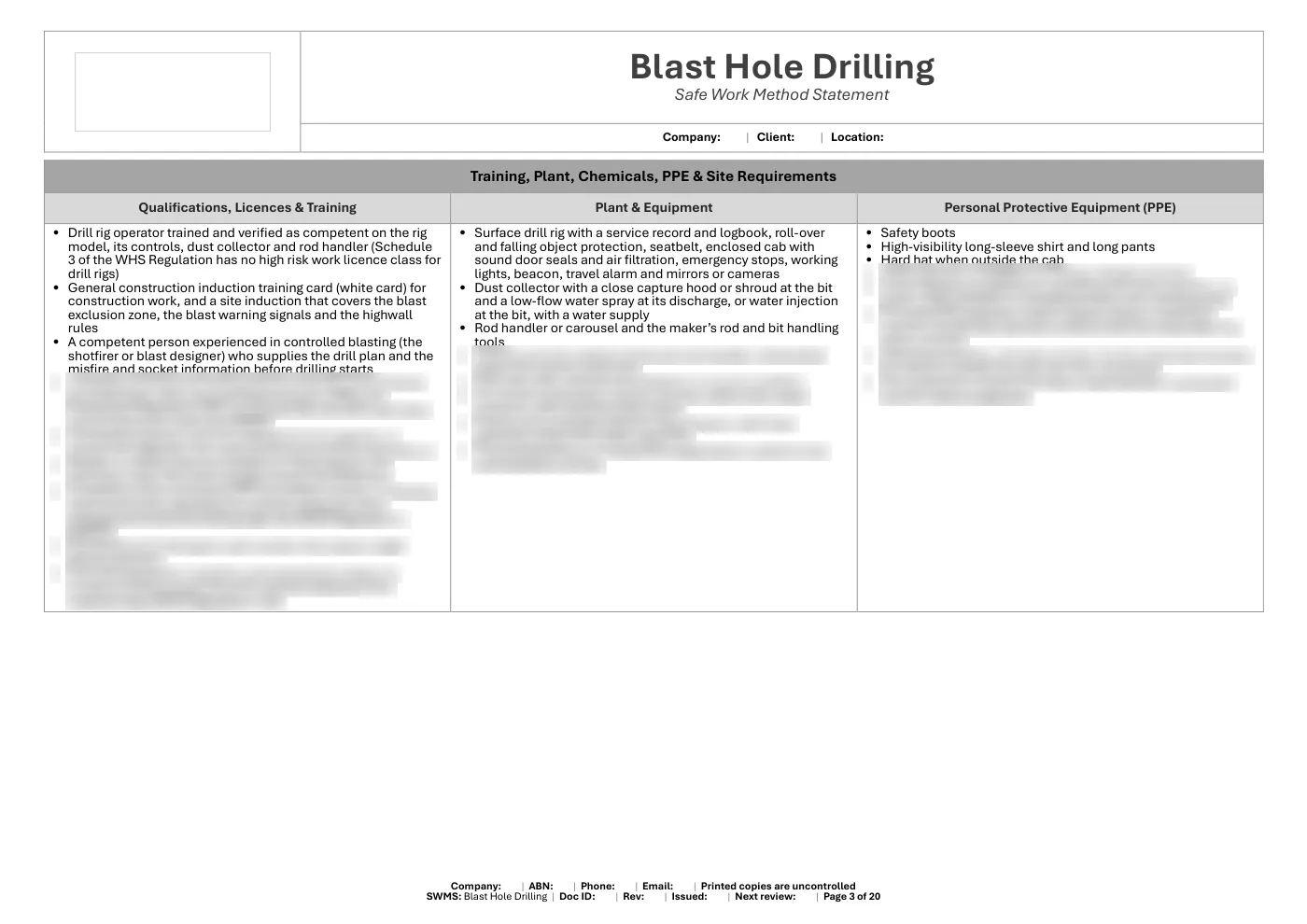
- Drill rig operator trained and verified as competent on the rig model, its controls, dust collector and rod handler (Schedule 3 of the WHS Regulation has no high risk work licence class for drill rigs)
- General construction induction training card (white card) for construction work, and a site induction that covers the blast exclusion zone, the blast warning signals and the highwall rules
- A competent person experienced in controlled blasting (the shotfirer or blast designer) who supplies the drill plan and the misfire and socket information before drilling starts
- Charging, priming and firing need the authority and licences the explosives laws require (Explosives Act 1999 s 53; Explosives Regulation 2017 ss 32 and 33); the drill crew does not do that work under this SWMS
- Competent person, such as a geotechnical engineer, to assess the highwall, the crest and the ground the rig works on
- Spotter or safety observer briefed on hand signals, the exclusion zone, the crest and the power line distances
- Crystalline silica training (a VET accredited course, or training approved by the regulator) for workers when the silica assessment finds the drilling high risk (WHS Regulation s 529CD)
- Fit-testing and training for each worker who wears a tight-fitting respirator
- First aid equipment, facilities and trained first aiders (or access to them) to suit the work and the distance from medical help (WHS Regulation s 42)
Legislation and Codes of Practice Referenced
- Work Health and Safety Act 2011 (Qld)
- Work Health and Safety Regulation 2011 (Qld)
- Excavation Work Code of Practice 2021
- Managing Risks of Plant in the Workplace Code of Practice 2021
- Managing respirable crystalline silica dust exposure in construction and manufacturing of construction elements Code of Practice 2022
- Managing Noise and Preventing Hearing Loss at Work Code of Practice 2021
- Hazardous Manual Tasks Code of Practice 2021
- Managing the Risk of Falls at Workplaces Code of Practice 2021
- Managing the Work Environment and Facilities Code of Practice 2021
- Managing Risks of Hazardous Chemicals in the Workplace Code of Practice 2021
- First Aid in the Workplace Code of Practice 2021
- How to Manage Work Health and Safety Risks Code of Practice 2021
- Explosives Act 1999 (Qld) and Explosives Regulation 2017 (Qld): the authority, licences, blast rules and notices for charging and firing, which this SWMS does not cover
- Mining and Quarrying Safety and Health Act 1999 (Qld): the WHS Act does not apply to a mine to which that Act applies (WHS Act schedule 1, part 2, division 1, section 2(1)(b)); a quarry is a mine (s 9(1)(f)), being a place where operations are carried on to produce construction or road building material, except in the cases listed in s 11(2)
- Electrical Safety Act 2002 (Qld)
- Electrical Safety Regulation 2026 (Qld): overhead and underground electric line duties (ss 13 to 15) and the exclusion zones in schedule 2
- Electrical Safety Code of Practice 2020 – Working near overhead and underground electric lines (distances come from the 2026 Regulation)
- AS/NZS 1716:2012 and AS/NZS 1715:2009 (respiratory protective devices, and their selection, use and maintenance, as WHS Regulation s 529B names them)
- Safe Work Australia model Code of Practice: Elevating work platforms (guidance); its power line contact advice is applied by analogy
What You Get
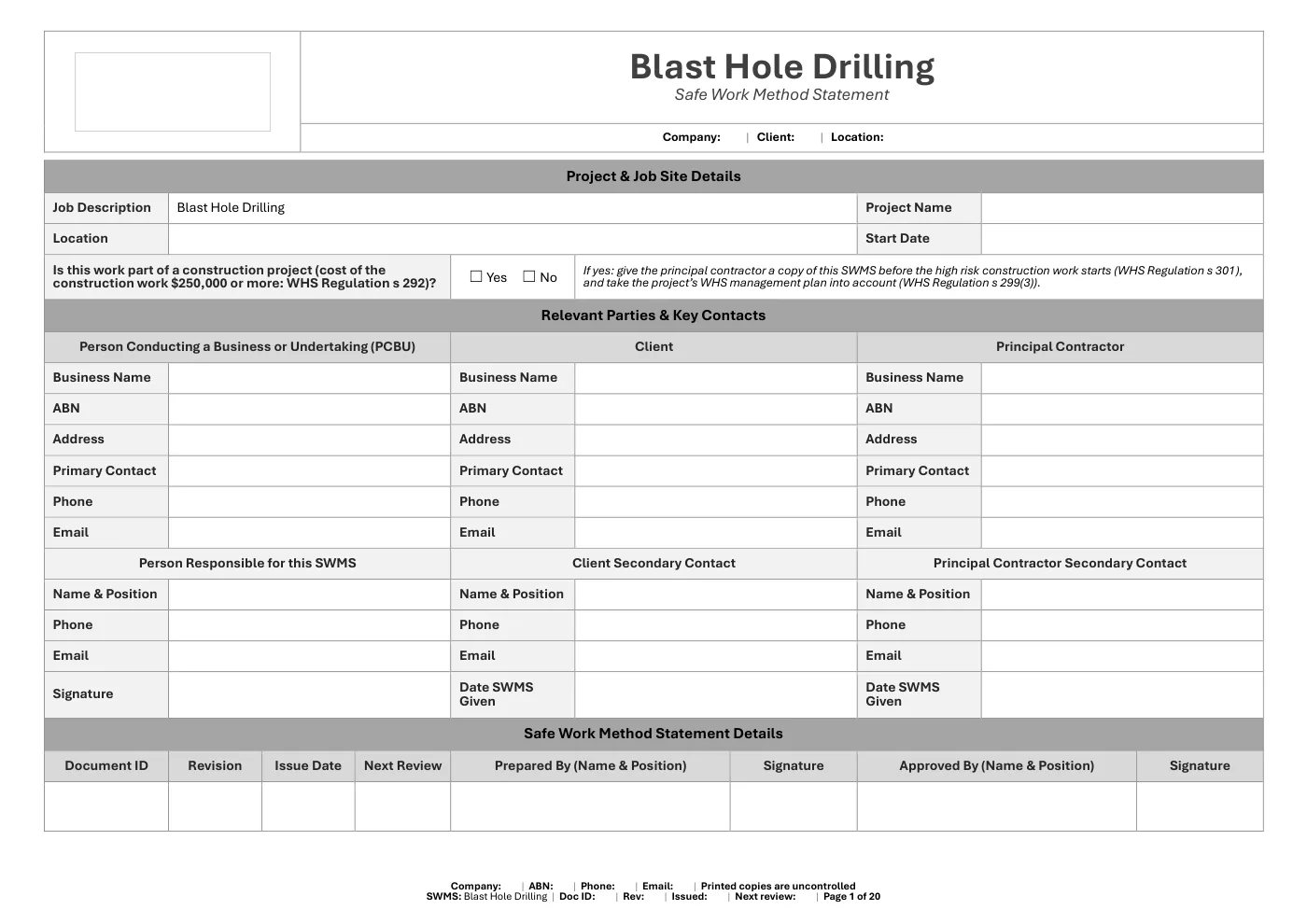
- An editable Microsoft Word document (20 pages), laid out on A4 landscape pages
- Business, client, job and document details typed once and filled in on every page, plus a space for your logo
- The high risk construction work checklist, worded as WHS Regulation s 291, and the construction project question (s 292)
- A worker and health and safety representative consultation record
- Qualifications, plant, PPE, hazardous chemicals, safety equipment, permits, references and emergency arrangements filled in for this work
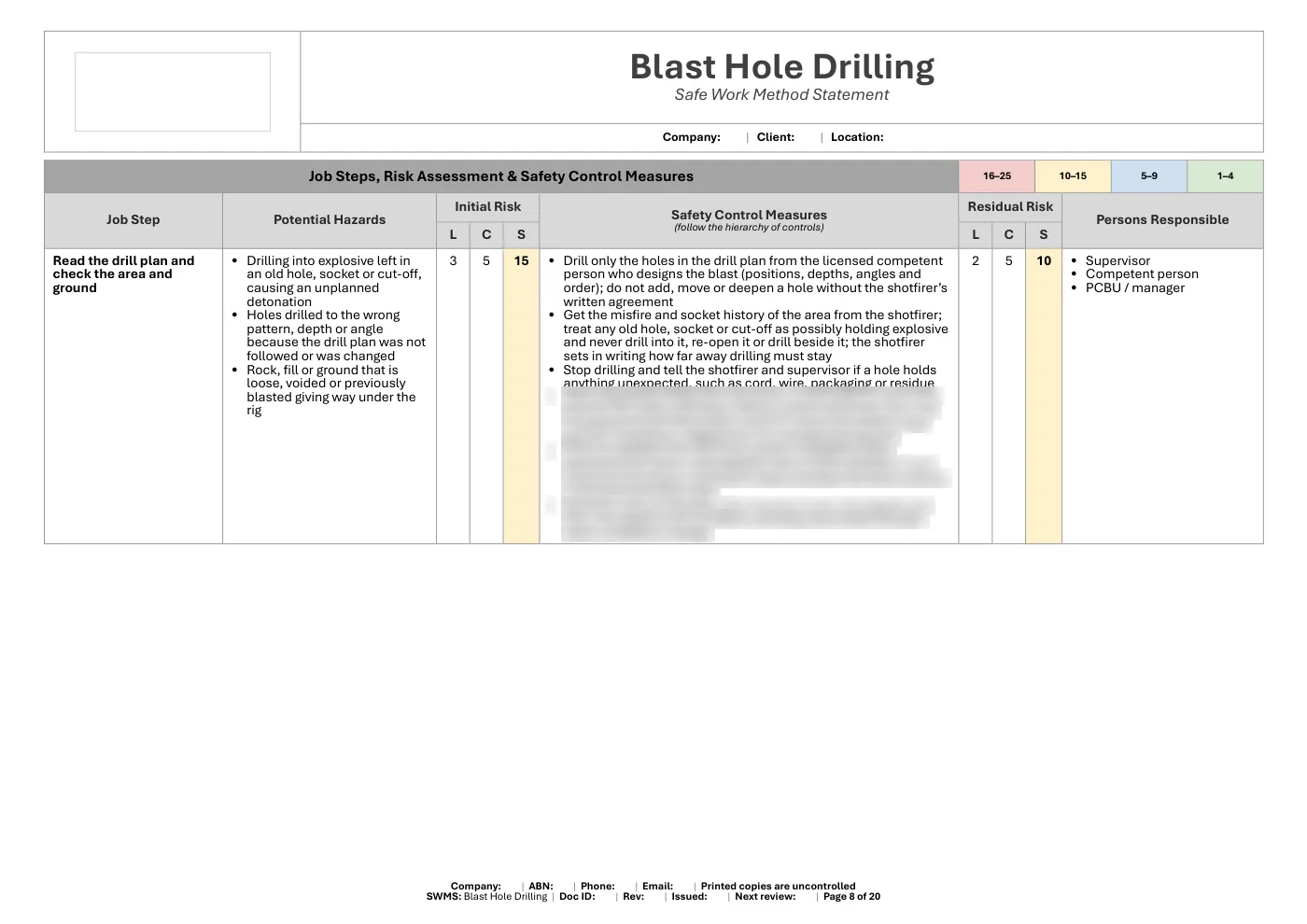
- A 5 x 5 risk matrix, and job steps with initial and residual risk scores and the people responsible
- Implementing, monitoring and review requirements, an additional controls log, revision history and a worker sign-on sheet
Review and adjust it for your site, your plant and the way your crew does the job, and talk it through with your workers before work starts. If you have any trouble downloading this SWMS, you can contact us at any time. Please make sure you read our Disclaimer before downloading this SWMS.
How to use it
From download to site in three steps
Buy and download
Check out with card, Apple Pay or Google Pay. Your download buttons appear straight away and the links are emailed to you.
Make it yours
Open it in Microsoft Word or Excel. Add your logo, business details, site and job information, and adjust it to how the work is done.
Brief your crew
Talk it through with the workers doing the job, have them sign on, and keep it on site. Review it whenever the job or conditions change.
What format is it?
Microsoft Word (registers are Excel). Edit it in Word or Excel, or free in Word and Excel for the web, and add your own logo and business details.
How do I get it after I pay?
Your download buttons appear as soon as checkout finishes, and the links are emailed to you. You can re-download from your account at any time.
Is it compliant with Queensland law?
It's written around Queensland's Work Health and Safety Act 2011 and Regulation 2011. Tailor it to your site, consult your workers and review it whenever conditions change; no template can guarantee compliance on its own.
What if it isn't right for my job?
If it doesn't match its description or has a fault, we'll fix it, and if we can't, we'll refund you (or give you store credit if you'd prefer). Check the sample pages first, as we don't refund a change of mind.
Reviews
More templates
Reviews