Grave Digging and Burial SWMS
Digging graves and conducting burials in Queensland: grave collapse and shoring, coffin handling, ground services and mini excavator use. An editable Word SWMS template.
RG
Written by Ryan Graham, health and safety professional (16 years on Queensland sites)
$39.99 incl. GST
AUD · one-off purchase · instant download
- Instant download · your links arrive by email straight after checkout and work for 3 months, so save your copy
- Make it yours in minutes · edit in Microsoft Word and add your logo
- Quality guarantee · we'll fix any problem, then refund you or give store credit if you're still not happy
- Secure checkout · card, Apple Pay or Google Pay through Stripe
About this template
For cemetery operators, council cemetery crews, grave diggers and funeral businesses who dig graves with a mini excavator and take part in burials. It follows the job from confirming the plot and services through digging, support, inspection, the graveside and lowering the coffin to backfilling, with respectful wording throughout. Excavation in general is covered by a separate SWMS.
A SWMS is required by law only for high risk construction work (WHS Regulation s 299), and digging a grave is not high risk construction work by itself: the WHS Regulation’s meaning of ‘excavation’ leaves out a trench for use as a place of interment, so grave digging is not ‘work connected with an excavation’ under section 289(2)(f) and the excavation work duties in sections 304 and 305 do not apply to it, which the Excavation Work Code of Practice 2021 also says. No item is pre-ticked, and the document works as a written safe work procedure or task risk assessment. Section 306 is worded for a trench at least 1.5 metres deep and the separate meaning of ‘trench’ has no exclusion for graves, so this template applies its secured-area and support controls to deep graves, and section 78 (falls) and the general duties in the WHS Act apply either way. If a job is construction work, for example building or altering a vault, crypt or retaining wall, tick the items that apply, such as the shaft or trench item when the grave is deeper than 1.5 metres (item g), powered mobile plant (item o), falls over 2 metres (item a) or energised services (item k). Burial and cemetery law and the cemetery operator’s rules sit outside this document and must be followed.
New to SWMS? Read What Is A Safe Work Method Statement?
What Is Covered In Our Grave Digging and Burial SWMS?
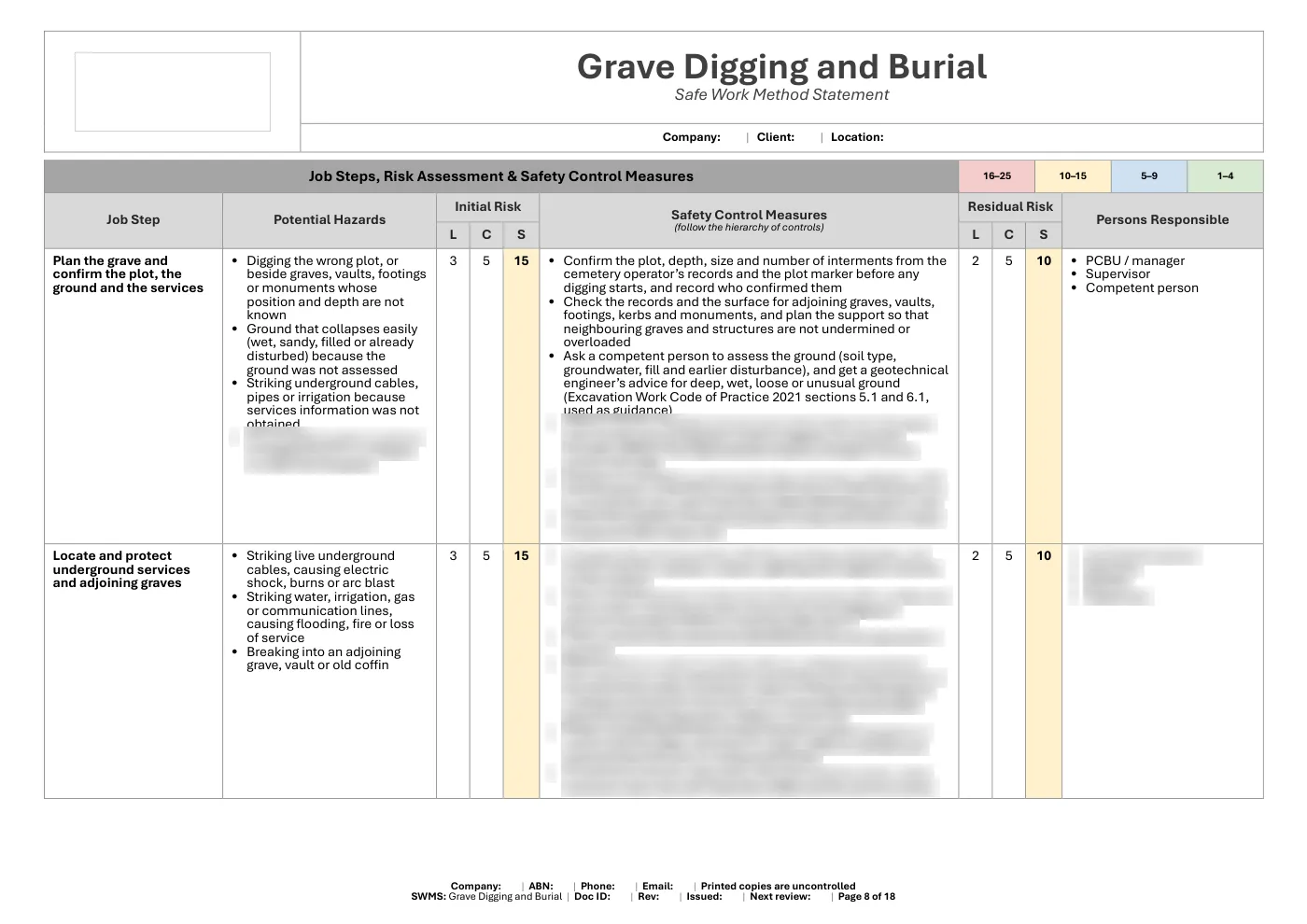
After the standard pre-start checks, the job steps run from “Plan the grave and confirm the plot, the ground and the services” to “Respond to a collapse, an unexpected find or distress”. The hazards and controls include:
- Grave wall collapse and engulfment
- Shoring or shields failing or used wrongly
- Entering a grave before it is inspected
- Falls into open graves
- Striking underground cables and pipes
- Undermining neighbouring graves and monuments
- Leaning headstones and monuments
- Workers struck by the mini excavator
- Excavator overturn on soft ground
- Manual handling when lowering a coffin
- Gas, water and unexpected finds in the ground
- Soil hygiene, biological hazards and worker distress
High Risk Construction Work
None of the high risk construction work items (WHS Regulation 2011 (Qld) s 291) are pre-ticked, because this job is not high risk construction work by itself. Tick any that apply on your site.
Licences, Training and Competency
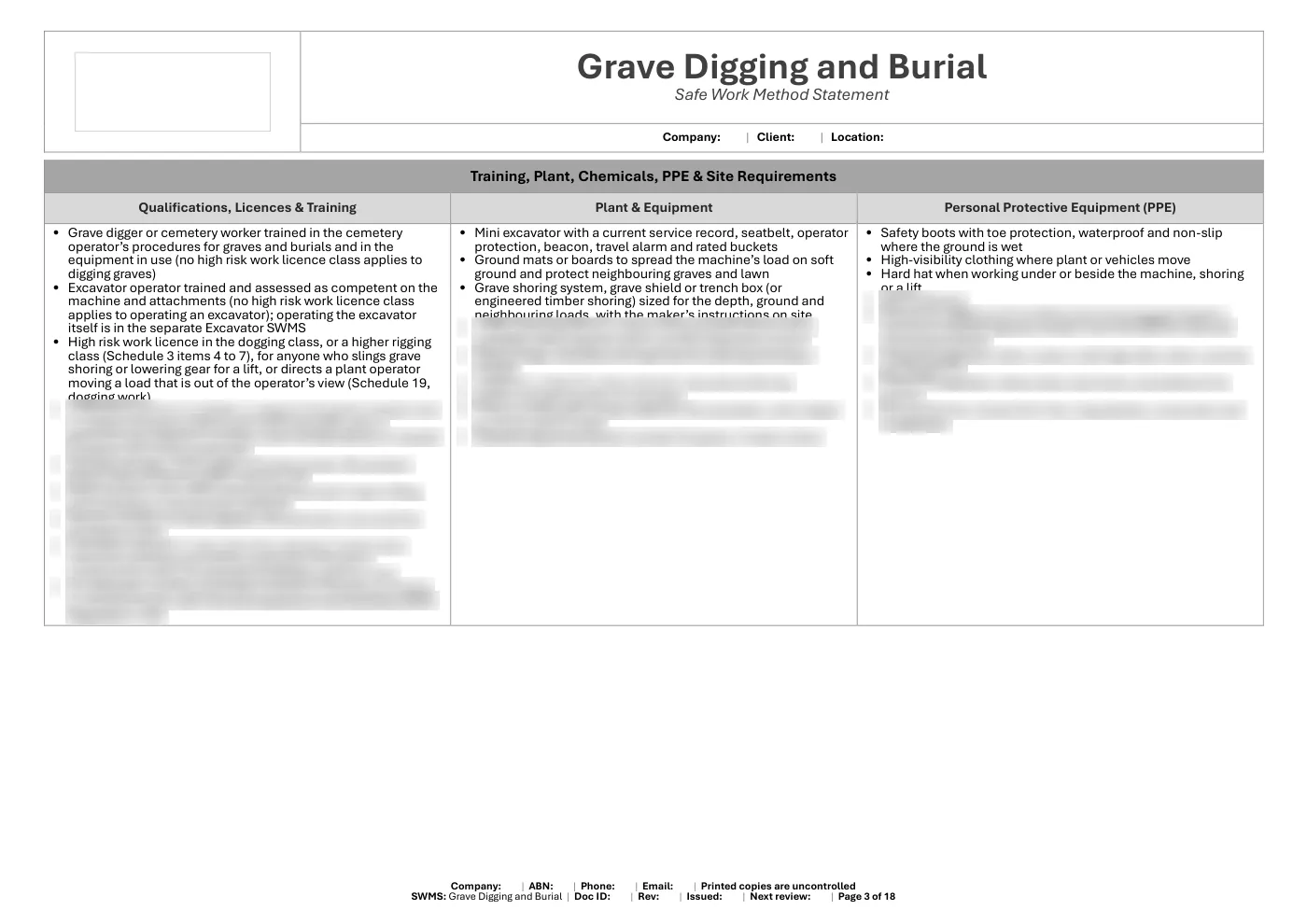
- Grave digger or cemetery worker trained in the cemetery operator’s procedures for graves and burials and in the equipment in use (no high risk work licence class applies to digging graves)
- Excavator operator trained and assessed as competent on the machine and attachments (no high risk work licence class applies to operating an excavator); operating the excavator itself is in the separate Excavator SWMS
- High risk work licence in the dogging class, or a higher rigging class (Schedule 3 items 4 to 7), for anyone who slings grave shoring or lowering gear for a lift, or directs a plant operator moving a load that is out of the operator’s view (Schedule 19, dogging work)
- Competent person to design or approve the grave support and to inspect the grave before each shift and after rain; a geotechnical engineer’s written, time-limited advice is needed if a grave will not be supported
- Trained operator of the cable and pipe locator (Excavation Work Code of Practice 2021 section 3.6)
- Staff trained in the coffin lowering device and in team lifting and hazardous manual task methods
- Spotter briefed on hand signals, the exclusion zone and the emergency plan
- Cemetery operator’s site induction; general construction induction training card (white card) only if the job is construction work, for example building a vault or crypt
- An adequate number of workers trained in first aid, or access to trained people, with first aid equipment and facilities (WHS Regulation s 42)
Legislation and Codes of Practice Referenced
- Work Health and Safety Act 2011 (Qld)
- Work Health and Safety Regulation 2011 (Qld)
- Work Health and Safety Regulation 2011 (Qld): the meaning of ‘excavation’ in schedule 19 leaves out a trench for use as a place of interment, so the excavation work duties in ss 304 and 305 do not apply to graves; s 306 is worded for a ‘trench’ at least 1.5 m deep and the separate schedule 19 meaning of ‘trench’ has no such exclusion, so it can reach a deep grave and this SWMS applies its controls to graves 1.5 m or more deep
- Work Health and Safety Regulation 2011 (Qld): s 78 (risk of falls), ss 214 and 215 (powered mobile plant), s 60 (hazardous manual tasks), ss 56 and 57 (noise), s 55C (psychosocial risks), ss 42 to 44 (first aid, emergency plan and personal protective equipment)
- Excavation Work Code of Practice 2021 (section 1.1 says the WHS requirements for excavation work do not apply to a trench used as a place of interment; its guidance in sections 3.6, 5.1 and 6.1 on services, trenches and ground conditions is used as good practice)
- Managing Risks of Plant in the Workplace Code of Practice 2021
- Hazardous Manual Tasks Code of Practice 2021
- Managing the Risk of Falls at Workplaces Code of Practice 2021
- Managing Noise and Preventing Hearing Loss at Work Code of Practice 2021
- Managing the risk of psychosocial hazards at work Code of Practice 2022
- Managing the Work Environment and Facilities Code of Practice 2021
- First Aid in the Workplace Code of Practice 2021
- How to Manage Work Health and Safety Risks Code of Practice 2021
- Safe Work Australia model Code of Practice: Managing the risks of biological hazards at work (model code, not approved in Queensland; guidance only)
- Electrical Safety Act 2002 (Qld)
- Electrical Safety Regulation 2026 (Qld): ss 10 to 13 and schedule 2 (overhead power line exclusion zones)
- Electrical Safety Regulation 2026 (Qld): ss 14 and 15 (underground electric lines)
- Electrical Safety Code of Practice 2020 – Working near overhead and underground electric lines
What You Get
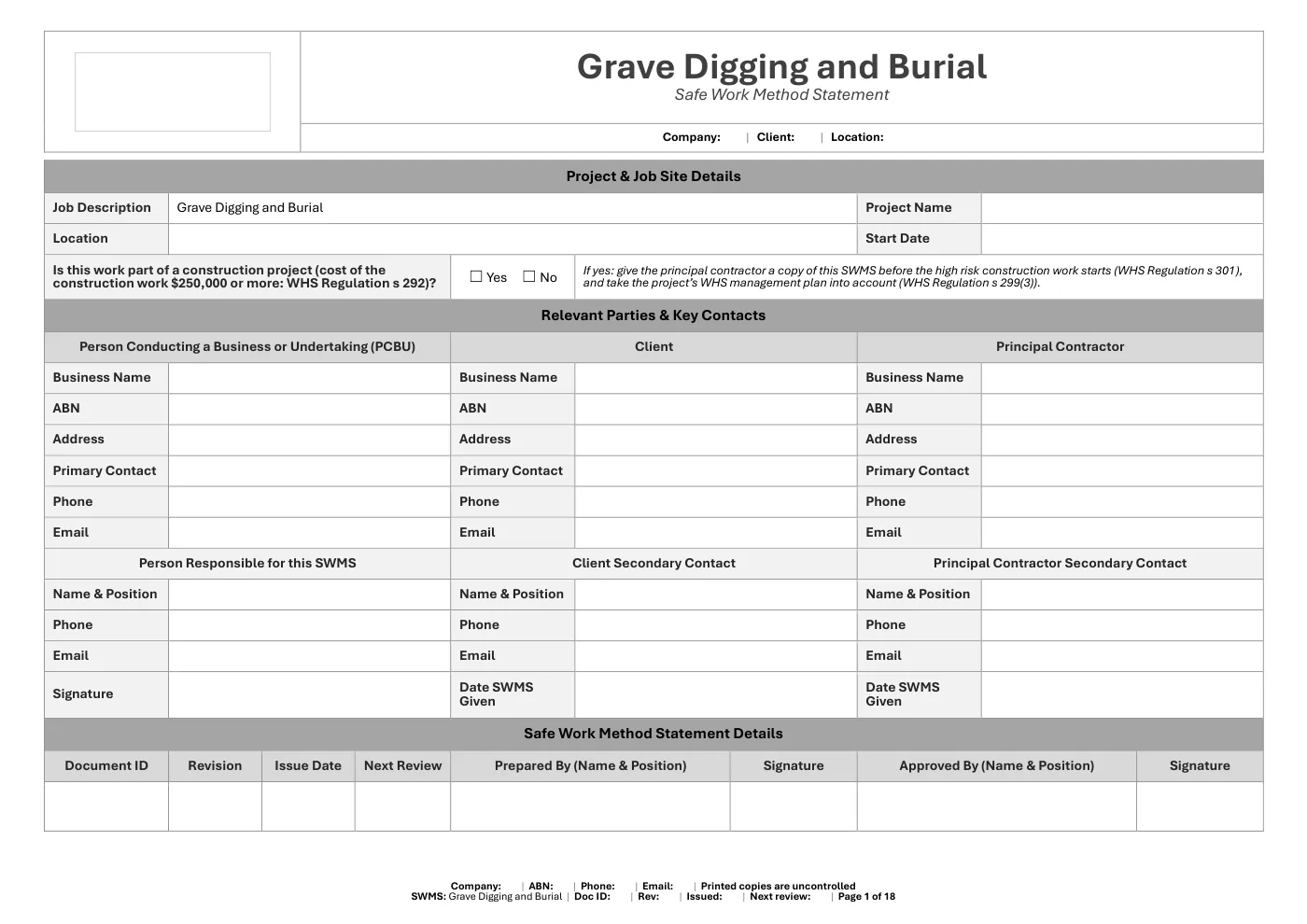
- An editable Microsoft Word document (18 A4 landscape pages). Type your business, client and job details once and they fill in on every page, with a space for your logo
- 10 job steps for this work, each with its hazards, controls, initial and residual risk scores and the person responsible
- PPE listed for this job: safety boots with toe protection, waterproof and non-slip where the ground is wet; high-visibility clothing where plant or vehicles move
- Emergency arrangements for: collapse or person trapped in a grave, person falls into a grave and damaged service or power line contact
- Plus the parts every Work Safety QLD SWMS shares, from the s 291 checklist to the worker sign-on sheet (see the layout in our free SWMS template)
Adjust it for your site, plant and crew, and talk it through with your workers before work starts. Please make sure you read our Disclaimer before downloading this SWMS.
Checked against the Queensland laws and codes of practice listed above. Last reviewed November 2026.
Having trouble with your download? Contact us any time. Please read our Disclaimer before downloading.
How to use it
From download to site in three steps
Buy and download
Check out with card, Apple Pay or Google Pay. Your download buttons appear straight away and the links are emailed to you. Links work for 3 months, so save your copies.
Make it yours
Open it in Microsoft Word or Excel. Add your logo, business details, site and job information, and adjust it to how the work is done.
Brief your crew
Talk it through with the workers doing the job, have them sign on, and keep it on site. Review it whenever the job or conditions change.
What format is it?
Microsoft Word. Edit it in Word, or free in Word for the web, and add your own logo and business details.
How do I get it after I pay?
Your download buttons appear as soon as checkout finishes, and the links are emailed to you. You can re-download from your account at any time.
Is it compliant with Queensland law?
It's written around Queensland's Work Health and Safety Act 2011 and Regulation 2011. Tailor it to your site, consult your workers and review it whenever conditions change; no template can guarantee compliance on its own.
What if it isn't right for my job?
If it doesn't match its description or has a fault, tell us and we'll fix it. If you're still not happy, we'll refund you or give you store credit, your choice. Check the sample pages first, as we don't refund a change of mind.
More templates like this
$49.99
Hot Work SWMS
$39.99

Confined Spaces SWMS
$49.99


Reviews