Skip to content

Electric Fence Installation SWMS

Installing electric fences on Queensland farms and rural properties: energiser connection, shock, pegging, wire handling and uneven ground. An editable Word SWMS template.

RG

Written by Ryan Graham, health and safety professional (16 years on Queensland sites)

$39.99 incl. GST

AUD · one-off purchase · instant download

  • Instant download · your links arrive by email straight after checkout and work for 3 months, so save your copy
  • Make it yours in minutes · edit in Microsoft Word and add your logo
  • Quality guarantee · we'll fix any problem, then refund you or give store credit if you're still not happy
  • Secure checkout · card, Apple Pay or Google Pay through Stripe

About this template

For fencing contractors, farmers, graziers and land managers who install electric fences. It follows the work from planning and working near power lines through travel, setting out and driving pegs, running wire, tape and insulators, and installing the energiser and earth system, to energising, testing, handover and emergency response. Post and wire fences and residential or commercial fences need their own SWMS.

A fence is a structure (anything constructed, WHS Act s 4) and construction work includes building a structure (WHS Regulation s 289(1)). A SWMS is required by law for high risk construction work (s 299). No reg 291 item is pre-ticked. An energiser plugged into a socket and an energised fence wire are most likely electrical equipment rather than an electrical installation (Electrical Safety Act 2002 ss 14 and 15, where equipment connected by plug and socket is not permanently connected), so tick the item for work on or near energised electrical installations or services only if the job connects the energiser to fixed supply wiring or is carried out on or near an energised switchboard, overhead line or underground cable. Tick movement of powered mobile plant if a tractor, quad bike or utility moves in the work area, and tick any other item that applies. Testing, maintenance or repair work of a minor nature is not construction work (s 289(3)(d)), so routine repairs to an existing electric fence may not need a SWMS by law; otherwise this works as a written safe work procedure and task risk assessment.

New to SWMS? Read What Is A Safe Work Method Statement?

What Is Covered In Our Electric Fence Installation SWMS?

After the standard pre-start checks, the job steps run from “Plan the fence and check the property” to “Respond to an electric shock, wire injury, snake bite or roll-over”. The hazards and controls include:

  • Electric shock from the energiser and fence
  • Mains and supply wiring at the energiser
  • Contact with overhead power lines
  • Striking underground cables
  • Wire recoil and cuts
  • Hammer and post driving injuries
  • Quad bike and tractor roll-over
  • Snake bites and insect stings
  • Heat illness and fatigue
  • Livestock near the fence
  • Lightning at the fence line
  • Remote work with no easy way to call for help

High Risk Construction Work

None of the high risk construction work items (WHS Regulation 2011 (Qld) s 291) are pre-ticked, because this job is not high risk construction work by itself. Tick any that apply on your site.

Licences, Training and Competency

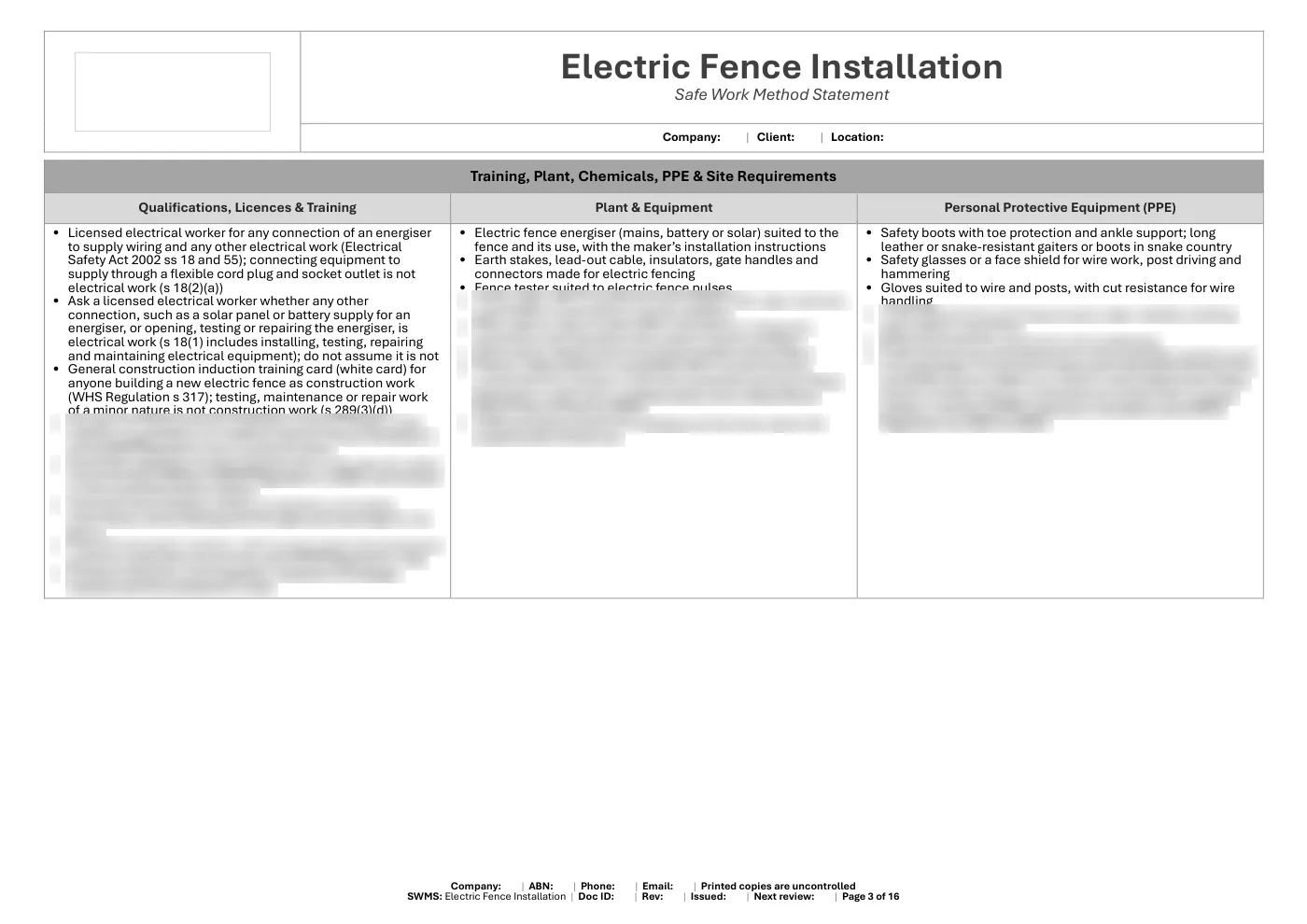
  • Licensed electrical worker for any connection of an energiser to supply wiring and any other electrical work (Electrical Safety Act 2002 ss 18 and 55); connecting equipment to supply through a flexible cord plug and socket outlet is not electrical work (s 18(2)(a))
  • Ask a licensed electrical worker whether any other connection, such as a solar panel or battery supply for an energiser, or opening, testing or repairing the energiser, is electrical work (s 18(1) includes installing, testing, repairing and maintaining electrical equipment); do not assume it is not
  • General construction induction training card (white card) for anyone building a new electric fence as construction work (WHS Regulation s 317); testing, maintenance or repair work of a minor nature is not construction work (s 289(3)(d))
  • No high risk work licence is required to drive a tractor, utility vehicle or quad bike or to install an electric fence; Schedule 3 of the WHS Regulation has no class for them
  • Quad bike operators at least 16 years old, or the age the maker recommends if different (WHS Regulation s 226A), and trained on the quad bike before riding it
  • Training in the energiser maker’s installation and safety instructions, fence testing and the signs and warnings for the fence
  • First aid training for workers, with access to first aid equipment suited to snake bite and remote work (WHS Regulation s 42)
  • Property induction covering gates, livestock, fire danger, hazards and the landowner’s rules

Legislation and Codes of Practice Referenced

  • Work Health and Safety Act 2011 (Qld)
  • Work Health and Safety Regulation 2011 (Qld)
  • Work Health and Safety Regulation 2011 (Qld): ss 226A to 226C (quad bikes)
  • Work Health and Safety Regulation 2011 (Qld): ss 205 to 216 (plant controls, guarding, powered mobile plant and roll-over protection on tractors)
  • Work Health and Safety Regulation 2011 (Qld): s 48 (remote or isolated work) and s 304 (excavation work: underground essential services information, where holes are excavation work)
  • Work Health and Safety Regulation 2011 (Qld): s 60 (hazardous manual tasks)
  • Rural Plant Code of Practice 2024
  • Managing Risks of Plant in the Workplace Code of Practice 2021
  • Hazardous Manual Tasks Code of Practice 2021
  • Managing the Work Environment and Facilities Code of Practice 2021
  • Managing Risks of Hazardous Chemicals in the Workplace Code of Practice 2021
  • First Aid in the Workplace Code of Practice 2021
  • Excavation Work Code of Practice 2021 (post and earth stake holes and underground services)
  • How to Manage Work Health and Safety Risks Code of Practice 2021
  • Electrical Safety Act 2002 (Qld): ss 14, 15, 18 and 55 (electrical equipment, electrical installation, what is electrical work, and that only licensed electrical workers do it)
  • Electrical Safety Regulation 2026 (Qld): ss 10 to 13 and schedule 2 (exclusion zones for overhead electric lines) and ss 14 and 15 (underground electric lines)
  • Electrical Safety Regulation 2026 (Qld): ss 125 and 141 (for a business that involves rural industry work, which includes fencing land for crops or farm animals: inspection of specified electrical equipment, and a safety switch or annual testing where it involves a stated electrical risk factor)
  • Electrical Safety Code of Practice 2020 – Working near overhead and underground electric lines (distances come from the 2026 Regulation)
  • Electrical Safety Code of Practice 2020 – Electrical equipment rural industry
  • Safe Work Australia model Code of Practice: Managing the risks of biological hazards at work (model code, not approved in Queensland; guidance only)
  • Safe Work Australia model Code of Practice: Managing the risk of fatigue at work (model code, not approved in Queensland; guidance only)

What You Get

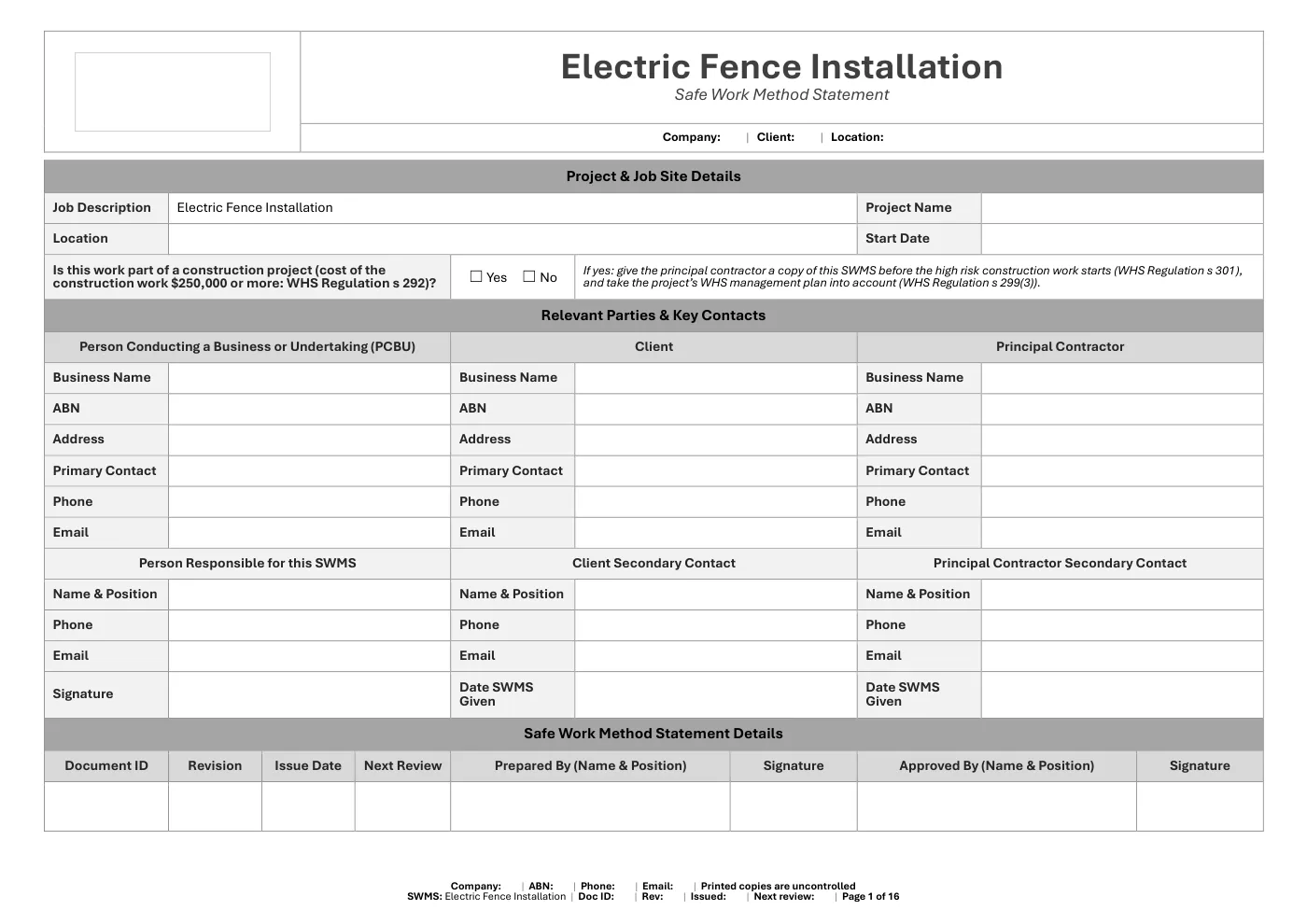
  • An editable Microsoft Word document (16 A4 landscape pages). Type your business, client and job details once and they fill in on every page, with a space for your logo
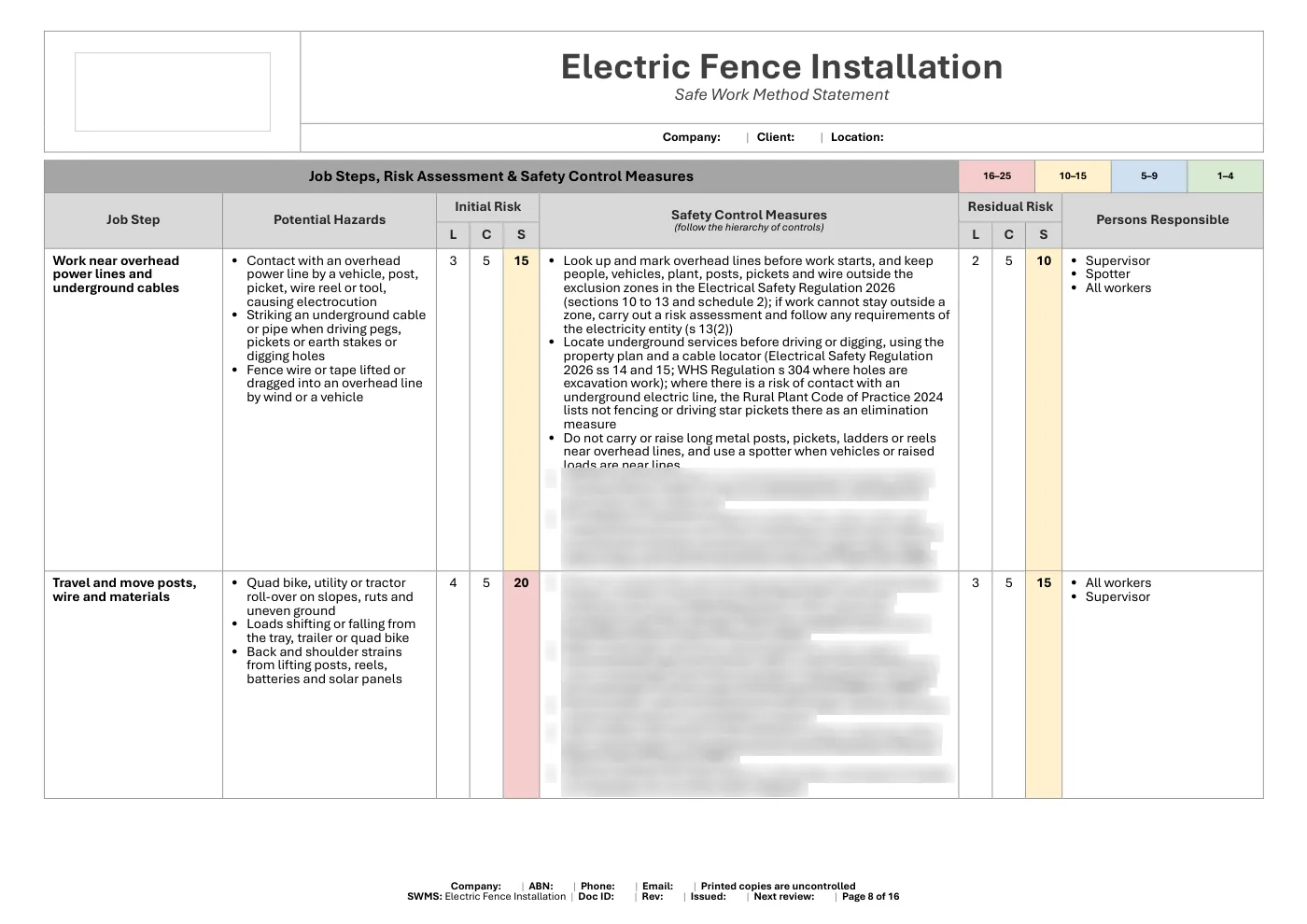
  • 10 job steps for this work, each with its hazards, controls, initial and residual risk scores and the person responsible
  • PPE listed for this job: safety boots with toe protection and ankle support; long leather or snake-resistant gaiters or boots in snake country; safety glasses or a face shield for wire work, post driving and hammering
  • Emergency arrangements for: electric shock or a person caught on the fence, vehicle contact with a power line and snake bite
  • Plus the parts every Work Safety QLD SWMS shares, from the s 291 checklist to the worker sign-on sheet (see the layout in our free SWMS template)

Adjust it for your site, plant and crew, and talk it through with your workers before work starts. Please make sure you read our Disclaimer before downloading this SWMS.

Checked against the Queensland laws and codes of practice listed above. Last reviewed November 2026.

Having trouble with your download? Contact us any time. Please read our Disclaimer before downloading.

How to use it

From download to site in three steps

Buy and download

Check out with card, Apple Pay or Google Pay. Your download buttons appear straight away and the links are emailed to you. Links work for 3 months, so save your copies.

Make it yours

Open it in Microsoft Word or Excel. Add your logo, business details, site and job information, and adjust it to how the work is done.

Brief your crew

Talk it through with the workers doing the job, have them sign on, and keep it on site. Review it whenever the job or conditions change.

FAQ

Before you buy

Something else? Ask us and a real person will reply.

What format is it?

Microsoft Word. Edit it in Word, or free in Word for the web, and add your own logo and business details.

How do I get it after I pay?

Your download buttons appear as soon as checkout finishes, and the links are emailed to you. You can re-download from your account at any time.

Is it compliant with Queensland law?

It's written around Queensland's Work Health and Safety Act 2011 and Regulation 2011. Tailor it to your site, consult your workers and review it whenever conditions change; no template can guarantee compliance on its own.

What if it isn't right for my job?

If it doesn't match its description or has a fault, tell us and we'll fix it. If you're still not happy, we'll refund you or give you store credit, your choice. Check the sample pages first, as we don't refund a change of mind.
Reviews

Be the first to review “Electric Fence Installation SWMS”

Your email address will not be published. Required fields are marked *

Bought or downloaded this template from us? Leave an honest review, good or bad, and we'll email you a code for a free template of your choice (single templates, not packs). One per order.

More templates like this