Chemical Dosing System Installation SWMS
Installing chemical dosing pumps, tanks, bunding and pipework in Queensland: splashes, incompatible chemicals, licensed electrical connection and first fill. An editable Word SWMS template.
RG
Written by Ryan Graham, health and safety professional (16 years on Queensland sites)
$49.99 incl. GST
AUD · one-off purchase · instant download
- Instant download · your links arrive by email straight after checkout and work for 3 months, so save your copy
- Make it yours in minutes · edit in Microsoft Word and add your logo
- Quality guarantee · we'll fix any problem, then refund you or give store credit if you're still not happy
- Secure checkout · card, Apple Pay or Google Pay through Stripe
About this template
Suits pool, water treatment and mechanical contractors who install fixed dosing systems for pools, cooling towers and water treatment plant. It follows the work in order, from planning and isolating existing plant to positioning tanks and bunds, fitting pumps and chemical pipework, plumbing and electrical connections, safety equipment, water testing, first fill and handover. Routine pool chemical handling and hazardous chemicals in general need their own SWMS.
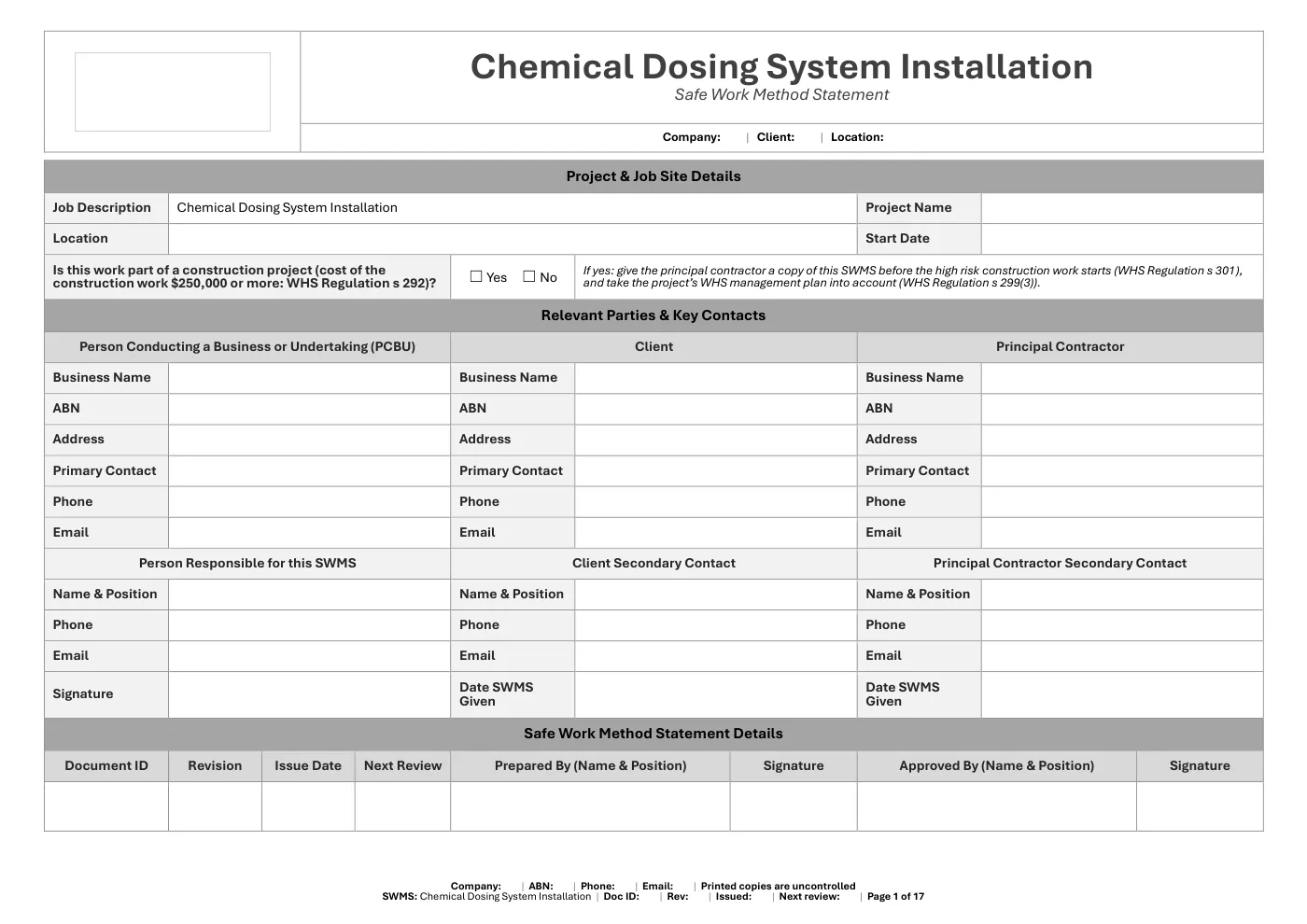
Installing fixed dosing plant, tanks and pipework in or on a building, plant room, pool or cooling system is construction work under WHS Regulation s 289 (installation connected with the fitting-out or alteration of a structure), unless it is only minor repair or maintenance (s 289(3)(d)). Work on chemical lines (item 9, s 291(j)) is pre-ticked, so a SWMS is required by law (s 299). Also tick the energised electrical installations or services item (s 291(k)) wherever work is carried out on or near energised equipment, for example testing or commissioning with the supply on, or work beside a live switchboard; connection by a licensed electrician after isolation does not need it on its own. Also tick the fall item for any fall of more than 2 m, the confined space item for a pit, sump or tank that is a confined space, and the drowning item for work in or near deep water.
New to SWMS? Read What Is A Safe Work Method Statement?
What Is Covered In Our Chemical Dosing System Installation SWMS?
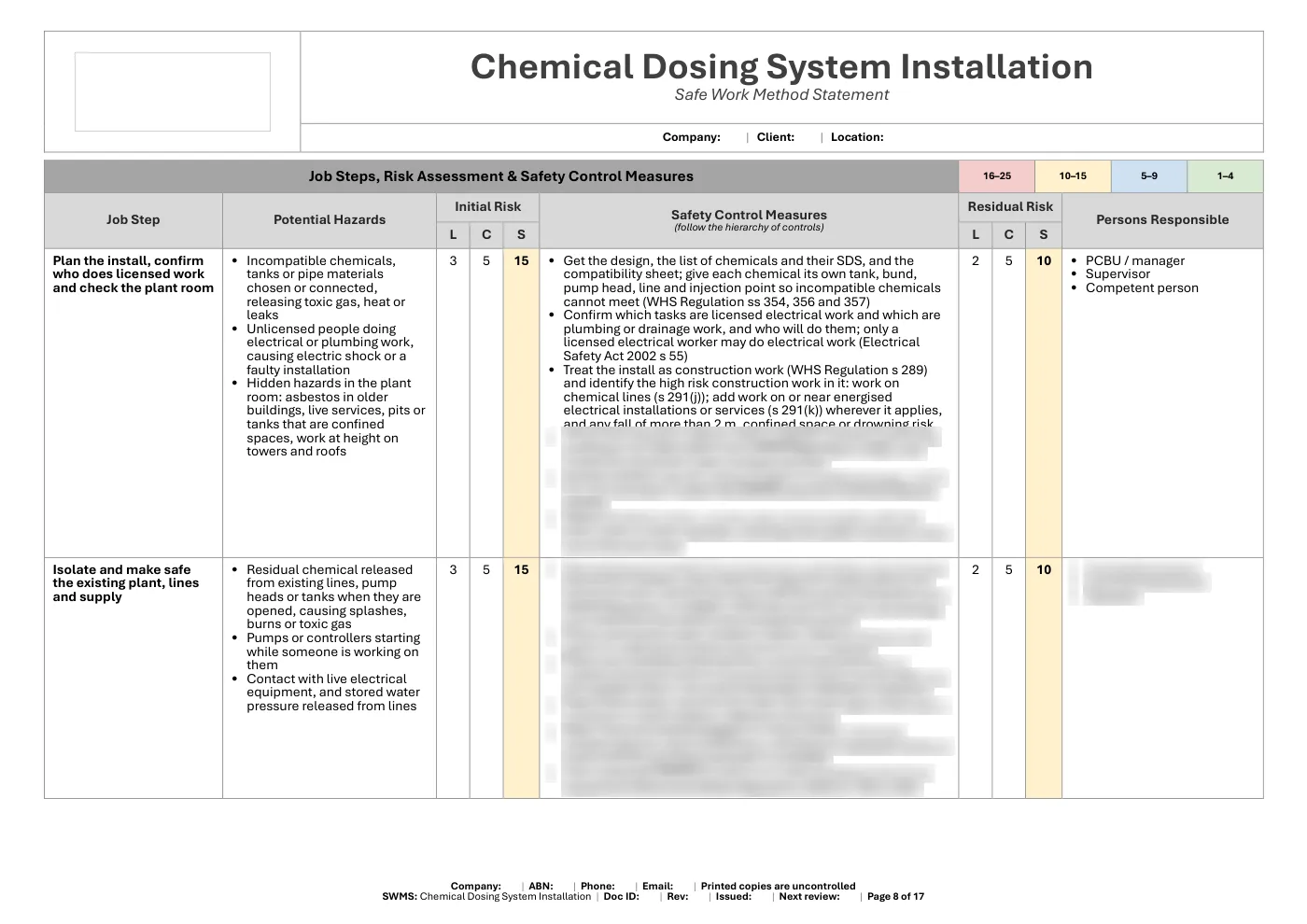
After the standard pre-start checks, the job steps run from “Plan the install, confirm who does licensed work and check the plant room” to “Hand over, clean up and update the records”. The hazards and controls include:
- Chemical splashes from lines, pumps and fittings
- Residual chemical in existing lines and tanks
- Incompatible chemicals meeting in shared lines or bunds
- Toxic gas from wrong connections or mixed products
- Unlicensed electrical or plumbing work
- Electric shock at pumps and switchboards
- Silica dust and noise from drilling anchors
- Falls from ladders, towers and roofs
- Heavy tanks and pumps dropped or tipping
- Pipe failure under test pressure
- Solvent cement fumes and fire
- Confined spaces in pits and tanks
- Missing eyewash and spill containment
High Risk Construction Work
These high risk construction work items (WHS Regulation 2011 (Qld) s 291) are already ticked because they are part of this work. Tick any others that apply to your job:
- Is carried out on or near chemical, fuel or refrigerant lines
Licences, Training and Competency
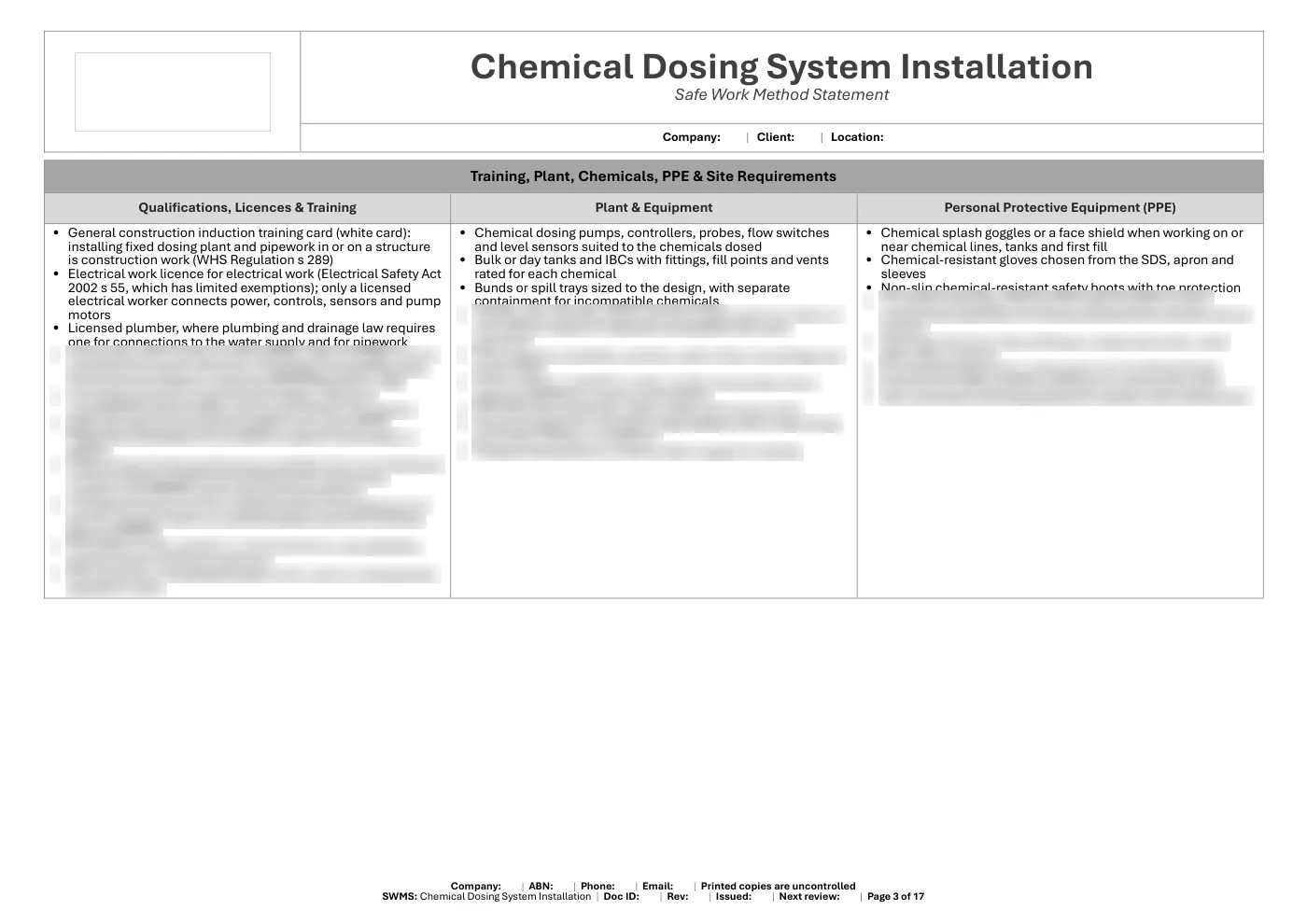
- General construction induction training card (white card): installing fixed dosing plant and pipework in or on a structure is construction work (WHS Regulation s 289)
- Electrical work licence for electrical work (Electrical Safety Act 2002 s 55, which has limited exemptions); only a licensed electrical worker connects power, controls, sensors and pump motors
- Licensed plumber, where plumbing and drainage law requires one for connections to the water supply and for pipework
- Training for every worker in the hazards, label and SDS of each chemical the system will dose, including incompatible pairs, first aid and emergency response (WHS Regulation s 39)
- Competent person to approve the design, chemical compatibility and bunding, and to commission the system
- High risk work licence for the forklift truck class (WHS Regulation Schedule 3) if a forklift is used to move tanks or pallets
- Chlorine gas dosing equipment is installed and commissioned only by workers trained and verified by the equipment supplier; this SWMS covers liquid dosing systems
- Competent person for the confined space risk assessment if any pit, sump or tank is a confined space (use the Confined Spaces SWMS)
- First aider on site, briefed on chemical burns, eye splashes, electric shock and fume exposure
- Site induction, including the plant room, pool or cooling tower operator’s rules
Legislation and Codes of Practice Referenced
- Work Health and Safety Act 2011 (Qld)
- Work Health and Safety Regulation 2011 (Qld)
- WHS Regulation 2011 (Qld) ss 289, 291 and 299: construction work, high risk construction work and the safe work method statement
- WHS Regulation 2011 (Qld) ss 343 and 344: labelling hazardous chemicals in pipe work; obtaining and giving access to safety data sheets
- WHS Regulation 2011 (Qld) ss 346 to 350 and 361: hazardous chemicals register, manifest, placard and emergency plan where Schedule 11 quantities are exceeded
- WHS Regulation 2011 (Qld) ss 351 to 358: managing risks, safety signs, physical or chemical reaction, fire and explosion, stability, spills and damage to containers and pipe work
- WHS Regulation 2011 (Qld) ss 359 to 363: fire protection, emergency equipment, emergency plans, safety equipment and storage or handling systems
- WHS Regulation 2011 (Qld) ss 52 and 53: ignition sources and flammable or combustible material
- WHS Regulation 2011 (Qld) ss 62 to 77: confined spaces (if a pit, sump or tank is one)
- WHS Regulation 2011 (Qld) ss 306C, 306D and 306M: falls in construction work and ladders; s 425: asbestos register
- WHS Regulation 2011 (Qld) chapter 8A: crystalline silica substances; ss 56 and 57: noise; s 60: hazardous manual tasks
- Managing Risks of Hazardous Chemicals in the Workplace Code of Practice 2021
- Labelling of Workplace Hazardous Chemicals Code of Practice 2021
- Preparation of Safety Data Sheets for Hazardous Chemicals Code of Practice 2021
- Confined Spaces Code of Practice 2021
- Managing the Risk of Falls at Workplaces Code of Practice 2021
- Managing respirable crystalline silica dust exposure in construction and manufacturing of construction elements Code of Practice 2022
- Hazardous Manual Tasks Code of Practice 2021; Managing Noise and Preventing Hearing Loss at Work Code of Practice 2021
- First Aid in the Workplace Code of Practice 2021; How to Manage Work Health and Safety Risks Code of Practice 2021
- Electrical Safety Act 2002 (Qld): s 55 (electrical work licence)
- Electrical Safety Regulation 2026 (Qld): s 140 (construction work: all electrical equipment for the performance of construction work must comply with AS/NZS 3012 Electrical installations – Construction and demolition sites, and s 140(3) limits when equipment may carry a tag with a test or retest date) and ss 199 to 204 (safe work method statement for work on or near energised electrical equipment)
- Plumbing and Drainage Act 2018 (Qld): ss 56 to 58 (a licence is needed to carry out, supervise or direct plumbing or drainage work, with exemptions that include unregulated work)
What You Get
- An editable Microsoft Word document (17 A4 landscape pages). Type your business, client and job details once and they fill in on every page, with a space for your logo
- 11 job steps for this work, each with its hazards, controls, initial and residual risk scores and the person responsible
- PPE listed for this job: chemical splash goggles or a face shield when working on or near chemical lines, tanks and first fill; chemical-resistant gloves chosen from the SDS, apron and sleeves
- Emergency arrangements for: chemical on skin or in eyes and electric shock
- Plus the parts every Work Safety QLD SWMS shares, from the s 291 checklist to the worker sign-on sheet (see the layout in our free SWMS template)
Adjust it for your site, plant and crew, and talk it through with your workers before work starts. Please make sure you read our Disclaimer before downloading this SWMS.
Checked against the Queensland laws and codes of practice listed above. Last reviewed November 2026.
Having trouble with your download? Contact us any time. Please read our Disclaimer before downloading.
How to use it
From download to site in three steps
Buy and download
Check out with card, Apple Pay or Google Pay. Your download buttons appear straight away and the links are emailed to you. Links work for 3 months, so save your copies.
Make it yours
Open it in Microsoft Word or Excel. Add your logo, business details, site and job information, and adjust it to how the work is done.
Brief your crew
Talk it through with the workers doing the job, have them sign on, and keep it on site. Review it whenever the job or conditions change.
What format is it?
Microsoft Word. Edit it in Word, or free in Word for the web, and add your own logo and business details.
How do I get it after I pay?
Your download buttons appear as soon as checkout finishes, and the links are emailed to you. You can re-download from your account at any time.
Is it compliant with Queensland law?
It's written around Queensland's Work Health and Safety Act 2011 and Regulation 2011. Tailor it to your site, consult your workers and review it whenever conditions change; no template can guarantee compliance on its own.
What if it isn't right for my job?
If it doesn't match its description or has a fault, tell us and we'll fix it. If you're still not happy, we'll refund you or give you store credit, your choice. Check the sample pages first, as we don't refund a change of mind.
More templates like this
$39.99
Concreting SWMS
$59.99

Confined Spaces SWMS
$49.99


Reviews