Hot Work SWMS
$39.99
Instant download · Editable Word & Excel files · Secure checkout with Apple Pay & Google Pay
About · Contact · Help & FAQ · My downloads

Manuals and plans
Best value
The SWMS principal contractors ask for most, in one download.
$810.00 incl. GST
Tell us what you need. Popular requests get written and added to the store.
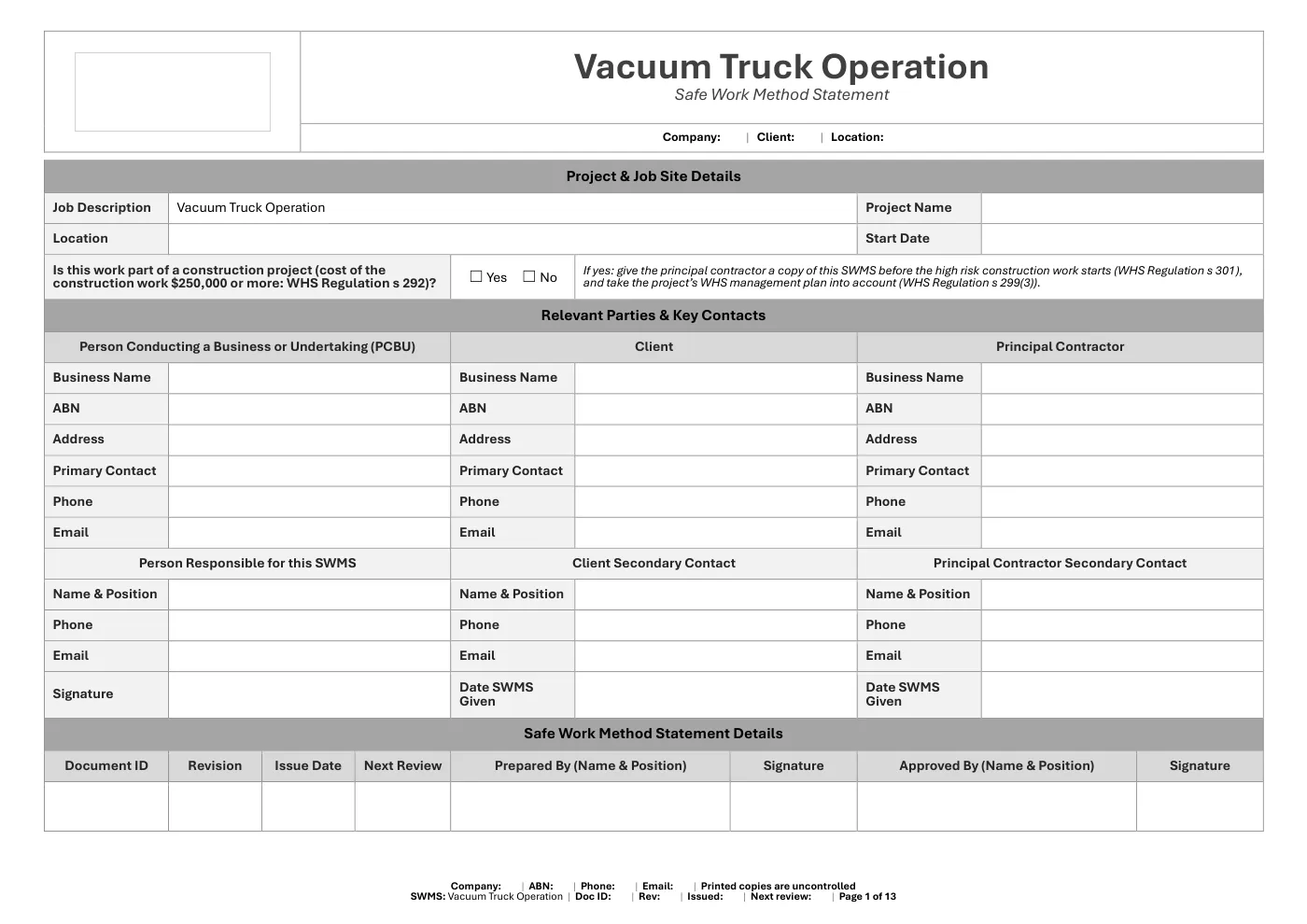
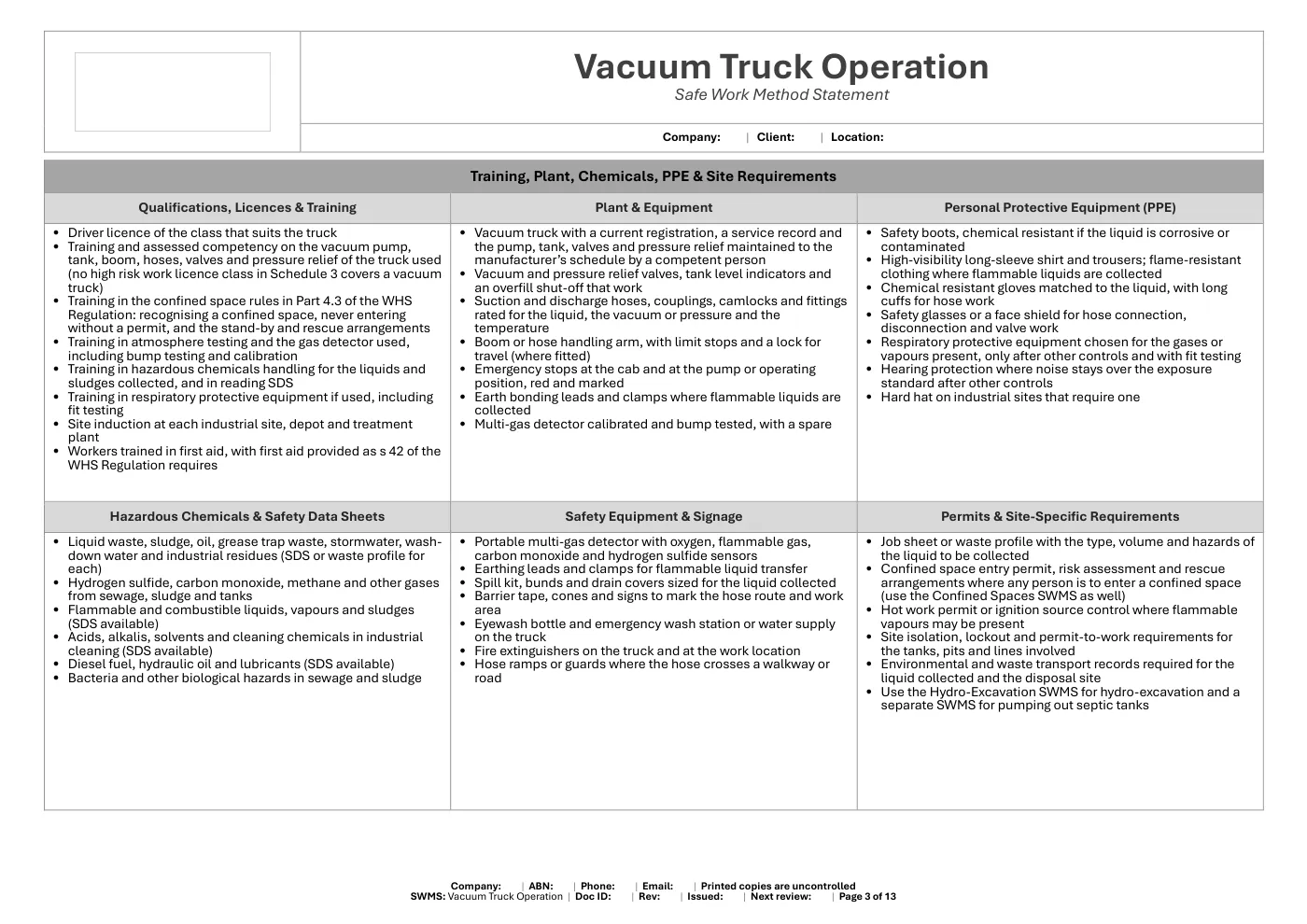
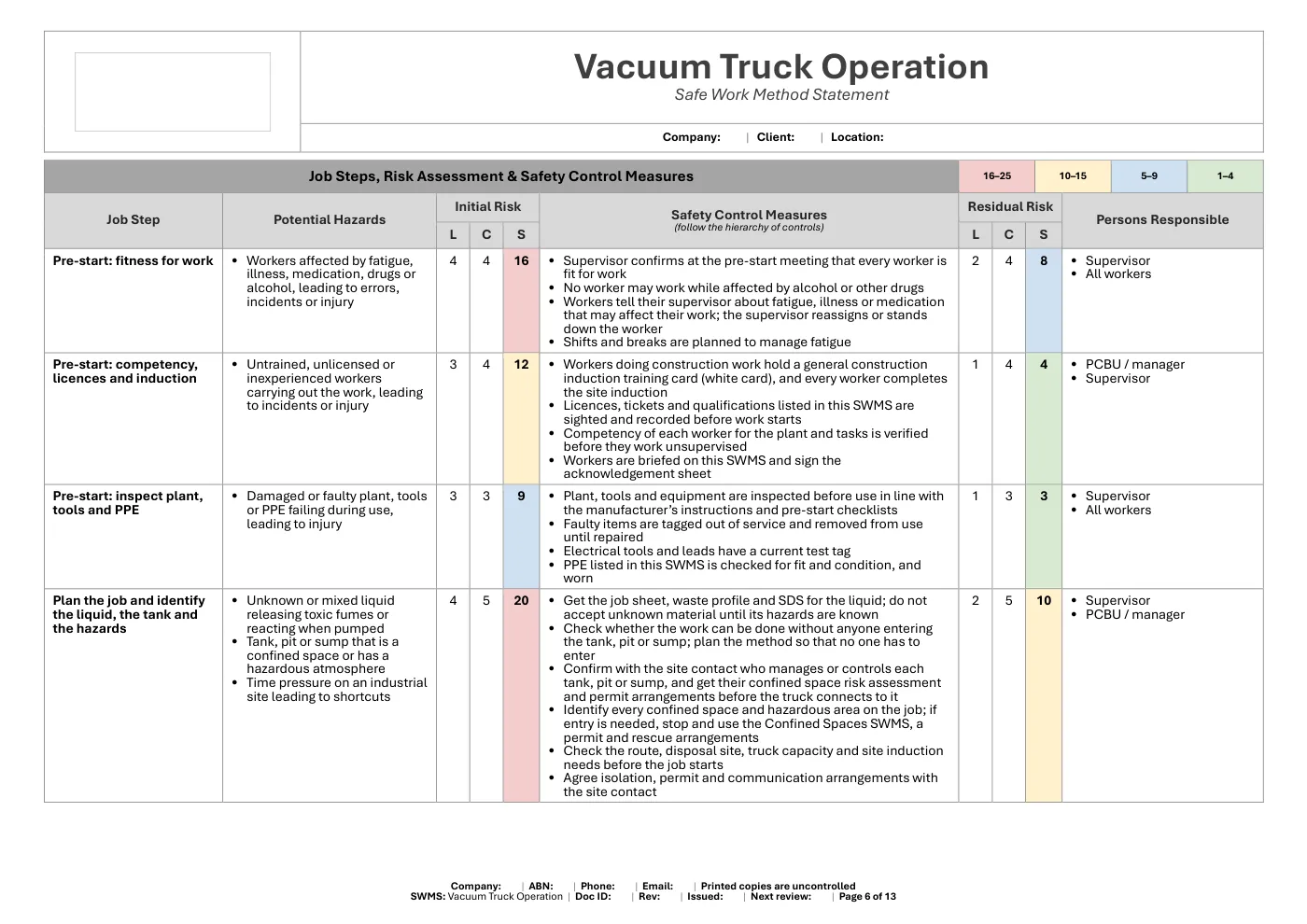
Editable Word SWMS template for vacuum trucks in Queensland: hose connections, toxic fumes, confined spaces, suction and pressure, spills and disposal.
RG
Written by Ryan Graham, health and safety professional (16 years on Queensland sites)
$39.99 incl. GST
AUD · one-off purchase · instant download
Save with a bundle
About this template
Suits liquid waste and industrial cleaning contractors whose vacuum trucks pump out tanks, pits, sumps, grease traps and wash-down bays. It follows the job from identifying the liquid and the space through pre-start, parking, atmosphere testing, hose connection, pumping, work near confined spaces, spill control, disconnection and discharge at the disposal site. Hydro-excavation and septic tank pump-out need a separate SWMS.
Vacuum truck work is not construction work by itself, so the high risk construction work list in the WHS Regulation (section 291) does not apply, no item is pre-ticked and section 299 does not require a SWMS for it. Cleaning or maintaining a structure such as a tank, pit or drain can be construction work (section 289); if the job is, tick the items that apply, such as in or near a confined space, a contaminated or flammable atmosphere, energised electrical installations or services, and traffic corridor in use. The confined space duties in Part 4.3 of the WHS Regulation apply at any workplace. The document works as a written safe work procedure and task risk assessment.
Learn More: What Is A Safe Work Method Statement?
Have you ever been asked to provide a SWMS on a project in Queensland? Read our guide to what a Safe Work Method Statement is and when you need one.
The job steps run in the order the work is done, from pre-start checks to finishing up. The hazards and controls include:
No high risk construction work items (WHS Regulation 2011 (Qld) s 291) are pre-ticked, because this work is not high risk construction work by itself. Tick the items that apply to your job, such as a fall risk of more than 2 metres or work where powered mobile plant is moving.
Review and adjust it for your site, your plant and the way your crew does the job, and talk it through with your workers before work starts. If you have any trouble downloading this SWMS, you can contact us at any time. Please make sure you read our Disclaimer before downloading this SWMS.
Having trouble with your download? Contact us any time. Please read our Disclaimer before downloading.
How to use it
Check out with card, Apple Pay or Google Pay. Your download buttons appear straight away and the links are emailed to you. Links work for 3 months, so save your copies.
Open it in Microsoft Word or Excel. Add your logo, business details, site and job information, and adjust it to how the work is done.
Talk it through with the workers doing the job, have them sign on, and keep it on site. Review it whenever the job or conditions change.
Microsoft Word. Edit it in Word, or free in Word for the web, and add your own logo and business details.
Your download buttons appear as soon as checkout finishes, and the links are emailed to you. You can re-download from your account at any time.
It's written around Queensland's Work Health and Safety Act 2011 and Regulation 2011. Tailor it to your site, consult your workers and review it whenever conditions change; no template can guarantee compliance on its own.
If it doesn't match its description or has a fault, tell us and we'll fix it. If you're still not happy, we'll refund you or give you store credit, your choice. Check the sample pages first, as we don't refund a change of mind.
Reviews