Skip to content

Wet and Dry Vacuum SWMS

Wet and dry vacuums on Queensland worksites: power supply, dust and slurry pick-up, silica and asbestos cautions, emptying and cleaning. An editable Word SWMS template.

RG

Written by Ryan Graham, health and safety professional (16 years on Queensland sites)

$29.99 incl. GST

AUD · one-off purchase · instant download

  • Instant download · your links arrive by email straight after checkout and work for 3 months, so save your copy
  • Make it yours in minutes · edit in Microsoft Word and add your logo
  • Quality guarantee · we'll fix any problem, then refund you or give store credit if you're still not happy
  • Secure checkout · card, Apple Pay or Google Pay through Stripe

About this template

For cleaners, builders, trades and maintenance crews who use a wet and dry vacuum to pick up dust, debris and liquids. It covers checking the vacuum, identifying what is being vacuumed, moving and setting up, vacuuming dry and wet material, emptying and cleaning the vacuum and packing up. It does not cover asbestos clean-up.

A SWMS is legally required under the WHS Regulation (s 299) only when the vacuuming is part of high risk construction work, such as work in a confined space, near energised equipment or involving silica dust (tick the contaminated atmosphere item, s 291(l)); otherwise this document works as a written safe work procedure or task risk assessment.

New to SWMS? Read What is a safe work method statement?

What is covered in our wet and dry vacuum SWMS?

After the standard pre-start checks, the job steps run from “Check the vacuum before use” to “Pack up and store the vacuum”. The hazards and controls include:

  • Electric shock from leads, plugs and wet pick-up
  • Silica dust from cutting and grinding concrete and masonry
  • Suspected asbestos in dust and debris
  • Fine dust escaping a wrong or damaged filter
  • Flammable liquids and hot or combustible material
  • Cuts from sharp debris
  • Slips on wet floors
  • Vacuum noise
  • Dust released when emptying and cleaning filters
  • Strains moving a heavy vacuum or full container
  • Trips over hoses and leads

High risk construction work

None of the high risk construction work items (WHS Regulation 2011 (Qld) s 291) are pre-ticked, because this job is not high risk construction work by itself. Tick any that apply on your site.

Licences, training and competency

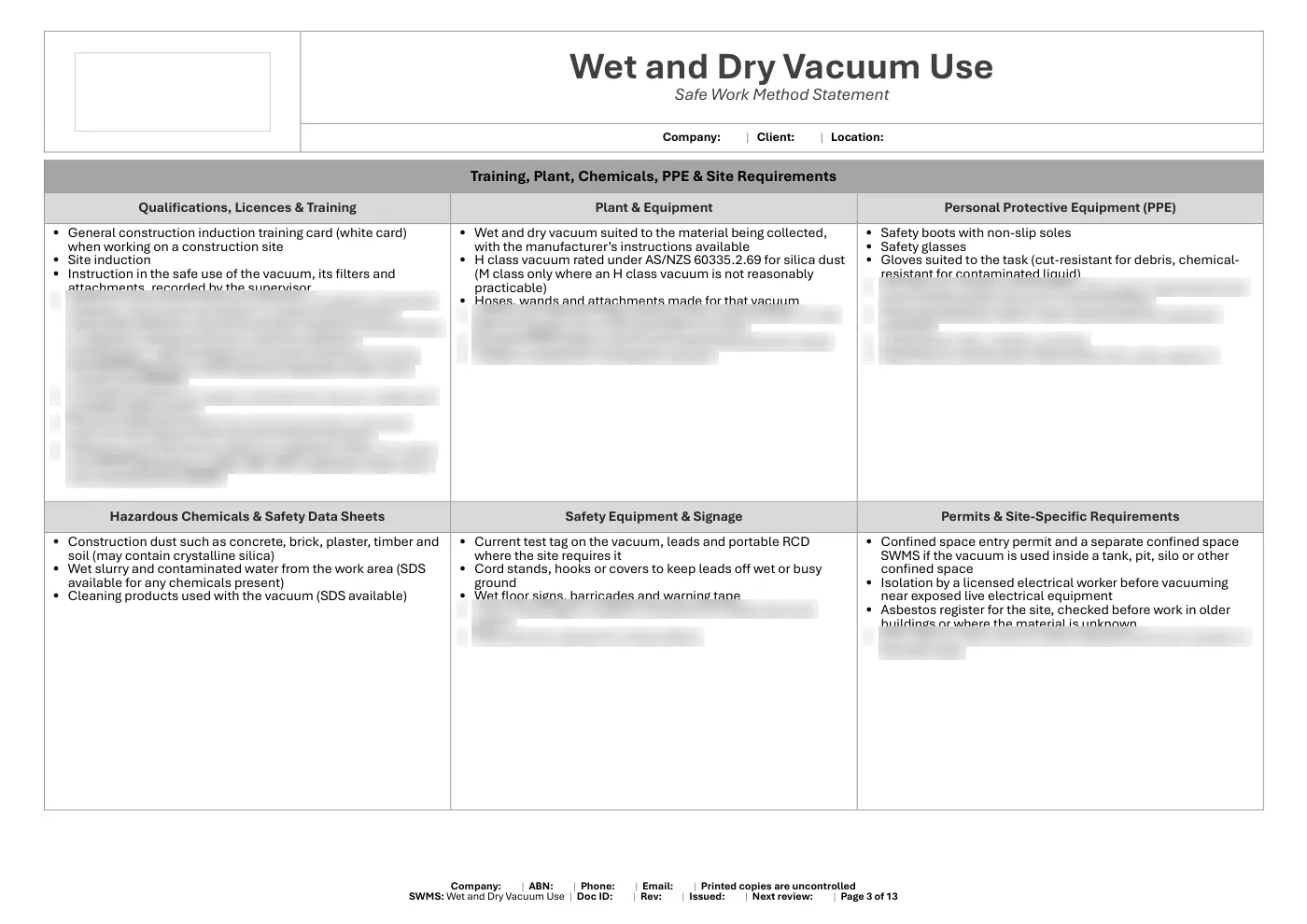
  • General construction induction training card (white card) when working on a construction site
  • Site induction
  • Instruction in the safe use of the vacuum, its filters and attachments, recorded by the supervisor
  • Asbestos awareness training so workers recognise suspected asbestos, stop work and report it; workers the business reasonably believes may be involved in asbestos removal work or asbestos-related work also need the asbestos identification, safe handling and control measures training that WHS Regulation s 445 requires (asbestos clean-up is outside this SWMS)
  • Competent person to inspect and test the vacuum, leads and portable safety switch
  • Person holding the electrical work licence that covers the work, for any repair to the vacuum’s electrical parts
  • Asbestos removal licence where an asbestos clean-up needs one (WHS Regulation ss 458, 485, 487); asbestos clean-up is not covered by this SWMS

Legislation and codes of practice referenced

  • Work Health and Safety Act 2011 (Qld)
  • Work Health and Safety Regulation 2011 (Qld)
  • Work Health and Safety Regulation 2011 (Qld): ss 36, 44 (control measures, PPE), ss 56 to 58 (noise)
  • Work Health and Safety Regulation 2011 (Qld): s 60 (hazardous manual tasks), ss 205 to 213 (plant)
  • Work Health and Safety Regulation 2011 (Qld): ss 49 and 529A to 529D (silica dust)
  • Work Health and Safety Regulation 2011 (Qld): ss 419, 422, 425, 445, 446, 479 (asbestos)
  • Work Health and Safety Regulation 2011 (Qld): ss 65 to 67 (confined space entry permit)
  • Managing Risks of Plant in the Workplace Code of Practice 2021
  • Managing Risks of Hazardous Chemicals in the Workplace Code of Practice 2021
  • Hazardous Manual Tasks Code of Practice 2021
  • Managing Noise and Preventing Hearing Loss at Work Code of Practice 2021
  • Managing respirable crystalline silica dust exposure in construction and manufacturing of construction elements Code of Practice 2022
  • How to Manage and Control Asbestos in the Workplace Code of Practice 2021
  • How to Safely Remove Asbestos Code of Practice 2021
  • Confined Spaces Code of Practice 2021
  • How to Manage Work Health and Safety Risks Code of Practice 2021
  • First Aid in the Workplace Code of Practice 2021
  • Work Health and Safety Consultation, Co-operation and Co-ordination Code of Practice 2021
  • Electrical Safety Act 2002 (Qld): ss 18 and 55
  • Electrical Safety Regulation 2026 (Qld): ss 17, 18 and 140
  • AS/NZS 60335.2.69:2017 (Household and similar electrical appliances – Safety – Particular requirements for wet and dry vacuum cleaners, including power brush, for industrial and commercial use), as named in the approved silica code

What you get

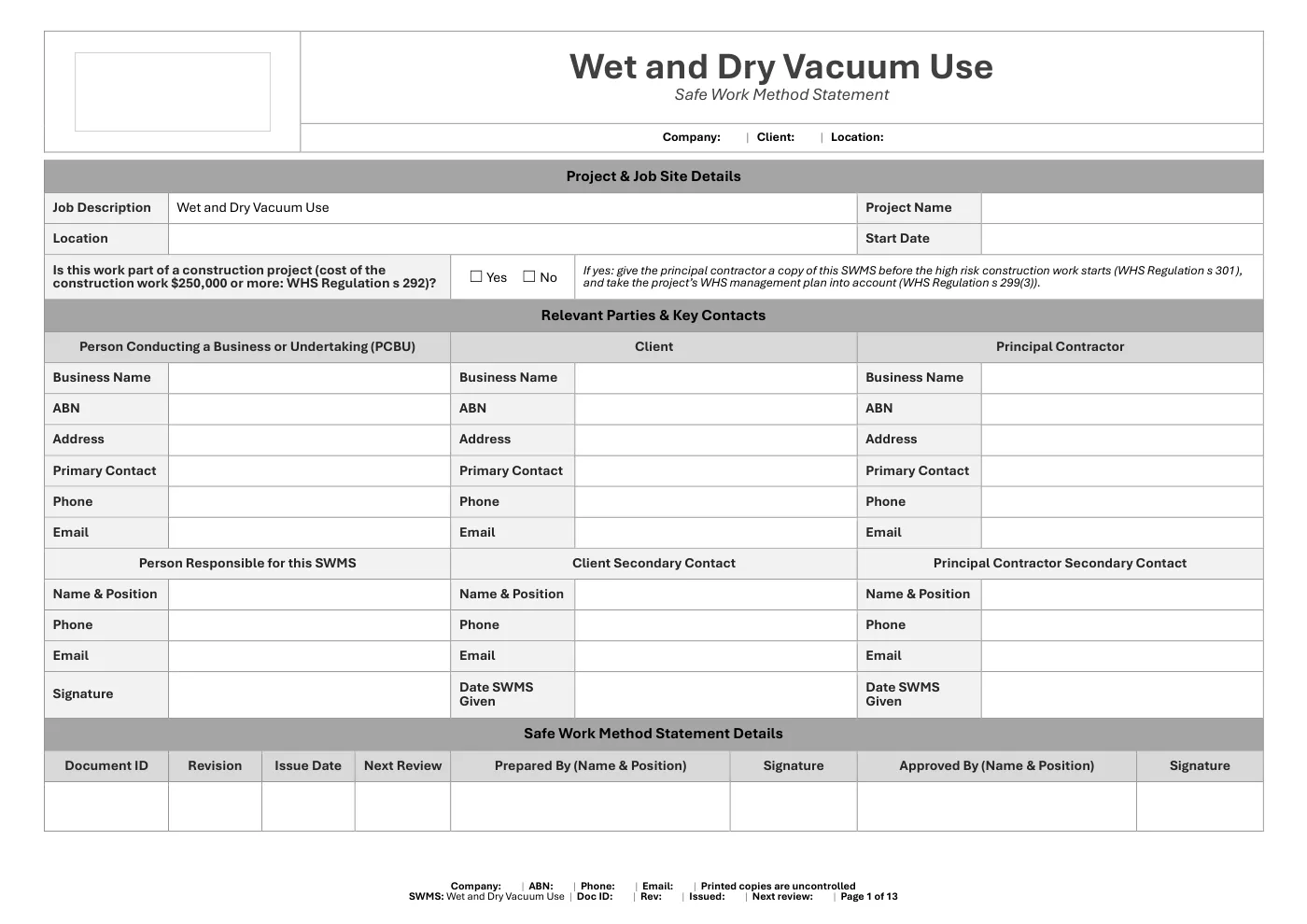
  • An editable Microsoft Word document (13 pages), laid out on A4 landscape pages. Type your business, client and job details once and they fill in on every page, with a space for your logo
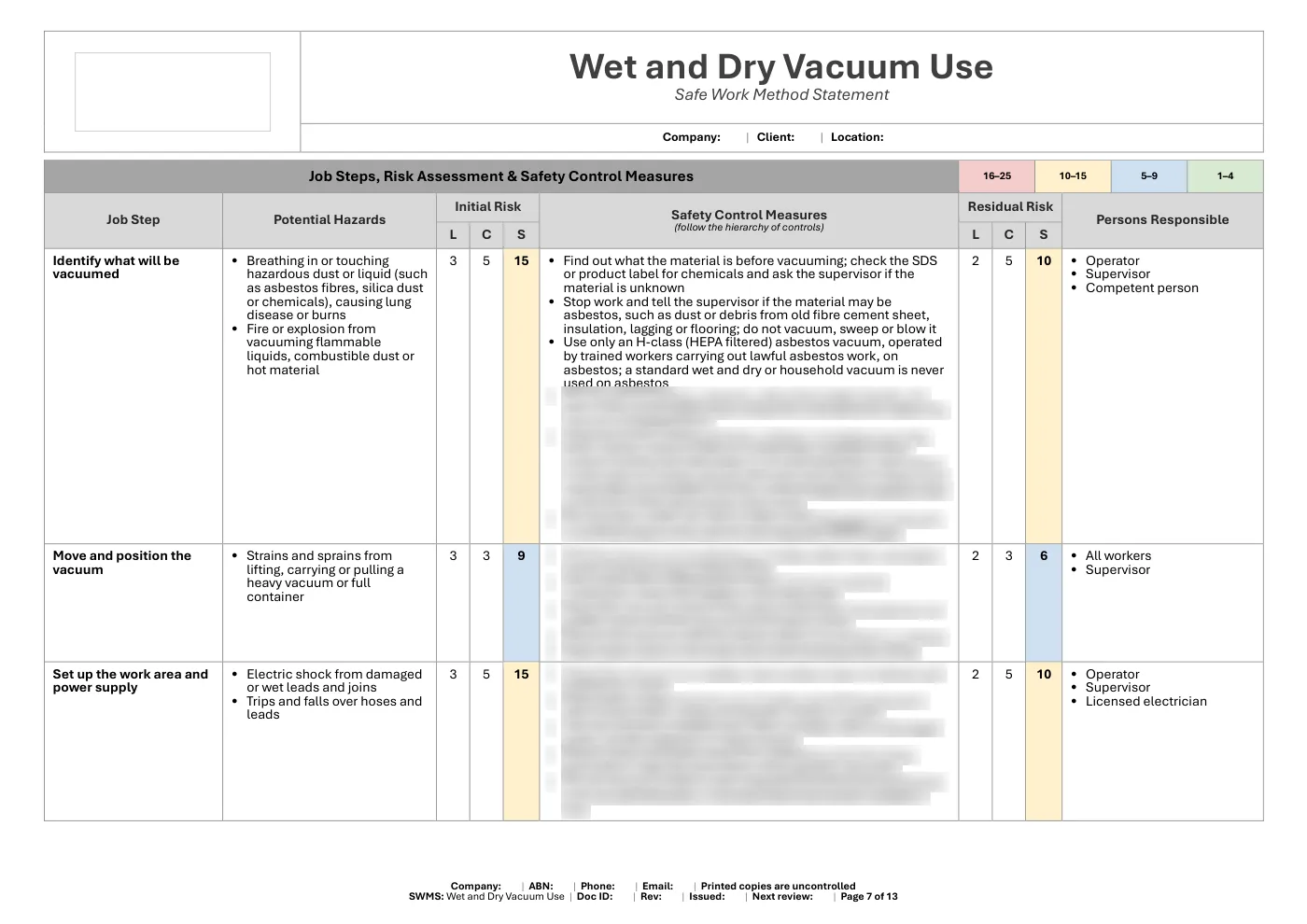
  • 9 job steps for this work, each with its hazards, controls, initial and residual risk scores and the person responsible
  • PPE listed for this job: safety boots with non-slip soles; safety glasses; gloves suited to the task (cut-resistant for debris, chemical-resistant for contaminated liquid)
  • Emergency arrangements for: electric shock, suspected asbestos or unknown hazardous dust and smoke, sparks or fire from the vacuum
  • Plus the parts every Work Safety QLD SWMS shares, from the s 291 checklist to the worker sign-on sheet (see the layout in our free SWMS template)

Adjust it for your site, plant and crew, and talk it through with your workers before work starts.

Checked against the Queensland laws and codes of practice listed above. Last reviewed October 2026.

Having trouble with your download? Contact us any time. Please read our Disclaimer before downloading.

How to use it

From download to site in three steps

Buy and download

Check out with card, Apple Pay or Google Pay. Your download buttons appear straight away and the links are emailed to you. Links work for 3 months, so save your copies.

Make it yours

Open it in Microsoft Word or Excel. Add your logo, business details, site and job information, and adjust it to how the work is done.

Brief your crew

Talk it through with the workers doing the job, have them sign on, and keep it on site. Review it whenever the job or conditions change.

FAQ

Before you buy

Something else? Ask us and a real person will reply.

What format is it?

Microsoft Word. Edit it in Word, or free in Word for the web, and add your own logo and business details.

How do I get it after I pay?

Your download buttons appear as soon as checkout finishes, and the links are emailed to you. You can re-download from your account at any time.

Is it compliant with Queensland law?

It's written around Queensland's Work Health and Safety Act 2011 and Regulation 2011. Tailor it to your site, consult your workers and review it whenever conditions change; no template can guarantee compliance on its own.

What if it isn't right for my job?

If it doesn't match its description or has a fault, tell us and we'll fix it. If you're still not happy, we'll refund you or give you store credit, your choice. Check the sample pages first, as we don't refund a change of mind.

Reviews

Only logged in customers who have purchased this product may leave a review.
More templates like this