Skip to content

Water Cart SWMS

Water cart and water truck operation in Queensland: rollover, slippery roads, pedestrians, filling points, overhead lines and dust suppression. An editable Word SWMS template.

RG

Written by Ryan Graham, health and safety professional (16 years on Queensland sites)

$49.99 incl. GST

AUD · one-off purchase · instant download

  • Instant download · your links arrive by email straight after checkout and work for 3 months, so save your copy
  • Your business name and logo · we fill them into every document for A$29 (free on orders of A$500 or more), or edit it yourself in Microsoft Word
  • Quality guarantee · we'll fix any problem, then refund you or give store credit if you're still not happy
  • Secure checkout · card, Apple Pay or Google Pay through Stripe

About this template

Suits civil, earthworks, road and construction businesses that run water carts and water trucks to suppress dust on haul roads and work areas. It follows the job in order, from planning routes and daily checks through filling, driving, working around pedestrians, spraying, overhead lines and public roads, to dust, noise and heat controls and parking. Work near overhead power lines in general has its own SWMS.

Using a water cart or water truck on construction work is high risk construction work because powered mobile plant moves in the work area (WHS Regulation ss 289 and 291(o)), so that item is ticked and a SWMS is required before it starts (s 299); away from construction work this document works as a written safe work procedure or task risk assessment. You can also tick a fall risk of more than 2 metres if the tank must be filled from the top, energised electrical installations or services if overhead lines are near the routes or filling points, a road in use, water with a drowning risk if the cart fills from a dam or creek, or the contaminated atmosphere item if the work creates silica dust, as the Queensland silica code advises.

New to SWMS? Read What is a safe work method statement?

What is covered in our water cart SWMS?

After the standard pre-start checks, the job steps run from “Plan the watering routes, times and traffic” to “Refuel, park, shut down and secure the cart”. The hazards and controls include:

  • Cart rollover on slopes and soft edges
  • Liquid surge in a partly filled tank
  • Slippery over-watered roads
  • Pedestrians struck by the cart
  • Reversing into people and plant
  • Falls from the tank top at filling points
  • Hose whip and overflow at hydrants and standpipes
  • Drowning risk and bank collapse at dams
  • Contact with overhead power lines
  • Overspray onto people, leads and equipment
  • Collisions on public roads and at entries
  • Silica dust, noise and vibration
  • Fatigue and heat on long shifts

High risk construction work

These high risk construction work items (WHS Regulation 2011 (Qld) s 291) are already ticked because they are part of this work. Tick any others that apply to your job:

  • Is carried out in an area at a workplace in which there is any movement of powered mobile plant

Licences, training and competency

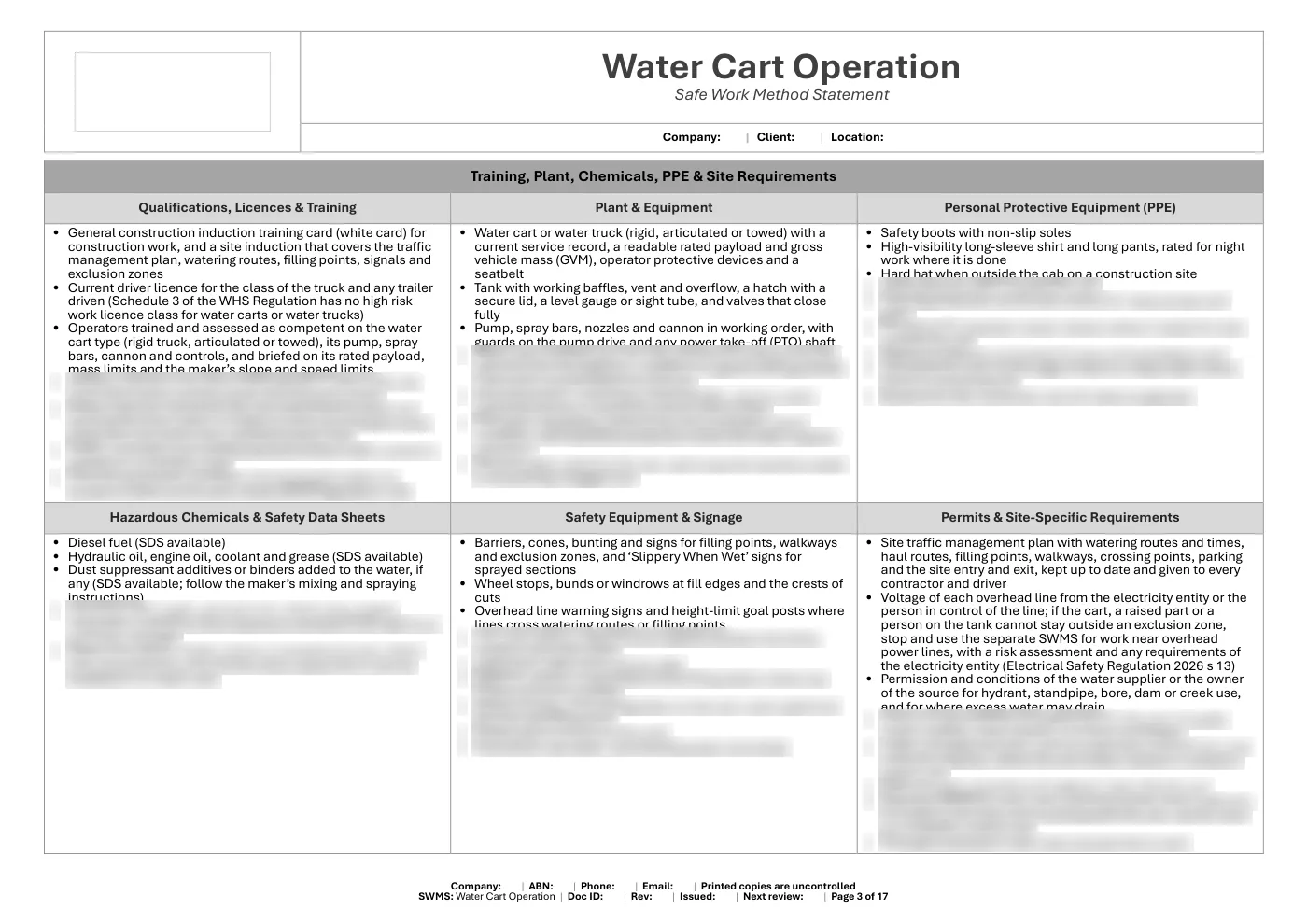
  • General construction induction training card (white card) for construction work, and a site induction that covers the traffic management plan, watering routes, filling points, signals and exclusion zones
  • Current driver licence for the class of the truck and any trailer driven (Schedule 3 of the WHS Regulation has no high risk work licence class for water carts or water trucks)
  • Operators trained and assessed as competent on the water cart type (rigid truck, articulated or towed), its pump, spray bars, cannon and controls, and briefed on its rated payload, mass limits and the maker’s slope and speed limits
  • Spotters trained in the site’s hand signals or radio calls, the cart’s blind spots and the power line exclusion zones
  • Safety observer trained for the role (watching the plant and warning the driver when it is likely to enter an exclusion zone) where the cart works near overhead power lines
  • Traffic controllers (accredited persons) where traffic control is needed on or beside a road
  • First aid equipment, facilities and trained first aiders (or access to them) as the work needs (WHS Regulation s 42)

Legislation and codes of practice referenced

  • Work Health and Safety Act 2011 (Qld)
  • Work Health and Safety Regulation 2011 (Qld)
  • Managing Risks of Plant in the Workplace Code of Practice 2021
  • Traffic Management for Construction or Maintenance Work Code of Practice 2008 (site entries and roads)
  • Managing respirable crystalline silica dust exposure in construction and manufacturing of construction elements Code of Practice 2022
  • Managing the Risk of Falls at Workplaces Code of Practice 2021 (access to vehicles and tank hatches)
  • Managing Noise and Preventing Hearing Loss at Work Code of Practice 2021
  • Hazardous Manual Tasks Code of Practice 2021 (whole-body vibration, hoses and standpipes)
  • Managing the Work Environment and Facilities Code of Practice 2021
  • Managing Risks of Hazardous Chemicals in the Workplace Code of Practice 2021
  • First Aid in the Workplace Code of Practice 2021
  • Excavation Work Code of Practice 2021 (keeping plant back from excavation edges)
  • How to Manage Work Health and Safety Risks Code of Practice 2021
  • Electrical Safety Act 2002 (Qld)
  • Electrical Safety Regulation 2026 (Qld): ss 10 to 13 and schedule 2 (exclusion zones), and s 140 (construction work)
  • Electrical Safety Code of Practice 2020 – Working near overhead and underground electric lines (distances come from the 2026 Regulation)
  • Heavy Vehicle National Law Act 2012 (Qld), which applies the Heavy Vehicle National Law in Queensland: chain of responsibility (s 26C), mass (s 96) and loading (s 111) for heavy vehicles on public roads
  • Transport Operations (Road Use Management – Accreditation and Other Provisions) Regulation 2015 (Qld): traffic controllers (ss 54 and 55)
  • Safe Work Australia model Code of Practice: Managing the risks of biological hazards at work (guidance)
  • Safe Work Australia model Code of Practice: Managing the risk of fatigue at work (guidance)
  • Safe Work Australia model Code of Practice: Elevating work platforms (guidance); its power line contact advice is applied by analogy

What you get

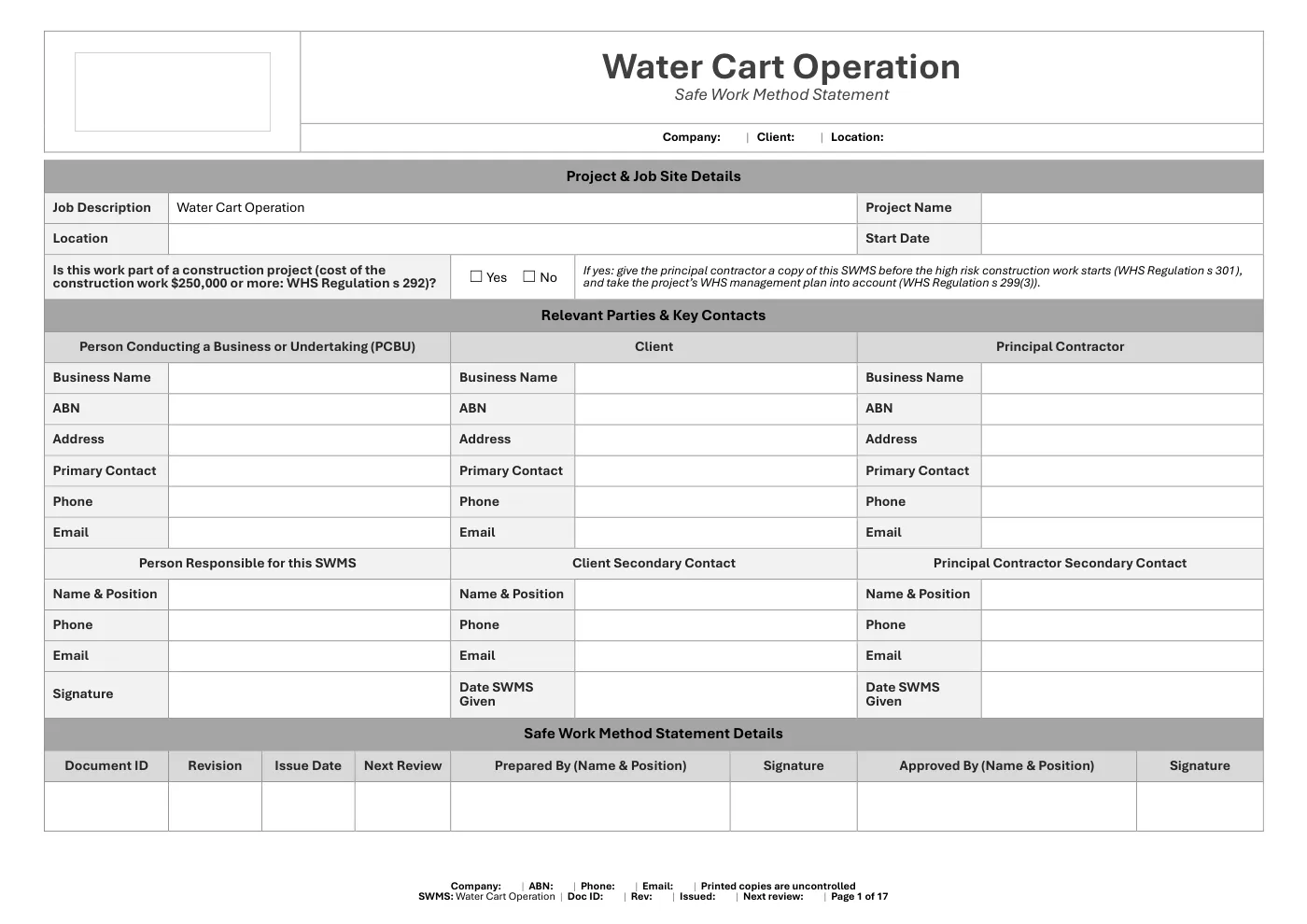
  • An editable Microsoft Word document (17 pages), laid out on A4 landscape pages. Type your business, client and job details once and they fill in on every page, with a space for your logo
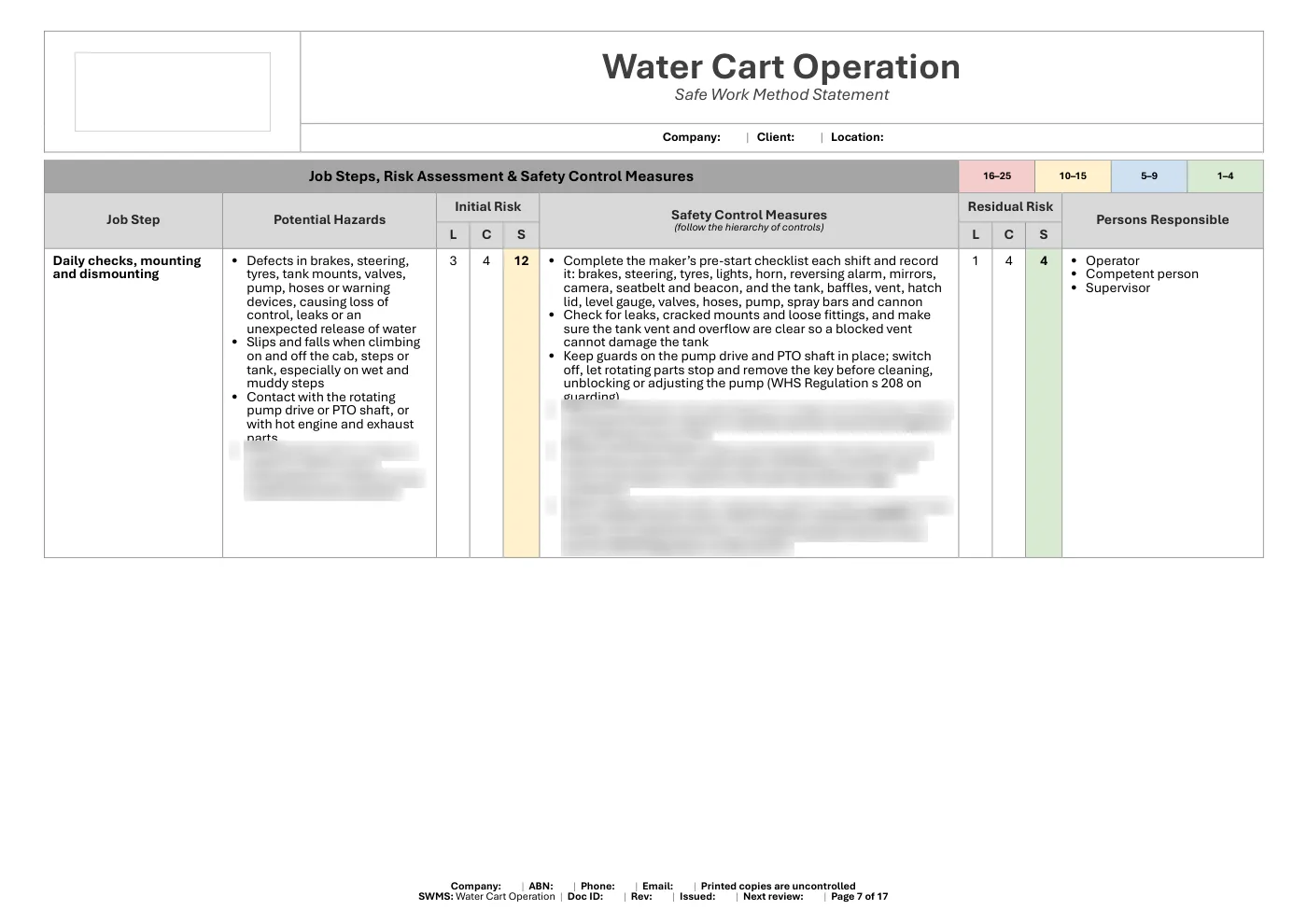
  • 10 job steps for this work, each with its hazards, controls, initial and residual risk scores and the person responsible
  • PPE listed for this job: safety boots with non-slip soles; high-visibility long-sleeve shirt and long pants, rated for night work where it is done; hard hat when outside the cab on a construction site
  • Emergency arrangements for: cart touches a power line, cart rolls over or goes over an edge and person struck, run over or trapped by the cart
  • Plus the parts every Work Safety QLD SWMS shares, from the s 291 checklist to the worker sign-on sheet (see the layout in our free SWMS template)

Adjust it for your site, plant and crew, and talk it through with your workers before work starts.

Checked against the Queensland laws and codes of practice listed above. Last reviewed October 2026.

Having trouble with your download? Contact us any time. Please read our Disclaimer before downloading.

How to use it

From download to site in three steps

Buy and download

Check out with card, Apple Pay or Google Pay. Your download buttons appear straight away and the links are emailed to you. Links work for 3 months, so save your copies.

Make it yours

Add your logo and business details in Word or Excel, or tick branding at checkout (A$29) and we add them. Then add your site and job details.

Brief your crew

Talk it through with the workers doing the job, have them sign on, and keep it on site. Review it whenever the job or conditions change.

FAQ

Before you buy

Something else? Ask us and a real person will reply.

What format is it?

Microsoft Word. Edit it in Word, or free in Word for the web, and add your own logo and business details. Or let us do it: tick "Add my business name and logo to every document" at checkout (A$29, free on orders of A$500 or more) and fill in a short form after payment.

How do I get it after I pay?

Your download buttons appear as soon as checkout finishes, and the links are emailed to you. You can re-download from your account at any time.

Is it compliant with Queensland law?

It's written around Queensland's Work Health and Safety Act 2011 and Regulation 2011. Tailor it to your site, consult your workers and review it whenever conditions change; no template can guarantee compliance on its own.

What if it isn't right for my job?

If it doesn't match its description or has a fault, tell us and we'll fix it. If you're still not happy, we'll refund you or give you store credit, your choice. Check the sample pages first, as we don't refund a change of mind.

Reviews

Only logged in customers who have purchased this product may leave a review.
More templates like this