
TV Antenna and Satellite Dish Installation SWMS
Installing domestic TV antennas and satellite dishes on Queensland roofs and walls: ladders, roof access, fall controls and overhead power lines. An editable Word SWMS template.
RG
Written by Ryan Graham, health and safety professional (16 years on Queensland sites)
$49.99 incl. GST
AUD · one-off purchase · instant download
- Instant download · your links arrive by email straight after checkout and work for 3 months, so save your copy
- Your business name and logo · we fill them into every document for A$29 (free on orders of A$500 or more), or edit it yourself in Microsoft Word
- Quality guarantee · we'll fix any problem, then refund you or give store credit if you're still not happy
- Secure checkout · card, Apple Pay or Google Pay through Stripe
About this template
Suits antenna and satellite installers working on houses, units and small commercial buildings. It follows the job in order, from roof inspection and power line checks through ladder set-up, roof access, mounting, raising the mast, cabling and handover. It covers fragile roofs, asbestos cement roofing and wind and lightning limits. Tower-mounted telecommunications antennas need a separate SWMS.
Installing an antenna or dish on a structure is construction work (WHS Regulation s 289(1) and (2)(a)), and roof and mast work carries a risk of a fall of more than 2 metres (s 291(a)), so the falls item is ticked for you. Also tick the item for work on or near energised electrical installations or services if an overhead line or the house service line is close enough to the mast, dish or person to be contacted, and the asbestos item if cement sheet roofing or eaves could be disturbed.
New to SWMS? Read What Is A Safe Work Method Statement?
What Is Covered In Our TV Antenna and Satellite Dish Installation SWMS?
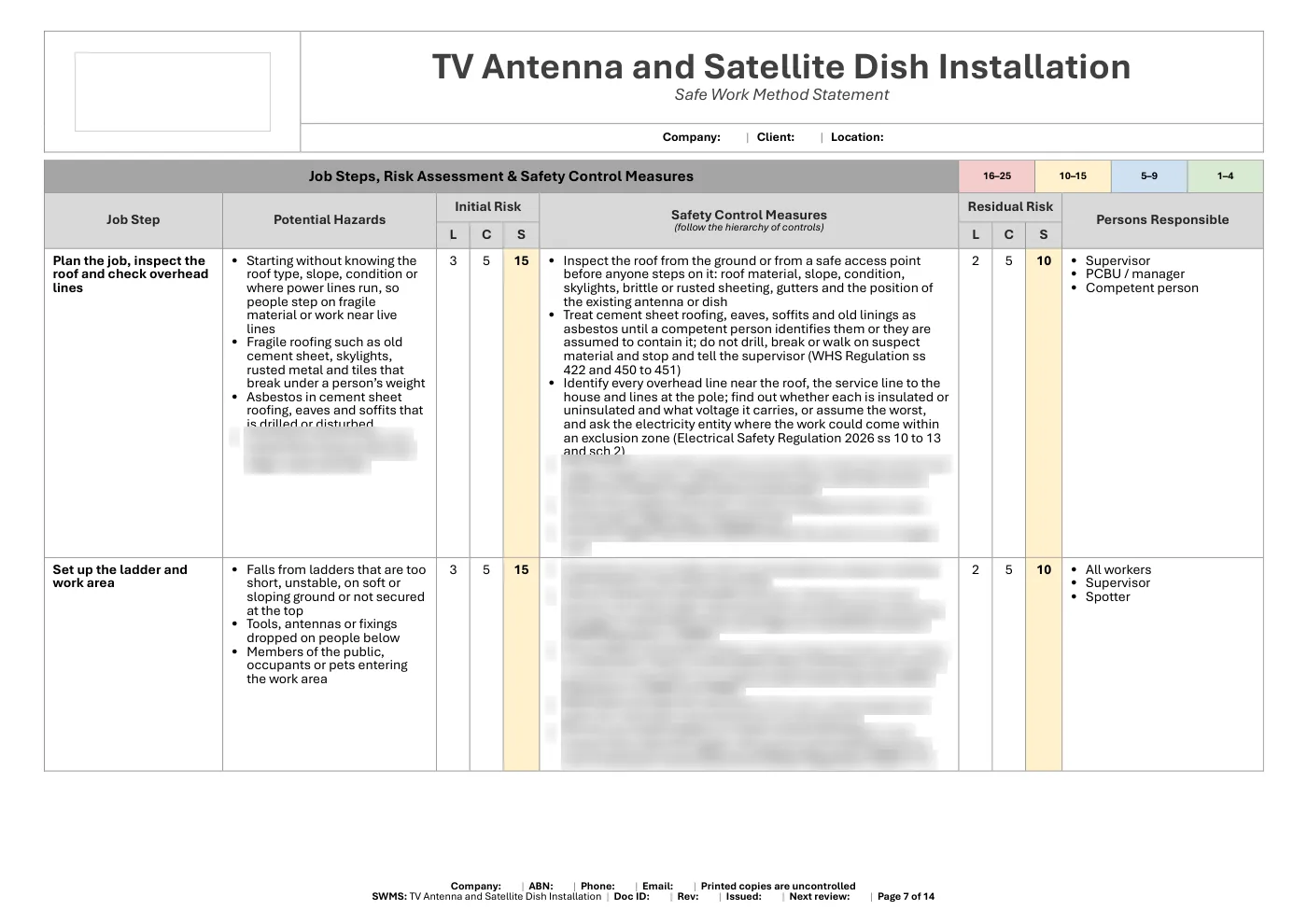
After the standard pre-start checks, the job steps run from “Plan the job, inspect the roof and check overhead lines” to “Come down, clean up and hand over”. The hazards and controls include:
- Falls from ladders and roof edges
- Falls through fragile roofing and skylights
- Contact with overhead power lines and house service lines
- Mast or dish dropped or blown over in wind
- Asbestos cement roofing, eaves and soffits
- Slips on wet, mossy, steep or hot roofs
- Dropped tools and fixings striking people below
- Drilling into roof framing and hidden services
- Hazardous manual tasks carrying masts and dishes
- Heat, sun exposure and fatigue on roofs
- Electric shock from mains-powered amplifiers and receivers
High Risk Construction Work
These high risk construction work items (WHS Regulation 2011 (Qld) s 291) are already ticked because they are part of this work. Tick any others that apply to your job:
- Involves a risk of a person falling more than 2m
Licences, Training and Competency
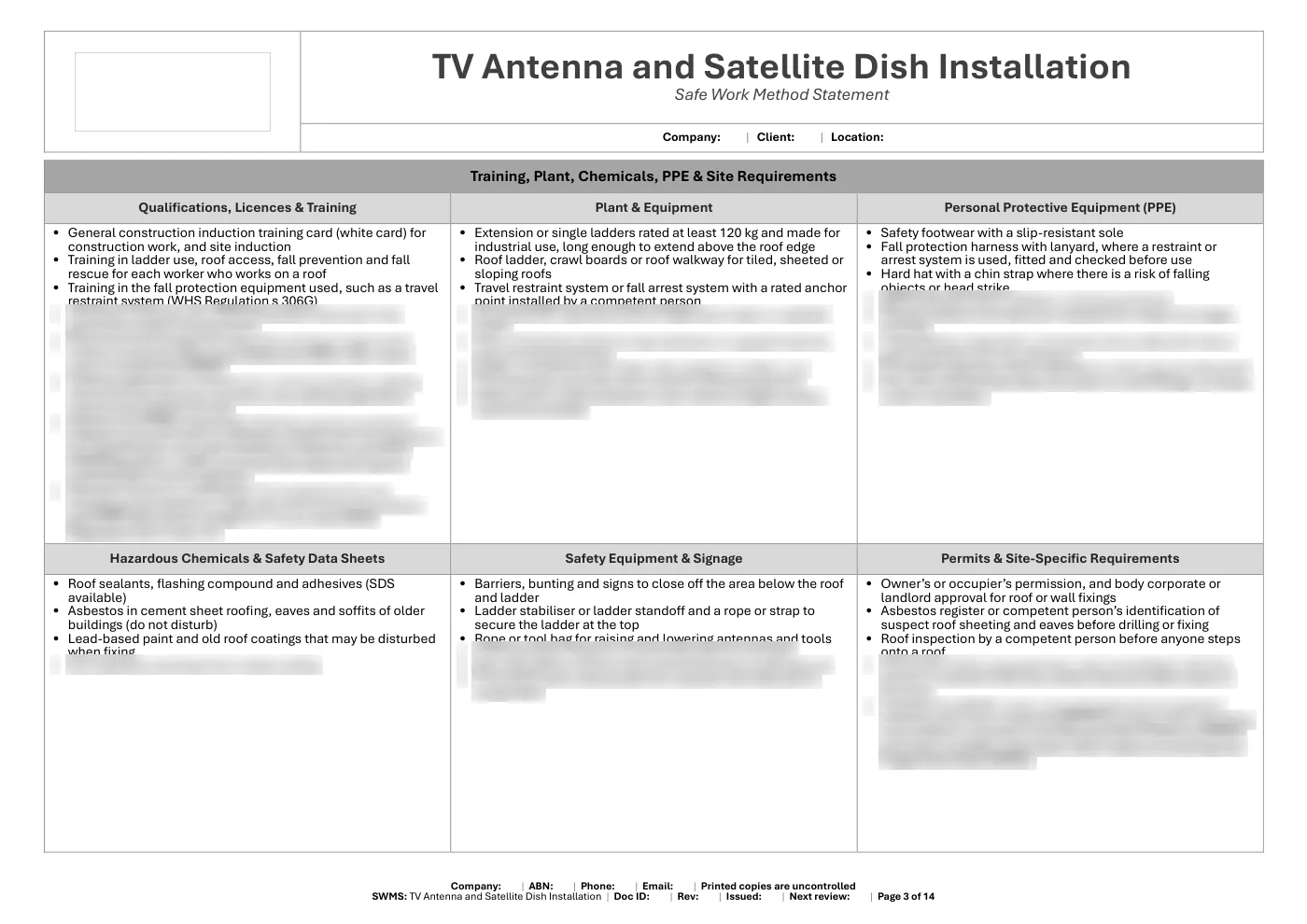
- General construction induction training card (white card) for construction work, and site induction
- Training in ladder use, roof access, fall prevention and fall rescue for each worker who works on a roof
- Training in the fall protection equipment used, such as a travel restraint system (WHS Regulation s 306G)
- Training in working near overhead power lines and in the electricity entity’s requirements
- Electrical work licence for any mains wiring or hard-wired mains connection (Electrical Safety Act 2002 s 55); mains work is outside this SWMS
- Cabling registration or licence for communications cabling where the law requires it (confirm any cabling registration requirement before the job)
- Workers the PCBU reasonably believes may be involved in asbestos removal work or asbestos-related work are trained in the identification and safe handling of asbestos and ACM (WHS Regulation s 445); everyone else stops and reports anything that may be asbestos
- Operator licence or verification of competency for any elevating work platform; a high risk work licence for a boom-type EWP with a boom length of 11 m or more (WHS Regulation Sch 3 item 21)
Legislation and Codes of Practice Referenced
- Work Health and Safety Act 2011 (Qld)
- Work Health and Safety Regulation 2011 (Qld)
- Work Health and Safety Regulation 2011 (Qld): ss 306A to 306Q (falls, ladders, travel restraint and platforms in construction work)
- Work Health and Safety Regulation 2011 (Qld): ss 315B to 315M (falling objects)
- Work Health and Safety Regulation 2011 (Qld): ss 419, 422, 445, 450 and 451 (asbestos)
- Electrical Safety Act 2002 (Qld): ss 14, 18 and 55 (meaning of electrical equipment, electrical work and licence requirement)
- Electrical Safety Regulation 2026 (Qld): ss 10 to 13 and sch 2 (overhead power line exclusion zones and unsafe distances)
- Electrical Safety Regulation 2026 (Qld): ss 14 and 15 (underground electric lines, where wall fixings or cable runs involve digging)
- Electrical Safety Code of Practice 2020 – Working near overhead and underground electric lines
- Managing the Risk of Falls at Workplaces Code of Practice 2021
- Hazardous Manual Tasks Code of Practice 2021
- How to Manage and Control Asbestos in the Workplace Code of Practice 2021
- Managing the Work Environment and Facilities Code of Practice 2021
- How to Manage Work Health and Safety Risks Code of Practice 2021
- First Aid in the Workplace Code of Practice 2021
What You Get
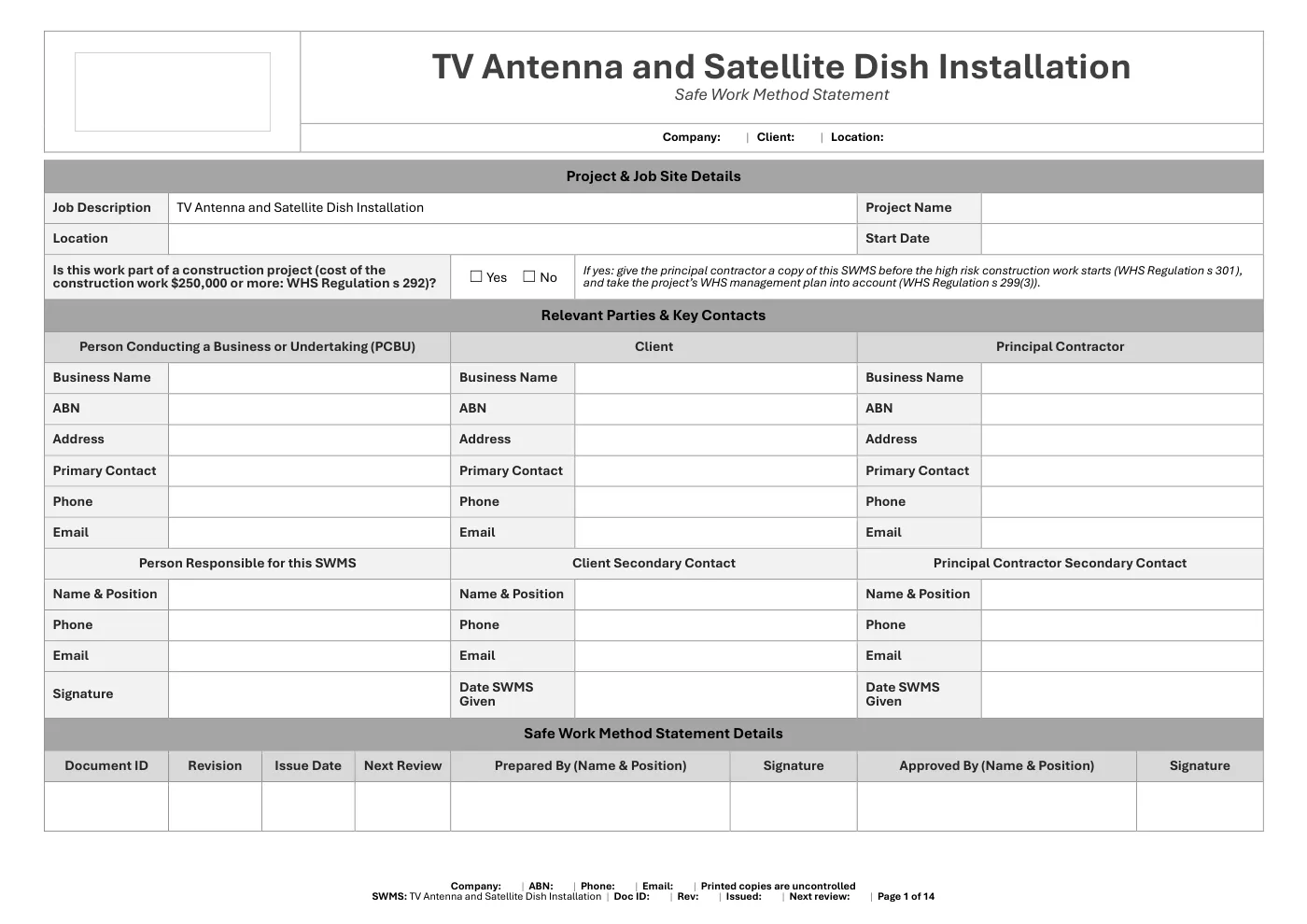
- An editable Microsoft Word document (14 A4 landscape pages). Type your business, client and job details once and they fill in on every page, with a space for your logo
- 7 job steps for this work, each with its hazards, controls, initial and residual risk scores and the person responsible
- PPE listed for this job: safety footwear with a slip-resistant sole; fall protection harness with lanyard, where a restraint or arrest system is used, fitted and checked before use
- Emergency arrangements for: fall from a ladder or roof, person suspended in a harness and electric shock or contact with a power line
- Plus the parts every Work Safety QLD SWMS shares, from the s 291 checklist to the worker sign-on sheet (see the layout in our free SWMS template)
Adjust it for your site, plant and crew, and talk it through with your workers before work starts. Please make sure you read our Disclaimer before downloading this SWMS.
Checked against the Queensland laws and codes of practice listed above. Last reviewed November 2026.
Having trouble with your download? Contact us any time. Please read our Disclaimer before downloading.
How to use it
From download to site in three steps
Buy and download
Check out with card, Apple Pay or Google Pay. Your download buttons appear straight away and the links are emailed to you. Links work for 3 months, so save your copies.
Make it yours
Add your logo and business details in Word or Excel, or tick branding at checkout (A$29) and we add them. Then add your site and job details.
Brief your crew
Talk it through with the workers doing the job, have them sign on, and keep it on site. Review it whenever the job or conditions change.
What format is it?
Microsoft Word. Edit it in Word, or free in Word for the web, and add your own logo and business details. Or let us do it: tick "Add my business name and logo to every document" at checkout (A$29, free on orders of A$500 or more) and fill in a short form after payment.
How do I get it after I pay?
Your download buttons appear as soon as checkout finishes, and the links are emailed to you. You can re-download from your account at any time.
Is it compliant with Queensland law?
It's written around Queensland's Work Health and Safety Act 2011 and Regulation 2011. Tailor it to your site, consult your workers and review it whenever conditions change; no template can guarantee compliance on its own.
What if it isn't right for my job?
If it doesn't match its description or has a fault, tell us and we'll fix it. If you're still not happy, we'll refund you or give you store credit, your choice. Check the sample pages first, as we don't refund a change of mind.
Only logged in customers who have purchased this product may leave a review.
Reviews