
Roof Tiling SWMS
Laying new concrete and terracotta roof tiles on Queensland buildings: battens, loading tiles, cutting (silica), pointing and falls from edges. An editable Word SWMS template.
RG
Written by Ryan Graham, health and safety professional (16 years on Queensland sites)
$49.99 incl. GST
AUD · one-off purchase · instant download
- Instant download · your links arrive by email straight after checkout and work for 3 months, so save your copy
- Your business name and logo · we fill them into every document for A$29 (free on orders of A$500 or more), or edit it yourself in Microsoft Word
- Quality guarantee · we'll fix any problem, then refund you or give store credit if you're still not happy
- Secure checkout · card, Apple Pay or Google Pay through Stripe
About this template
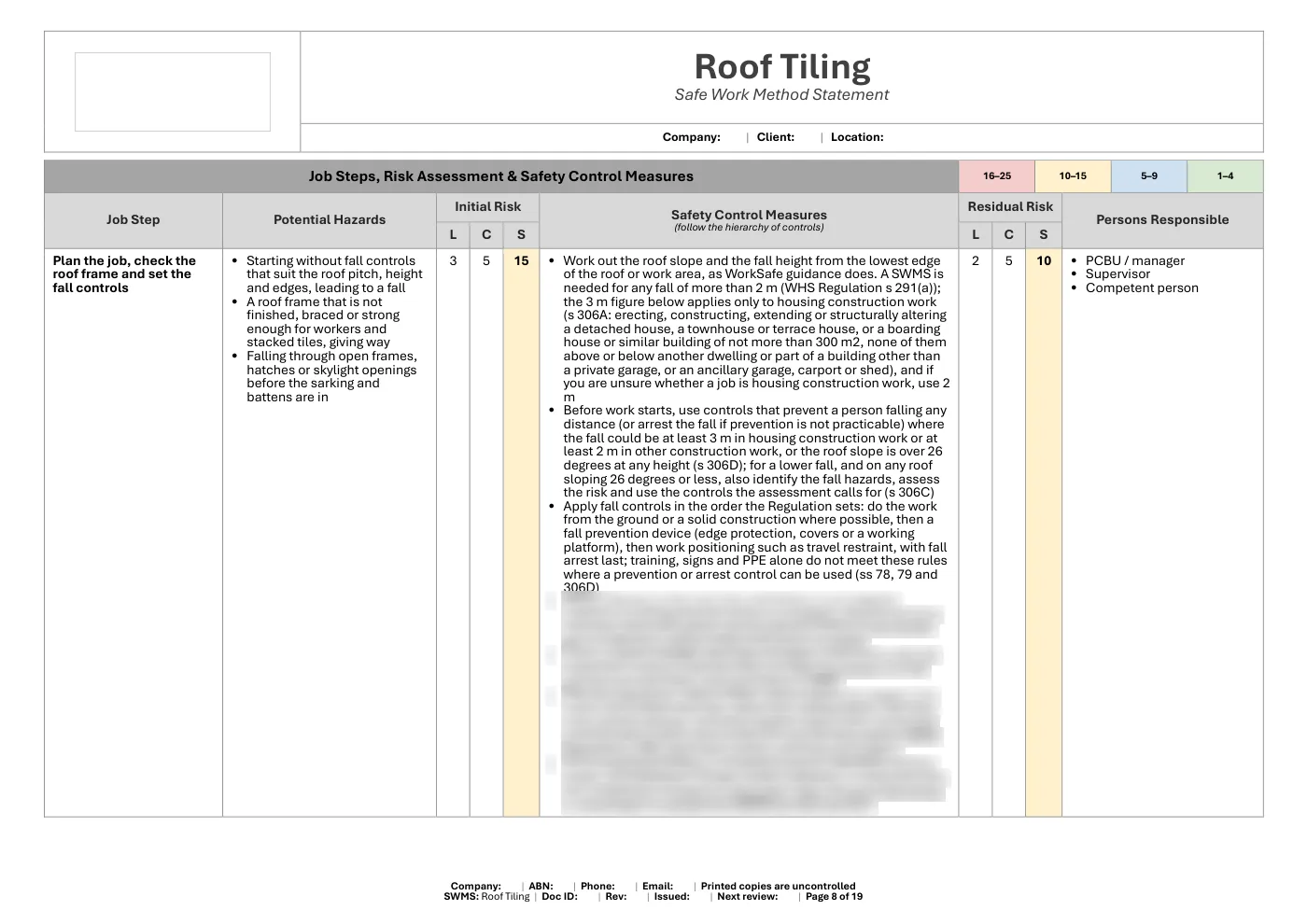
Suits roof tilers, roofing contractors and builders who lay new concrete or terracotta tiles. It follows the job in order, from checking the roof frame and setting the fall controls through edge protection, overhead lines, loading tiles, sarking and battens, cutting at a ground station, laying, ridge and hip bedding and pointing, to weather and pack-up. Stripping and replacing old roof coverings and metal roof sheeting have their own SWMS.
Roof tiling is high risk construction work when a person could fall more than 2 metres (WHS Regulation s 291), which is the item ticked on the form, so a SWMS is required (s 299); the 3 metre figure in ss 306C and 306D applies only to housing construction work and changes which fall controls are needed, not whether a SWMS is required. You can also tick energised electrical installations if overhead lines are near the roof, powered mobile plant if a crane, forklift or delivery truck moves where the work is done, and the contaminated atmosphere item if cutting tiles or mixing mortar creates silica dust, as the Queensland silica code advises.
New to SWMS? Read What is a safe work method statement?
What is covered in our roof tiling SWMS?
After the standard pre-start checks, the job steps run from “Plan the job, check the roof frame and set the fall controls” to “Pack up, clear debris and hand over”. The hazards and controls include:
- Falls from the roof edge, eaves, ridge and gable ends
- Falls through open frames and between battens
- Falls from ladders during roof access
- Roof frames overloaded by stacked tile packs
- Being struck by cranes, conveyors and falling loads
- Contact with overhead power lines
- Tiles, clips and tools sliding onto people below
- Silica dust from cutting tiles and mixing mortar
- Noise from saws and nail guns
- Alkaline burns from wet cement and pointing
- Wind, rain and slippery tile surfaces
- Heat illness and hot tile surfaces
- Cuts and strains from handling tiles
High risk construction work
These high risk construction work items (WHS Regulation 2011 (Qld) s 291) are already ticked because they are part of this work. Tick any others that apply to your job:
- Involves a risk of a person falling more than 2m
Licences, training and competency
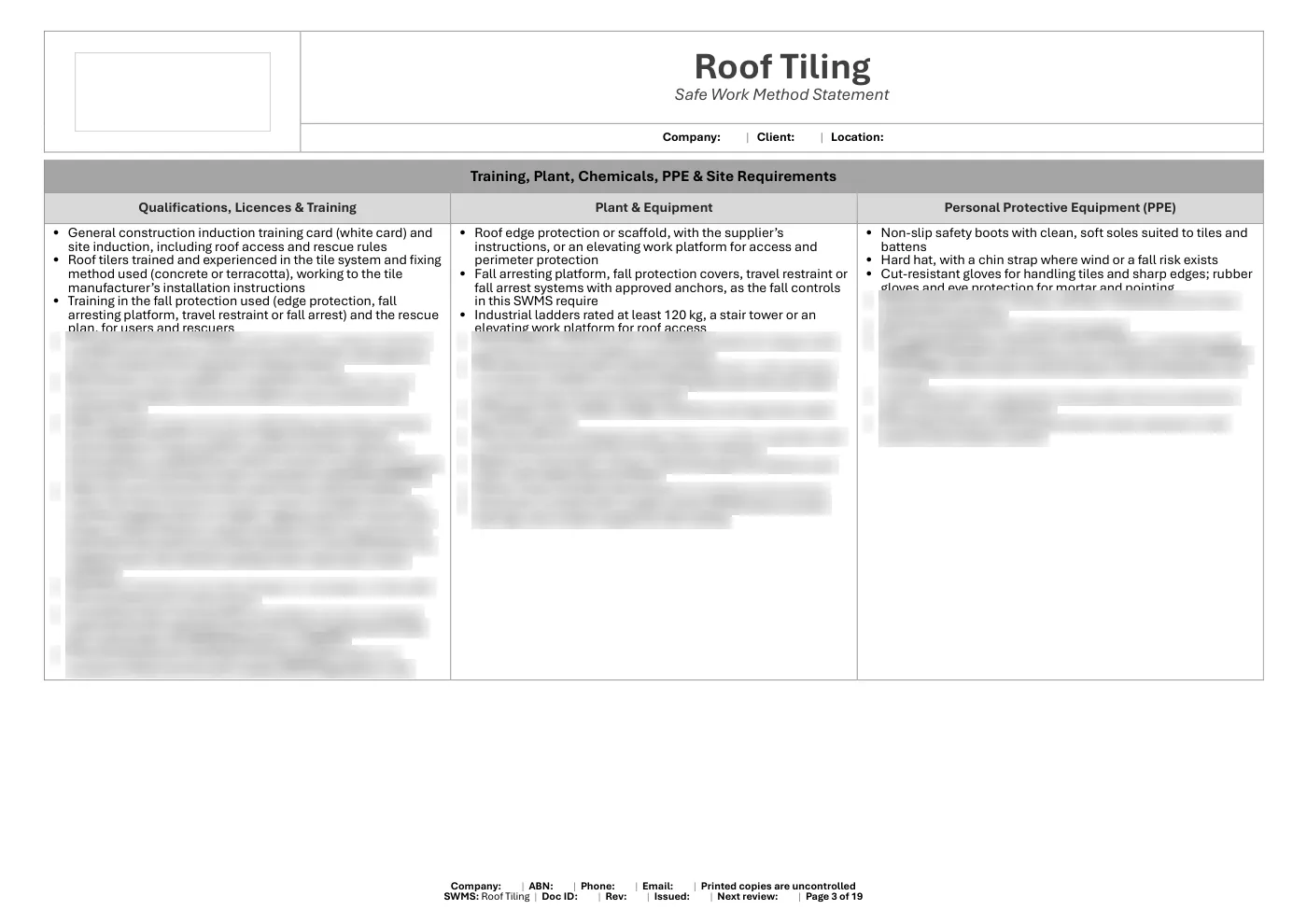
- General construction induction training card (white card) and site induction, including roof access and rescue rules
- Roof tilers trained and experienced in the tile system and fixing method used (concrete or terracotta), working to the tile manufacturer’s installation instructions
- Training in the fall protection used (edge protection, fall arresting platform, travel restraint or fall arrest) and the rescue plan, for users and rescuers
- Competent person to install travel restraint, inspect restraint and fall arrest systems at least every 6 months, and approve anchor points (or an engineer to design them)
- Roof framer, truss supplier or engineer to confirm the roof frame is complete, braced and able to carry workers and stacked tiles
- High risk work licence for the scaffolding class that matches any scaffold used for access or edge protection (basic, intermediate or advanced) for anyone erecting, altering or dismantling a scaffold from which a person or object could fall more than 4 m (erected under a separate scaffolding SWMS)
- High risk work licence for the class of any vehicle loading crane (10 metre tonnes or more), crane or forklift truck used, and the dogging class or a higher rigging class for anyone who slings a load or directs a plant operator in the movement of a load when the load is out of the operator’s view (Schedule 19, dogging work; the vehicle loading crane class also covers slinging)
- Operators trained on any tile elevator or conveyor, in line with the manufacturer’s instructions
- Crystalline silica training (VET accredited course or training approved by the regulator) where the dust assessment finds tile cutting high risk (WHS Regulation s 529CD)
- First aid equipment, facilities and trained first aiders (or access to them) as the work needs (WHS Regulation s 42)
Legislation and codes of practice referenced
- Work Health and Safety Act 2011 (Qld)
- Work Health and Safety Regulation 2011 (Qld)
- Managing the Risk of Falls at Workplaces Code of Practice 2021
- Scaffolding Code of Practice 2021 (where scaffold is used for access or edge protection)
- Managing Risks of Plant in the Workplace Code of Practice 2021
- Mobile Crane Code of Practice 2024 (vehicle loading crane lifts of tile packs)
- Hazardous Manual Tasks Code of Practice 2021
- Managing Noise and Preventing Hearing Loss at Work Code of Practice 2021
- Managing the Work Environment and Facilities Code of Practice 2021
- Managing Risks of Hazardous Chemicals in the Workplace Code of Practice 2021
- Managing respirable crystalline silica dust exposure in construction and manufacturing of construction elements Code of Practice 2022 (tile cutting and mortar)
- How to Manage and Control Asbestos in the Workplace Code of Practice 2021 (existing buildings)
- First Aid in the Workplace Code of Practice 2021
- How to Manage Work Health and Safety Risks Code of Practice 2021
- Electrical Safety Act 2002 (Qld)
- Electrical Safety Regulation 2026 (Qld): overhead line exclusion zones in schedule 2, and construction site electrical equipment (s 140)
- Electrical Safety Code of Practice 2020 – Working near overhead and underground electric lines (distances come from the 2026 Regulation)
- AS/NZS 4994.2 Temporary edge protection – Roof edge protection – Installation and dismantling (cited in the Falls Code)
- WorkSafe Queensland guidance: Managing the risk of falls while working on roofs in housing construction (guidance, not a code)
What you get
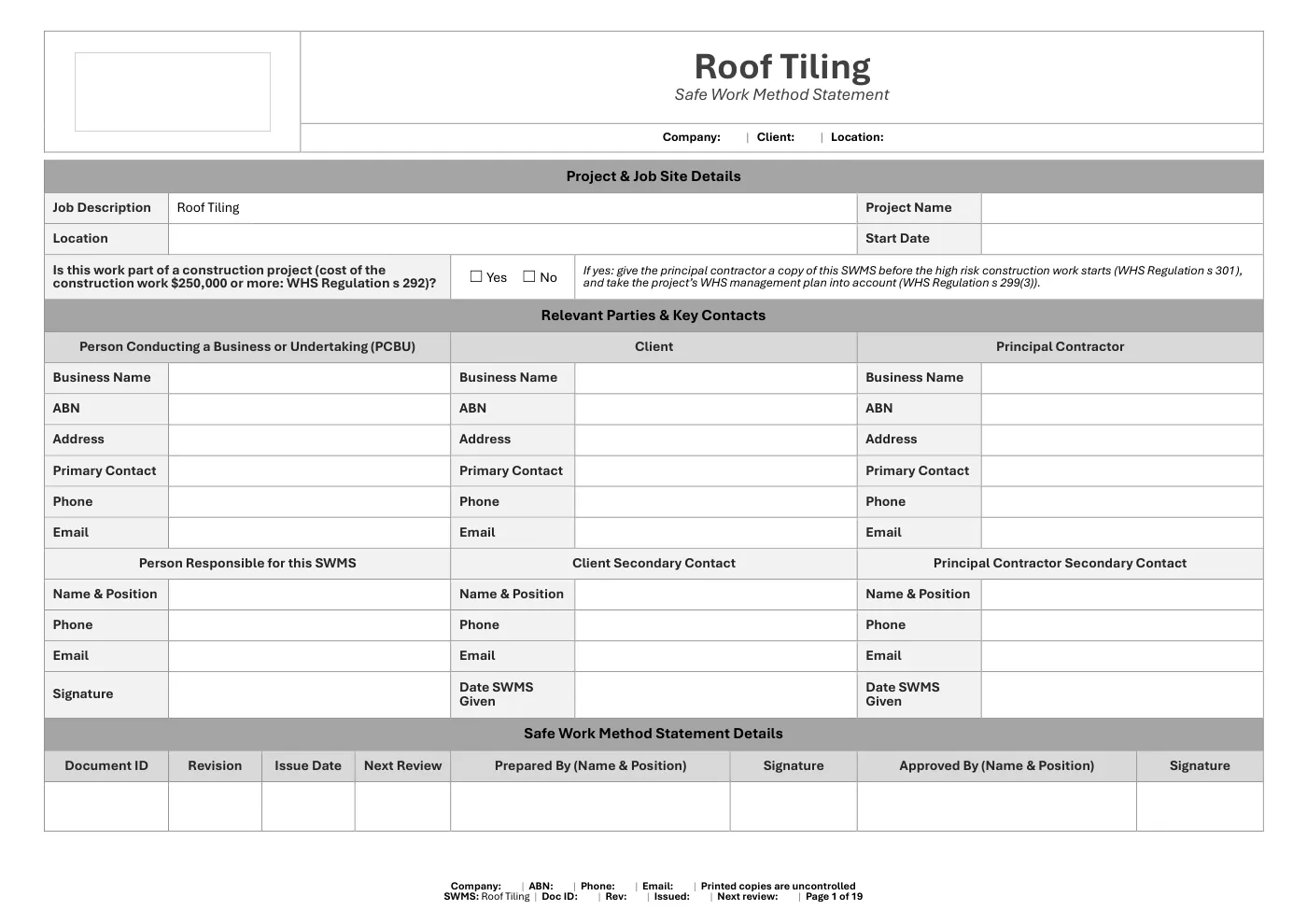
- An editable Microsoft Word document (19 pages), laid out on A4 landscape pages. Type your business, client and job details once and they fill in on every page, with a space for your logo
- 10 job steps for this work, each with its hazards, controls, initial and residual risk scores and the person responsible
- PPE listed for this job: non-slip safety boots with clean, soft soles suited to tiles and battens; hard hat, with a chin strap where wind or a fall risk exists
- Emergency arrangements for: fall or fall through the frame, worker hanging in a harness after an arrested fall and contact with an overhead power line
- Plus the parts every Work Safety QLD SWMS shares, from the s 291 checklist to the worker sign-on sheet (see the layout in our free SWMS template)
Adjust it for your site, plant and crew, and talk it through with your workers before work starts.
Checked against the Queensland laws and codes of practice listed above. Last reviewed October 2026.
Having trouble with your download? Contact us any time. Please read our Disclaimer before downloading.
How to use it
From download to site in three steps
Buy and download
Check out with card, Apple Pay or Google Pay. Your download buttons appear straight away and the links are emailed to you. Links work for 3 months, so save your copies.
Make it yours
Add your logo and business details in Word or Excel, or tick branding at checkout (A$29) and we add them. Then add your site and job details.
Brief your crew
Talk it through with the workers doing the job, have them sign on, and keep it on site. Review it whenever the job or conditions change.
What format is it?
Microsoft Word. Edit it in Word, or free in Word for the web, and add your own logo and business details. Or let us do it: tick "Add my business name and logo to every document" at checkout (A$29, free on orders of A$500 or more) and fill in a short form after payment.
How do I get it after I pay?
Your download buttons appear as soon as checkout finishes, and the links are emailed to you. You can re-download from your account at any time.
Is it compliant with Queensland law?
It's written around Queensland's Work Health and Safety Act 2011 and Regulation 2011. Tailor it to your site, consult your workers and review it whenever conditions change; no template can guarantee compliance on its own.
What if it isn't right for my job?
If it doesn't match its description or has a fault, tell us and we'll fix it. If you're still not happy, we'll refund you or give you store credit, your choice. Check the sample pages first, as we don't refund a change of mind.
Only logged in customers who have purchased this product may leave a review.
Reviews