Poultry Shed Clean-Out SWMS
Editable Word SWMS template for cleaning out poultry sheds in Queensland with loaders and washdown: dust, ammonia, mould, heat, machinery and wet-area electrical safety.
RG
Written by Ryan Graham, health and safety professional (16 years on Queensland sites)
$39.99 incl. GST
AUD · one-off purchase · instant download
- Instant download · your links arrive by email straight after checkout and work for 3 months, so save your copy
- Make it yours in minutes · edit in Microsoft Word and add your logo
- Quality guarantee · we'll fix any problem, then refund you or give store credit if you're still not happy
- Secure checkout · card, Apple Pay or Google Pay through Stripe
Save with a bundle
About this template
Suits poultry growers, shed clean-out contractors and farm crews who remove litter with loaders and wash down empty sheds. It follows the job from biosecurity checks and shutting down the shed equipment, through ventilation, loader work, hand clean-out, carting litter, washdown and disinfectant use, to heat, hygiene and notifying work-related illness.
Cleaning out a poultry shed is rural work, not high risk construction work, so no high risk construction work items are pre-ticked. A SWMS is required by law only for high risk construction work (WHS Regulation s 299); tick the items that apply if the work forms part of such work. Otherwise it works as a written safe work procedure and risk assessment.
Learn More: What Is A Safe Work Method Statement?
Have you ever been asked to provide a SWMS on a project in Queensland? Read our guide to what a Safe Work Method Statement is and when you need one.
What Is Covered In Our Poultry Shed Clean-Out SWMS?
The job steps run in the order the work is done, from pre-start checks to finishing up. The hazards and controls include:
- Ammonia, organic dust and mould in the shed air
- Loader and skid steer collisions and rollover
- Entanglement in feed lines, augers and fans
- Electric shock during wet washdown
- High-pressure water and slips
- Disinfectant burns and toxic gas from mixing products
- Contact with dead birds, litter and sharp objects
- Zoonotic illness such as Q fever and psittacosis
- Heat, humidity and fatigue
- Working alone and biosecurity
High Risk Construction Work
No high risk construction work items (WHS Regulation 2011 (Qld) s 291) are pre-ticked, because this work is not high risk construction work by itself. Tick the items that apply to your job, such as a fall risk of more than 2 metres or work where powered mobile plant is moving.
Licences, Training and Competency
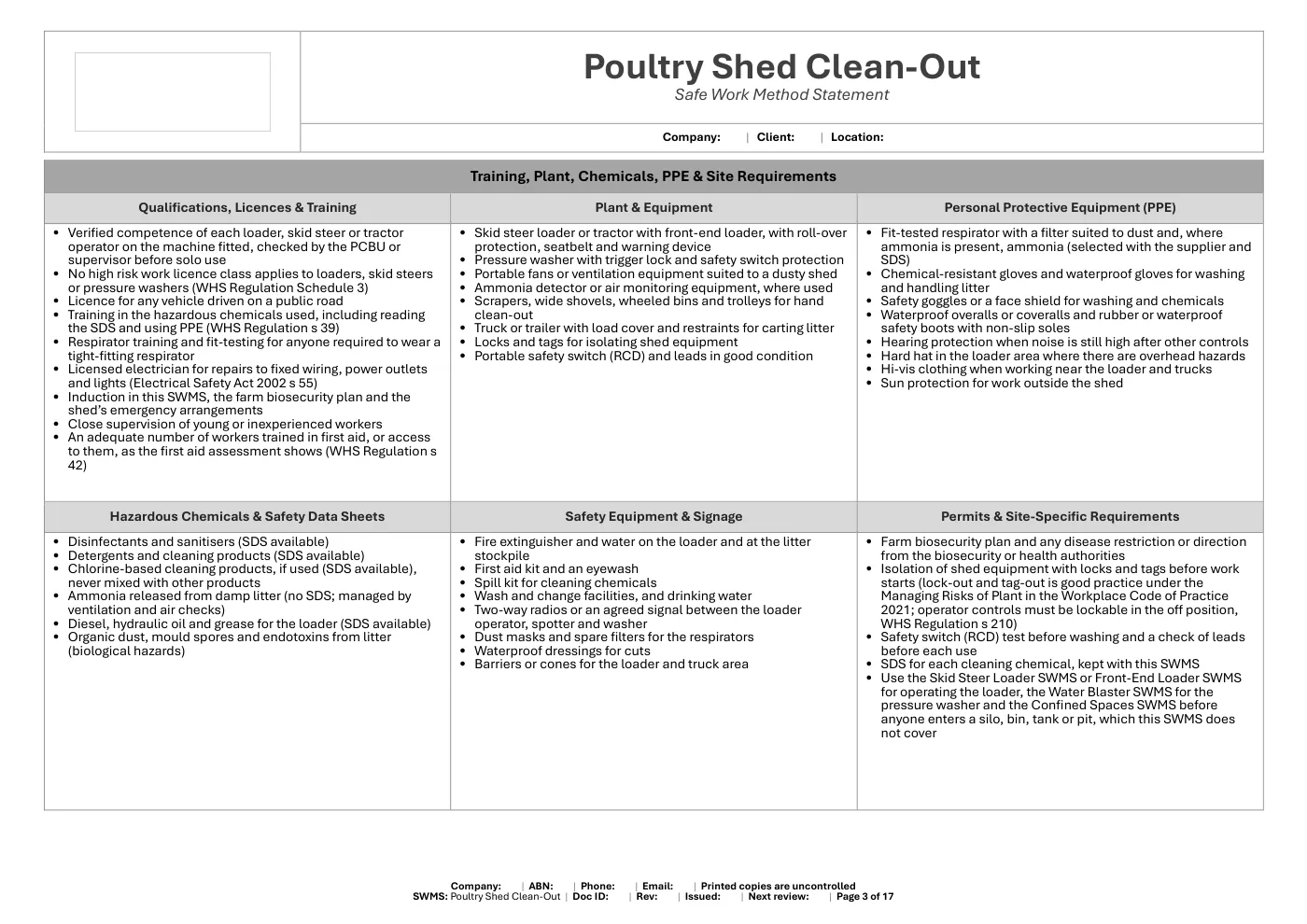
- Verified competence of each loader, skid steer or tractor operator on the machine fitted, checked by the PCBU or supervisor before solo use
- No high risk work licence class applies to loaders, skid steers or pressure washers (WHS Regulation Schedule 3)
- Licence for any vehicle driven on a public road
- Training in the hazardous chemicals used, including reading the SDS and using PPE (WHS Regulation s 39)
- Respirator training and fit-testing for anyone required to wear a tight-fitting respirator
- Licensed electrician for repairs to fixed wiring, power outlets and lights (Electrical Safety Act 2002 s 55)
- Induction in this SWMS, the farm biosecurity plan and the shed’s emergency arrangements
- Close supervision of young or inexperienced workers
- An adequate number of workers trained in first aid, or access to them, as the first aid assessment shows (WHS Regulation s 42)
Legislation and Codes of Practice Referenced
- Work Health and Safety Act 2011 (Qld)
- Work Health and Safety Regulation 2011 (Qld)
- WHS Act 2011 (Qld) ss 36 and 38 and WHS Regulation 2011 (Qld) s 699: notifying a serious illness, such as Q fever, avian influenza or psittacosis, contracted through contact with animals or animal waste
- Rural Plant Code of Practice 2024
- Managing Risks of Plant in the Workplace Code of Practice 2021
- Managing Risks of Hazardous Chemicals in the Workplace Code of Practice 2021
- Hazardous Manual Tasks Code of Practice 2021
- Managing Noise and Preventing Hearing Loss at Work Code of Practice 2021
- Managing the Work Environment and Facilities Code of Practice 2021
- First Aid in the Workplace Code of Practice 2021
- How to Manage Work Health and Safety Risks Code of Practice 2021
- Children and Young Workers Code of Practice 2006
- Electrical Safety Act 2002 (Qld)
- Electrical Safety Regulation 2026 (Qld): section 125 (rural industry work) and section 141 (requirements for rural industry work, including washdown areas)
- Electrical Safety Code of Practice 2020 – Electrical equipment rural industry
- Heavy Vehicle National Law (Queensland), applied by the Heavy Vehicle National Law Act 2012 (Qld): s 6 (heavy vehicle means a vehicle with a GVM or ATM of more than 4.5 t), s 26C (primary duty of each party in the chain of responsibility), s 96 (compliance with mass requirements), s 110 (national regulations may prescribe loading requirements), s 111 (compliance with the loading requirements) and s 228 (duty of driver to avoid driving while fatigued or unfit to drive)
- AS/NZS 1715 Selection, use and maintenance of respiratory protective equipment (as named in the Safe Work Australia model biological hazards code, which is guidance only and not approved in Queensland; applied here as good practice)
- Safe Work Australia model Code of Practice: Managing the risks of biological hazards at work (guidance)
- Safe Work Australia model Code of Practice: Managing the risk of fatigue at work (guidance)
What You Get
- An editable Microsoft Word document (17 pages), laid out on A4 landscape pages
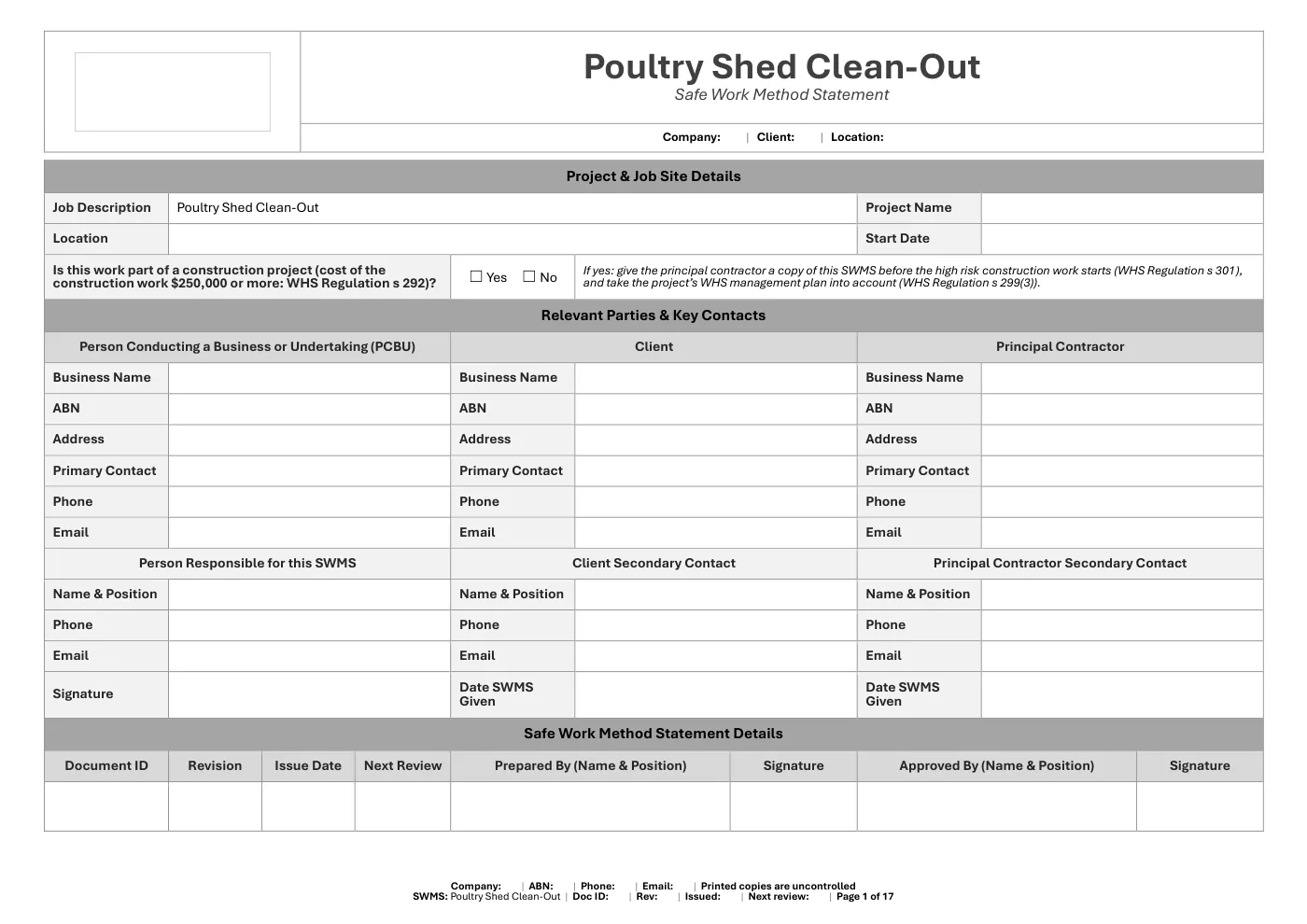
- Business, client, job and document details typed once and filled in on every page, plus a space for your logo
- The high risk construction work checklist, worded as WHS Regulation s 291, and the construction project question (s 292)
- A worker and health and safety representative consultation record
- Qualifications, plant, PPE, hazardous chemicals, safety equipment, permits, references and emergency arrangements filled in for this work
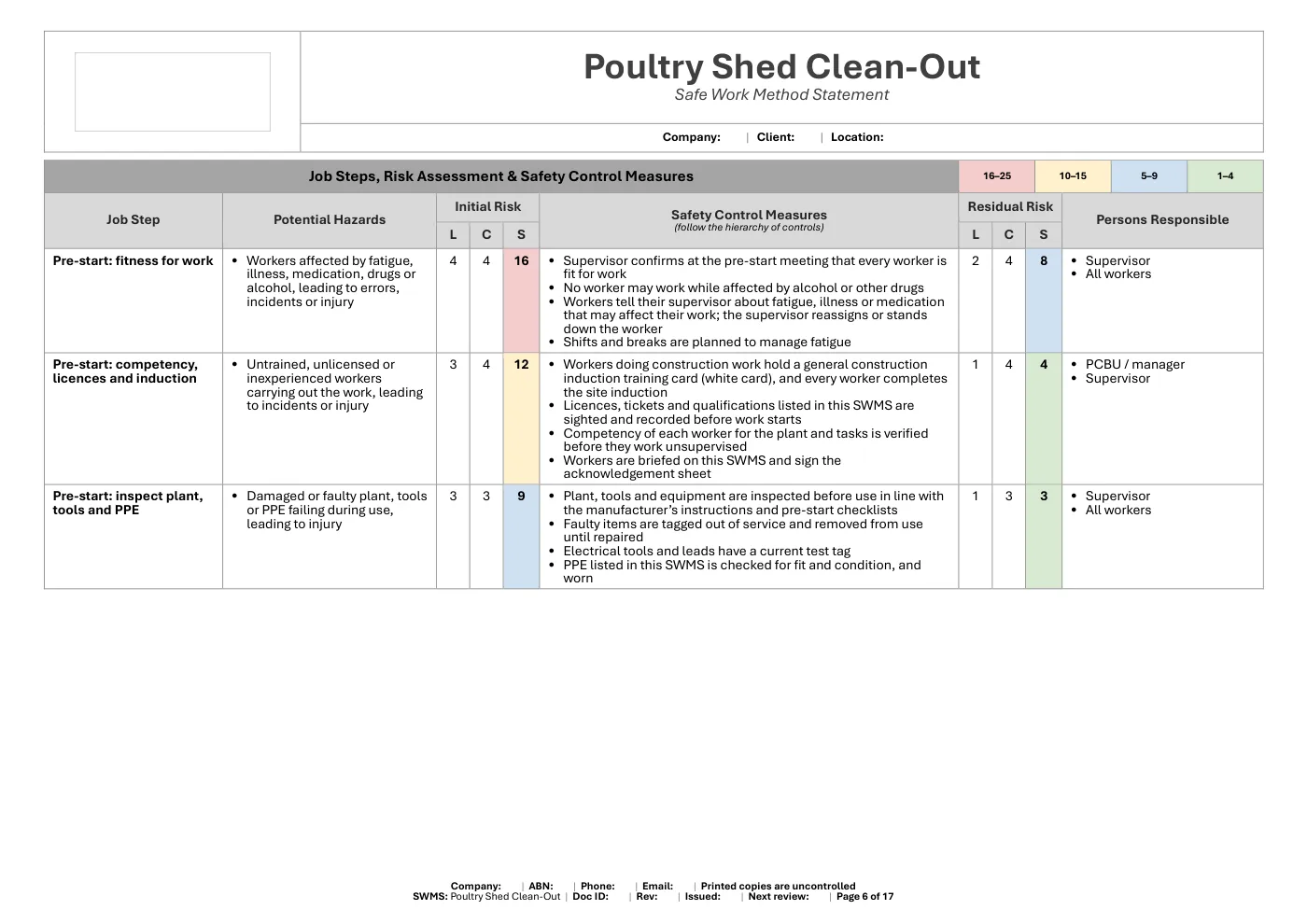
- A 5 x 5 risk matrix, and job steps with initial and residual risk scores and the people responsible
- Implementing, monitoring and review requirements, an additional controls log, revision history and a worker sign-on sheet
Review and adjust it for your site, your plant and the way your crew does the job, and talk it through with your workers before work starts. If you have any trouble downloading this SWMS, you can contact us at any time. Please make sure you read our Disclaimer before downloading this SWMS.
Having trouble with your download? Contact us any time. Please read our Disclaimer before downloading.
How to use it
From download to site in three steps
Buy and download
Check out with card, Apple Pay or Google Pay. Your download buttons appear straight away and the links are emailed to you. Links work for 3 months, so save your copies.
Make it yours
Open it in Microsoft Word or Excel. Add your logo, business details, site and job information, and adjust it to how the work is done.
Brief your crew
Talk it through with the workers doing the job, have them sign on, and keep it on site. Review it whenever the job or conditions change.
What format is it?
Microsoft Word. Edit it in Word, or free in Word for the web, and add your own logo and business details.
How do I get it after I pay?
Your download buttons appear as soon as checkout finishes, and the links are emailed to you. You can re-download from your account at any time.
Is it compliant with Queensland law?
It's written around Queensland's Work Health and Safety Act 2011 and Regulation 2011. Tailor it to your site, consult your workers and review it whenever conditions change; no template can guarantee compliance on its own.
What if it isn't right for my job?
If it doesn't match its description or has a fault, tell us and we'll fix it. If you're still not happy, we'll refund you or give you store credit, your choice. Check the sample pages first, as we don't refund a change of mind.
More templates like this
$39.99

Confined Spaces SWMS
$49.99
Excavator SWMS
$49.99


Reviews