
Pipe Relining SWMS
Editable Word SWMS template for cured-in-place pipe relining in Queensland: pits and confined spaces, resin and styrene fumes, steam or UV curing, pressure, noise and heat.
RG
Written by Ryan Graham, health and safety professional (16 years on Queensland sites)
$49.99 incl. GST
AUD · one-off purchase · instant download
- Instant download · your links arrive by email straight after checkout
- Make it yours in minutes · edit in Microsoft Word or Excel and add your logo
- Quality guarantee · we'll fix it or refund you if it isn't as described
- Secure checkout · card, Apple Pay or Google Pay through Stripe
About this template
For drainage, plumbing and trenchless relining contractors who reline sewer and drainage pipes with cured-in-place liners from pits and access points. It follows the job from the camera survey and confined space assessment through set-up, cleaning the pipe, mixing resin, installing the liner and steam, hot water or UV curing, to venting, trimming and pack-up. Entering a pit or pipe is not covered and needs a separate confined space SWMS.
Pipe relining is high risk construction work here because it is carried out in or near confined spaces (the pits, chambers and pipe being lined) and in an area that may have a contaminated or flammable atmosphere (WHS Regulation sections 291(f), 291(l) and 299), so those two items are ticked even though nobody enters a pit or pipe under this document; entry needs its own SWMS, written risk assessment and entry permit. Tick any others that apply, such as an access pit deeper than 1.5 metres, work on or beside a road in use, or work on or near energised electrical services.
Learn More: What Is A Safe Work Method Statement?
Have you ever been asked to provide a SWMS on a project in Queensland? Read our guide to what a Safe Work Method Statement is and when you need one.
What Is Covered In Our Pipe Relining SWMS?
The job steps run in the order the work is done, from pre-start checks to finishing up. The hazards and controls include:
- Overcome by sewer gas or low oxygen at a pit
- Falls into open pits and crushed hands on covers
- Styrene and resin vapour in the air
- Fire and explosion from resin, catalyst and vapour
- Resin and catalyst burns to skin and eyes
- Scalds and burns from steam and hot water
- Pressure release from air, steam and hoses
- UV light and electric shock from lamp trains
- Water jet and cutter injuries
- Hearing loss made worse by styrene
- Sewage contact and infection
- Asbestos in old pipes
- Heat illness and heavy manual handling
- Traffic and the public near the truck
High Risk Construction Work
These high risk construction work items (WHS Regulation 2011 (Qld) s 291) are already ticked because they are part of this work. Tick any others that apply to your job:
- Is carried out in or near a confined space
- Is carried out in an area that may have a contaminated or flammable atmosphere
Licences, Training and Competency
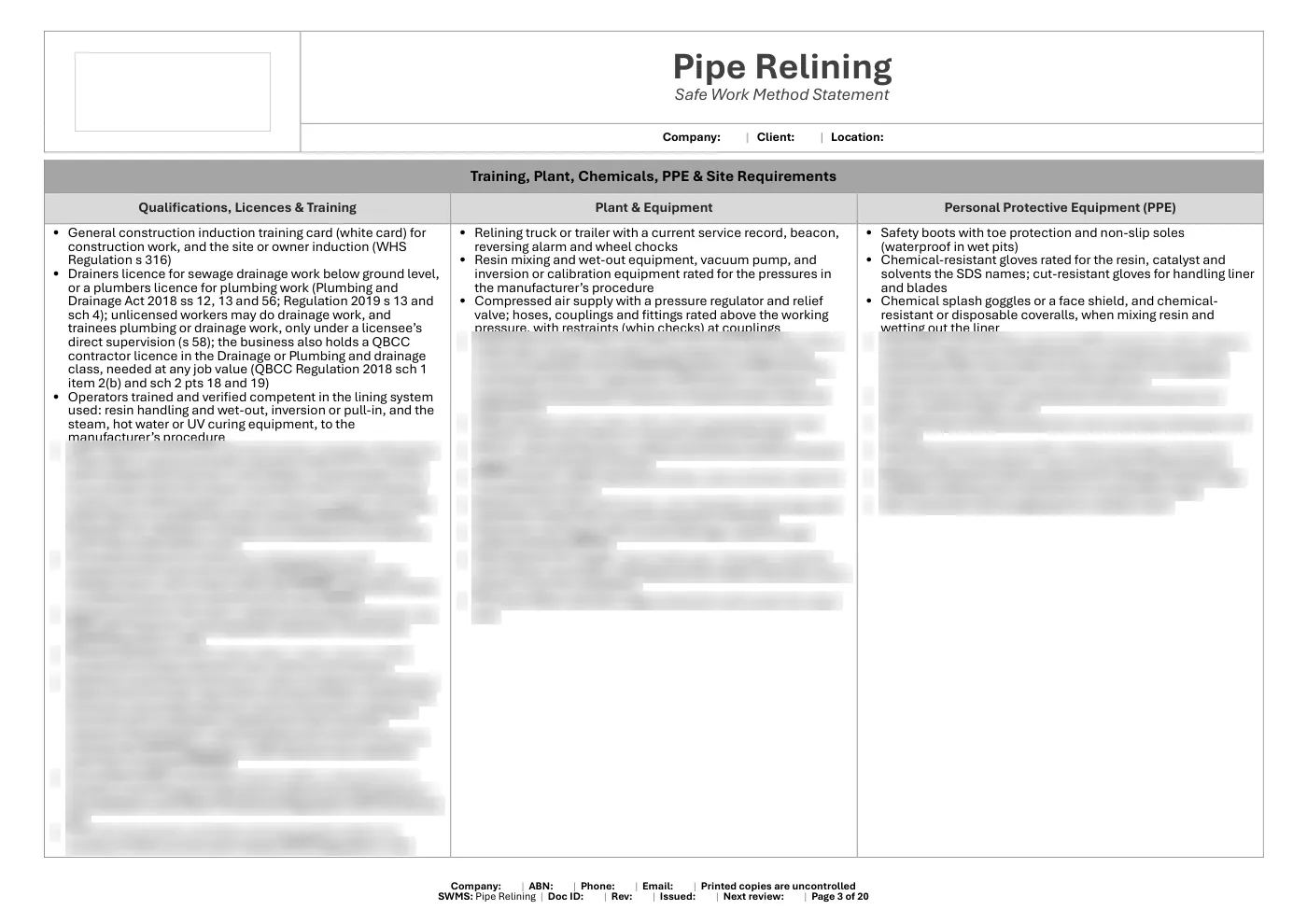
- General construction induction training card (white card) for construction work, and the site or owner induction (WHS Regulation s 316)
- Drainers licence for sewage drainage work below ground level, or a plumbers licence for plumbing work (Plumbing and Drainage Act 2018 ss 12, 13 and 56; Regulation 2019 s 13 and sch 4); unlicensed workers may do drainage work, and trainees plumbing or drainage work, only under a licensee’s direct supervision (s 58); the business also holds a QBCC contractor licence in the Drainage or Plumbing and drainage class, needed at any job value (QBCC Regulation 2018 sch 1 item 2(b) and sch 2 pts 18 and 19)
- Operators trained and verified competent in the lining system used: resin handling and wet-out, inversion or pull-in, and the steam, hot water or UV curing equipment, to the manufacturer’s procedure
- High risk work licence for standard boiler operation (Schedule 3 item 26) or advanced boiler operation (item 27, for a boiler with multiple fuel sources, a pre-heater, a superheater or an economiser) when the steam unit has 5 m2 or more heating surface and 150 kilowatts or more output; a steam unit under either figure is outside the boiler classes (WHS Regulation Schedule 19, definition of boiler, for schedule 3), so read the unit’s data plate before work
- Competent person to write the confined space risk assessment for each pit and pipe (WHS Regulation s 66); nobody enters a pit or pipe under this SWMS, and entry needs a confined space entry permit and its own SWMS
- Workers trained in the resin, catalyst and solvent hazards, the SDS, spill response, and respirator selection, fit and care (WHS Regulation s 39)
- Trained operators for the water jetter, cutter, winch, CCTV equipment and gas detector (use, alarms and checks)
- Asbestos awareness training so crews recognise old asbestos pipes and surrounds, stop work and report them; workers the business reasonably believes may be involved in asbestos removal work or asbestos-related work also need the asbestos identification, safe handling and control measures training that WHS Regulation s 445 requires (any asbestos work has a separate SWMS)
- Accredited traffic controllers where traffic is directed on or beside a road (Transport Operations (Road Use Management – Accreditation and Other Provisions) Regulation 2015 ss 54 and 55)
- First aid equipment, facilities and trained first aiders (or access to them) as the work needs (WHS Regulation s 42)
Legislation and Codes of Practice Referenced
- Work Health and Safety Act 2011 (Qld)
- Work Health and Safety Regulation 2011 (Qld)
- Confined Spaces Code of Practice 2021
- Managing Risks of Hazardous Chemicals in the Workplace Code of Practice 2021
- Managing Risks of Plant in the Workplace Code of Practice 2021
- Managing Noise and Preventing Hearing Loss at Work Code of Practice 2021
- Hazardous Manual Tasks Code of Practice 2021
- Managing the Risk of Falls at Workplaces Code of Practice 2021 (open pits)
- Excavation Work Code of Practice 2021 (where an access pit is dug)
- How to Manage and Control Asbestos in the Workplace Code of Practice 2021
- Managing the Work Environment and Facilities Code of Practice 2021
- First Aid in the Workplace Code of Practice 2021
- Traffic Management for Construction or Maintenance Work Code of Practice 2008
- How to Manage Work Health and Safety Risks Code of Practice 2021
- Plumbing and Drainage Act 2018 (Qld) and Plumbing and Drainage Regulation 2019 (Qld)
- Electrical Safety Act 2002 (Qld)
- Electrical Safety Regulation 2026 (Qld): construction electrical equipment (s 140) and electric lines (ss 10 to 15, schedule 2)
- Transport Operations (Road Use Management – Accreditation and Other Provisions) Regulation 2015 (Qld): traffic controllers
- Workplace exposure standards for airborne contaminants (Safe Work Australia), the list the WHS Regulation uses for exposure standards
- Safe Work Australia model Code of Practice: Managing the risks of biological hazards at work (guidance)
What You Get
- An editable Microsoft Word document (20 pages), laid out on A4 landscape pages
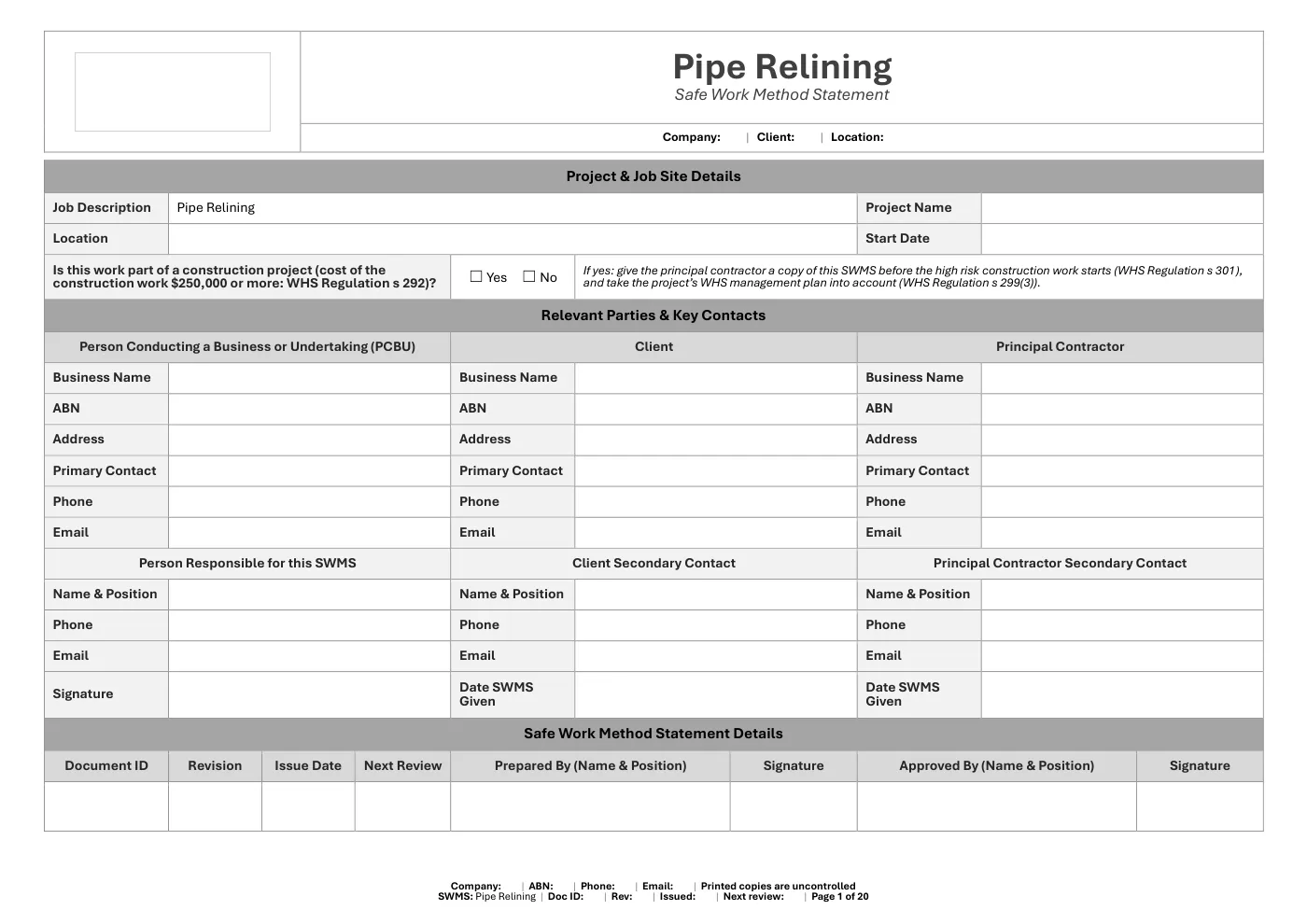
- Business, client, job and document details typed once and filled in on every page, plus a space for your logo
- The high risk construction work checklist, worded as WHS Regulation s 291, and the construction project question (s 292)
- A worker and health and safety representative consultation record
- Qualifications, plant, PPE, hazardous chemicals, safety equipment, permits, references and emergency arrangements filled in for this work
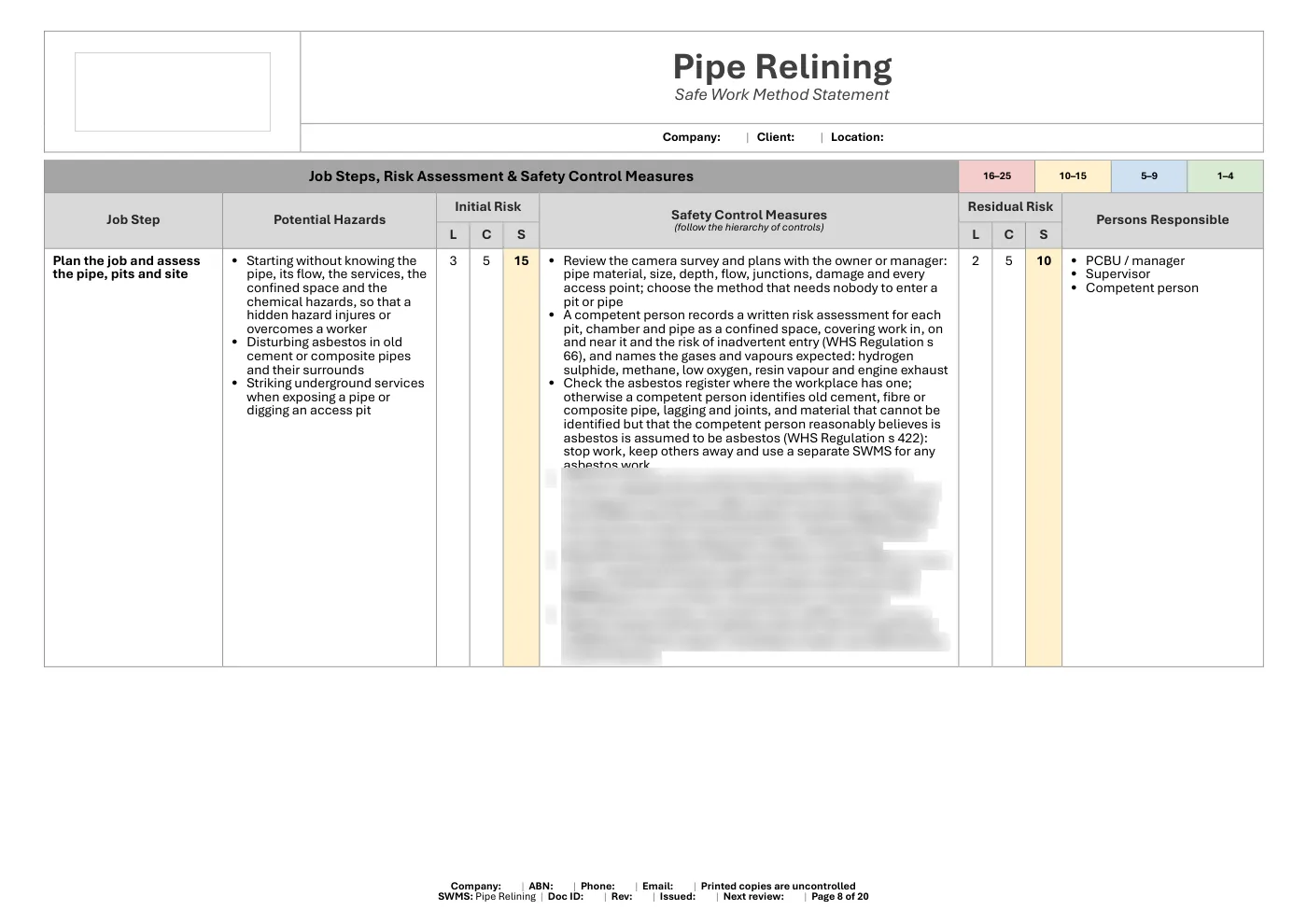
- A 5 x 5 risk matrix, and job steps with initial and residual risk scores and the people responsible
- Implementing, monitoring and review requirements, an additional controls log, revision history and a worker sign-on sheet
Review and adjust it for your site, your plant and the way your crew does the job, and talk it through with your workers before work starts. If you have any trouble downloading this SWMS, you can contact us at any time. Please make sure you read our Disclaimer before downloading this SWMS.
How to use it
From download to site in three steps
Buy and download
Check out with card, Apple Pay or Google Pay. Your download buttons appear straight away and the links are emailed to you.
Make it yours
Open it in Microsoft Word or Excel. Add your logo, business details, site and job information, and adjust it to how the work is done.
Brief your crew
Talk it through with the workers doing the job, have them sign on, and keep it on site. Review it whenever the job or conditions change.
What format is it?
Microsoft Word (registers are Excel). Edit it in Word or Excel, or free in Word and Excel for the web, and add your own logo and business details.
How do I get it after I pay?
Your download buttons appear as soon as checkout finishes, and the links are emailed to you. You can re-download from your account at any time.
Is it compliant with Queensland law?
It's written around Queensland's Work Health and Safety Act 2011 and Regulation 2011. Tailor it to your site, consult your workers and review it whenever conditions change; no template can guarantee compliance on its own.
What if it isn't right for my job?
If it doesn't match its description or has a fault, we'll fix it, and if we can't, we'll refund you (or give you store credit if you'd prefer). Check the sample pages first, as we don't refund a change of mind.
Reviews
Reviews