Panel Saw SWMS
Operating panel saws on sheet materials in Queensland: blade contact, kickback, dust, sheet handling and guarding. An editable Word SWMS template.
RG
Written by Ryan Graham, health and safety professional (16 years on Queensland sites)
$39.99 incl. GST
AUD · one-off purchase · instant download
- Instant download · your links arrive by email straight after checkout and work for 3 months, so save your copy
- Make it yours in minutes · edit in Microsoft Word and add your logo
- Quality guarantee · we'll fix any problem, then refund you or give store credit if you're still not happy
- Secure checkout · card, Apple Pay or Google Pay through Stripe
Save with a bundle
About this template
Suits joiners, cabinet makers, shopfitters, timber yards and school or training workshops that cut plywood, MDF, particleboard and laminate-faced sheets on a vertical or sliding table panel saw. It follows the job in order: setting up the area, checking the guards and brake, power and isolation, blade changes, loading sheets, through cuts and narrow strips, clearing jams, dust, noise and shutdown. Hand-held circular saws and table saws have their own SWMS.
A panel saw is not high risk construction work by itself, so no item is pre-ticked and a SWMS is required by law only for high risk construction work (WHS Regulation s 299). If the saw is used as part of construction work on a construction site, tick the reg 291 items that apply, for example a risk of a fall of more than 2 metres (reg 291(a)) or movement of powered mobile plant in the area (reg 291(o)). Otherwise the document works as a written safe work procedure and task risk assessment that you tailor to your machine.
Similar job: if it is closer to your work, see the Radial Arm Saw SWMS.
New to SWMS? Read What Is A Safe Work Method Statement?
What Is Covered In Our Panel Saw SWMS?
After the standard pre-start checks, the job steps run from “Plan the job and set up the saw area and sheet storage” to “Shut down, store and leave the saw safe”. The hazards and controls include:
- Contact with the saw blade
- Kickback and thrown offcuts
- Missing or bypassed guards and clamps
- Sheets falling from racks or tipping on the saw
- Strains from lifting full-size sheets
- Fingers crushed under the pressure beam
- Narrow strips and small pieces near the blade
- Saw starting during blade changes
- Electric shock from leads and wiring
- MDF and board dust
- Combustible dust and fire
- Noise and hearing loss
High Risk Construction Work
None of the high risk construction work items (WHS Regulation 2011 (Qld) s 291) are pre-ticked, because this job is not high risk construction work by itself. Tick any that apply on your site.
Licences, Training and Competency
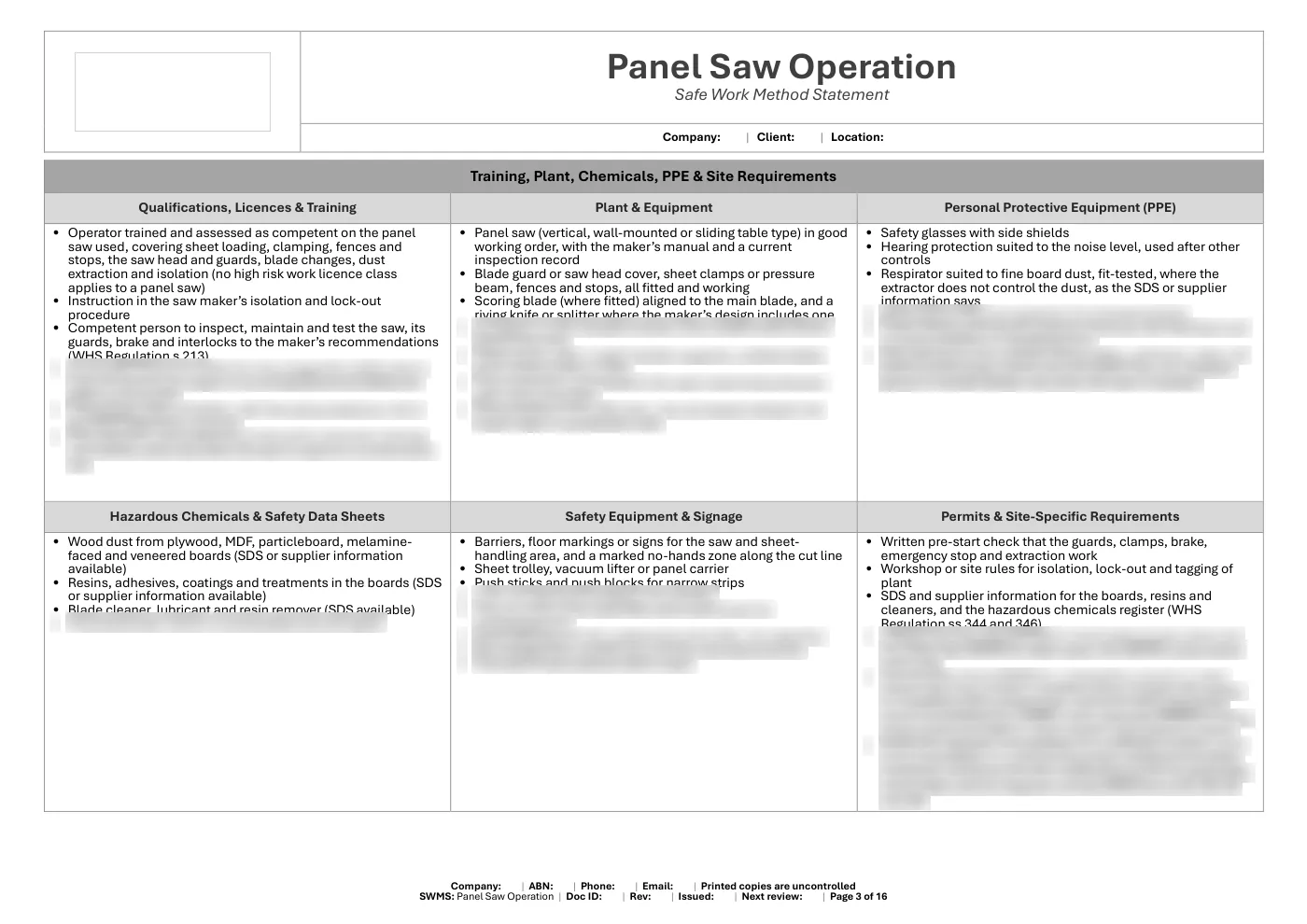
- Operator trained and assessed as competent on the panel saw used, covering sheet loading, clamping, fences and stops, the saw head and guards, blade changes, dust extraction and isolation (no high risk work licence class applies to a panel saw)
- Instruction in the saw maker’s isolation and lock-out procedure
- Competent person to inspect, maintain and test the saw, its guards, brake and interlocks to the maker’s recommendations (WHS Regulation s 213)
- A licensed electrical worker for any connection of the saw to fixed wiring and any repair to its wiring (Electrical Safety Act 2002 ss 18 and 55)
- Trained first aider available, with first aid provided as s 42 of the WHS Regulation requires
- Site induction, and a general construction induction training card (white card) only when the saw is used on a construction site
Legislation and Codes of Practice Referenced
- Work Health and Safety Act 2011 (Qld)
- Work Health and Safety Regulation 2011 (Qld)
- Work Health and Safety Regulation 2011 (Qld): ss 203, 206, 207, 208, 210, 211 and 213 (plant: managing risks, proper use, plant not in use, guarding, operational controls, emergency stops, maintenance and inspection)
- Work Health and Safety Regulation 2011 (Qld): ss 36 and 44 (hierarchy of control, personal protective equipment)
- Work Health and Safety Regulation 2011 (Qld): ss 49 to 53 (exposure standards, air monitoring, hazardous atmosphere, ignition sources, flammable stock)
- Work Health and Safety Regulation 2011 (Qld): ss 56 to 58 (noise)
- Work Health and Safety Regulation 2011 (Qld): s 60 (hazardous manual tasks)
- Work Health and Safety Regulation 2011 (Qld): ss 344, 346 and 351 (safety data sheets, hazardous chemicals register, managing chemical risks)
- Work Health and Safety Regulation 2011 (Qld): ss 42 and 43 (first aid, emergency plan)
- Work Health and Safety Regulation 2011 (Qld): chapter 8A (crystalline silica substances) and s 529D (engineered stone prohibition)
- Managing Risks of Plant in the Workplace Code of Practice 2021
- Hazardous Manual Tasks Code of Practice 2021
- Managing Noise and Preventing Hearing Loss at Work Code of Practice 2021
- Managing Risks of Hazardous Chemicals in the Workplace Code of Practice 2021
- Managing the Work Environment and Facilities Code of Practice 2021 (ventilation, lighting and housekeeping)
- First Aid in the Workplace Code of Practice 2021
- How to Manage Work Health and Safety Risks Code of Practice 2021
- Electrical Safety Act 2002 (Qld): ss 18 and 55 (electrical work and electrical work licences)
- Electrical Safety Regulation 2026 (Qld): ss 131 to 136, only where the work is manufacturing work as section 123 defines it (assembly, disassembly, fabrication, installation, maintenance, manufacturing, refurbishment or repair, but not amusement, construction or rural industry work): no double adaptors or piggyback plugs (s 132); specified electrical equipment inspected, tested and tagged by a competent person at least yearly if double insulated and otherwise at least every 6 months, and used from a socket-outlet that has a safety switch (s 133, with the exemption in s 135); a non-portable safety switch for qualifying socket-outlets, only where manufacturing work is the primary work performed at the workplace (s 134); and testing of safety switches under AS/NZS 3760 (In-service safety inspection and testing of electrical equipment and RCDs) (s 136)
- Electrical Safety Regulation 2026 (Qld): ss 137 to 139, only where the work is service work or office work as section 123 defines it (for example teaching at an education facility): specified electrical equipment inspected and tested by a competent person (at least yearly, or at least every 5 years if used only for office work) or connected to a safety switch (s 138), and testing of safety switches under AS/NZS 3760 (s 139)
- Electrical Safety Regulation 2026 (Qld): s 140, only where the work is construction work: electrical equipment for the work, and construction wiring, comply with AS/NZS 3012 (Electrical installations – Construction and demolition sites); a tag showing a test or retest date goes only on equipment mentioned in AS/NZS 3012 clause 3.1 that is new or was inspected and tested by a competent person and found to comply (s 140(3)); s 140 sets no test interval and no safety switch rule
- Electrical Safety Code of Practice 2021 – Managing electrical risks in the workplace
What You Get
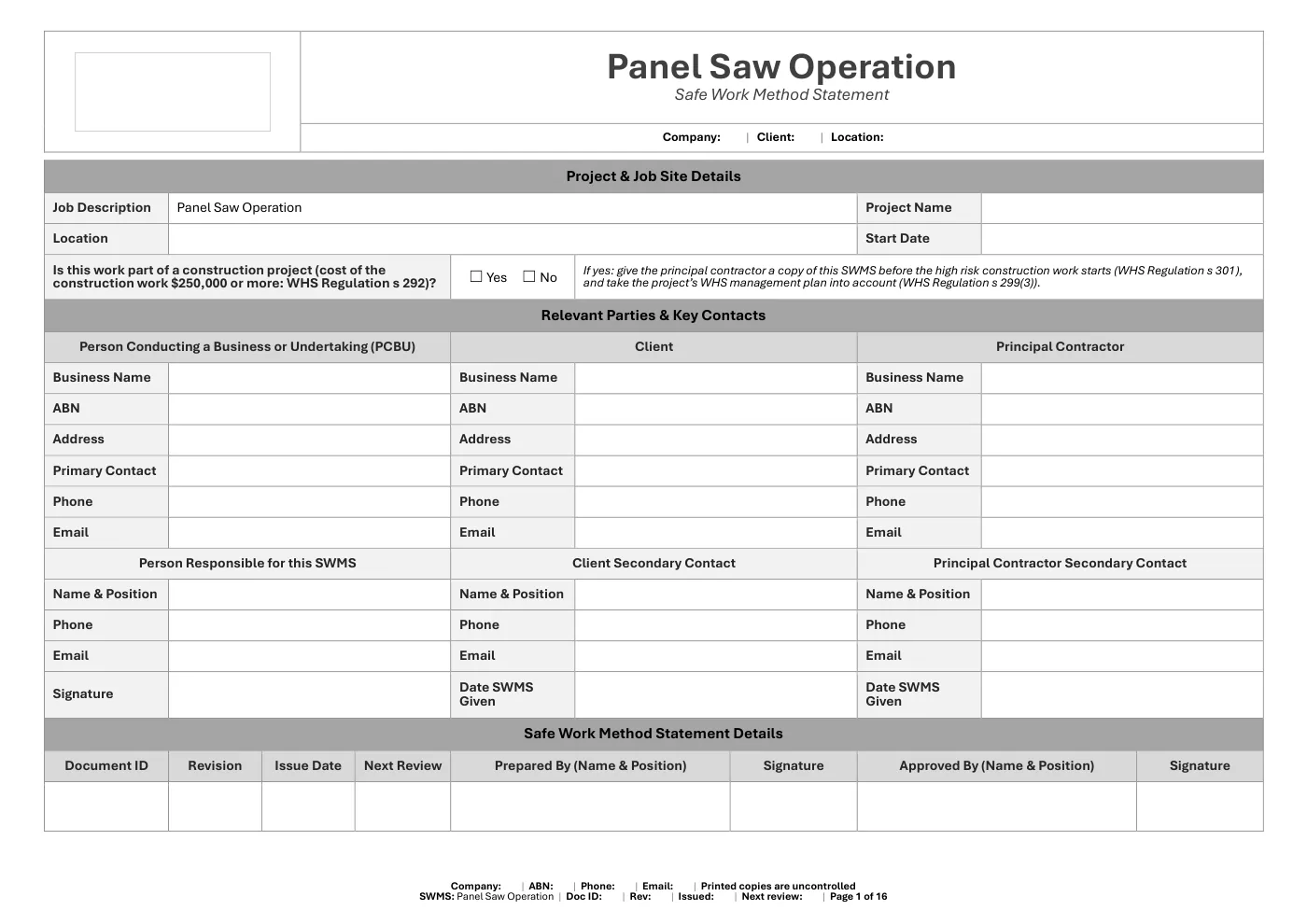
- An editable Microsoft Word document (16 A4 landscape pages). Type your business, client and job details once and they fill in on every page, with a space for your logo
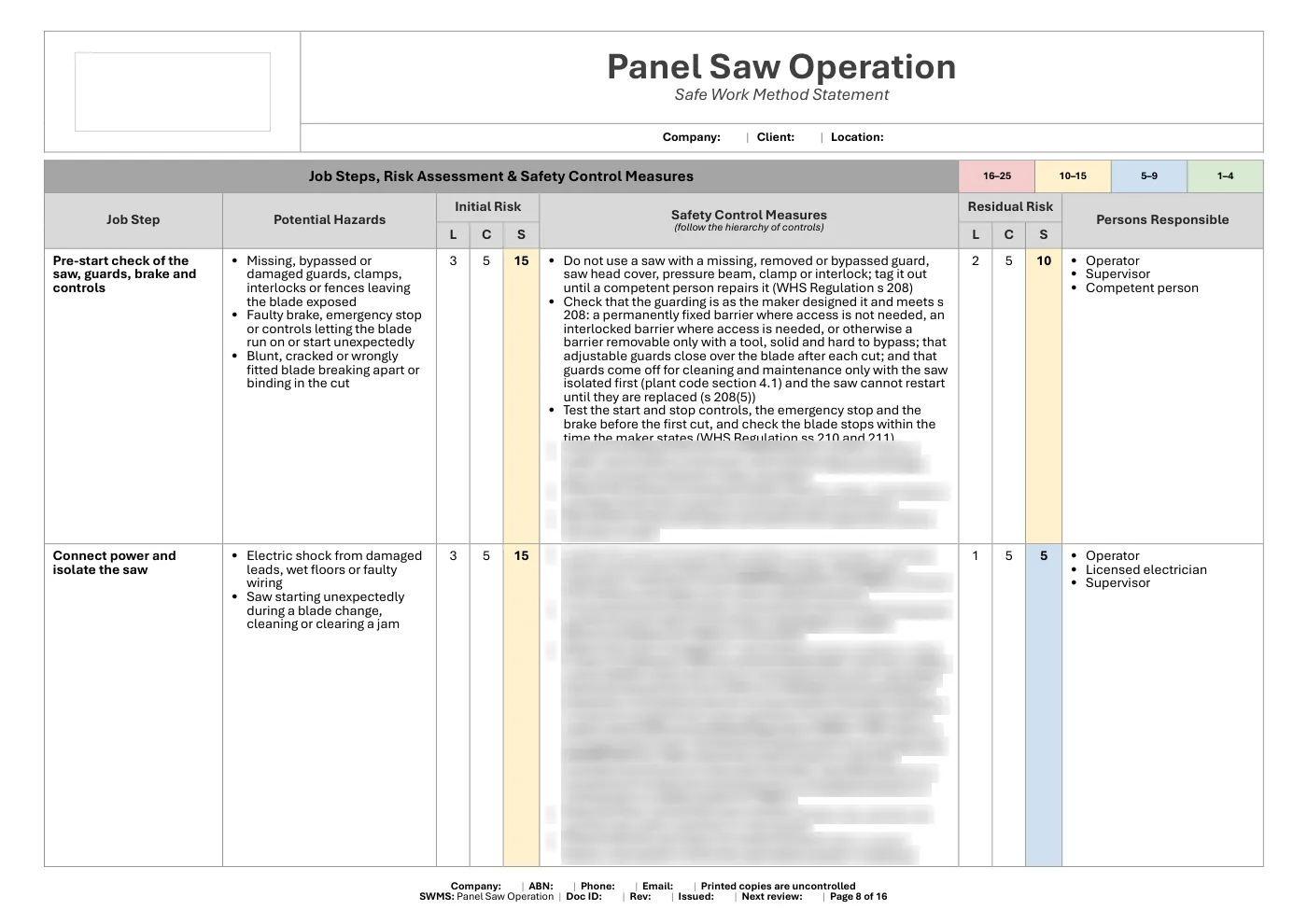
- 11 job steps for this work, each with its hazards, controls, initial and residual risk scores and the person responsible
- PPE listed for this job: safety glasses with side shields; hearing protection suited to the noise level, used after other controls
- Emergency arrangements for: blade contact or amputation, crush under a falling sheet or rack and electric shock
- Plus the parts every Work Safety QLD SWMS shares, from the s 291 checklist to the worker sign-on sheet (see the layout in our free SWMS template)
Adjust it for your site, plant and crew, and talk it through with your workers before work starts. Please make sure you read our Disclaimer before downloading this SWMS.
Checked against the Queensland laws and codes of practice listed above. Last reviewed November 2026.
Having trouble with your download? Contact us any time. Please read our Disclaimer before downloading.
How to use it
From download to site in three steps
Buy and download
Check out with card, Apple Pay or Google Pay. Your download buttons appear straight away and the links are emailed to you. Links work for 3 months, so save your copies.
Make it yours
Open it in Microsoft Word or Excel. Add your logo, business details, site and job information, and adjust it to how the work is done.
Brief your crew
Talk it through with the workers doing the job, have them sign on, and keep it on site. Review it whenever the job or conditions change.
What format is it?
Microsoft Word. Edit it in Word, or free in Word for the web, and add your own logo and business details.
How do I get it after I pay?
Your download buttons appear as soon as checkout finishes, and the links are emailed to you. You can re-download from your account at any time.
Is it compliant with Queensland law?
It's written around Queensland's Work Health and Safety Act 2011 and Regulation 2011. Tailor it to your site, consult your workers and review it whenever conditions change; no template can guarantee compliance on its own.
What if it isn't right for my job?
If it doesn't match its description or has a fault, tell us and we'll fix it. If you're still not happy, we'll refund you or give you store credit, your choice. Check the sample pages first, as we don't refund a change of mind.
More templates like this
$39.99

Excavator SWMS
$49.99


Reviews