
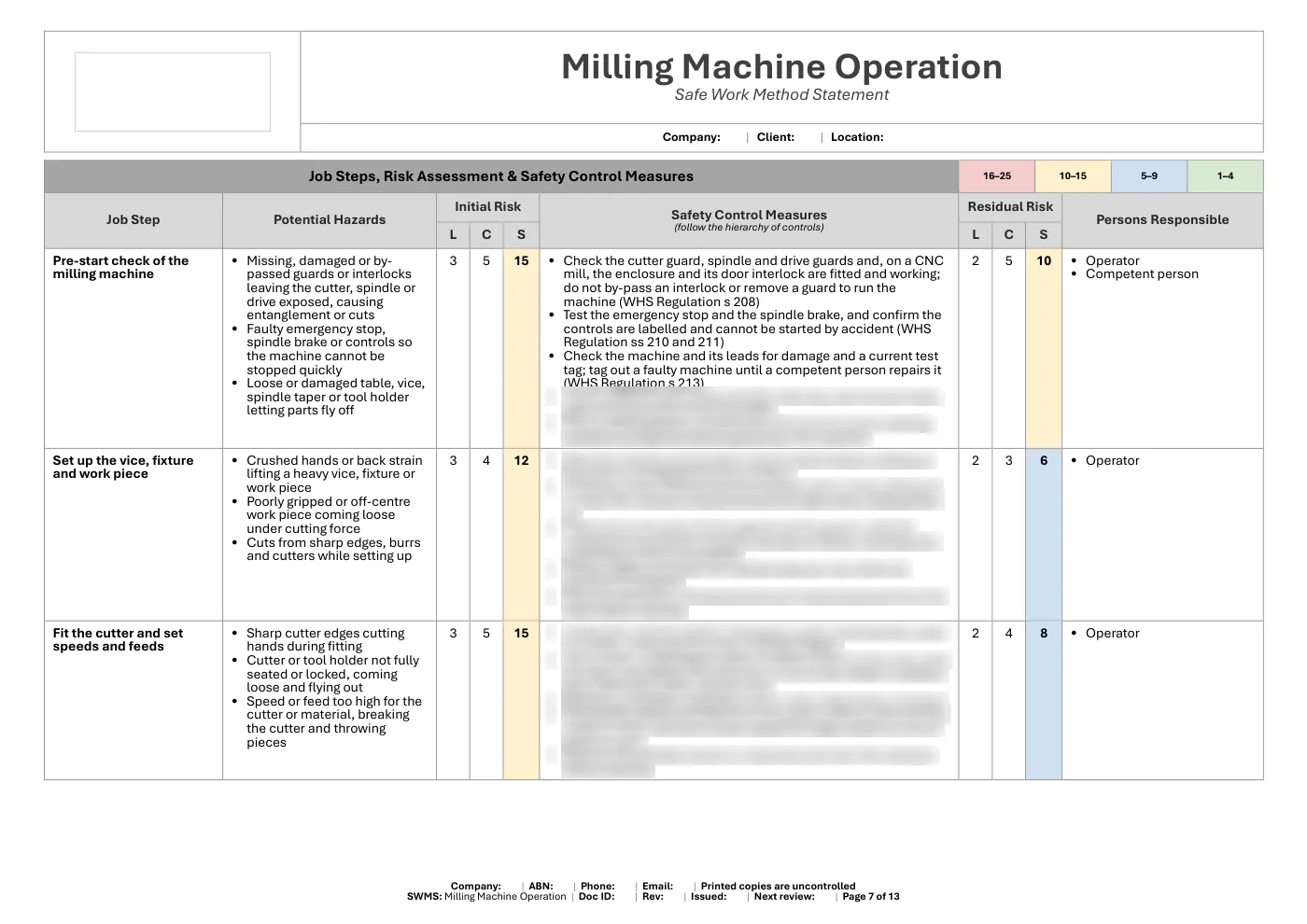
Milling Machine SWMS
Operating manual and CNC milling machines in Queensland: rotating cutters, swarf, work holding, coolant and guarding. An editable Word SWMS template.
RG
Written by Ryan Graham, health and safety professional (16 years on Queensland sites)
$39.99 incl. GST
AUD · one-off purchase · instant download
- Instant download · your links arrive by email straight after checkout and work for 3 months, so save your copy
- Your business name and logo · we fill them into every document for A$29 (free on orders of A$500 or more), or edit it yourself in Microsoft Word
- Quality guarantee · we'll fix any problem, then refund you or give store credit if you're still not happy
- Secure checkout · card, Apple Pay or Google Pay through Stripe
About this template
Suits machine shops, fabricators, toolrooms, maintenance workshops, schools and training colleges that use knee-type, bed-type or CNC milling machines. It follows the job in order: planning, pre-start checks, work holding, cutter fitting, manual milling, CNC proving and cycles, coolant and swarf, adjusting and fault clearing, and shut-down. Lathes (see the Lathe SWMS) and welding or grinding at the machine need separate SWMS.
Milling in a workshop is not high risk construction work, so no item is pre-ticked and a SWMS is required by law only for high risk construction work (WHS Regulation s 299). If the machine is used as part of construction work, tick the reg 291 items that apply. Otherwise the document works as a written safe work procedure and task risk assessment that you tailor to your machine.
Similar job: if it is closer to your work, see the Lathe SWMS.
New to SWMS? Read What Is A Safe Work Method Statement?
What Is Covered In Our Milling Machine SWMS?
After the standard pre-start checks, the job steps run from “Plan the job and check the machine, work piece and work area” to “Shut down, clean and store”. The hazards and controls include:
- Entanglement in the rotating cutter and spindle
- Contact with the cutter during adjusting and measuring
- Missing or by-passed guards and interlocks
- Flying chips and cutter breakage
- Cuts from sharp cutters and hot swarf
- Work piece coming loose in the vice or fixture
- Heavy vice and work piece lifting
- CNC axis motion and crash with the door open
- Cutting fluid, oil mist and skin disease
- Fine metal dust and fire from swarf
- Noise from heavy cuts
- Starting the machine by mistake during clearing
High Risk Construction Work
None of the high risk construction work items (WHS Regulation 2011 (Qld) s 291) are pre-ticked, because this job is not high risk construction work by itself. Tick any that apply on your site.
Licences, Training and Competency
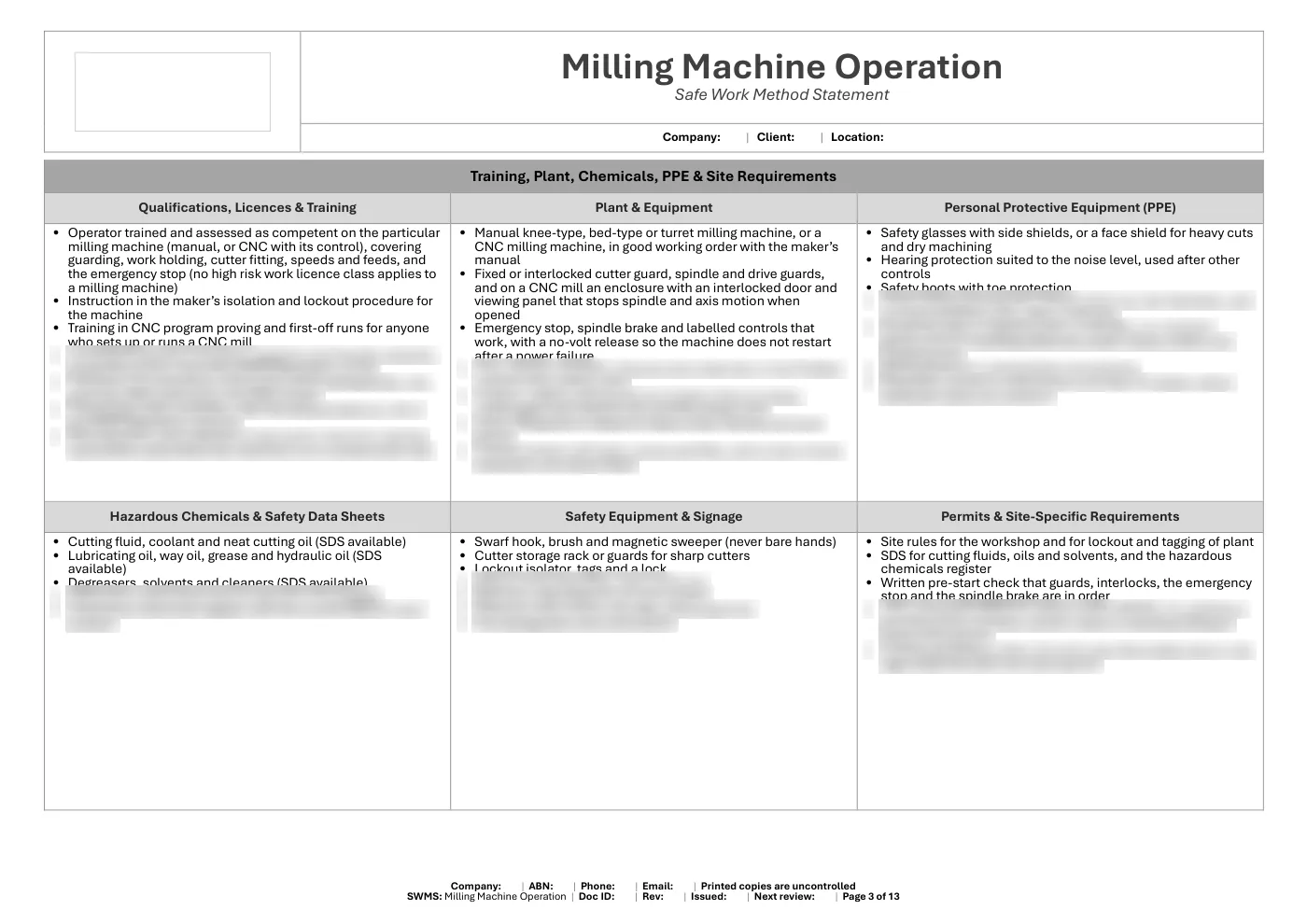
- Operator trained and assessed as competent on the particular milling machine (manual, or CNC with its control), covering guarding, work holding, cutter fitting, speeds and feeds, and the emergency stop (no high risk work licence class applies to a milling machine)
- Instruction in the maker’s isolation and lockout procedure for the machine
- Training in CNC program proving and first-off runs for anyone who sets up or runs a CNC mill
- Competent person to inspect, maintain and test the machine, its guards and its interlocks (WHS Regulation s 213)
- Training in the hazardous chemicals used (cutting fluids, oils, solvents: SDS read) and in the PPE chosen
- Trained first aider available, with first aid provided as s 42 of the WHS Regulation requires
- Site induction, and a general construction induction training card (white card) where the machine is on a construction site
Legislation and Codes of Practice Referenced
- Work Health and Safety Act 2011 (Qld)
- Work Health and Safety Regulation 2011 (Qld)
- WHS Regulation 2011 (Qld) ss 205 to 213: plant (proper use s 206, guarding s 208, operational controls s 210, emergency stops s 211, maintenance and inspection s 213)
- WHS Regulation 2011 (Qld) ss 36 and 44: hierarchy of control measures and personal protective equipment
- WHS Regulation 2011 (Qld) ss 56 and 57: noise exposure standard and managing the risk of hearing loss
- WHS Regulation 2011 (Qld) s 60: managing risks of hazardous manual tasks
- WHS Regulation 2011 (Qld) s 351: managing risks of hazardous chemicals
- Managing Risks of Plant in the Workplace Code of Practice 2021
- Hazardous Manual Tasks Code of Practice 2021
- Managing Noise and Preventing Hearing Loss at Work Code of Practice 2021
- Managing Risks of Hazardous Chemicals in the Workplace Code of Practice 2021
- Managing the Work Environment and Facilities Code of Practice 2021
- First Aid in the Workplace Code of Practice 2021
- How to Manage Work Health and Safety Risks Code of Practice 2021
- Electrical Safety Act 2002 (Qld)
- Electrical Safety Regulation 2026 (Qld)
What You Get
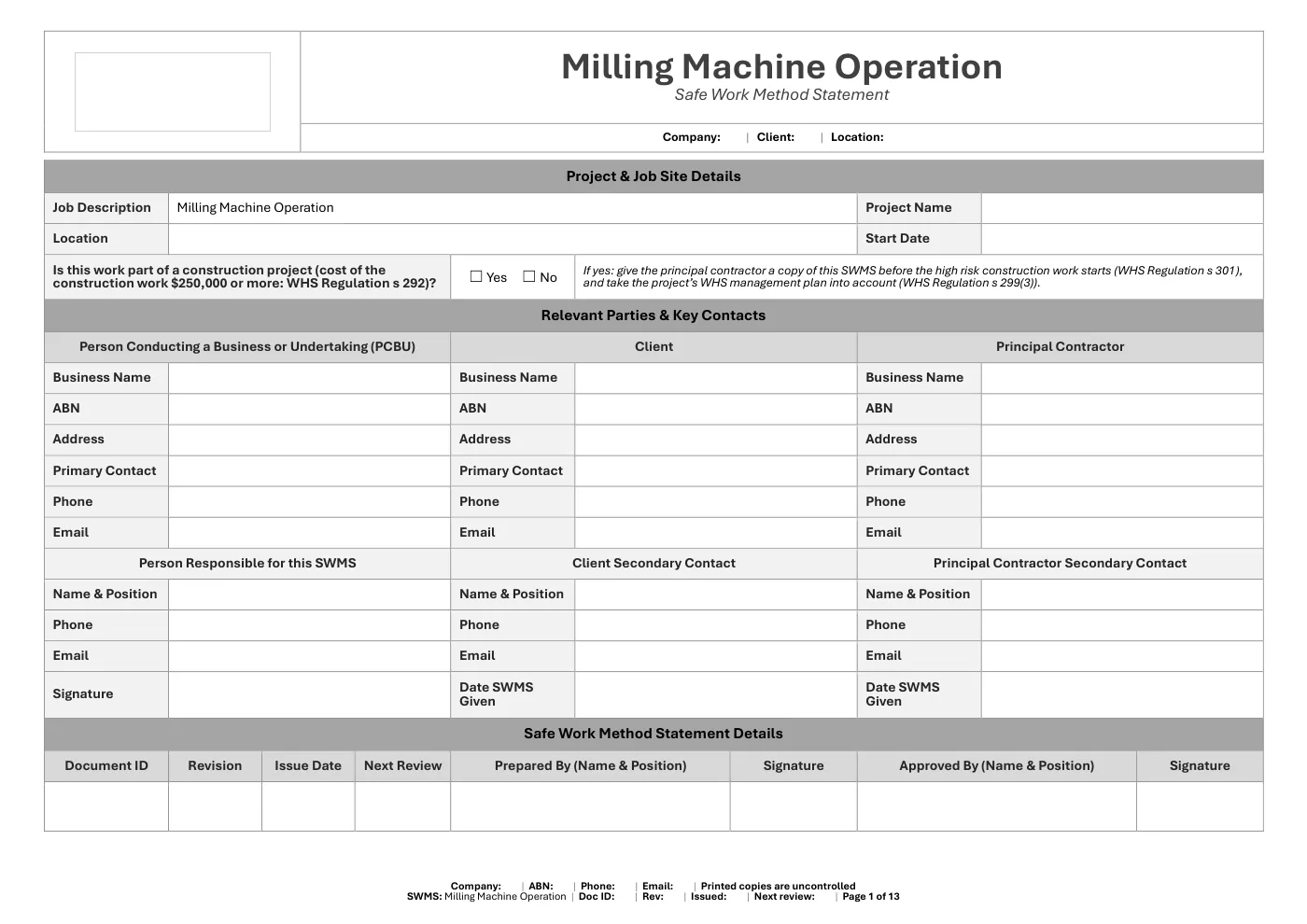
- An editable Microsoft Word document (13 A4 landscape pages). Type your business, client and job details once and they fill in on every page, with a space for your logo
- 10 job steps for this work, each with its hazards, controls, initial and residual risk scores and the person responsible
- PPE listed for this job: safety glasses with side shields, or a face shield for heavy cuts and dry machining; hearing protection suited to the noise level, used after other controls; safety boots with toe protection
- Emergency arrangements for: hand or sleeve caught by the cutter or spindle, deep cut or amputation and fire in swarf, oil or coolant
- Plus the parts every Work Safety QLD SWMS shares, from the s 291 checklist to the worker sign-on sheet (see the layout in our free SWMS template)
Adjust it for your site, plant and crew, and talk it through with your workers before work starts. Please make sure you read our Disclaimer before downloading this SWMS.
Checked against the Queensland laws and codes of practice listed above. Last reviewed November 2026.
Having trouble with your download? Contact us any time. Please read our Disclaimer before downloading.
How to use it
From download to site in three steps
Buy and download
Check out with card, Apple Pay or Google Pay. Your download buttons appear straight away and the links are emailed to you. Links work for 3 months, so save your copies.
Make it yours
Add your logo and business details in Word or Excel, or tick branding at checkout (A$29) and we add them. Then add your site and job details.
Brief your crew
Talk it through with the workers doing the job, have them sign on, and keep it on site. Review it whenever the job or conditions change.
What format is it?
Microsoft Word. Edit it in Word, or free in Word for the web, and add your own logo and business details. Or let us do it: tick "Add my business name and logo to every document" at checkout (A$29, free on orders of A$500 or more) and fill in a short form after payment.
How do I get it after I pay?
Your download buttons appear as soon as checkout finishes, and the links are emailed to you. You can re-download from your account at any time.
Is it compliant with Queensland law?
It's written around Queensland's Work Health and Safety Act 2011 and Regulation 2011. Tailor it to your site, consult your workers and review it whenever conditions change; no template can guarantee compliance on its own.
What if it isn't right for my job?
If it doesn't match its description or has a fault, tell us and we'll fix it. If you're still not happy, we'll refund you or give you store credit, your choice. Check the sample pages first, as we don't refund a change of mind.
Only logged in customers who have purchased this product may leave a review.
More templates like this
Paper Guillotine SWMS
$39.99
Reviews