
Livestock Loading and Unloading SWMS
Loading and unloading livestock on trucks and trailers in Queensland: kicks, crush injuries, ramp falls, truck movement and zoonoses. An editable Word SWMS template.
RG
Written by Ryan Graham, health and safety professional (16 years on Queensland sites)
$39.99 incl. GST
AUD · one-off purchase · instant download
- Instant download · your links arrive by email straight after checkout and work for 3 months, so save your copy
- Your business name and logo · we fill them into every document for A$29 (free on orders of A$500 or more), or edit it yourself in Microsoft Word
- Quality guarantee · we'll fix any problem, then refund you or give store credit if you're still not happy
- Secure checkout · card, Apple Pay or Google Pay through Stripe
About this template
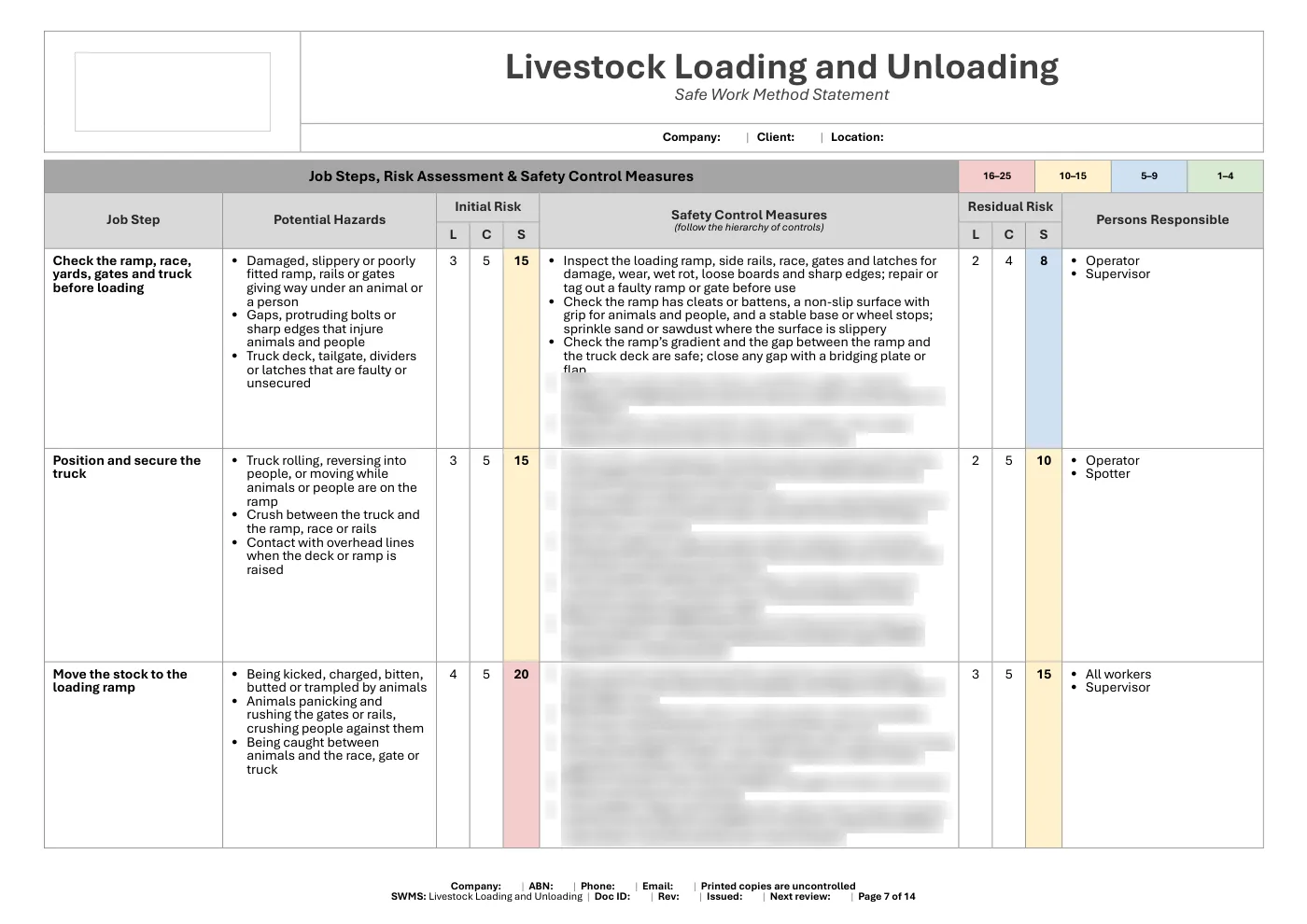
Suits livestock producers, stock contractors, saleyard and abattoir staff, transport operators and drivers who load and unload cattle, sheep and other stock on trucks and trailers. It follows the job in order: planning, ramp and truck checks, truck positioning, moving stock to the ramp, loading, working on the deck, securing the load, unloading, down animals, hygiene and clean-down. Yard work needs its own SWMS.
Loading livestock is not high risk construction work, so no item is pre-ticked and a SWMS is required by law only for high risk construction work (WHS Regulation s 299). If the work is part of construction work, tick the reg 291 items that apply. Otherwise the document works as a written safe work procedure and task risk assessment that you tailor to your site and stock.
New to SWMS? Read What Is A Safe Work Method Statement?
What Is Covered In Our Livestock Loading and Unloading SWMS?
After the standard pre-start checks, the job steps run from “Plan the load and check the weather, light and people” to “Clean the truck deck and ramp and finish up”. The hazards and controls include:
- Kicks, charges and trampling by livestock
- Crush injuries against rails, gates and the truck
- Falls from the ramp, the deck and the side rails
- Slippery ramps and decks
- Truck moving or reversing near people
- Fingers caught in gates, latches and dividers
- Tailgate and ramp movement
- Overloaded or poorly balanced trucks
- Down, injured or aggressive animals
- Zoonoses such as Q fever and leptospirosis
- Heat, dust and fatigue
- Children and visitors near the ramp
High Risk Construction Work
None of the high risk construction work items (WHS Regulation 2011 (Qld) s 291) are pre-ticked, because this job is not high risk construction work by itself. Tick any that apply on your site.
Licences, Training and Competency
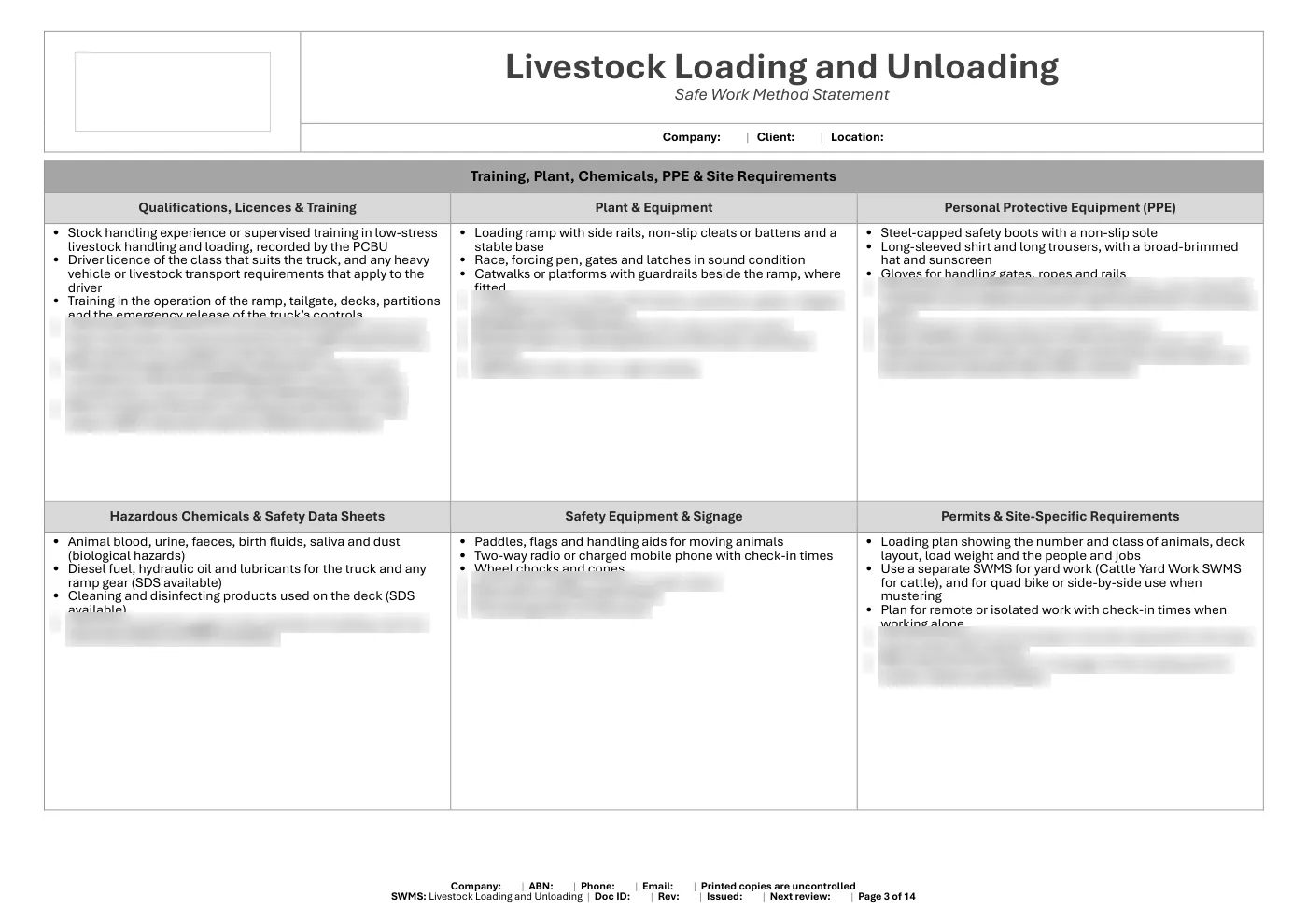
- Stock handling experience or supervised training in low-stress livestock handling and loading, recorded by the PCBU
- Driver licence of the class that suits the truck, and any heavy vehicle or livestock transport requirements that apply to the driver
- Training in the operation of the ramp, tailgate, decks, partitions and the emergency release of the truck’s controls
- Information for workers on zoonoses and hygiene, and on Q fever vaccination as good practice (not a legal requirement), with workers encouraged to ask their doctor
- First aid arrangements for the loading site, with first aid provided as s 42 of the WHS Regulation requires, and for remote sites a way to call for help (WHS Regulation s 48)
- Site or property induction covering escape routes, no-go areas, traffic rules and rules for children and visitors
Legislation and Codes of Practice Referenced
- Work Health and Safety Act 2011 (Qld)
- Work Health and Safety Regulation 2011 (Qld)
- WHS Regulation 2011 (Qld) ss 214 and 215: powered mobile plant, general control of risk and specific control measures (collision with pedestrians, warning devices)
- WHS Regulation 2011 (Qld) ss 60 and 351: hazardous manual tasks and hazardous chemical risks
- WHS Regulation 2011 (Qld) s 699 and WHS Act 2011 (Qld) ss 36 and 38: notifying a serious illness such as Q fever or leptospirosis contracted through contact with animals
- WHS Regulation 2011 (Qld) ss 42 and 48: first aid and remote or isolated work
- Heavy Vehicle National Law (Queensland), applied by the Heavy Vehicle National Law Act 2012 (Qld): s 6 (heavy vehicle means a vehicle with a GVM or ATM of more than 4.5 t), s 26C (primary duty of each party in the chain of responsibility), s 96 (compliance with mass requirements), s 110 (national regulations may prescribe loading requirements), s 111 (compliance with the loading requirements) and s 228 (duty of driver to avoid driving while fatigued or unfit to drive)
- Rural Plant Code of Practice 2024
- Managing Risks of Plant in the Workplace Code of Practice 2021
- Managing the Risk of Falls at Workplaces Code of Practice 2021
- Hazardous Manual Tasks Code of Practice 2021
- Managing the Work Environment and Facilities Code of Practice 2021
- First Aid in the Workplace Code of Practice 2021
- Children and Young Workers Code of Practice 2006
- How to Manage Work Health and Safety Risks Code of Practice 2021
- Electrical Safety Act 2002 (Qld)
- Electrical Safety Regulation 2026 (Qld): overhead power line exclusion zones in sections 10 to 13 and schedule 2
- Safe Work Australia model Code of Practice: Managing the risks of biological hazards at work (guidance)
What You Get
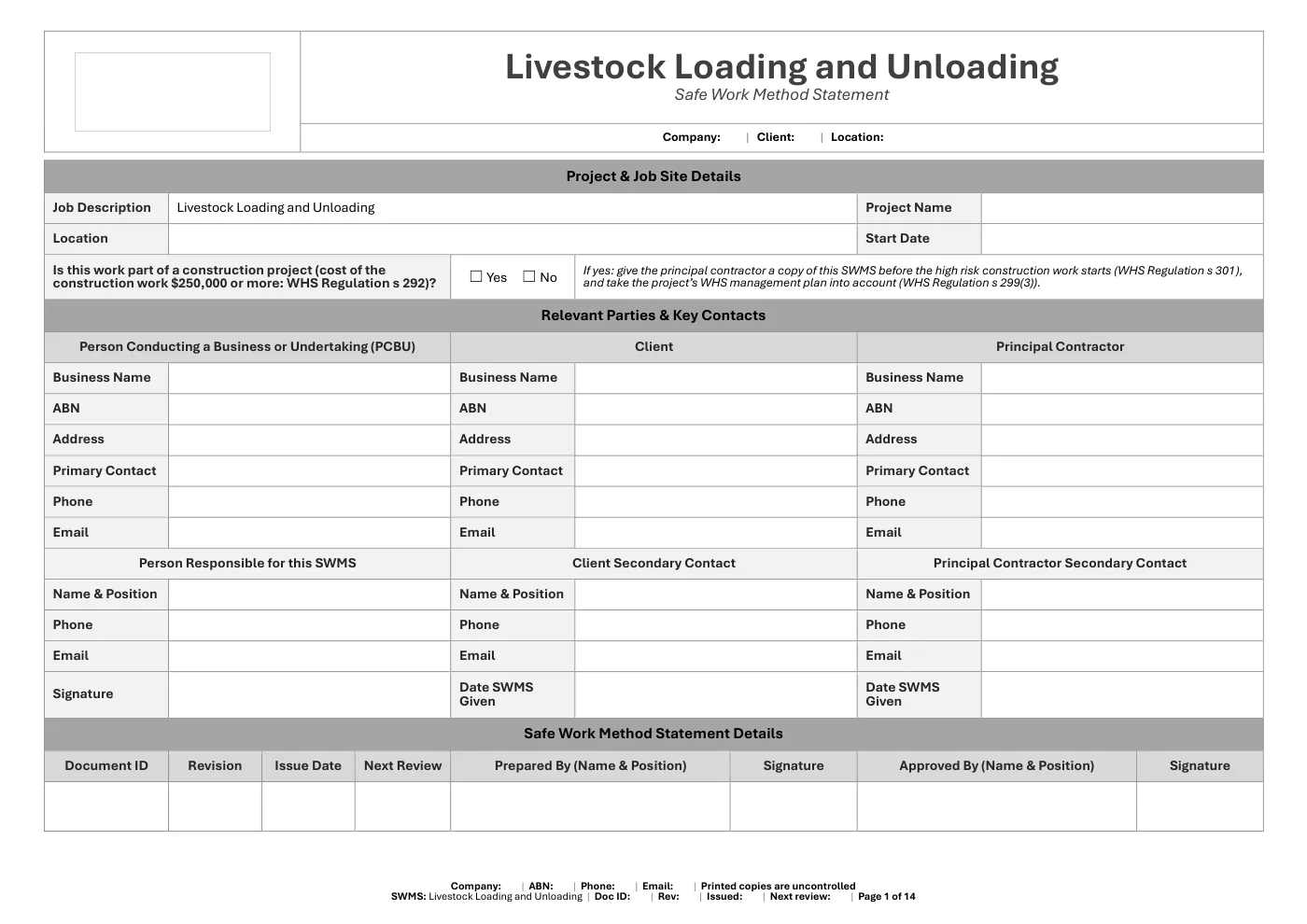
- An editable Microsoft Word document (14 A4 landscape pages). Type your business, client and job details once and they fill in on every page, with a space for your logo
- 11 job steps for this work, each with its hazards, controls, initial and residual risk scores and the person responsible
- PPE listed for this job: steel-capped safety boots with a non-slip sole; long-sleeved shirt and long trousers, with a broad-brimmed hat and sunscreen; gloves for handling gates, ropes and rails
- Emergency arrangements for: person trapped or crushed on the ramp or against rails, truck rolling or moving unexpectedly and aggressive animal loose
- Plus the parts every Work Safety QLD SWMS shares, from the s 291 checklist to the worker sign-on sheet (see the layout in our free SWMS template)
Adjust it for your site, plant and crew, and talk it through with your workers before work starts. Please make sure you read our Disclaimer before downloading this SWMS.
Checked against the Queensland laws and codes of practice listed above. Last reviewed November 2026.
Having trouble with your download? Contact us any time. Please read our Disclaimer before downloading.
How to use it
From download to site in three steps
Buy and download
Check out with card, Apple Pay or Google Pay. Your download buttons appear straight away and the links are emailed to you. Links work for 3 months, so save your copies.
Make it yours
Add your logo and business details in Word or Excel, or tick branding at checkout (A$29) and we add them. Then add your site and job details.
Brief your crew
Talk it through with the workers doing the job, have them sign on, and keep it on site. Review it whenever the job or conditions change.
What format is it?
Microsoft Word. Edit it in Word, or free in Word for the web, and add your own logo and business details. Or let us do it: tick "Add my business name and logo to every document" at checkout (A$29, free on orders of A$500 or more) and fill in a short form after payment.
How do I get it after I pay?
Your download buttons appear as soon as checkout finishes, and the links are emailed to you. You can re-download from your account at any time.
Is it compliant with Queensland law?
It's written around Queensland's Work Health and Safety Act 2011 and Regulation 2011. Tailor it to your site, consult your workers and review it whenever conditions change; no template can guarantee compliance on its own.
What if it isn't right for my job?
If it doesn't match its description or has a fault, tell us and we'll fix it. If you're still not happy, we'll refund you or give you store credit, your choice. Check the sample pages first, as we don't refund a change of mind.
Only logged in customers who have purchased this product may leave a review.
Reviews