

Irrigation System Installation SWMS
Installing garden and farm irrigation in Queensland: trenching, pipework, pumps, valves and controllers, with services, plumbing licence and pressure testing controls. An editable Word SWMS template.
RG
Written by Ryan Graham, health and safety professional (16 years on Queensland sites)
$39.99 incl. GST
AUD · one-off purchase · instant download
- Instant download · your links arrive by email straight after checkout and work for 3 months, so save your copy
- Your business name and logo · we fill them into every document for A$29 (free on orders of A$500 or more), or edit it yourself in Microsoft Word
- Quality guarantee · we'll fix any problem, then refund you or give store credit if you're still not happy
- Secure checkout · card, Apple Pay or Google Pay through Stripe
About this template
Suits irrigation installers, landscapers, farm contractors and builders who put in garden and farm irrigation. It follows the job from planning and locating underground services through digging, laying pipe, fitting pumps, valves and controllers to flushing, pressure testing and handover, and says which parts need a licensed plumber or electrician and which are unregulated plumbing work. Trenches deeper than 1.5 metres and electrical connections are covered by separate SWMS.
Installing irrigation is construction work (a pipeline is a structure and excavation is included, WHS Regulation s 289), but it is not high risk construction work by itself. A SWMS is legally required under s 299 only for high risk construction work (s 291), such as a trench deeper than 1.5 metres, work near energised services or powered mobile plant, or work in or near water with a risk of drowning; otherwise this document works as a written safe work procedure or task risk assessment. No item is ticked by default: tick the items that apply to your job.
New to SWMS? Read What is a safe work method statement?
What is covered in our irrigation system installation SWMS?
After the standard pre-start checks, the job steps run from “Plan the job, check the water source and confirm who may do each part” to “Backfill, clean up and hand over”. The hazards and controls include:
- Striking underground cables, gas and water lines
- Contact with overhead power lines from pipe and plant
- Trench collapse and falls into open trenches
- Strains from carrying long pipe lengths and pumps
- Primer and solvent cement fumes and fire
- Pipes and fittings failing under pressure
- Drowning risk at dams, tanks and creeks
- Low oxygen and fumes in tanks, pits and pump sheds
- Rotating pump shafts, couplings and engine exhaust
- Electric shock from pump motors and controllers
- Licensed plumbing work and backflow prevention devices
- Heat, sun, snakes and stinging insects
- Open trenches left in paddocks and gardens
- Noise from trenchers, breakers and engine pumps
High risk construction work
None of the high risk construction work items (WHS Regulation 2011 (Qld) s 291) are pre-ticked, because this job is not high risk construction work by itself. Tick any that apply on your site.
Licences, training and competency
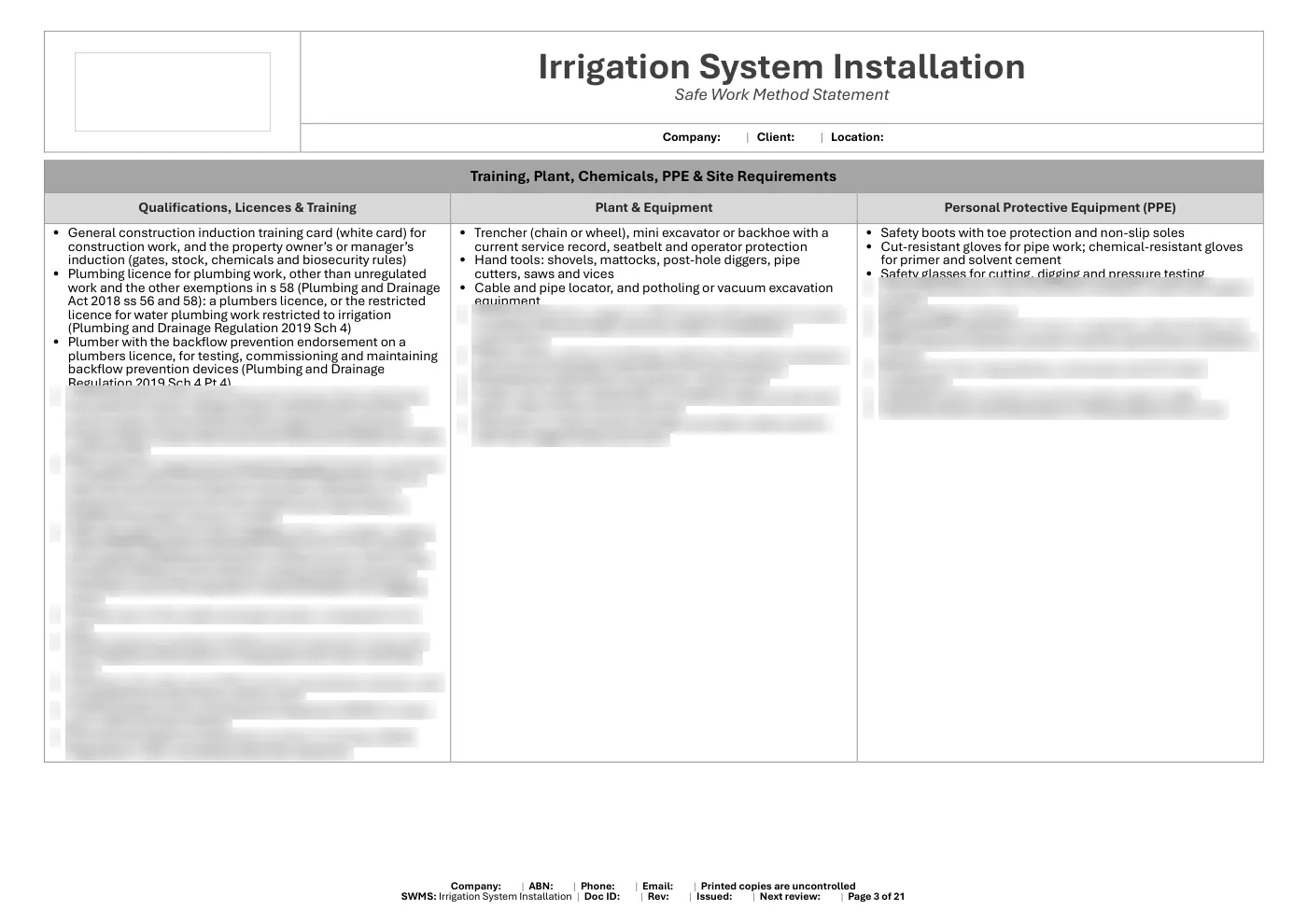
- General construction induction training card (white card) for construction work, and the property owner’s or manager’s induction (gates, stock, chemicals and biosecurity rules)
- Plumbing licence for plumbing work, other than unregulated work and the other exemptions in s 58 (Plumbing and Drainage Act 2018 ss 56 and 58): a plumbers licence, or the restricted licence for water plumbing work restricted to irrigation (Plumbing and Drainage Regulation 2019 Sch 4)
- Plumber with the backflow prevention endorsement on a plumbers licence, for testing, commissioning and maintaining backflow prevention devices (Plumbing and Drainage Regulation 2019 Sch 4 Pt 4)
- Licensed electrician (electrical work licence that authorises the work) for mains-voltage wiring, switchboards and the pump supply; the business holds an electrical contractor licence when it does electrical work (Electrical Safety Act 2002 ss 55 and 56)
- Plant operator trained and assessed on the trencher, excavator or backhoe used (Schedule 3 of the WHS Regulation has no high risk work licence class for trenchers, excavators or backhoes); the licence for the forklift truck class where a forklift moves pipe, pumps or tanks
- High risk work licence in the dogging class, or a higher rigging class (WHS Regulation Schedule 3 items 4 to 7), for anyone who applies slinging techniques to sling a pump, tank or pipe bundle for lifting, or who directs a plant operator moving a load that is out of the operator’s view (Schedule 19, dogging work)
- Trained user of the cable and pipe locator, competent in its use
- Safety observer (spotter) briefed on the exclusion zones and hand signals where plant or long pipes work near overhead lines
- Training in the safe use of PVC primer and solvent cement, and in polyethylene pipe fusion where used
- Confined space entry training and a separate SWMS if a tank, pit or well must be entered
- First aid training for an adequate number of workers (WHS Regulation s 42), including snake bite response
Legislation and codes of practice referenced
- Work Health and Safety Act 2011 (Qld)
- Work Health and Safety Regulation 2011 (Qld)
- Excavation Work Code of Practice 2021
- Rural Plant Code of Practice 2024 (section 7.8, irrigation and associated equipment)
- Managing Risks of Plant in the Workplace Code of Practice 2021
- Hazardous Manual Tasks Code of Practice 2021
- Managing Risks of Hazardous Chemicals in the Workplace Code of Practice 2021
- Managing Noise and Preventing Hearing Loss at Work Code of Practice 2021
- Confined Spaces Code of Practice 2021
- How to Manage and Control Asbestos in the Workplace Code of Practice 2021
- Managing the Work Environment and Facilities Code of Practice 2021
- First Aid in the Workplace Code of Practice 2021
- How to Manage Work Health and Safety Risks Code of Practice 2021
- Work Health and Safety Consultation, Co-operation and Co-ordination Code of Practice 2021
- Plumbing and Drainage Act 2018 (Qld): licensing and unregulated work (ss 56 to 58), backflow prevention devices (s 71)
- Plumbing and Drainage Regulation 2019 (Qld): Schedules 1 to 4, testable backflow prevention devices (ss 102 and 103)
- Electrical Safety Act 2002 (Qld)
- Electrical Safety Regulation 2026 (Qld): overhead and underground electric lines (ss 10 to 15 and Schedule 2) and electrical equipment (ss 140 and 141)
- Electrical Safety Code of Practice 2020 – Electrical equipment rural industry
- Electrical Safety Code of Practice 2020 – Working near overhead and underground electric lines (distances come from the 2026 Regulation)
What you get
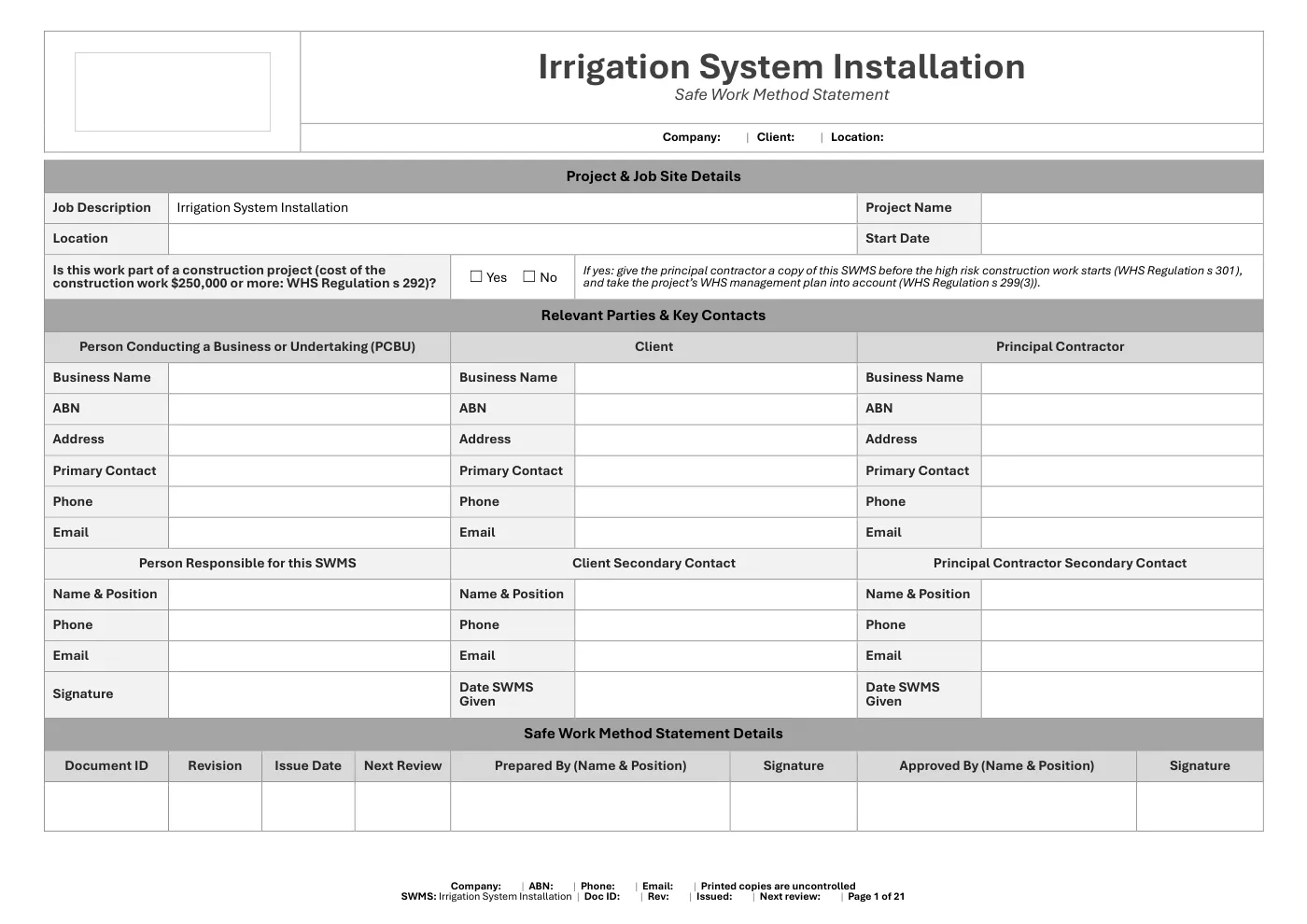
- An editable Microsoft Word document (21 pages), laid out on A4 landscape pages. Type your business, client and job details once and they fill in on every page, with a space for your logo
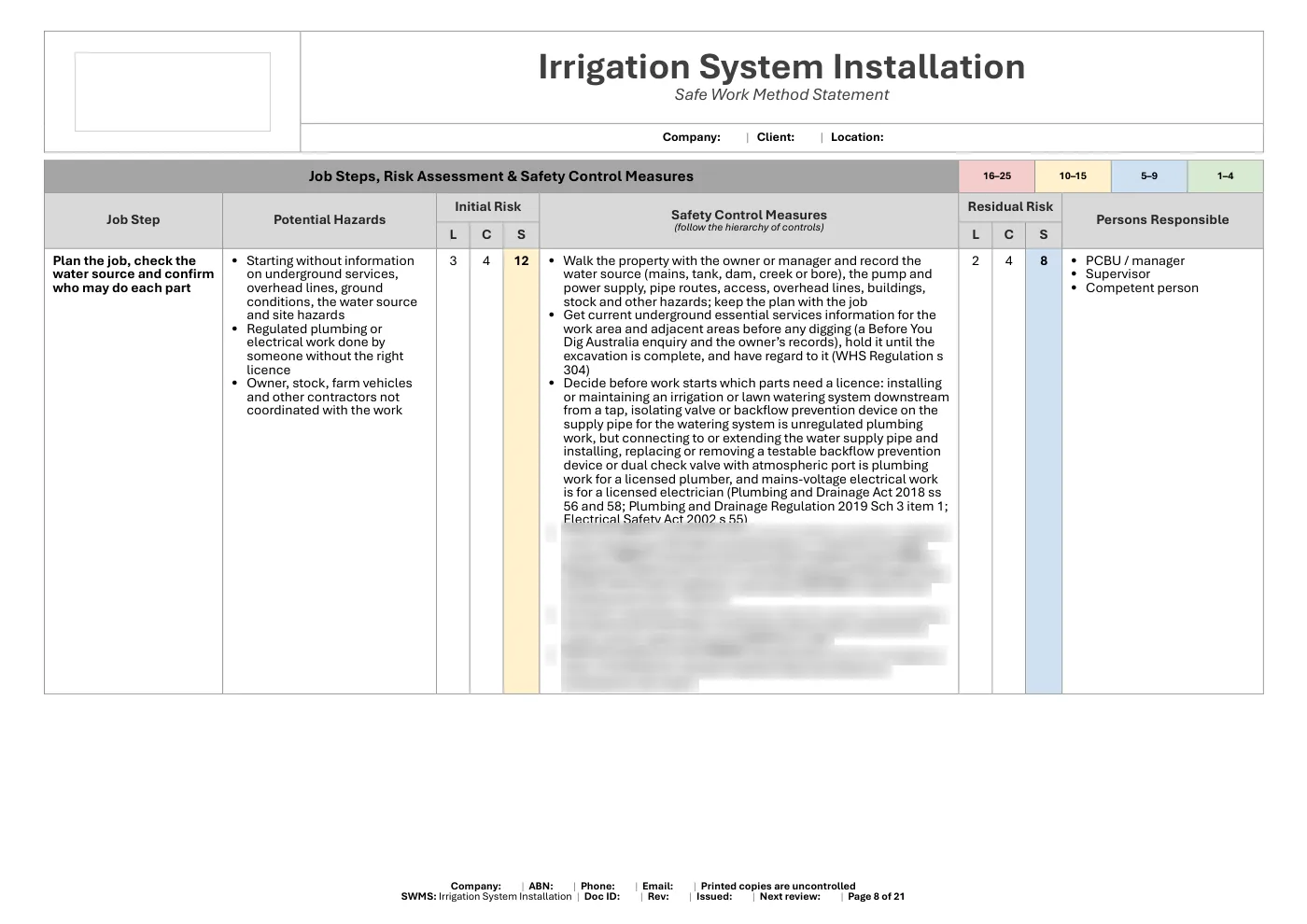
- 11 job steps for this work, each with its hazards, controls, initial and residual risk scores and the person responsible
- PPE listed for this job: safety boots with toe protection and non-slip soles; cut-resistant gloves for pipe work; chemical-resistant gloves for primer and solvent cement
- Emergency arrangements for: trench collapse or person trapped, contact with an overhead power line, or a struck underground cable and person in the water at a dam, tank or creek
- Plus the parts every Work Safety QLD SWMS shares, from the s 291 checklist to the worker sign-on sheet (see the layout in our free SWMS template)
Adjust it for your site, plant and crew, and talk it through with your workers before work starts.
Checked against the Queensland laws and codes of practice listed above. Last reviewed November 2026.
Having trouble with your download? Contact us any time. Please read our Disclaimer before downloading.
How to use it
From download to site in three steps
Buy and download
Check out with card, Apple Pay or Google Pay. Your download buttons appear straight away and the links are emailed to you. Links work for 3 months, so save your copies.
Make it yours
Add your logo and business details in Word or Excel, or tick branding at checkout (A$29) and we add them. Then add your site and job details.
Brief your crew
Talk it through with the workers doing the job, have them sign on, and keep it on site. Review it whenever the job or conditions change.
What format is it?
Microsoft Word. Edit it in Word, or free in Word for the web, and add your own logo and business details. Or let us do it: tick "Add my business name and logo to every document" at checkout (A$29, free on orders of A$500 or more) and fill in a short form after payment.
How do I get it after I pay?
Your download buttons appear as soon as checkout finishes, and the links are emailed to you. You can re-download from your account at any time.
Is it compliant with Queensland law?
It's written around Queensland's Work Health and Safety Act 2011 and Regulation 2011. Tailor it to your site, consult your workers and review it whenever conditions change; no template can guarantee compliance on its own.
What if it isn't right for my job?
If it doesn't match its description or has a fault, tell us and we'll fix it. If you're still not happy, we'll refund you or give you store credit, your choice. Check the sample pages first, as we don't refund a change of mind.
Only logged in customers who have purchased this product may leave a review.
More templates like this
Quad Bike Operation SWMS
$39.99
Tractor Operation SWMS
$39.99
Reviews