
Hybrid and Electric Vehicle Servicing SWMS
Servicing hybrid and electric vehicles in Queensland: high-voltage depowering, battery handling and fire response. An editable Word SWMS template.
RG
Written by Ryan Graham, health and safety professional (16 years on Queensland sites)
$39.99 incl. GST
AUD · one-off purchase · instant download
- Instant download · your links arrive by email straight after checkout and work for 3 months, so save your copy
- Your business name and logo · we fill them into every document for A$29 (free on orders of A$500 or more), or edit it yourself in Microsoft Word
- Quality guarantee · we'll fix any problem, then refund you or give store credit if you're still not happy
- Secure checkout · card, Apple Pay or Google Pay through Stripe
About this template
Suits workshops and mobile mechanics who service hybrid and battery electric vehicles. It covers the pre-start check, identifying the high-voltage system, immobilising and depowering, working while depowered, battery removal, fluids, damaged batteries and re-energising. General workshop work such as brake and clutch servicing uses a separate SWMS.
Servicing hybrid and electric vehicles is not high risk construction work by itself, so no item is pre-ticked and a SWMS is required by law only for high risk construction work (WHS Regulation s 299); this document works as a written safe work procedure or task risk assessment that you tailor to your workshop. If the work is part of construction work, tick the reg 291 items that apply.
New to SWMS? Read What Is A Safe Work Method Statement?
What Is Covered In Our Hybrid and Electric Vehicle Servicing SWMS?
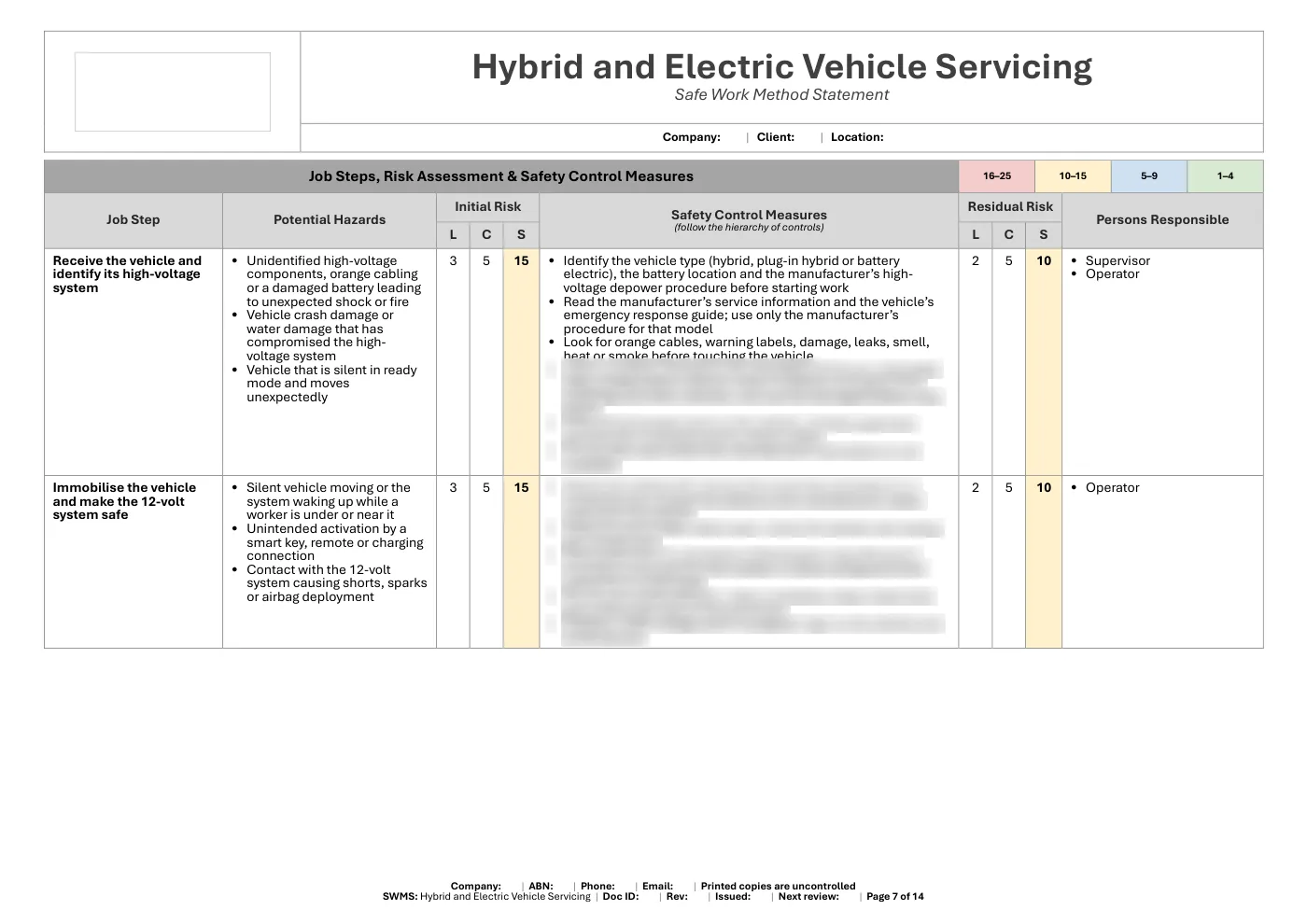
After the standard pre-start checks, the job steps run from “Pre-start workshop and high-voltage equipment check” to “Return the vehicle and record the work”. The hazards and controls include:
- High-voltage electric shock and arc flash
- Unsafe or incomplete depowering
- Silent vehicle moving unexpectedly
- Lithium-ion battery fire and thermal runaway
- Heavy battery pack lifting and crush injuries
- Vehicle falling from a hoist or jack
- Contact with orange high-voltage cables
- Coolant, refrigerant and fluid exposure
- Damaged or crashed vehicle batteries
- Faulty charge equipment and wiring
- Re-energising and charging hazards
- Untrained or unlicensed workers on live systems
High Risk Construction Work
None of the high risk construction work items (WHS Regulation 2011 (Qld) s 291) are pre-ticked, because this job is not high risk construction work by itself. Tick any that apply on your site.
Licences, Training and Competency
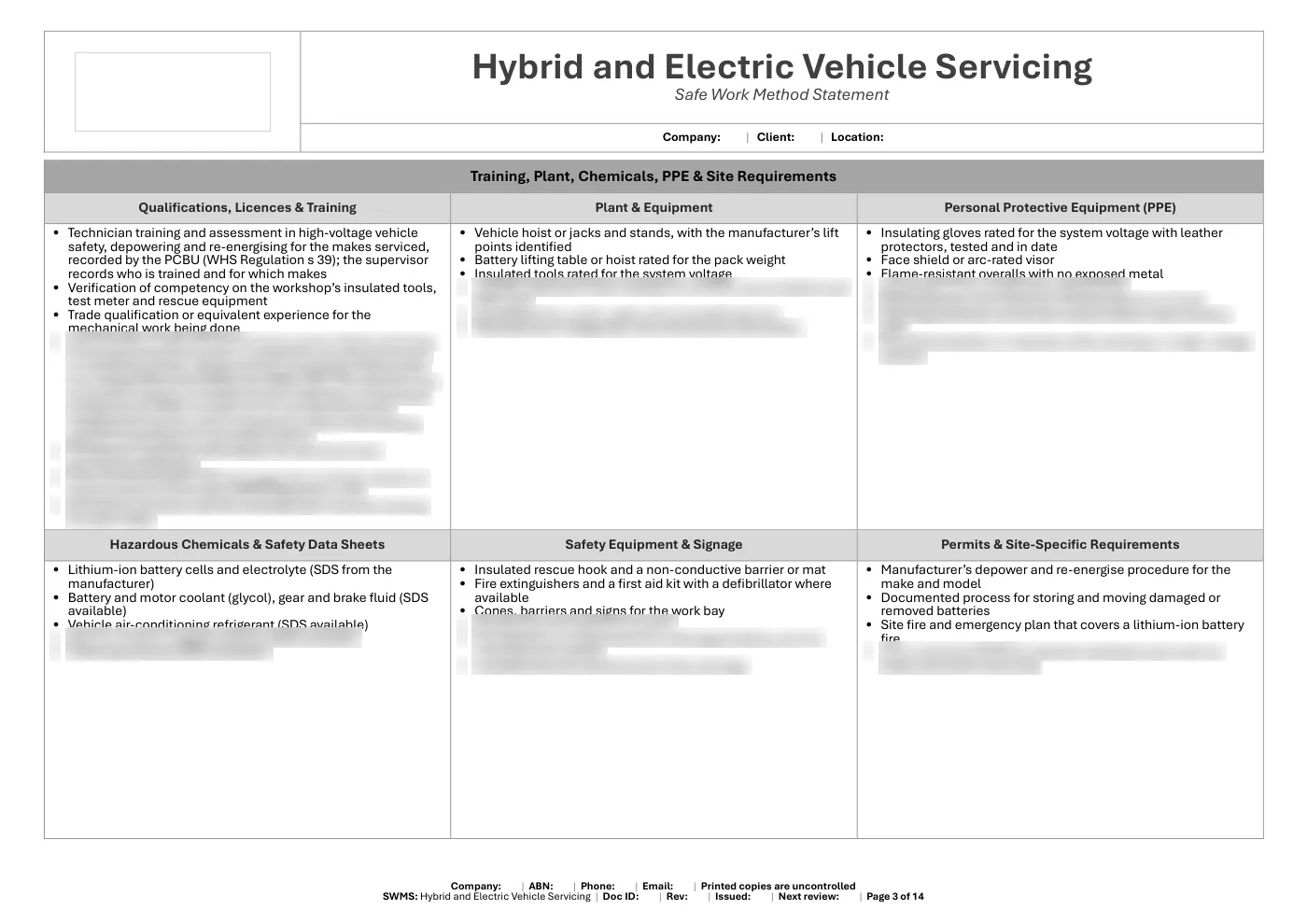
- Technician training and assessment in high-voltage vehicle safety, depowering and re-energising for the makes serviced, recorded by the PCBU (WHS Regulation s 39); the supervisor records who is trained and for which makes
- Verification of competency on the workshop’s insulated tools, test meter and rescue equipment
- Trade qualification or equivalent experience for the mechanical work being done
- No Schedule 3 high risk work licence covers vehicle servicing. A licensed electrical worker is needed for any electrical work on workshop wiring, charge points or equipment above extra low voltage (Electrical Safety Act 2002 s 55). The vehicle’s own propulsion system is outside the Act’s definition of electrical equipment (s 14(2)), so work on it is not electrical work needing that licence, and competence rests on the training and the manufacturer’s procedure above
- Refrigerant handling authorisation for any technician recovering refrigerant
- First aid training with CPR and response to electric shock; at least access to a first aider (WHS Regulation s 42)
- Workshop induction and the manufacturer’s service training for each make
Legislation and Codes of Practice Referenced
- Work Health and Safety Act 2011 (Qld)
- Work Health and Safety Regulation 2011 (Qld)
- WHS Regulation 2011 (Qld) ss 36, 39, 42, 44 and 60: hierarchy of controls, training, first aid, personal protective equipment and hazardous manual tasks
- WHS Regulation 2011 (Qld) ss 208, 210, 213 and 214: guarding, operational controls, maintenance and plant risks
- WHS Regulation 2011 (Qld) ss 351 and 357: hazardous chemicals and spills
- WHS Regulation 2011 (Qld) ss 56 and 57: noise exposure standard and managing hearing loss
- Electrical Safety Act 2002 (Qld): s 14(2) (electrical equipment does not include vehicle equipment that is part of the propulsion unit or powered by it) and s 55 (electrical work licence)
- Electrical Safety Regulation 2026 (Qld)
- Electrical Safety Code of Practice 2021 – Managing electrical risks in the workplace
- Managing Risks of Plant in the Workplace Code of Practice 2021
- Hazardous Manual Tasks Code of Practice 2021
- Managing Risks of Hazardous Chemicals in the Workplace Code of Practice 2021
- Managing Noise and Preventing Hearing Loss at Work Code of Practice 2021
- Managing the Work Environment and Facilities Code of Practice 2021
- First Aid in the Workplace Code of Practice 2021
- How to Manage Work Health and Safety Risks Code of Practice 2021
- Transport Operations (Road Use Management – Dangerous Goods) Regulation 2018 (Qld): carrying batteries or chemicals by road
What You Get
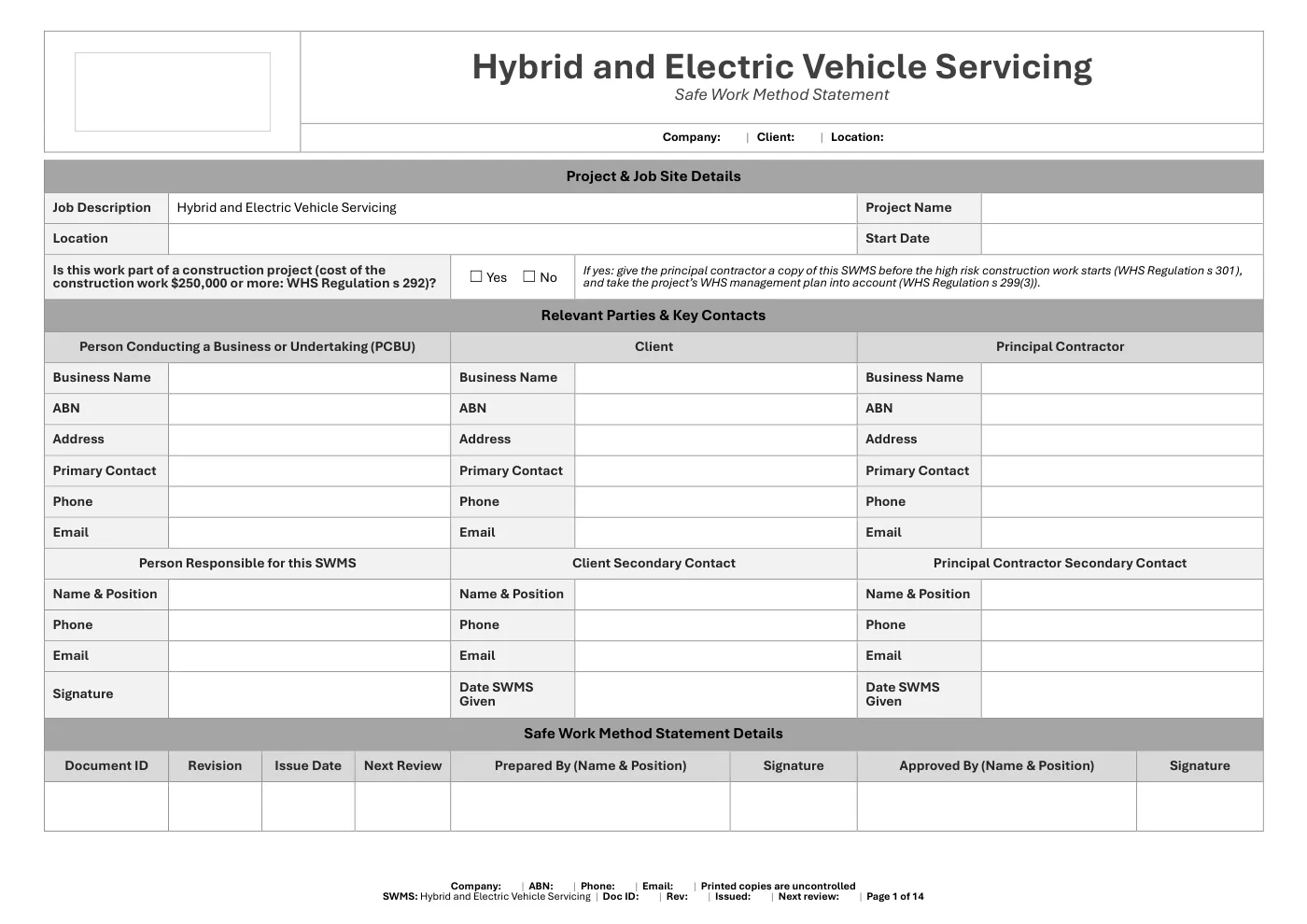
- An editable Microsoft Word document (14 A4 landscape pages). Type your business, client and job details once and they fill in on every page, with a space for your logo
- 10 job steps for this work, each with its hazards, controls, initial and residual risk scores and the person responsible
- PPE listed for this job: insulating gloves rated for the system voltage with leather protectors, tested and in date; face shield or arc-rated visor; flame-resistant overalls with no exposed metal
- Emergency arrangements for: electric shock, battery smoke, heat or fire and spill of coolant or electrolyte
- Plus the parts every Work Safety QLD SWMS shares, from the s 291 checklist to the worker sign-on sheet (see the layout in our free SWMS template)
Adjust it for your site, plant and crew, and talk it through with your workers before work starts. Please make sure you read our Disclaimer before downloading this SWMS.
Checked against the Queensland laws and codes of practice listed above. Last reviewed November 2026.
Having trouble with your download? Contact us any time. Please read our Disclaimer before downloading.
How to use it
From download to site in three steps
Buy and download
Check out with card, Apple Pay or Google Pay. Your download buttons appear straight away and the links are emailed to you. Links work for 3 months, so save your copies.
Make it yours
Add your logo and business details in Word or Excel, or tick branding at checkout (A$29) and we add them. Then add your site and job details.
Brief your crew
Talk it through with the workers doing the job, have them sign on, and keep it on site. Review it whenever the job or conditions change.
What format is it?
Microsoft Word. Edit it in Word, or free in Word for the web, and add your own logo and business details. Or let us do it: tick "Add my business name and logo to every document" at checkout (A$29, free on orders of A$500 or more) and fill in a short form after payment.
How do I get it after I pay?
Your download buttons appear as soon as checkout finishes, and the links are emailed to you. You can re-download from your account at any time.
Is it compliant with Queensland law?
It's written around Queensland's Work Health and Safety Act 2011 and Regulation 2011. Tailor it to your site, consult your workers and review it whenever conditions change; no template can guarantee compliance on its own.
What if it isn't right for my job?
If it doesn't match its description or has a fault, tell us and we'll fix it. If you're still not happy, we'll refund you or give you store credit, your choice. Check the sample pages first, as we don't refund a change of mind.
Only logged in customers who have purchased this product may leave a review.
Reviews