Skip to content

Forwarder and Skidder Log Extraction SWMS

Forwarder and skidder log extraction in Queensland: rollover, falling timber, winch rope failure, power lines and the log landing. An editable Word SWMS template.

RG

Written by Ryan Graham, health and safety professional (16 years on Queensland sites)

$39.99 incl. GST

AUD · one-off purchase · instant download

  • Instant download · your links arrive by email straight after checkout and work for 3 months, so save your copy
  • Make it yours in minutes · edit in Microsoft Word and add your logo
  • Quality guarantee · we'll fix any problem, then refund you or give store credit if you're still not happy
  • Secure checkout · card, Apple Pay or Google Pay through Stripe

About this template

Suits forest harvesting contractors, plantation and native forest crews and timber haulage teams who extract logs with forwarders and skidders. It follows the job in order: the harvesting plan and site check, power lines, machine checks, travel on slopes, working with fellers, snigging and winching, forwarding, the landing and truck loading, refuelling and maintenance, and fatigue and heat. Chainsaw felling and harvester work need their own SWMS.

Log extraction in a forest is not high risk construction work by itself, so no item is pre-ticked and a SWMS is required by law only for high risk construction work (WHS Regulation s 299); otherwise the document works as a written safe work procedure and task risk assessment that you tailor to your machines and harvesting plan. If the extraction is part of construction work, such as clearing a building site, tick the reg 291 items that apply, for example movement of powered mobile plant, or energised electrical installations or services where overhead lines are near.

New to SWMS? Read What Is A Safe Work Method Statement?

What Is Covered In Our Forwarder and Skidder Log Extraction SWMS?

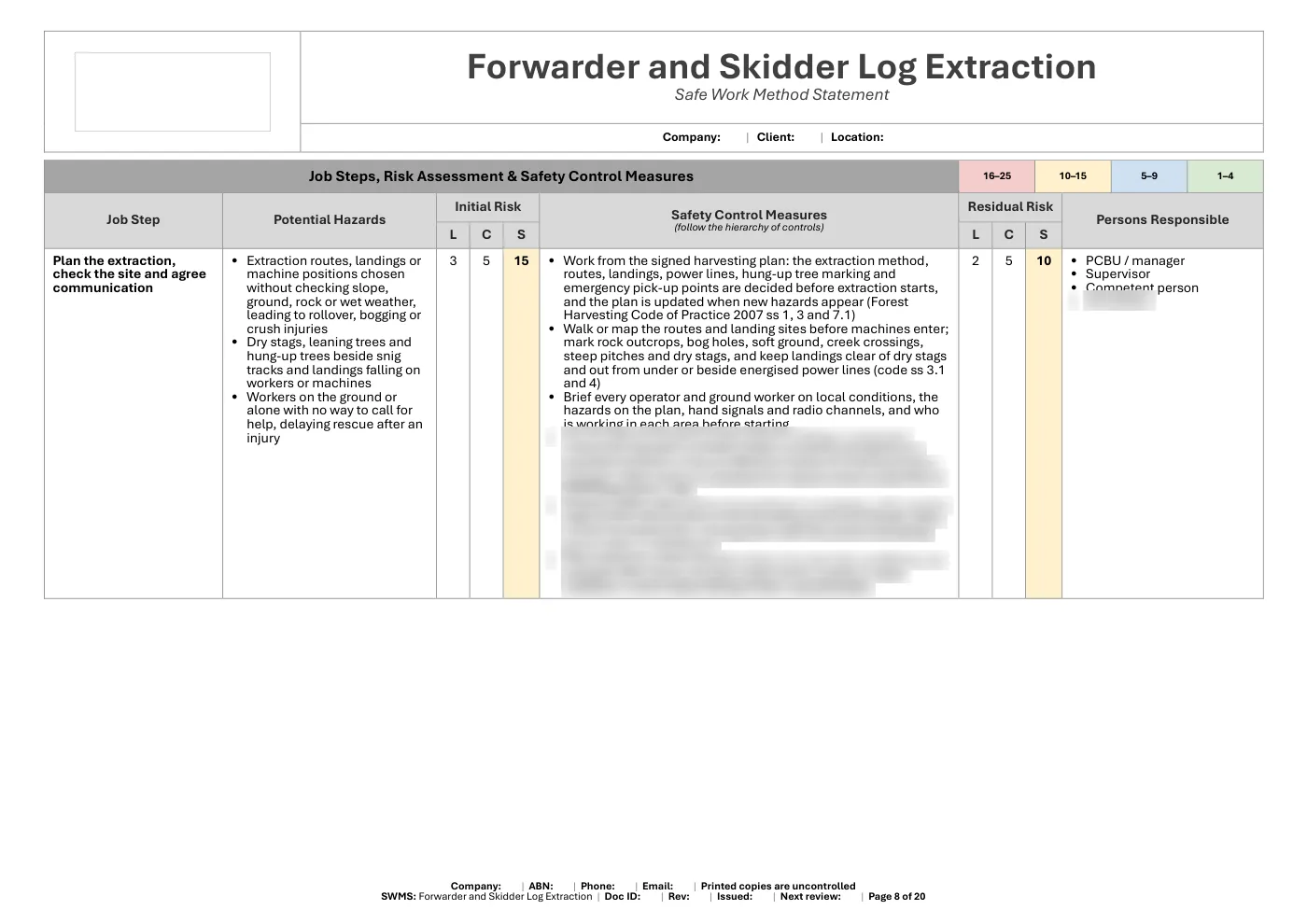
After the standard pre-start checks, the job steps run from “Plan the extraction, check the site and agree communication” to “Manage fatigue, heat, noise, dust and working alone”. The hazards and controls include:

  • Forwarder and skidder rollover on slopes and soft ground
  • Trees, dry stags and hung-up limbs falling on people and machines
  • Winch rope, choker and chain failure and stored energy
  • Offsider and ground workers caught at the hook-up
  • Machines entering a felling zone
  • Contact with overhead power lines
  • Logs rolling or falling at the landing
  • Loader swing and dropped logs when forwarding
  • Truck loading and the driver in the danger area
  • Hydraulic injection and stored energy during maintenance
  • Fire in dry forest and at the fuel point
  • Fatigue, heat, noise and working alone

High Risk Construction Work

None of the high risk construction work items (WHS Regulation 2011 (Qld) s 291) are pre-ticked, because this job is not high risk construction work by itself. Tick any that apply on your site.

Licences, Training and Competency

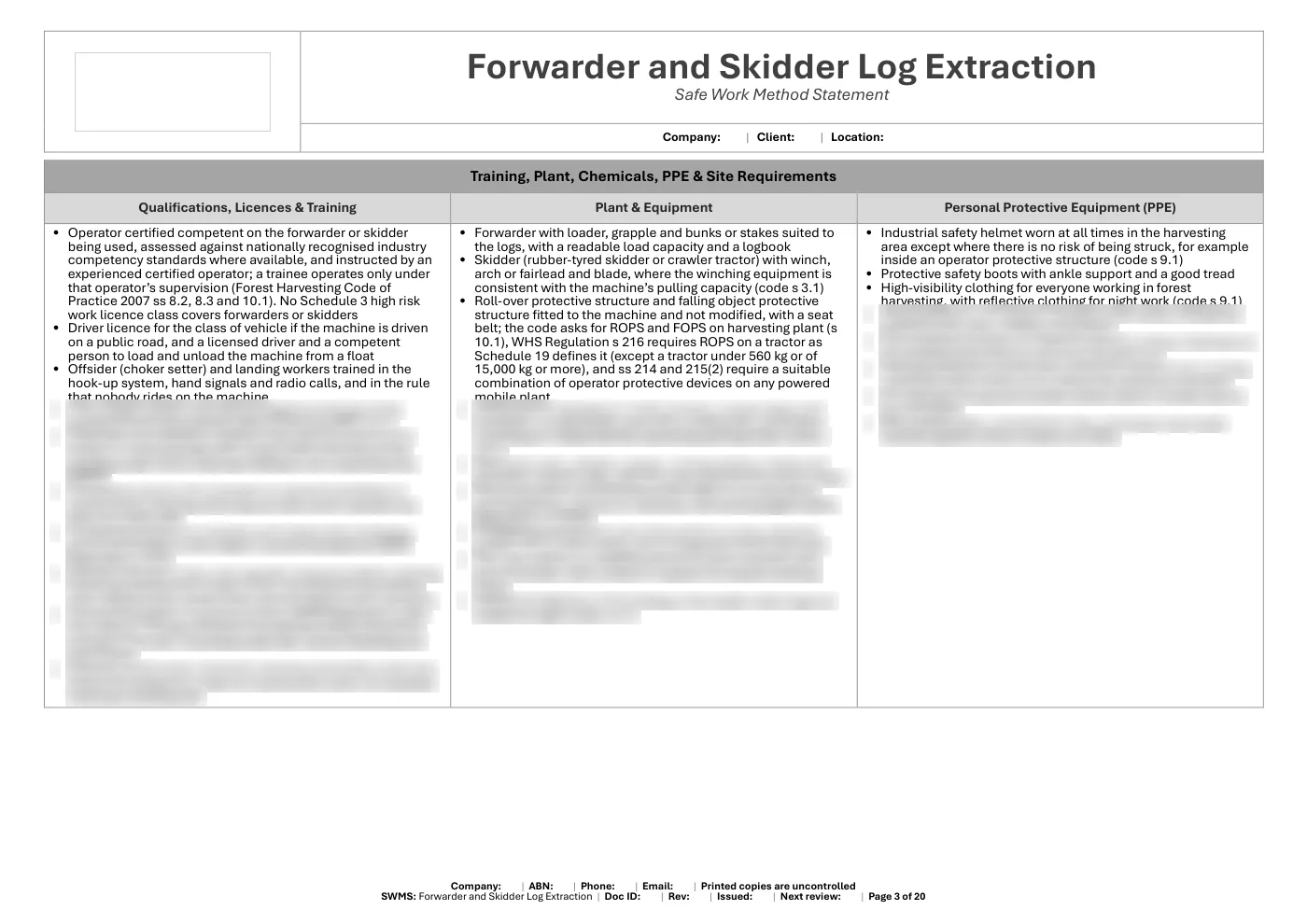
  • Operator certified competent on the forwarder or skidder being used, assessed against nationally recognised industry competency standards where available, and instructed by an experienced certified operator; a trainee operates only under that operator’s supervision (Forest Harvesting Code of Practice 2007 ss 8.2, 8.3 and 10.1). No Schedule 3 high risk work licence class covers forwarders or skidders
  • Driver licence for the class of vehicle if the machine is driven on a public road, and a licensed driver and a competent person to load and unload the machine from a float
  • Offsider (choker setter) and landing workers trained in the hook-up system, hand signals and radio calls, and in the rule that nobody rides on the machine
  • Only trained people operate log loading machines at the landing (Forest Harvesting Code of Practice 2007 s 4.1)
  • Chainsaw accreditation suited to the work for anyone who docks or crosscuts logs with a hand-held chainsaw at the landing (code s 8.3); chainsaw felling is not covered by this SWMS
  • Competent person (for example an experienced feller) to assess dead, leaning and hung-up trees and to decide how they are made safe
  • Competent person to maintain and inspect the machines, winch and loader to the maker’s recommendations (WHS Regulation s 213)
  • General induction and a site-specific induction before starting forest harvesting work (code s 8.4), including the harvesting plan, felling zones, power lines and emergency pick-up points
  • Trained first aiders or access to them (WHS Regulation s 42); the code (s 7.2) says all forest harvesting workers should be trained in first aid, including snake bite, severe bleeding and heat illness
  • General construction induction training card (white card) only where the extraction is part of construction work, for example clearing a building site

Legislation and Codes of Practice Referenced

  • Work Health and Safety Act 2011 (Qld)
  • Work Health and Safety Regulation 2011 (Qld)
  • Forest Harvesting Code of Practice 2007 (extraction, snigging and forwarding s 3, log landings and loading s 4, power lines s 6, plant safety s 10, fatigue s 13, heat stress s 14)
  • Managing Risks of Plant in the Workplace Code of Practice 2021 (powered mobile plant s 3.8, isolating energy sources s 4.5)
  • How to Manage Work Health and Safety Risks Code of Practice 2021
  • Hazardous Manual Tasks Code of Practice 2021 (whole-body vibration)
  • Managing Noise and Preventing Hearing Loss at Work Code of Practice 2021
  • Managing the Work Environment and Facilities Code of Practice 2021 (heat, remote or isolated work s 4.2)
  • First Aid in the Workplace Code of Practice 2021
  • Managing Risks of Hazardous Chemicals in the Workplace Code of Practice 2021 (fuel)
  • Electrical Safety Act 2002 (Qld)
  • Electrical Safety Regulation 2026 (Qld): overhead power line exclusion zones in sections 10 to 13 and schedule 2
  • Electrical Safety Code of Practice 2020 – Working near overhead and underground electric lines (distances come from the 2026 Regulation)
  • Heavy Vehicle National Law (Queensland), applied by the Heavy Vehicle National Law Act 2012 (Qld): s 6 (heavy vehicle means a vehicle with a GVM or ATM of more than 4.5 t), s 26C (primary duty of each party in the chain of responsibility), s 96 (compliance with mass requirements), s 110 (national regulations may prescribe loading requirements), s 111 (compliance with the loading requirements) and s 228 (duty of driver to avoid driving while fatigued or unfit to drive)
  • AS 2759 Steel wire rope – Use, operation and maintenance, AS 2294.1 Earth-moving machinery – Protective structures – Part 1: General, AS 1636 Tractors – Roll-over protective structures – Criteria and tests, and AS 1319 Safety signs for the occupational environment (each as named in the Forest Harvesting Code of Practice 2007)
  • Safe Work Australia model Code of Practice: Managing the risk of fatigue at work (model code, not approved in Queensland; guidance only)

What You Get

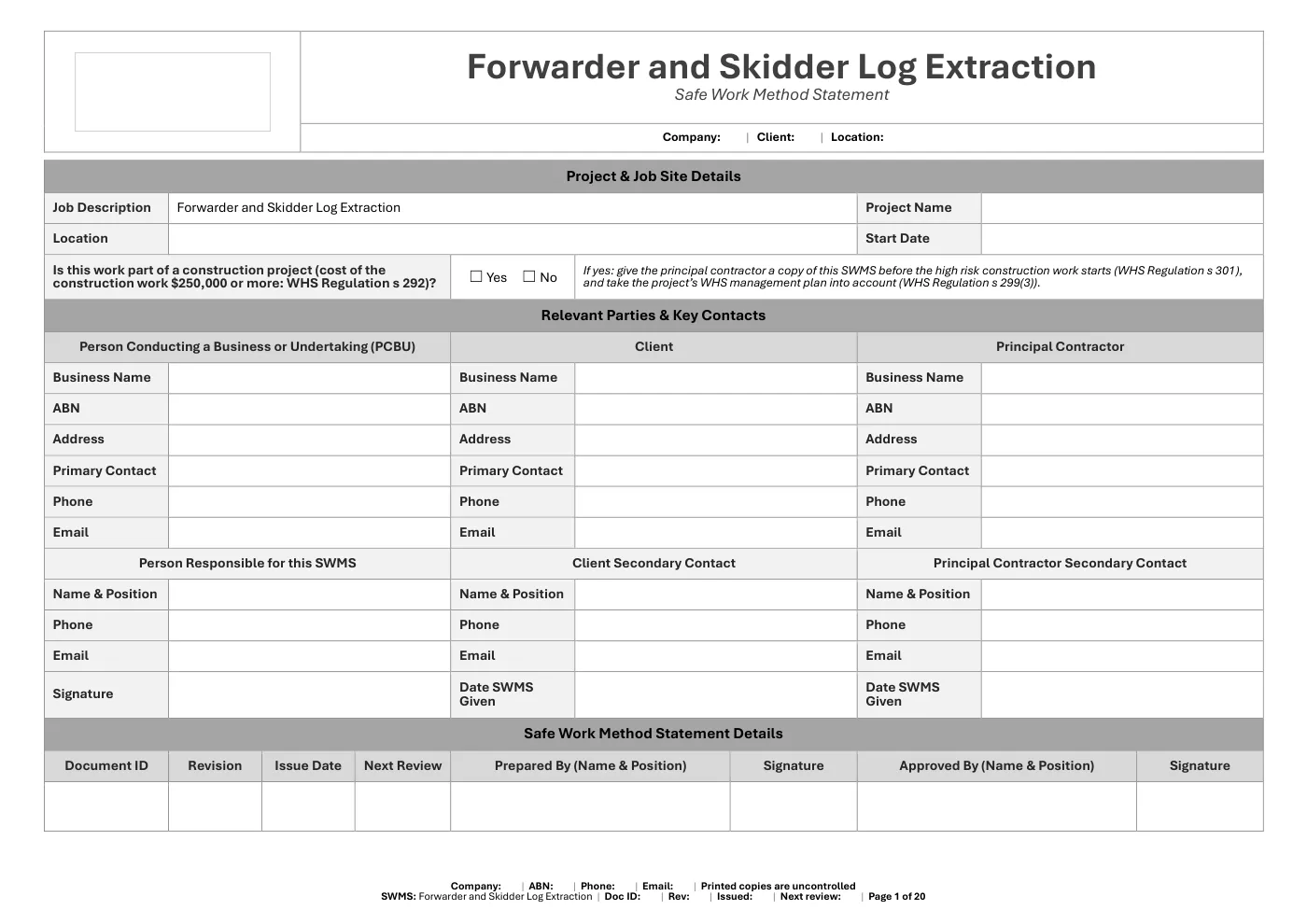
  • An editable Microsoft Word document (20 A4 landscape pages). Type your business, client and job details once and they fill in on every page, with a space for your logo
  • 11 job steps for this work, each with its hazards, controls, initial and residual risk scores and the person responsible
  • PPE listed for this job: industrial safety helmet worn at all times in the harvesting area except where there is no risk of being struck, for example inside an operator protective structure (code s 9.1)
  • Emergency arrangements for: machine rolls over or is struck by a falling tree or limb, touching an overhead power line with the machine or load and fire
  • Plus the parts every Work Safety QLD SWMS shares, from the s 291 checklist to the worker sign-on sheet (see the layout in our free SWMS template)

Adjust it for your site, plant and crew, and talk it through with your workers before work starts. Please make sure you read our Disclaimer before downloading this SWMS.

Checked against the Queensland laws and codes of practice listed above. Last reviewed November 2026.

Having trouble with your download? Contact us any time. Please read our Disclaimer before downloading.

How to use it

From download to site in three steps

Buy and download

Check out with card, Apple Pay or Google Pay. Your download buttons appear straight away and the links are emailed to you. Links work for 3 months, so save your copies.

Make it yours

Open it in Microsoft Word or Excel. Add your logo, business details, site and job information, and adjust it to how the work is done.

Brief your crew

Talk it through with the workers doing the job, have them sign on, and keep it on site. Review it whenever the job or conditions change.

FAQ

Before you buy

Something else? Ask us and a real person will reply.

What format is it?

Microsoft Word. Edit it in Word, or free in Word for the web, and add your own logo and business details.

How do I get it after I pay?

Your download buttons appear as soon as checkout finishes, and the links are emailed to you. You can re-download from your account at any time.

Is it compliant with Queensland law?

It's written around Queensland's Work Health and Safety Act 2011 and Regulation 2011. Tailor it to your site, consult your workers and review it whenever conditions change; no template can guarantee compliance on its own.

What if it isn't right for my job?

If it doesn't match its description or has a fault, tell us and we'll fix it. If you're still not happy, we'll refund you or give you store credit, your choice. Check the sample pages first, as we don't refund a change of mind.
Reviews

Be the first to review “Forwarder and Skidder Log Extraction SWMS”

Your email address will not be published. Required fields are marked *

Bought or downloaded this template from us? Leave an honest review, good or bad, and we'll email you a code for a free template of your choice (single templates, not packs). One per order.

More templates like this