

Fibre Cement Sheeting Installation SWMS
Fixing fibre cement eaves, soffit and wet-area wall sheeting in Queensland, covering silica dust, working at height, asbestos in old sheeting and manual handling. An editable Word SWMS template for Queensland.
RG
Written by Ryan Graham, health and safety professional (16 years on Queensland sites)
$49.99 incl. GST
AUD · one-off purchase · instant download
- Instant download · your links arrive by email straight after checkout and work for 3 months, so save your copy
- Your business name and logo · we fill them into every document for A$29 (free on orders of A$500 or more), or edit it yourself in Microsoft Word
- Quality guarantee · we'll fix any problem, then refund you or give store credit if you're still not happy
- Secure checkout · card, Apple Pay or Google Pay through Stripe
About this template
Suits carpenters, builders and renovators who fix flat fibre cement sheet to eaves, soffits and internal wet-area walls. It covers identifying existing sheeting, access and falls, power lines and services, handling and cutting sheets, fixing, wet-area details, and clean-up.
Fixing fibre cement to eaves and soffits is construction work, usually from a scaffold or platform at height, and cutting fibre cement creates crystalline silica dust, so the falls and contaminated atmosphere items are ticked (WHS Regulation s 291). Untick falls only for a job done wholly at low height, such as internal wet-area walls. Tick asbestos disturbance if the existing sheeting is asbestos or assumed to be, and energised electrical installations or services where work goes on or near them.
New to SWMS? Read What Is A Safe Work Method Statement?
What Is Covered In Our Fibre Cement Sheeting Installation SWMS?
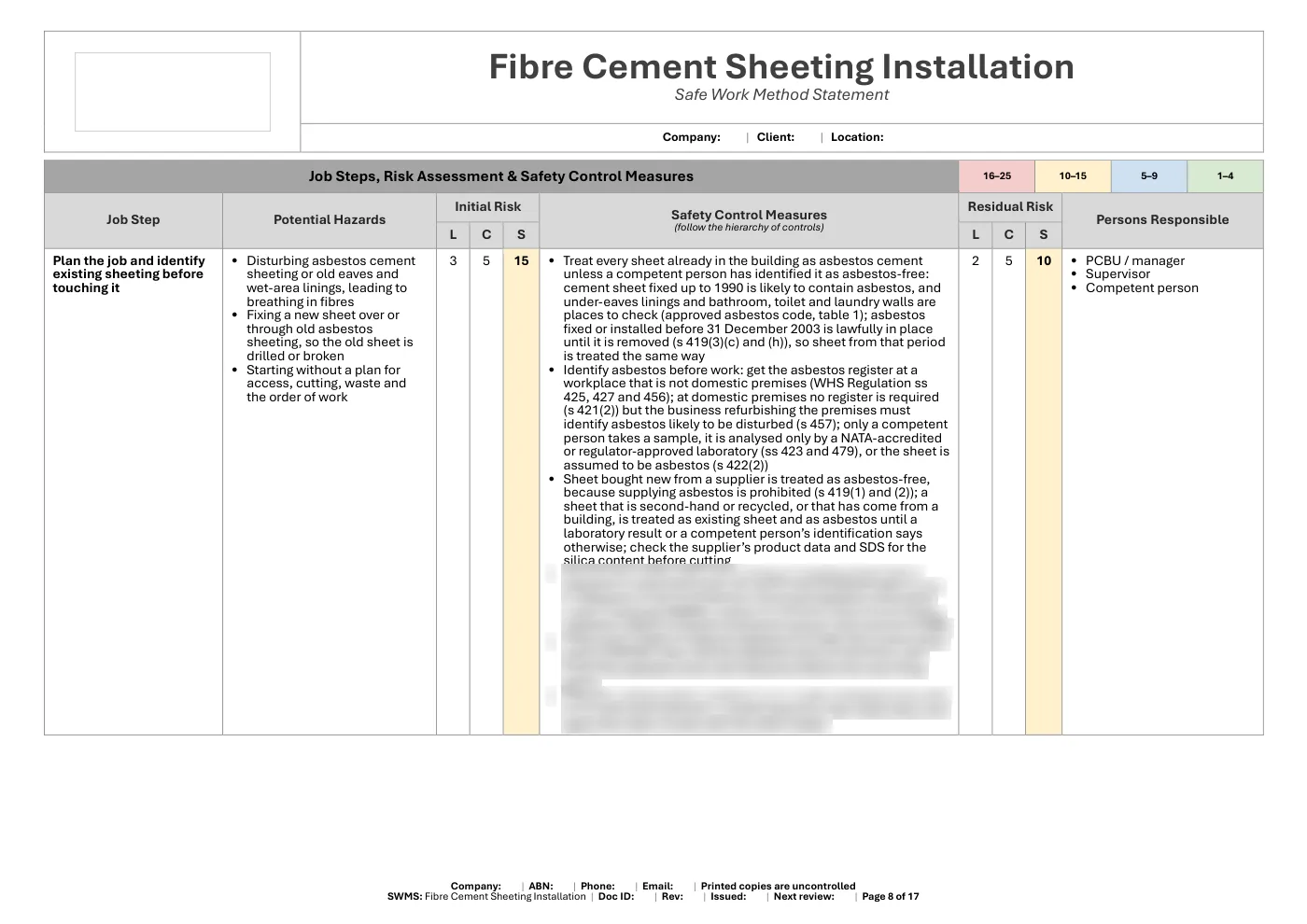
After the standard pre-start checks, the job steps run from “Plan the job and identify existing sheeting before touching it” to “Clean up, waste and pack up”. The hazards and controls include:
- Asbestos cement in existing eaves and wet-area linings
- Respirable crystalline silica dust from cutting
- Falls from scaffolds, platforms and ladders at eaves
- Scaffold ties and guardrails moved to reach the work
- Overhead power lines and building service lines
- Fixing through cables and pipes in walls
- Strains from carrying and holding heavy sheets overhead
- Nail gun misfires and ricochets
- Cement jointing compound burns
- Falling sheets, tools and offcuts
- Noise from saws and extractors
High Risk Construction Work
These high risk construction work items (WHS Regulation 2011 (Qld) s 291) are already ticked because they are part of this work. Tick any others that apply to your job:
- Involves a risk of a person falling more than 2m
- Is carried out in an area that may have a contaminated or flammable atmosphere
Licences, Training and Competency
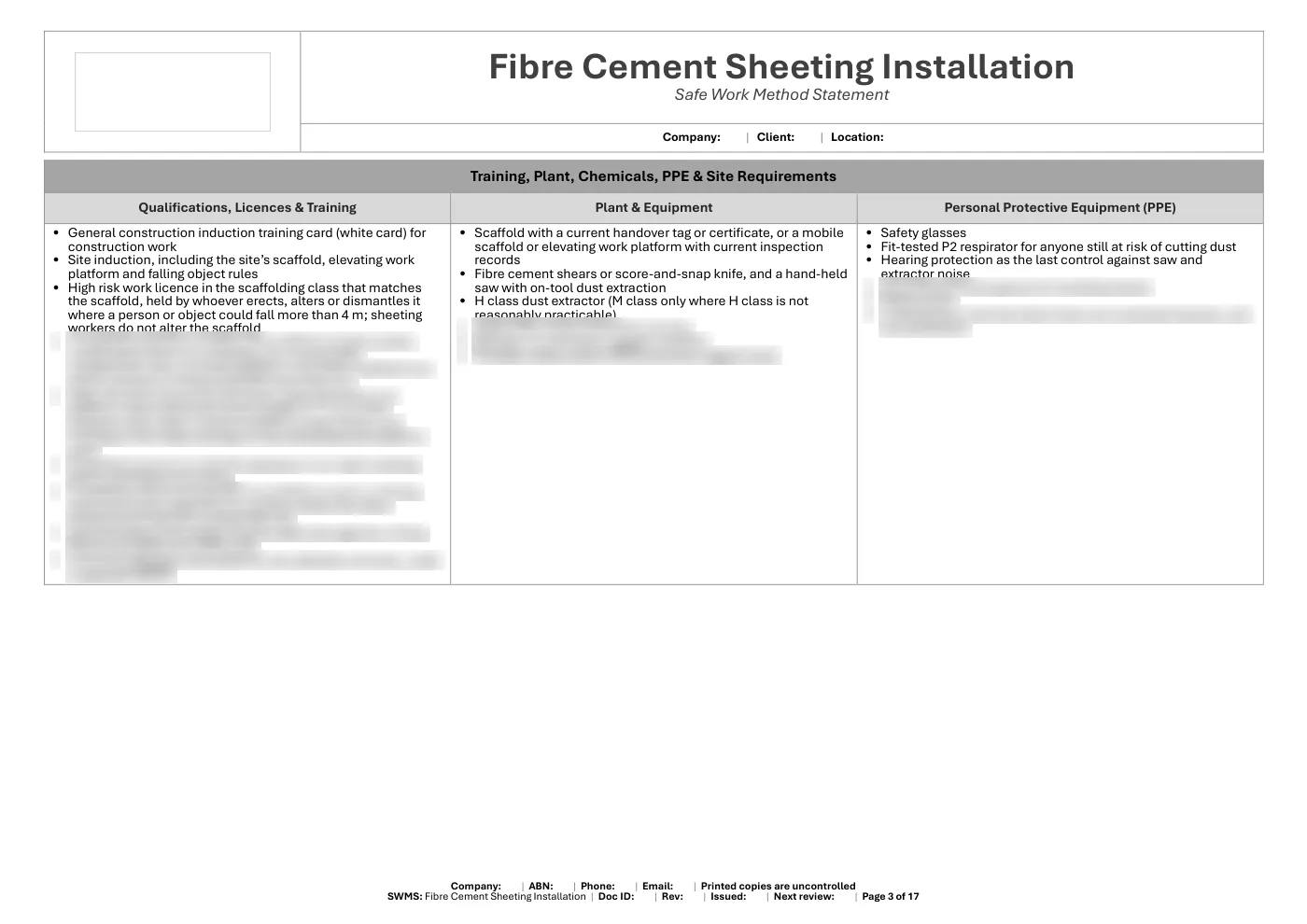
- General construction induction training card (white card) for construction work
- Site induction, including the site’s scaffold, elevating work platform and falling object rules
- High risk work licence in the scaffolding class that matches the scaffold, held by whoever erects, alters or dismantles it where a person or object could fall more than 4 m; sheeting workers do not alter the scaffold
- Competent person to inspect the scaffold and give written confirmation that it is complete, for a suspended, cantilevered, spur or hung scaffold or any other scaffold from which a person or thing could fall more than 4 m
- High risk work licence for the boom-type elevating work platform class where the boom length is 11 m or more (trainees only under a licence holder’s supervision), and training on the make and type of any elevating work platform used
- Competent person to identify asbestos in an older building before sheeting work starts
- Crystalline silica training (VET accredited course or training approved by the regulator) for workers where the silica assessment finds the cutting high risk
- Licensed electrical worker for any cable damaged by a fixing (Electrical Safety Act 2002 s 55)
- Licensed asbestos removalist for any asbestos removal, under a separate SWMS
Legislation and Codes of Practice Referenced
- Work Health and Safety Act 2011 (Qld)
- Work Health and Safety Regulation 2011 (Qld)
- Managing the Risk of Falls at Workplaces Code of Practice 2021
- Scaffolding Code of Practice 2021
- Managing Risks of Plant in the Workplace Code of Practice 2021
- Hazardous Manual Tasks Code of Practice 2021
- Managing respirable crystalline silica dust exposure in construction and manufacturing of construction elements Code of Practice 2022
- Managing Noise and Preventing Hearing Loss at Work Code of Practice 2021
- Managing Risks of Hazardous Chemicals in the Workplace Code of Practice 2021
- How to Manage and Control Asbestos in the Workplace Code of Practice 2021
- First Aid in the Workplace Code of Practice 2021
- How to Manage Work Health and Safety Risks Code of Practice 2021
- Electrical Safety Act 2002 (Qld)
- Electrical Safety Regulation 2026 (Qld): overhead power line exclusion zones
- AS/NZS 60335.2.69:2017 (wet and dry vacuum cleaners for industrial and commercial use), as named in the approved silica code
What You Get
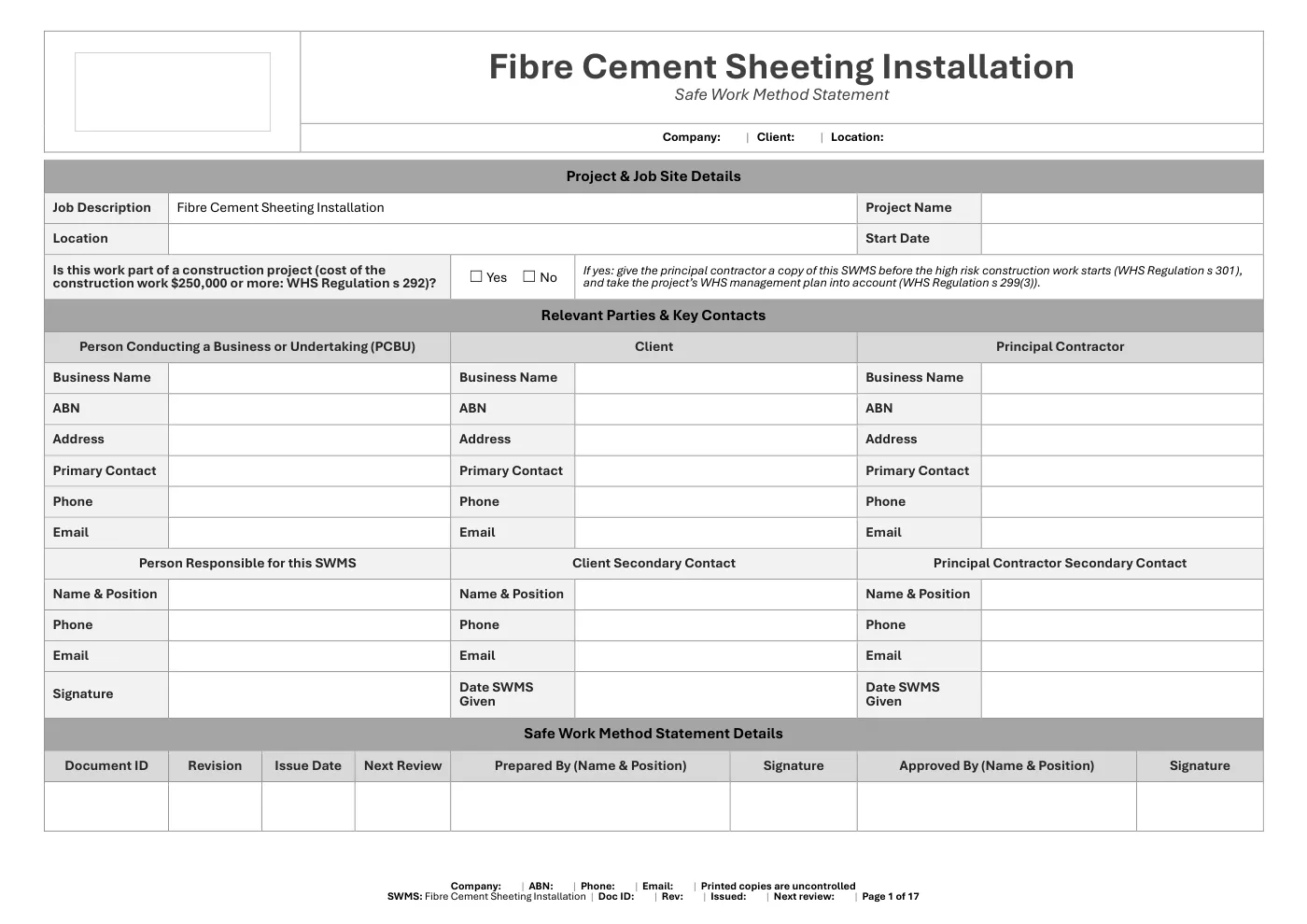
- An editable Microsoft Word document (17 A4 landscape pages). Type your business, client and job details once and they fill in on every page, with a space for your logo
- 8 job steps for this work, each with its hazards, controls, initial and residual risk scores and the person responsible
- PPE listed for this job: safety glasses; fit-tested P2 respirator for anyone still at risk of cutting dust; hearing protection as the last control against saw and extractor noise; cut-resistant work gloves for handling sheets
- Emergency arrangements for: suspected asbestos found, fall from height and cement burn
- Plus the parts every Work Safety QLD SWMS shares, from the s 291 checklist to the worker sign-on sheet (see the layout in our free SWMS template)
Adjust it for your site, plant and crew, and talk it through with your workers before work starts. Please make sure you read our Disclaimer before downloading this SWMS.
Checked against the Queensland laws and codes of practice listed above. Last reviewed November 2026.
Having trouble with your download? Contact us any time. Please read our Disclaimer before downloading.
How to use it
From download to site in three steps
Buy and download
Check out with card, Apple Pay or Google Pay. Your download buttons appear straight away and the links are emailed to you. Links work for 3 months, so save your copies.
Make it yours
Add your logo and business details in Word or Excel, or tick branding at checkout (A$29) and we add them. Then add your site and job details.
Brief your crew
Talk it through with the workers doing the job, have them sign on, and keep it on site. Review it whenever the job or conditions change.
What format is it?
Microsoft Word. Edit it in Word, or free in Word for the web, and add your own logo and business details. Or let us do it: tick "Add my business name and logo to every document" at checkout (A$29, free on orders of A$500 or more) and fill in a short form after payment.
How do I get it after I pay?
Your download buttons appear as soon as checkout finishes, and the links are emailed to you. You can re-download from your account at any time.
Is it compliant with Queensland law?
It's written around Queensland's Work Health and Safety Act 2011 and Regulation 2011. Tailor it to your site, consult your workers and review it whenever conditions change; no template can guarantee compliance on its own.
What if it isn't right for my job?
If it doesn't match its description or has a fault, tell us and we'll fix it. If you're still not happy, we'll refund you or give you store credit, your choice. Check the sample pages first, as we don't refund a change of mind.
Only logged in customers who have purchased this product may leave a review.
Reviews