
Entertainment Chain Hoist and Truss Rigging SWMS
Rigging chain hoists and truss for stages and events in Queensland: heights, overhead loads, rated gear, exclusion zones and rescue. Tailor it to your job. An editable Word SWMS template.
RG
Written by Ryan Graham, health and safety professional (16 years on Queensland sites)
$49.99 incl. GST
AUD · one-off purchase · instant download
- Instant download · your links arrive by email straight after checkout and work for 3 months, so save your copy
- Your business name and logo · we fill them into every document for A$29 (free on orders of A$500 or more), or edit it yourself in Microsoft Word
- Quality guarantee · we'll fix any problem, then refund you or give store credit if you're still not happy
- Secure checkout · card, Apple Pay or Google Pay through Stripe
About this template
For production riggers, staging contractors and venue crews who hang chain hoists and truss for stages, concerts and events. It follows the job in order, from the rigging plot and rigging point checks through inspecting rated gear, working at height, lifting truss over drop zones and hanging loads, to wind, power lines and dismantling. Crane lifts, general rigging and dogging, and stage deck assembly are not covered here and need their own SWMS.
Treat rigging truss and chain hoists for an event as construction work: a truss rig is a structure (the WHS Act definition includes temporary and moveable framework) and putting prefabricated elements together into a structure is construction work (WHS Regulation s 289(1) and (2)(d)), and no regulator guidance treats event rigs differently. If a person could fall more than 2 metres it is high risk construction work and a SWMS is legally required (ss 291(a) and 299), so that item is ticked. You can also tick energised electrical installations if overhead lines are near an outdoor rig and powered mobile plant if EWPs or forklifts work in the area.
New to SWMS? Read What is a safe work method statement?
What is covered in our entertainment chain hoist and truss rigging SWMS?
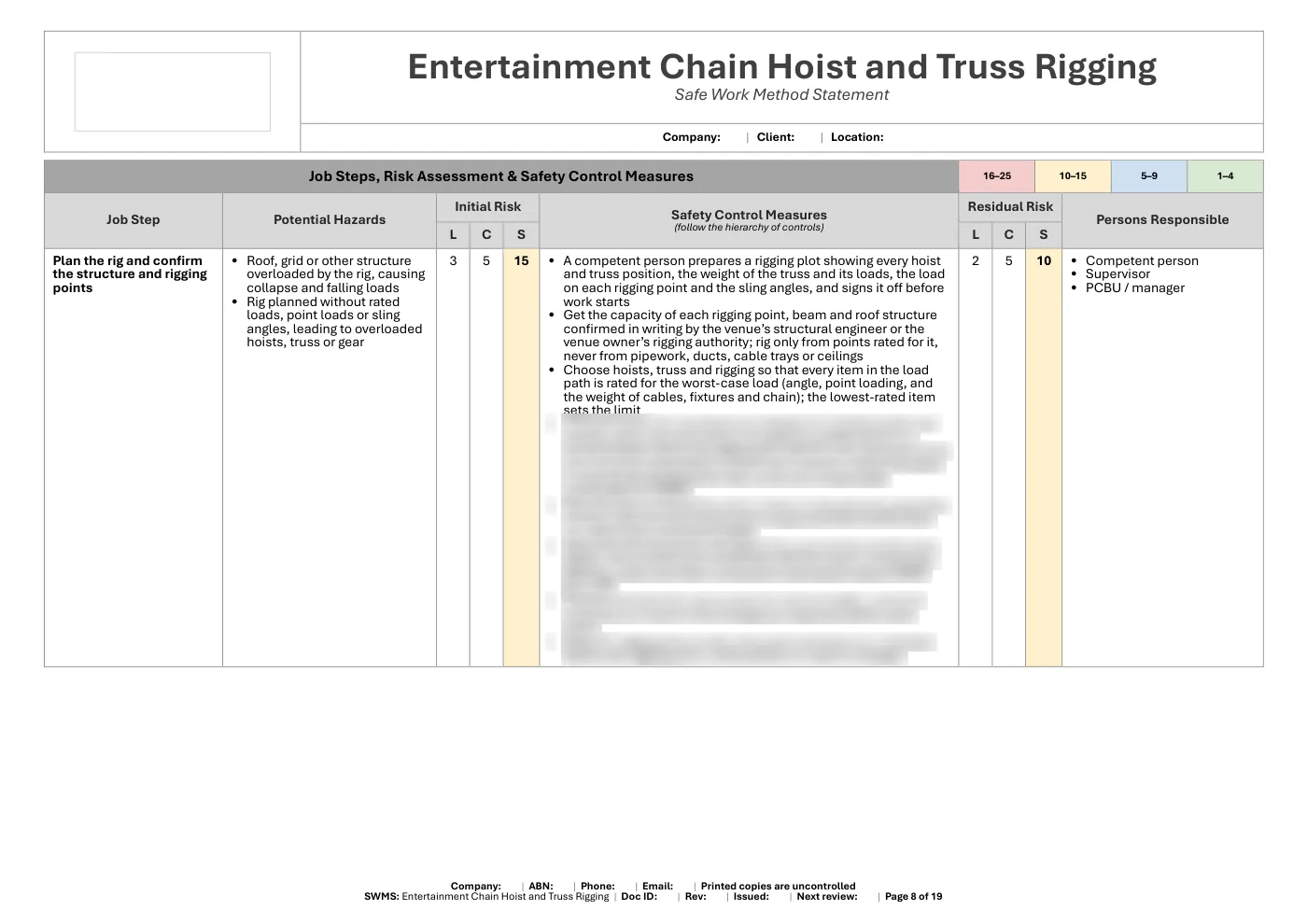
After the standard pre-start checks, the job steps run from “Plan the rig and confirm the structure and rigging points” to “Dismantle the rig, load out and pack up”. The hazards and controls include:
- Falls from height when rigging and hanging hoists
- Roof or grid structures overloaded by the rig
- Unrated, damaged or mismatched rigging gear
- Hoist or truss failure dropping a load
- Loads suspended over people
- Truss tilting or one hoist taking too much load
- Dropped tools, shackles and hoists
- Drop zones under overhead work
- Electric shock from hoist power and controls
- Hands crushed while joining truss
- Wind, storms and overhead power lines at outdoor events
- Fatigue and rushed bump-outs
High risk construction work
These high risk construction work items (WHS Regulation 2011 (Qld) s 291) are already ticked because they are part of this work. Tick any others that apply to your job:
- Involves a risk of a person falling more than 2m
Licences, training and competency
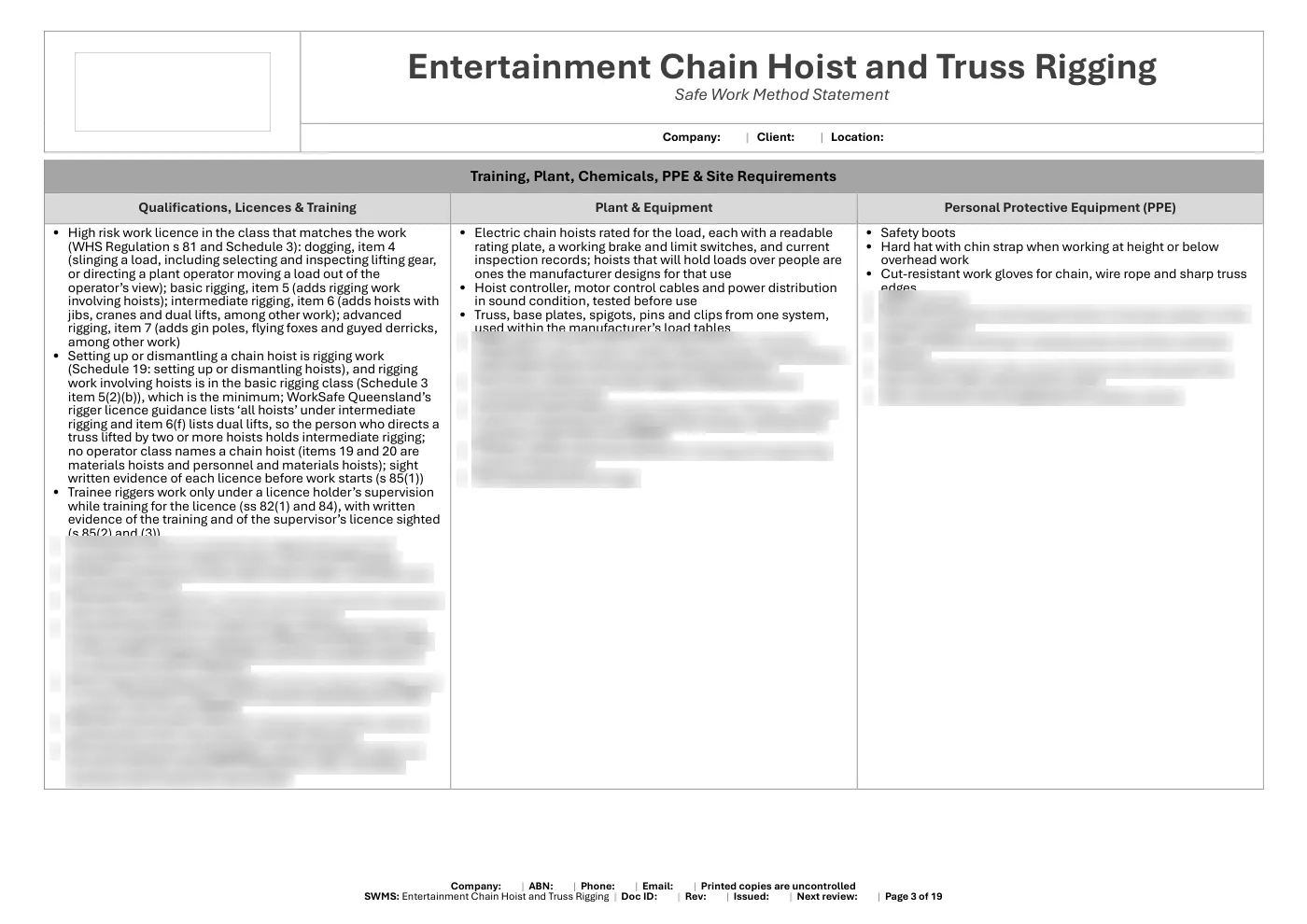
- High risk work licence in the class that matches the work (WHS Regulation s 81 and Schedule 3): dogging, item 4 (slinging a load, including selecting and inspecting lifting gear, or directing a plant operator moving a load out of the operator’s view); basic rigging, item 5 (adds rigging work involving hoists); intermediate rigging, item 6 (adds hoists with jibs, cranes and dual lifts, among other work); advanced rigging, item 7 (adds gin poles, flying foxes and guyed derricks, among other work)
- Setting up or dismantling a chain hoist is rigging work (Schedule 19: setting up or dismantling hoists), and rigging work involving hoists is in the basic rigging class (Schedule 3 item 5(2)(b)), which is the minimum; WorkSafe Queensland’s rigger licence guidance lists ‘all hoists’ under intermediate rigging and item 6(f) lists dual lifts, so the person who directs a truss lifted by two or more hoists holds intermediate rigging; no operator class names a chain hoist (items 19 and 20 are materials hoists and personnel and materials hoists); sight written evidence of each licence before work starts (s 85(1))
- Trainee riggers work only under a licence holder’s supervision while training for the licence (ss 82(1) and 84), with written evidence of the training and of the supervisor’s licence sighted (s 85(2) and (3))
- Competent person to prepare the rigging plot and load calculations and to inspect hoists, truss and lifting gear
- Verified competency in the chain hoist model, controller and truss system used
- Training in fall protection, harness use and rescue for everyone who works at height or may carry out a rescue
- Licensed electrician for supply wiring, testing and repairs to hoists and distribution equipment (Electrical Safety Act 2002 ss 18 and 55); plugging a flexible cord into a socket outlet is not electrical work (s 18(2)(a))
- Boom-type elevating work platform licence (boom length 11 m or more, Schedule 3 item 21) for anyone operating one; EWP operation has its own SWMS
- General construction induction training card (white card) for construction work, plus venue and site induction
- First aid equipment and facilities, and trained first aiders as the work and site need (WHS Regulation s 42), including someone who knows the rescue plan
Legislation and codes of practice referenced
- Work Health and Safety Act 2011 (Qld)
- Work Health and Safety Regulation 2011 (Qld)
- Managing Risks of Plant in the Workplace Code of Practice 2021
- Managing the Risk of Falls at Workplaces Code of Practice 2021
- Hazardous Manual Tasks Code of Practice 2021
- Managing Noise and Preventing Hearing Loss at Work Code of Practice 2021
- Managing the Work Environment and Facilities Code of Practice 2021
- How to Manage Work Health and Safety Risks Code of Practice 2021
- Work Health and Safety Consultation, Co-operation and Co-ordination Code of Practice 2021
- First Aid in the Workplace Code of Practice 2021
- Electrical Safety Act 2002 (Qld)
- Electrical Safety Regulation 2026 (Qld): overhead power line exclusion zones, Schedule 2 (uninsulated lines)
- Electrical Safety Code of Practice 2020 – Working near overhead and underground electric lines (distances come from the 2026 Regulation)
- AS 4991 Lifting devices and AS 2550 (series) Cranes, hoists and winches – Safe use (examples of technical standards listed in Appendix D of the Managing Risks of Plant in the Workplace Code of Practice 2021)
What you get
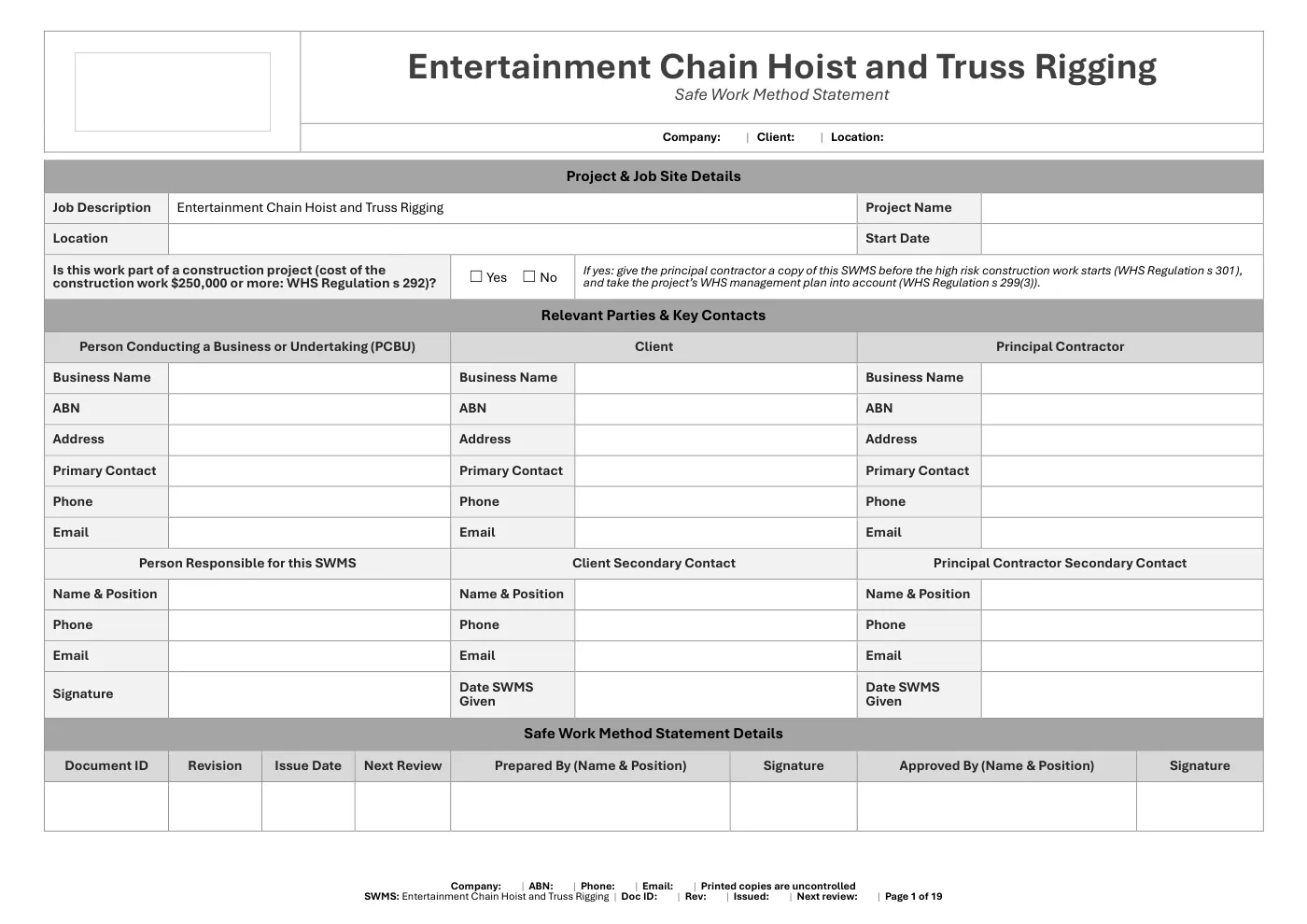
- An editable Microsoft Word document (19 pages), laid out on A4 landscape pages. Type your business, client and job details once and they fill in on every page, with a space for your logo
- 11 job steps for this work, each with its hazards, controls, initial and residual risk scores and the person responsible
- PPE listed for this job: safety boots; hard hat with chin strap when working at height or below overhead work; cut-resistant work gloves for chain, wire rope and sharp truss edges; safety glasses
- Emergency arrangements for: dropped load or hoist failure, person hanging in a harness and runaway or unexpected hoist movement
- Plus the parts every Work Safety QLD SWMS shares, from the s 291 checklist to the worker sign-on sheet (see the layout in our free SWMS template)
Adjust it for your site, plant and crew, and talk it through with your workers before work starts.
Checked against the Queensland laws and codes of practice listed above. Last reviewed November 2026.
Having trouble with your download? Contact us any time. Please read our Disclaimer before downloading.
How to use it
From download to site in three steps
Buy and download
Check out with card, Apple Pay or Google Pay. Your download buttons appear straight away and the links are emailed to you. Links work for 3 months, so save your copies.
Make it yours
Add your logo and business details in Word or Excel, or tick branding at checkout (A$29) and we add them. Then add your site and job details.
Brief your crew
Talk it through with the workers doing the job, have them sign on, and keep it on site. Review it whenever the job or conditions change.
What format is it?
Microsoft Word. Edit it in Word, or free in Word for the web, and add your own logo and business details. Or let us do it: tick "Add my business name and logo to every document" at checkout (A$29, free on orders of A$500 or more) and fill in a short form after payment.
How do I get it after I pay?
Your download buttons appear as soon as checkout finishes, and the links are emailed to you. You can re-download from your account at any time.
Is it compliant with Queensland law?
It's written around Queensland's Work Health and Safety Act 2011 and Regulation 2011. Tailor it to your site, consult your workers and review it whenever conditions change; no template can guarantee compliance on its own.
What if it isn't right for my job?
If it doesn't match its description or has a fault, tell us and we'll fix it. If you're still not happy, we'll refund you or give you store credit, your choice. Check the sample pages first, as we don't refund a change of mind.
Only logged in customers who have purchased this product may leave a review.
Reviews