
Container Unpacking (Devanning) SWMS
Editable Word SWMS template for unpacking shipping containers in Queensland: shifted loads, fumigant gases, heat, dust, forklifts and manual handling, set out as job steps.
RG
Written by Ryan Graham, health and safety professional (16 years on Queensland sites)
$39.99 incl. GST
AUD · one-off purchase · instant download
- Instant download · your links arrive by email straight after checkout
- Make it yours in minutes · edit in Microsoft Word or Excel and add your logo
- Quality guarantee · we'll fix it or refund you if it isn't as described
- Secure checkout · card, Apple Pay or Google Pay through Stripe
About this template
For warehouses, distribution centres, importers, freight forwarders and depots that unpack shipping containers by hand and with forklifts or pallet jacks. It follows the job from checking the consignment documents and positioning the container through opening the doors, testing the air and making the load safe to unpacking, heat control, stacking and close-out. Forklift operation and moving the container itself are not covered and need their own SWMS.
Unpacking containers in a warehouse or depot is not construction work, so the high risk construction work list in WHS Regulation s 291 does not apply, no item is pre-ticked and s 299 does not require a SWMS for it. This document works as a written safe work procedure and task risk assessment that a warehouse, depot or customer may still ask for. If the unpacking forms part of construction work, for example on a building site, tick the items on the form that apply.
Learn More: What Is A Safe Work Method Statement?
Have you ever been asked to provide a SWMS on a project in Queensland? Read our guide to what a Safe Work Method Statement is and when you need one.
What Is Covered In Our Container Unpacking (Devanning) SWMS?
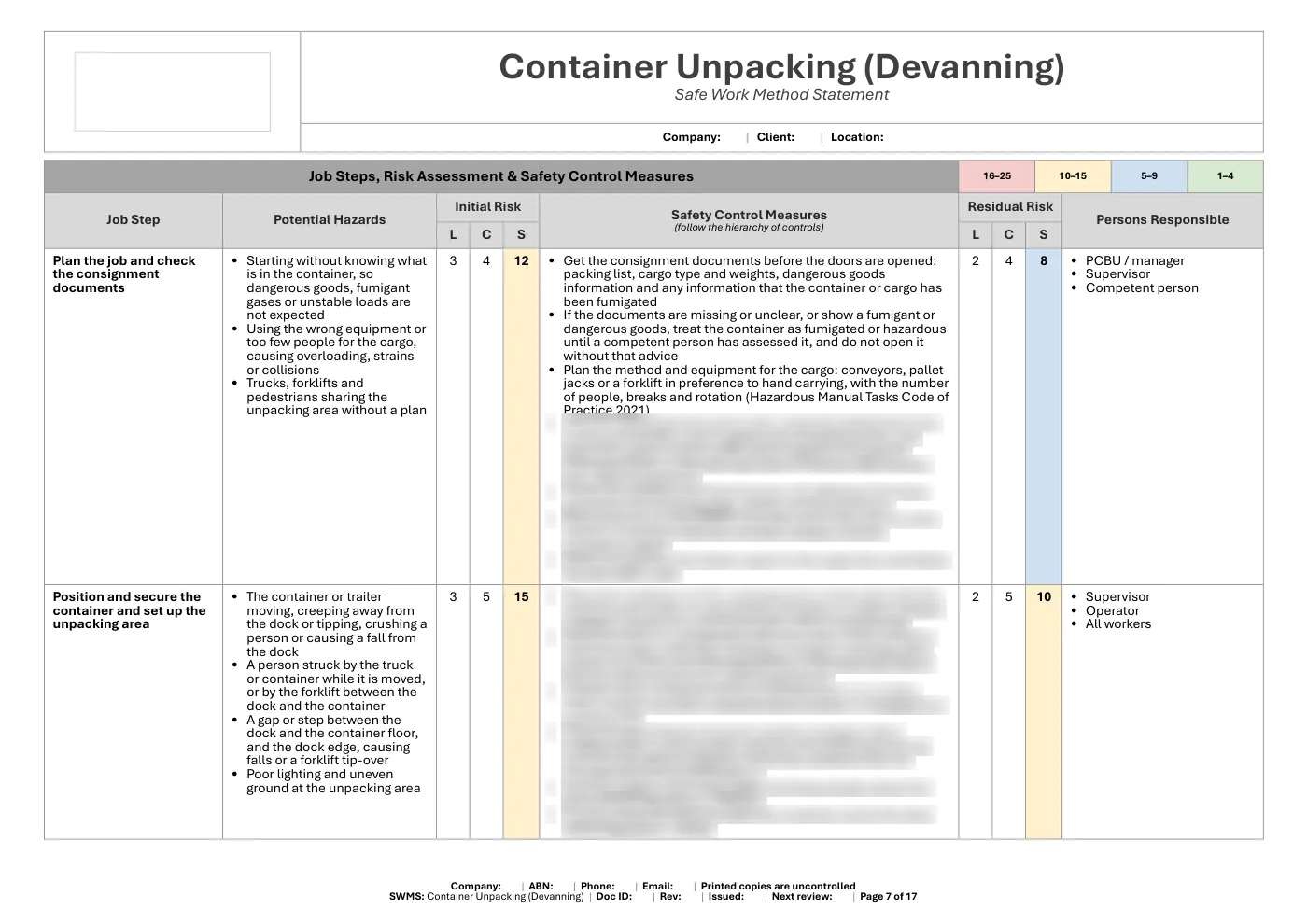
The job steps run in the order the work is done, from pre-start checks to finishing up. The hazards and controls include:
- Shifted cargo falling out when the doors open
- Fumigant gases and fumes in closed containers
- Workers entering a container before the air is tested
- Heat illness inside hot containers
- Strains from heavy and awkward cartons
- Forklift collisions and tip-overs at the dock and in the container
- Exhaust gases from engines working in the container
- Container or trailer movement at the dock
- Falls from dock edges and across the dock gap
- Stacks collapsing when unpacked or stored
- Dust, spilled chemicals and dangerous goods
- Bites and stings from pests in cargo
- Cuts from banding, nails and packaging
High Risk Construction Work
No high risk construction work items (WHS Regulation 2011 (Qld) s 291) are pre-ticked, because this work is not high risk construction work by itself. Tick the items that apply to your job, such as a fall risk of more than 2 metres or work where powered mobile plant is moving.
Licences, Training and Competency
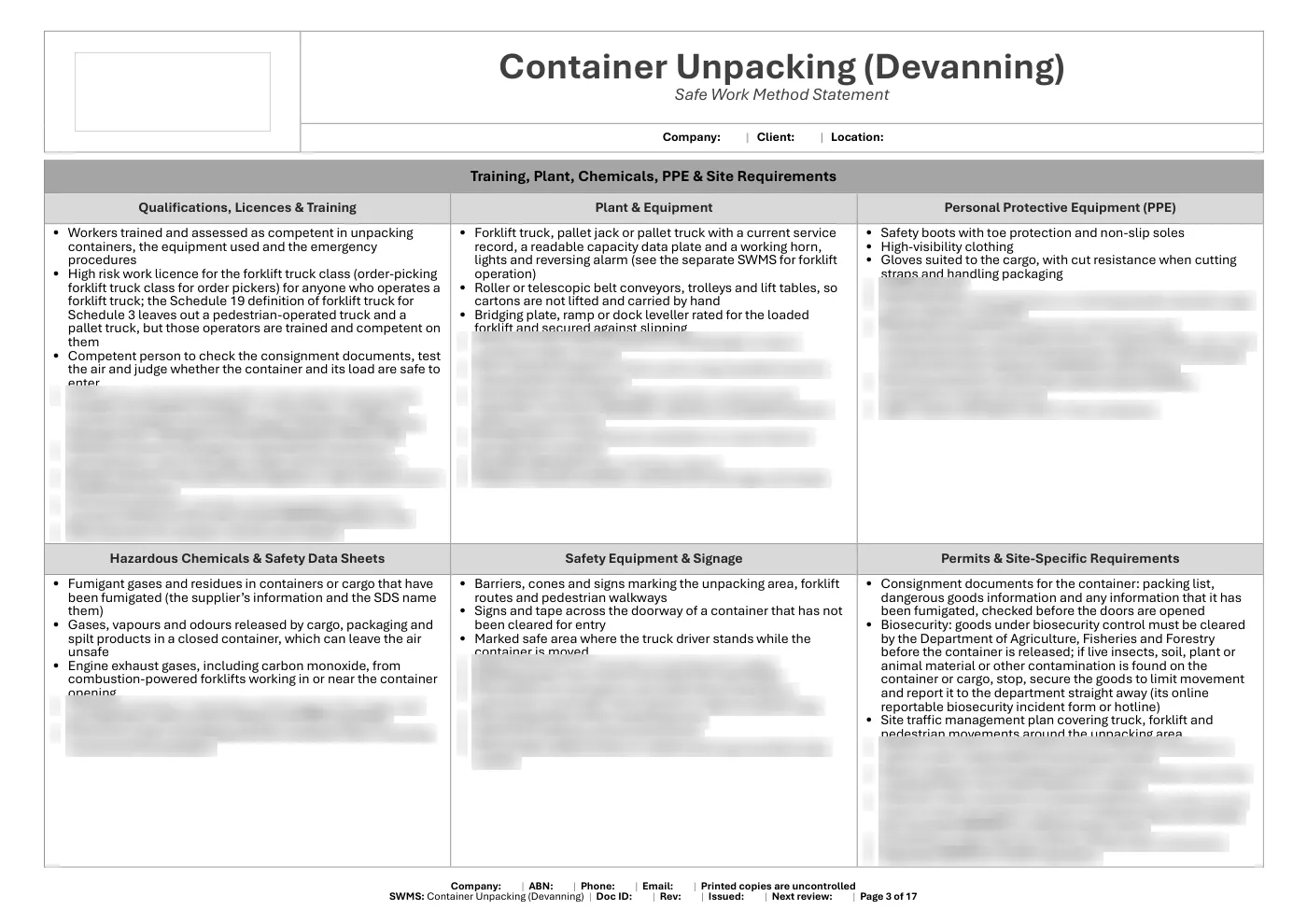
- Workers trained and assessed as competent in unpacking containers, the equipment used and the emergency procedures
- High risk work licence for the forklift truck class (order-picking forklift truck class for order pickers) for anyone who operates a forklift truck; the Schedule 19 definition of forklift truck for Schedule 3 leaves out a pedestrian-operated truck and a pallet truck, but those operators are trained and competent on them
- Competent person to check the consignment documents, test the air and judge whether the container and its load are safe to enter
- Instruction and training specific to the task for anyone who handles a fumigated container, or who loads, unloads or receives dangerous goods (Transport Operations (Road Use Management – Dangerous Goods) Regulation 2018 s 20)
- Workers trained in emergency response for hazardous atmospheres, and in the signs of gas and fume exposure
- Spotter trained in the site’s hand signals or radio system and in forklift blind spots
- First aid equipment, facilities and trained first aiders (or access to them) as the work needs (WHS Regulation s 42)
- Site induction for workers, drivers and visitors
Legislation and Codes of Practice Referenced
- Work Health and Safety Act 2011 (Qld)
- Work Health and Safety Regulation 2011 (Qld)
- Work Health and Safety Regulation 2011 (Qld): ss 49 to 51 (exposure standards, air monitoring, hazardous atmospheres), ss 54 and 55 (falling objects) and ss 214 and 215 (powered mobile plant)
- Hazardous Manual Tasks Code of Practice 2021
- Managing Risks of Plant in the Workplace Code of Practice 2021 (forklifts)
- Managing Risks of Hazardous Chemicals in the Workplace Code of Practice 2021
- Confined Spaces Code of Practice 2021 (a fumigated shipping container with a large ground-level opening is generally not a confined space, but a space can become one)
- Managing Risks in Stevedoring Code of Practice 2023 (air quality, fumigation, loading areas and stack stability; written for stevedoring operations and used here as good practice)
- Managing the Work Environment and Facilities Code of Practice 2021 (heat, ventilation and lighting)
- Managing the Risk of Falls at Workplaces Code of Practice 2021 (dock edges)
- Managing Noise and Preventing Hearing Loss at Work Code of Practice 2021
- First Aid in the Workplace Code of Practice 2021
- How to Manage Work Health and Safety Risks Code of Practice 2021
- Transport Operations (Road Use Management – Dangerous Goods) Regulation 2018 (Qld), called the Dangerous Goods (road) Regulation in this SWMS: s 20 (instruction and training for handling a fumigated cargo transport unit)
- Safe Work Australia model Code of Practice: Managing the risks of biological hazards at work (guidance)
What You Get
- An editable Microsoft Word document (17 pages), laid out on A4 landscape pages
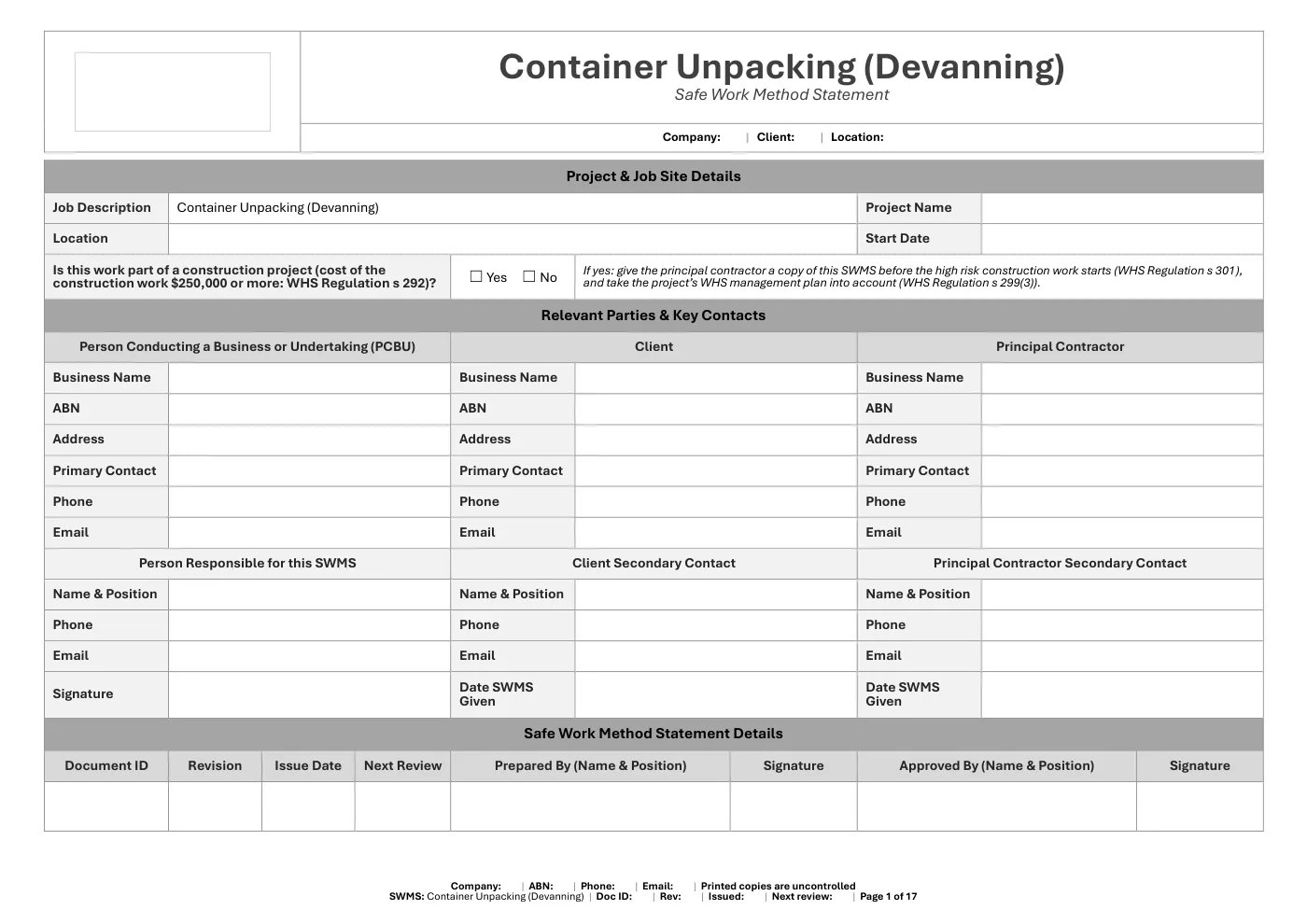
- Business, client, job and document details typed once and filled in on every page, plus a space for your logo
- The high risk construction work checklist, worded as WHS Regulation s 291, and the construction project question (s 292)
- A worker and health and safety representative consultation record
- Qualifications, plant, PPE, hazardous chemicals, safety equipment, permits, references and emergency arrangements filled in for this work
- A 5 x 5 risk matrix, and job steps with initial and residual risk scores and the people responsible
- Implementing, monitoring and review requirements, an additional controls log, revision history and a worker sign-on sheet
Review and adjust it for your site, your plant and the way your crew does the job, and talk it through with your workers before work starts. If you have any trouble downloading this SWMS, you can contact us at any time. Please make sure you read our Disclaimer before downloading this SWMS.
How to use it
From download to site in three steps
Buy and download
Check out with card, Apple Pay or Google Pay. Your download buttons appear straight away and the links are emailed to you.
Make it yours
Open it in Microsoft Word or Excel. Add your logo, business details, site and job information, and adjust it to how the work is done.
Brief your crew
Talk it through with the workers doing the job, have them sign on, and keep it on site. Review it whenever the job or conditions change.
What format is it?
Microsoft Word (registers are Excel). Edit it in Word or Excel, or free in Word and Excel for the web, and add your own logo and business details.
How do I get it after I pay?
Your download buttons appear as soon as checkout finishes, and the links are emailed to you. You can re-download from your account at any time.
Is it compliant with Queensland law?
It's written around Queensland's Work Health and Safety Act 2011 and Regulation 2011. Tailor it to your site, consult your workers and review it whenever conditions change; no template can guarantee compliance on its own.
What if it isn't right for my job?
If it doesn't match its description or has a fault, we'll fix it, and if we can't, we'll refund you (or give you store credit if you'd prefer). Check the sample pages first, as we don't refund a change of mind.
Reviews
Reviews