Skip to content

Aggregate Chip Spreading SWMS

Spreading aggregate chip over sprayed bitumen seals in Queensland: hot binder, flying stone, reversing trucks, rollers and live traffic. An editable Word SWMS template.

RG

Written by Ryan Graham, health and safety professional (16 years on Queensland sites)

$49.99 incl. GST

AUD · one-off purchase · instant download

  • Instant download · your links arrive by email straight after checkout and work for 3 months, so save your copy
  • Make it yours in minutes · edit in Microsoft Word and add your logo
  • Quality guarantee · we'll fix any problem, then refund you or give store credit if you're still not happy
  • Secure checkout · card, Apple Pay or Google Pay through Stripe

About this template

For road crews, sealing contractors and councils spreading and rolling aggregate chip behind a sprayer. It follows the work in order, from planning and traffic management through truck loading, spreading, flying stone control and rolling to sweeping and reopening the road. Bitumen spraying and traffic control set-up are separate work.

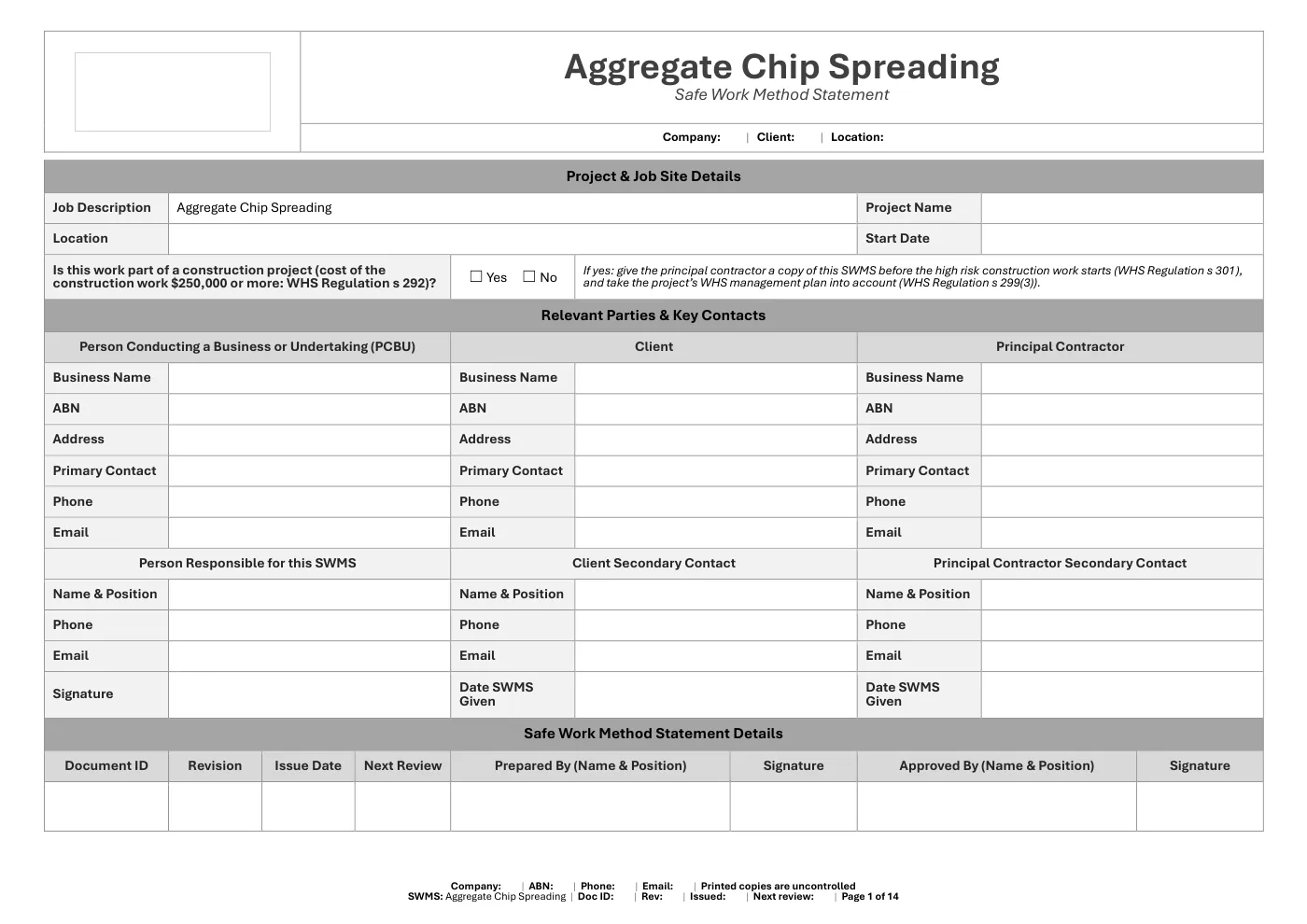
Items 13 (road in use by traffic) and 14 (powered mobile plant) of WHS Regulation s 291 are ticked. A road closed to all traffic is not caught by item 13, so untick it if that applies. Tick any other item that applies, such as work near energised overhead lines (item 10).

Similar job: if it is closer to your work, see the Sprayed Bitumen Sealing SWMS.

New to SWMS? Read What Is A Safe Work Method Statement?

What Is Covered In Our Aggregate Chip Spreading SWMS?

After the standard pre-start checks, the job steps run from “Plan the spreading run, confirm traffic management and brief the crew” to “Finish the shift, remove traffic control and reopen the road”. The hazards and controls include:

  • Hot bitumen burns from fresh binder
  • Flying stone from spreader, tyres and rollers
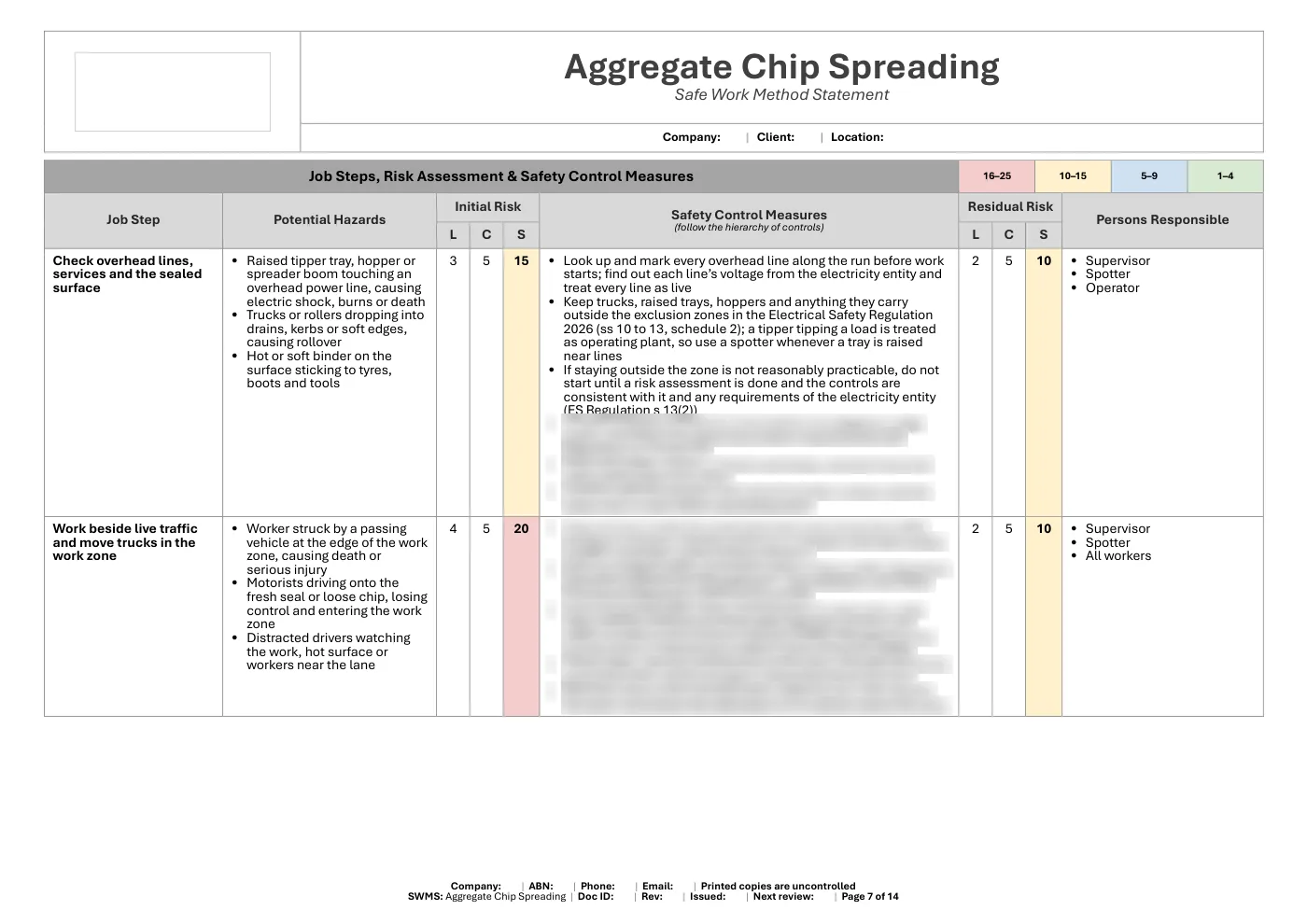
  • Workers struck by traffic beside the work zone
  • Tipper trucks reversing to the spreader
  • Raised tipper tray and overhead power lines
  • Crush at the hopper, tailgate and feed rollers
  • Roller rollover and blind zones
  • Aggregate dust, fume and diesel exhaust
  • Loose chip skids and windscreen damage
  • Heat stress, noise and fatigue
  • Fuel fire and spills at refuelling

High Risk Construction Work

These high risk construction work items (WHS Regulation 2011 (Qld) s 291) are already ticked because they are part of this work. Tick any others that apply to your job:

  • Is carried out on, in or adjacent to a road, railway, shipping lane or other traffic corridor that is in use by traffic other than pedestrians
  • Is carried out in an area at a workplace in which there is any movement of powered mobile plant

Licences, Training and Competency

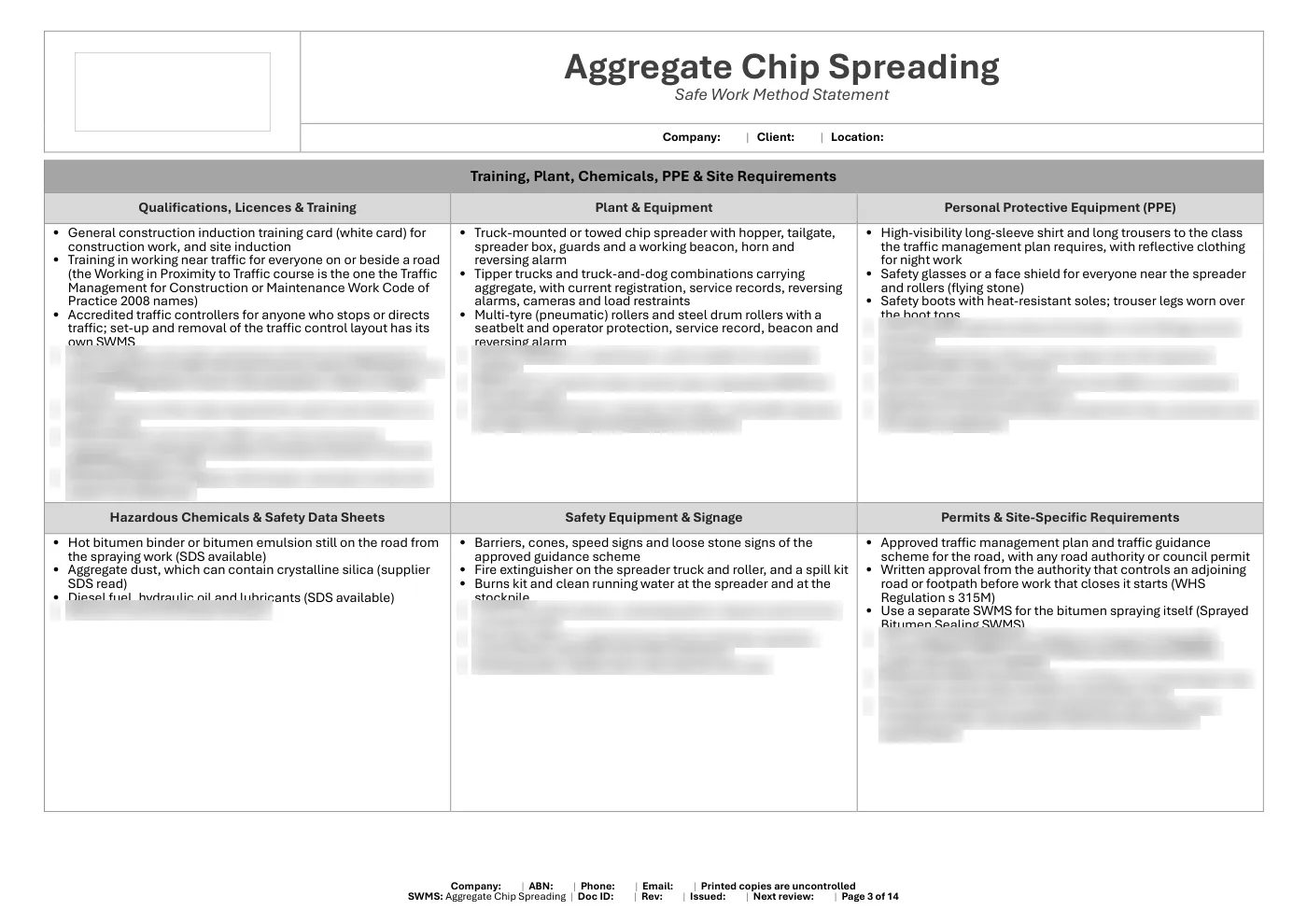
  • General construction induction training card (white card) for construction work, and site induction
  • Training in working near traffic for everyone on or beside a road (the Working in Proximity to Traffic course is the one the Traffic Management for Construction or Maintenance Work Code of Practice 2008 names)
  • Accredited traffic controllers for anyone who stops or directs traffic; set-up and removal of the traffic control layout has its own SWMS
  • Chip spreader and roller operators trained and assessed on each machine (no high risk work licence class in Schedule 3 of the WHS Regulation covers chip spreaders, rollers or tipper trucks)
  • Driver licence of the class required for each truck driven on a public road
  • Crew trained in the binder SDS, burn first aid and fire response; an adequate number of workers trained in first aid (WHS Regulation s 42)
  • Spotters briefed on signals, blind spots, exclusion zones and power line distances

Legislation and Codes of Practice Referenced

  • Work Health and Safety Act 2011 (Qld)
  • Work Health and Safety Regulation 2011 (Qld)
  • Traffic Management for Construction or Maintenance Work Code of Practice 2008
  • Transport Operations (Road Use Management – Accreditation and Other Provisions) Regulation 2015 (Qld): traffic controllers, sections 51 to 55
  • Managing Risks of Plant in the Workplace Code of Practice 2021
  • Managing Risks of Hazardous Chemicals in the Workplace Code of Practice 2021
  • Preparation of Safety Data Sheets for Hazardous Chemicals Code of Practice 2021
  • Managing Noise and Preventing Hearing Loss at Work Code of Practice 2021
  • Hazardous Manual Tasks Code of Practice 2021
  • Managing the Work Environment and Facilities Code of Practice 2021
  • First Aid in the Workplace Code of Practice 2021
  • How to Manage Work Health and Safety Risks Code of Practice 2021
  • Electrical Safety Act 2002 (Qld)
  • Electrical Safety Regulation 2026 (Qld): ss 10 to 13 and sch 2 (overhead exclusion zones); ss 14 and 15 (underground lines)
  • Heavy Vehicle National Law (Queensland), applied by the Heavy Vehicle National Law Act 2012 (Qld): heavy vehicle (s 6), chain of responsibility (s 26C), mass and loading (ss 96, 111), fatigue and fitness to drive (s 228)
  • Safe Work Australia model Code of Practice: Managing the risk of fatigue at work (model code, not approved in Queensland; guidance only)

What You Get

  • An editable Microsoft Word document (14 A4 landscape pages). Type your business, client and job details once and they fill in on every page, with a space for your logo
  • 11 job steps for this work, each with its hazards, controls, initial and residual risk scores and the person responsible
  • PPE listed for this job: high-visibility long-sleeve shirt and long trousers to the class the traffic management plan requires, with reflective clothing for night work
  • Emergency arrangements for: vehicle enters the work zone, hot binder burn and tipper or spreader touches an overhead power line
  • Plus the parts every Work Safety QLD SWMS shares, from the s 291 checklist to the worker sign-on sheet (see the layout in our free SWMS template)

Adjust it for your site, plant and crew, and talk it through with your workers before work starts. Please make sure you read our Disclaimer before downloading this SWMS.

Checked against the Queensland laws and codes of practice listed above. Last reviewed November 2026.

Having trouble with your download? Contact us any time. Please read our Disclaimer before downloading.

How to use it

From download to site in three steps

Buy and download

Check out with card, Apple Pay or Google Pay. Your download buttons appear straight away and the links are emailed to you. Links work for 3 months, so save your copies.

Make it yours

Open it in Microsoft Word or Excel. Add your logo, business details, site and job information, and adjust it to how the work is done.

Brief your crew

Talk it through with the workers doing the job, have them sign on, and keep it on site. Review it whenever the job or conditions change.

FAQ

Before you buy

Something else? Ask us and a real person will reply.

What format is it?

Microsoft Word. Edit it in Word, or free in Word for the web, and add your own logo and business details.

How do I get it after I pay?

Your download buttons appear as soon as checkout finishes, and the links are emailed to you. You can re-download from your account at any time.

Is it compliant with Queensland law?

It's written around Queensland's Work Health and Safety Act 2011 and Regulation 2011. Tailor it to your site, consult your workers and review it whenever conditions change; no template can guarantee compliance on its own.

What if it isn't right for my job?

If it doesn't match its description or has a fault, tell us and we'll fix it. If you're still not happy, we'll refund you or give you store credit, your choice. Check the sample pages first, as we don't refund a change of mind.
Reviews

Be the first to review “Aggregate Chip Spreading SWMS”

Your email address will not be published. Required fields are marked *

Bought or downloaded this template from us? Leave an honest review, good or bad, and we'll email you a code for a free template of your choice (single templates, not packs). One per order.

More templates like this