Concrete Agitator Truck Delivery SWMS
Concrete agitator truck delivery in Queensland: reversing, chute handling, wet concrete and overhead power lines. An editable Word SWMS template.
RG
Written by Ryan Graham, health and safety professional (16 years on Queensland sites)
$39.99 incl. GST
AUD · one-off purchase · instant download
- Instant download · your links arrive by email straight after checkout and work for 3 months, so save your copy
- Make it yours in minutes · edit in Microsoft Word and add your logo
- Quality guarantee · we'll fix any problem, then refund you or give store credit if you're still not happy
- Secure checkout · card, Apple Pay or Google Pay through Stripe
Save with a bundle
About this template
For concrete suppliers, truck drivers and builders who deliver and discharge ready-mixed concrete from agitator trucks. It follows the delivery in order: planning the access and power line checks, pre-start, entering and reversing, discharging, handling wet concrete, washing down and leaving site. Pumping, placing and finishing need their own SWMS.
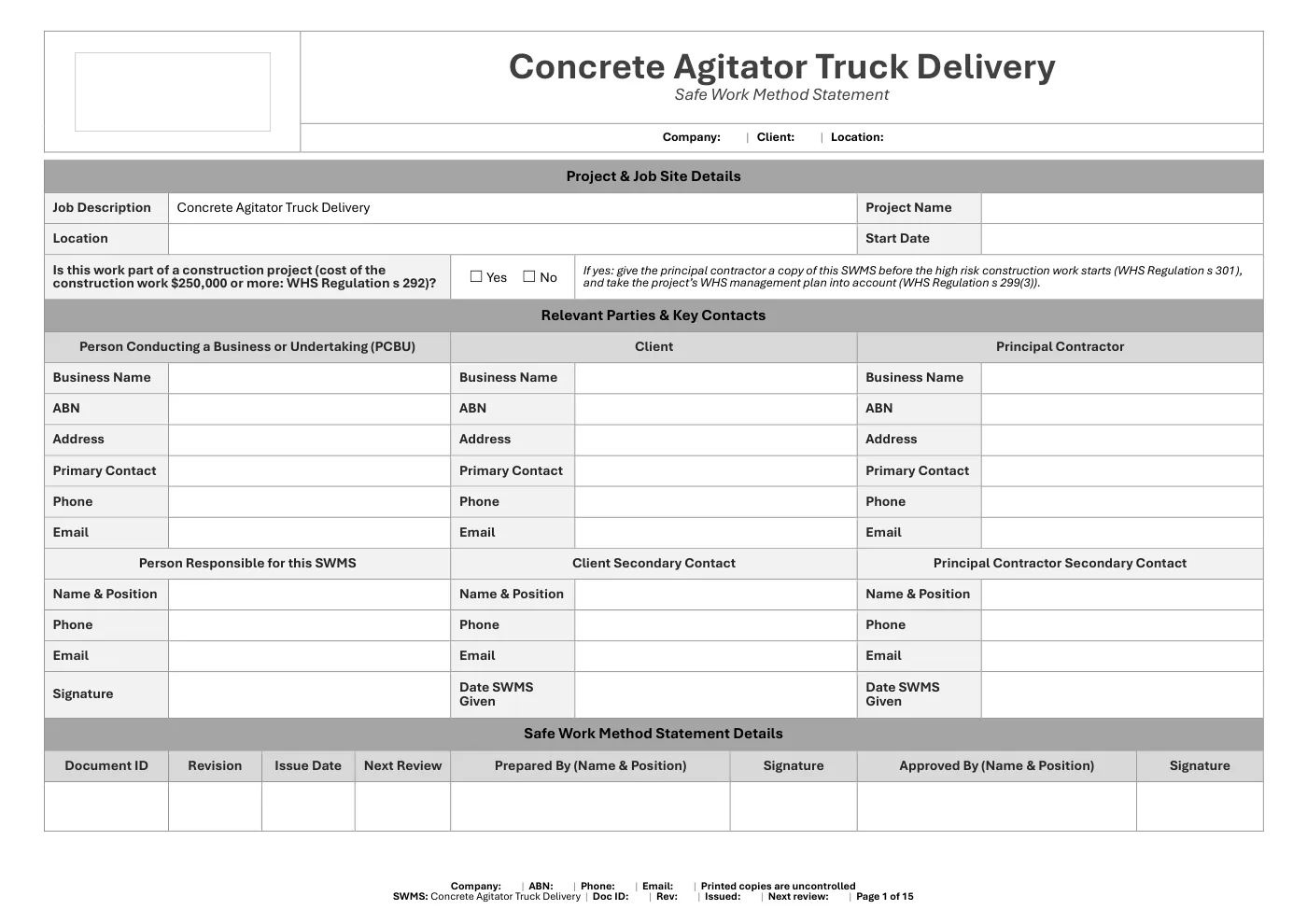
A truck delivery is not high risk construction work by itself, and the Regulation does not say whether a supplier’s driver discharging concrete is doing construction work, so no item is pre-ticked. Where the delivery is part of a construction project, WHS Regulation s 299 requires a SWMS if a s 291 item applies: tick item 14 (powered mobile plant movement), item 10 (energised electrical services, including overhead lines), item 13 (a road or traffic corridor in use) or item 6 (a trench or shaft deeper than 1.5 metres nearby) as the job requires. Otherwise this document works as a written safe work procedure and task risk assessment.
New to SWMS? Read What Is A Safe Work Method Statement?
What Is Covered In Our Concrete Agitator Truck Delivery SWMS?
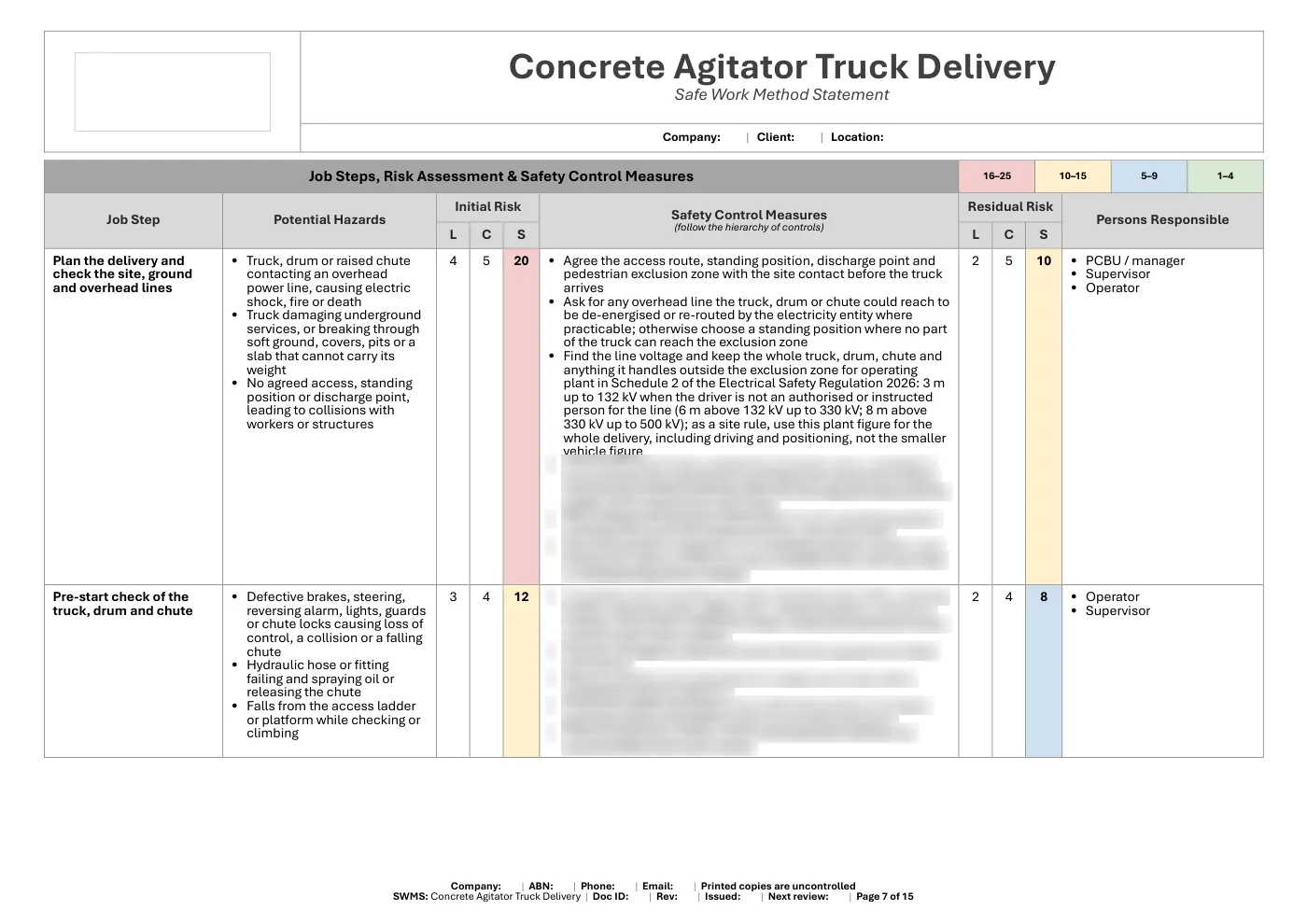
After the standard pre-start checks, the job steps run from “Plan the delivery and check the site, ground and overhead lines” to “Handle a stuck truck, a rejected load or an unplanned discharge”. The hazards and controls include:
- Truck, drum or chute contacting overhead power lines
- Reversing into workers, plant or formwork
- Truck overturning on soft ground, ramps or edges
- Chute swing, pinch points and heavy extensions
- Concrete burns to skin and eyes
- Dry cement and silica dust when cleaning
- Falls from the truck ladder and platform
- Entering the drum to chip out concrete
- Slips on wet concrete and slurry
- Road users and pedestrians at the site entry
- Noise and heat during the pour
- Bogged trucks and rejected loads
High Risk Construction Work
None of the high risk construction work items (WHS Regulation 2011 (Qld) s 291) are pre-ticked, because this job is not high risk construction work by itself. Tick any that apply on your site.
Licences, Training and Competency
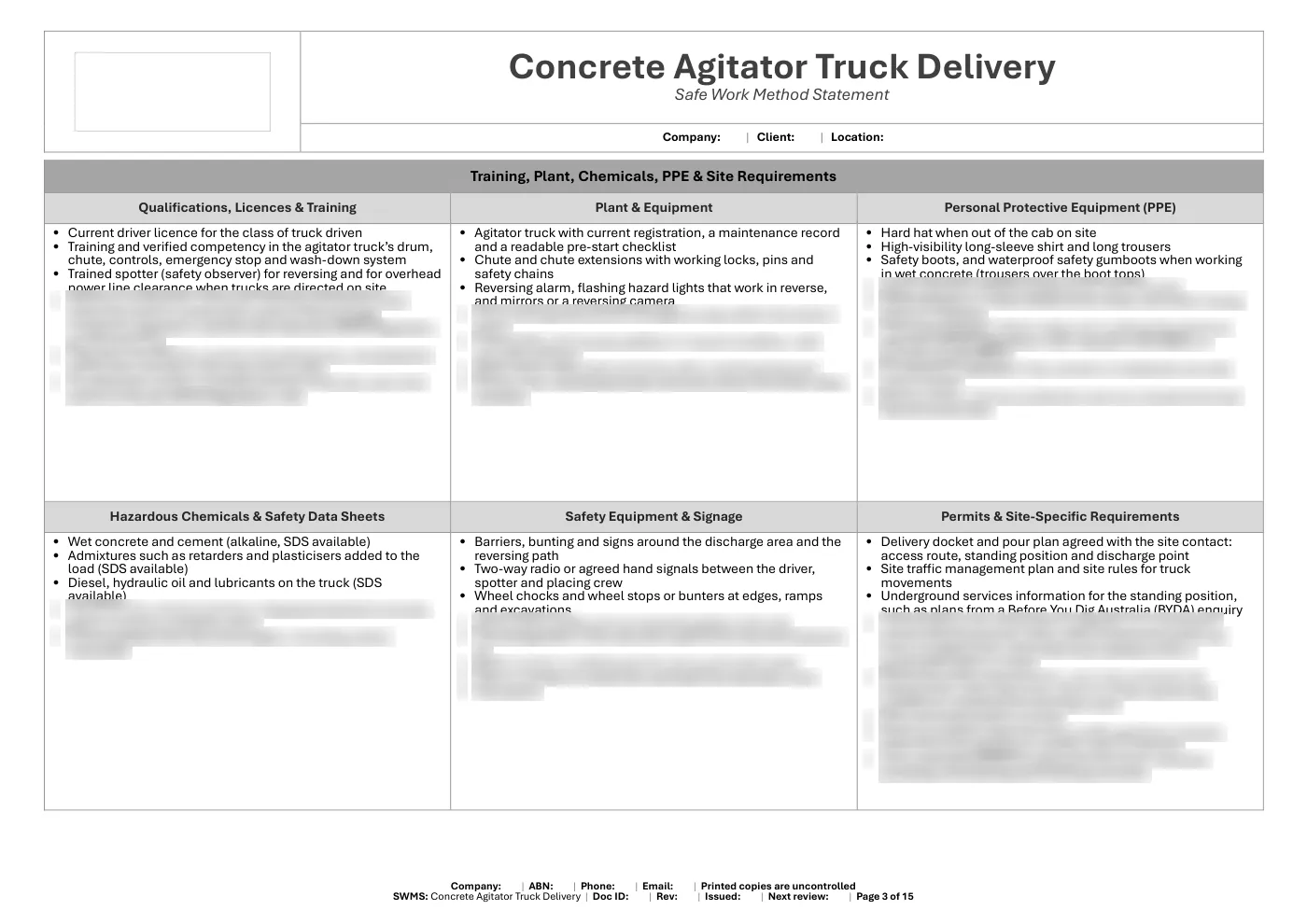
- Current driver licence for the class of truck driven
- Training and verified competency in the agitator truck’s drum, chute, controls, emergency stop and wash-down system
- Trained spotter (safety observer) for reversing and for overhead power line clearance when trucks are directed on site
- General construction induction training card (white card) where the work is construction work or the principal contractor requires it, and the site induction (WHS Regulation ss 316 and 317)
- Training in the SDS for cement and admixtures, including first aid for wet concrete in the eyes and on skin
- An adequate number of people trained in first aid, and a first aid kit on the job (WHS Regulation s 42)
Legislation and Codes of Practice Referenced
- Work Health and Safety Act 2011 (Qld)
- Work Health and Safety Regulation 2011 (Qld)
- Work Health and Safety Regulation 2011 (Qld): ss 214 and 215 (powered mobile plant: overturning, collisions and warning devices)
- Work Health and Safety Regulation 2011 (Qld): ss 56 and 57 (noise) and s 62 (confined spaces)
- Work Health and Safety Regulation 2011 (Qld): ss 344, 346 and 351 (safety data sheets, register and chemical risks)
- Concrete Pumping Code of Practice 2019 (delivery of concrete to a pump hopper: truck access, reversing, spotters and chute handling)
- Managing Risks of Plant in the Workplace Code of Practice 2021
- Traffic Management for Construction or Maintenance Work Code of Practice 2008
- Confined Spaces Code of Practice 2021 (drum entry)
- Managing Risks of Hazardous Chemicals in the Workplace Code of Practice 2021
- Managing Noise and Preventing Hearing Loss at Work Code of Practice 2021
- Managing the Risk of Falls at Workplaces Code of Practice 2021
- Managing the Work Environment and Facilities Code of Practice 2021
- Hazardous Manual Tasks Code of Practice 2021
- How to Manage Work Health and Safety Risks Code of Practice 2021
- First Aid in the Workplace Code of Practice 2021
- Electrical Safety Act 2002 (Qld)
- Electrical Safety Regulation 2026 (Qld): ss 10, 11, 13 to 15 and Schedule 2 (overhead and underground electric lines)
- Electrical Safety Code of Practice 2020 – Working near overhead and underground electric lines (distances come from Schedule 2 of the 2026 Regulation)
- Managing respirable crystalline silica dust exposure in construction and manufacturing of construction elements Code of Practice 2022 (only if hardened concrete is chipped or cut)
What You Get
- An editable Microsoft Word document (15 A4 landscape pages). Type your business, client and job details once and they fill in on every page, with a space for your logo
- 10 job steps for this work, each with its hazards, controls, initial and residual risk scores and the person responsible
- PPE listed for this job: hard hat when out of the cab on site; high-visibility long-sleeve shirt and long trousers; safety boots, and waterproof safety gumboots when working in wet concrete (trousers over the boot tops)
- Emergency arrangements for: contact with an overhead power line, person struck, run over or trapped by the truck, chute or drum and wet concrete in the eyes
- Plus the parts every Work Safety QLD SWMS shares, from the s 291 checklist to the worker sign-on sheet (see the layout in our free SWMS template)
Adjust it for your site, plant and crew, and talk it through with your workers before work starts. Please make sure you read our Disclaimer before downloading this SWMS.
Checked against the Queensland laws and codes of practice listed above. Last reviewed October 2026.
Having trouble with your download? Contact us any time. Please read our Disclaimer before downloading.
How to use it
From download to site in three steps
Buy and download
Check out with card, Apple Pay or Google Pay. Your download buttons appear straight away and the links are emailed to you. Links work for 3 months, so save your copies.
Make it yours
Open it in Microsoft Word or Excel. Add your logo, business details, site and job information, and adjust it to how the work is done.
Brief your crew
Talk it through with the workers doing the job, have them sign on, and keep it on site. Review it whenever the job or conditions change.
What format is it?
Microsoft Word. Edit it in Word, or free in Word for the web, and add your own logo and business details.
How do I get it after I pay?
Your download buttons appear as soon as checkout finishes, and the links are emailed to you. You can re-download from your account at any time.
Is it compliant with Queensland law?
It's written around Queensland's Work Health and Safety Act 2011 and Regulation 2011. Tailor it to your site, consult your workers and review it whenever conditions change; no template can guarantee compliance on its own.
What if it isn't right for my job?
If it doesn't match its description or has a fault, tell us and we'll fix it. If you're still not happy, we'll refund you or give you store credit, your choice. Check the sample pages first, as we don't refund a change of mind.
More templates like this
$59.99
Excavator SWMS
$49.99

Concrete Saw SWMS
$39.99


Reviews