For arborists, tree crews and crane crews who have decided, after weighing every other practicable method, that a crane is the only way to remove a tree in sections. The Mobile Crane Code of Practice 2024 recommends that mobile cranes not be used for tree lopping and allows it only in very limited situations when every condition it lists can be ensured, so this template is written around those conditions and is not a routine method. It follows the work from deciding whether a crane is justified and writing the work procedure, through power lines, exclusion zones and crane set-up, to slinging, cutting and lifting each section, landing it, rescue and pack-up; felling from the ground and general crane operation have their own SWMS.
The Mobile Crane Code of Practice 2024 (section 12.4) recommends against using a mobile crane for tree lopping and allows it only in very limited situations when its listed conditions are all met and there is no other practicable alternative. Removing a tree is not high risk construction work by itself. A SWMS is legally required under WHS Regulation s 299 only for high risk construction work, such as tree removal that is part of site clearing for construction. If that applies, tick the items that fit the job, such as powered mobile plant (item o), a fall of more than 2 metres (item a), energised overhead lines (item k) or a road in use (item n). Otherwise it works as a written safe work procedure and task risk assessment.
New to SWMS? Read What Is A Safe Work Method Statement?
What Is Covered In Our Crane-Assisted Tree Removal SWMS?
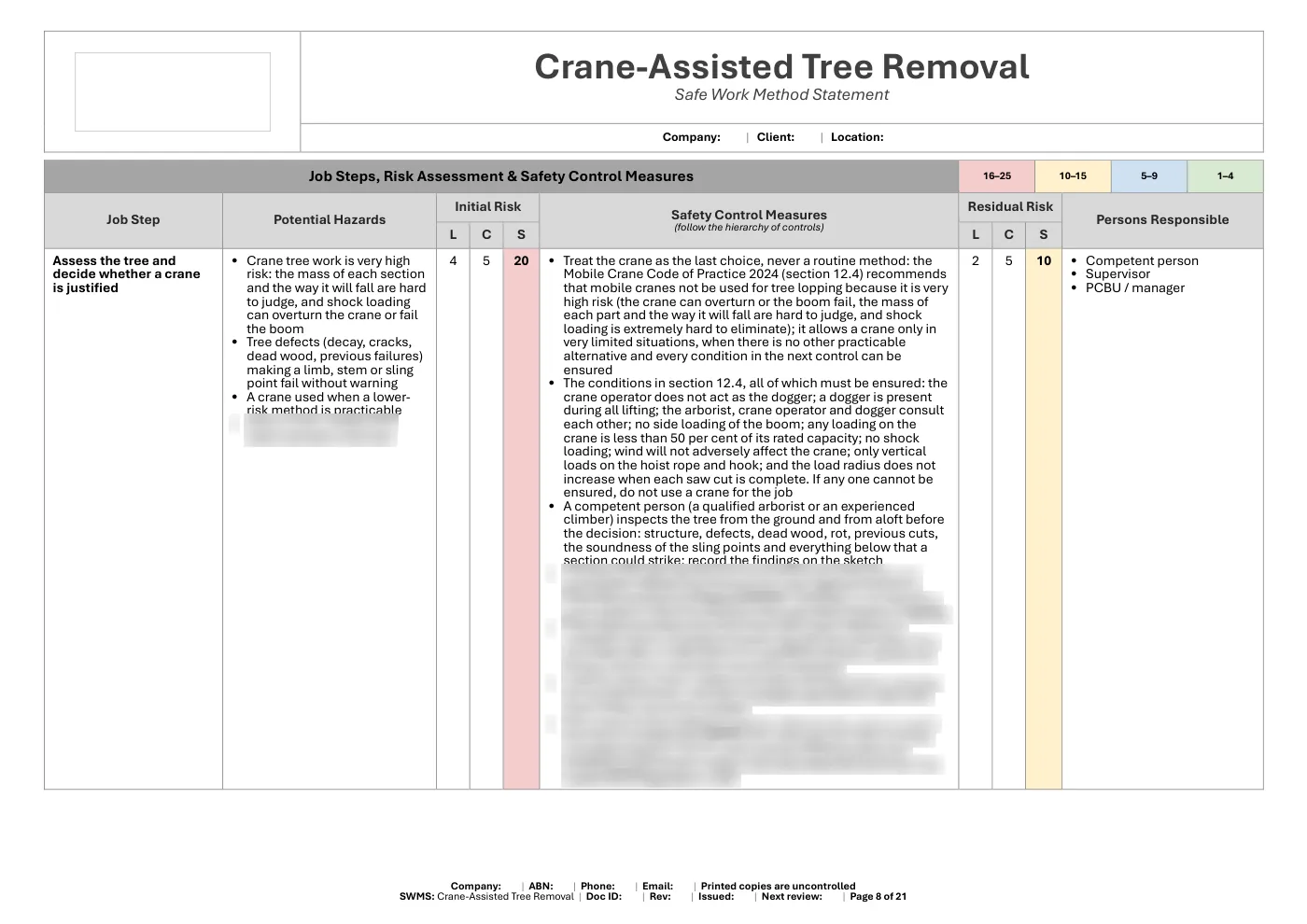
After the standard pre-start checks, the job steps run from “Assess the tree and decide whether a crane is justified” to “Inspect the gear, pack up and make the site safe”. The hazards and controls include:
- Crane used where a safer method is practicable
- Crane overturning or boom failure from sectional lifts
- Sections heavier than estimated
- Shock loading when the cut is finished
- Side loading of the crane boom
- Contact with overhead power lines
- Sections swinging into the climber or ground crew
- Falls of climbers from the tree
- Climber caught by the hook or sling
- Crane set up on weak ground or over services
- Workers under suspended sections
- Traffic and the public near the work
- Injured climber unable to descend
High Risk Construction Work
None of the high risk construction work items (WHS Regulation 2011 (Qld) s 291) are pre-ticked, because this job is not high risk construction work by itself. Tick any that apply on your site.
Licences, Training and Competency
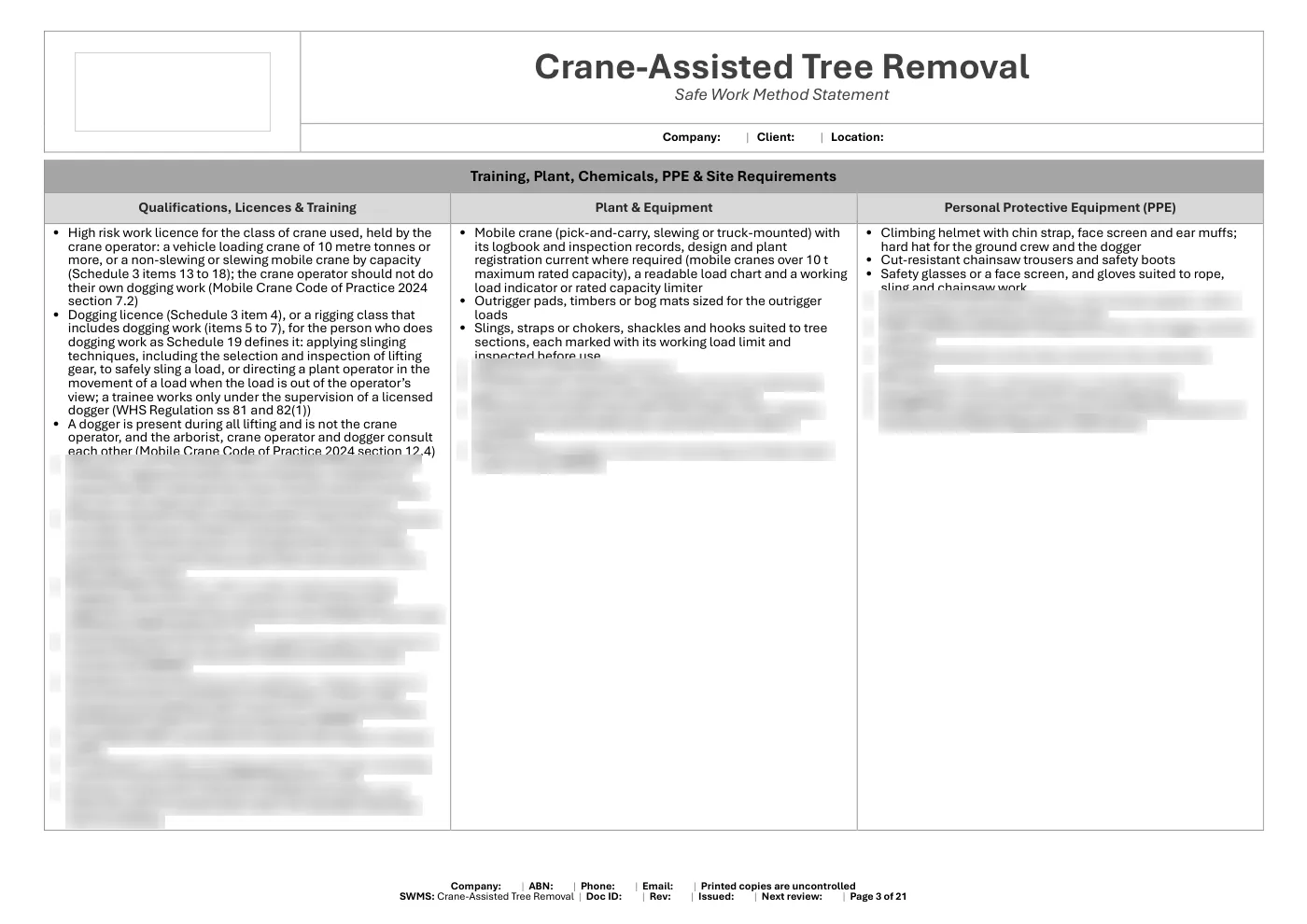
- High risk work licence for the class of crane used, held by the crane operator: a vehicle loading crane of 10 metre tonnes or more, or a non-slewing or slewing mobile crane by capacity (Schedule 3 items 13 to 18); the crane operator should not do their own dogging work (Mobile Crane Code of Practice 2024 section 7.2)
- Dogging licence (Schedule 3 item 4), or a rigging class that includes dogging work (items 5 to 7), for the person who does dogging work as Schedule 19 defines it: applying slinging techniques, including the selection and inspection of lifting gear, to safely sling a load, or directing a plant operator in the movement of a load when the load is out of the operator’s view; a trainee works only under the supervision of a licensed dogger (WHS Regulation ss 81 and 82(1))
- A dogger is present during all lifting and is not the crane operator, and the arborist, crane operator and dogger consult each other (Mobile Crane Code of Practice 2024 section 12.4)
- Arborist or tree crew leader with nationally recognised tree climbing, rigging and aerial rescue training, competent to assess the tree, estimate the mass of each section and plan the cuts, who takes part in the documented procedure
- Climbers trained in the climbing system used and in chainsaw use aloft, with each climber’s competency checked and recorded; a trained rescuer on the ground for every climb, practised in the aerial rescue plan (tree work practice, not a fixed legal number)
- Trained safety observer, with no other duties (including dogging), where the crane, a section or the sling could approach an overhead line exclusion zone (Mobile Crane Code of Practice 2024 section 9.1.2)
- Authorised person for the line, arranged through the person in control of the line, for any work inside an exclusion zone (outside this SWMS)
- Operators of any elevating work platform, chipper, loader or truck trained and competent on that plant; a boom-type elevating work platform with a boom of 11 m or more needs the Schedule 3 item 21 licence (separate SWMS)
- Accredited traffic controllers for anyone who stops or directs traffic
- An adequate number of workers trained in first aid, including control of severe bleeding (WHS Regulation s 42)
- General construction induction training card (white card) when the work is construction work, for example clearing a site for building
Legislation and Codes of Practice Referenced
- Work Health and Safety Act 2011 (Qld)
- Work Health and Safety Regulation 2011 (Qld)
- Work Health and Safety Regulation 2011 (Qld): s 219 (plant that lifts or suspends loads), ss 78 to 80 (falls), s 48 (remote or isolated work), ss 81, 82 and 85 and Schedules 3 and 19 (high risk work licences; dogging work)
- Work Health and Safety Regulation 2011 (Qld): ss 289, 291 and 299 (construction work, high risk construction work and safe work method statements)
- Mobile Crane Code of Practice 2024 (sections 7.2 crane crew, 7.4 communication, 7.5 documented lifting procedures, 8.2 ground and crane support, 8.4 wind, 9.1 power lines, 12.4 and 12.4.1 tree lopping and the crane access method)
- Managing the Risk of Falls at Workplaces Code of Practice 2021 (work positioning systems, rope access systems, rescue and suspension intolerance)
- Forest Harvesting Code of Practice 2007 (chainsaw features and protective equipment; written for forest harvesting and used here as good practice for tree work)
- How to Manage Work Health and Safety Risks Code of Practice 2021
- Managing Risks of Plant in the Workplace Code of Practice 2021
- Hazardous Manual Tasks Code of Practice 2021
- Managing Noise and Preventing Hearing Loss at Work Code of Practice 2021
- Managing the Work Environment and Facilities Code of Practice 2021
- First Aid in the Workplace Code of Practice 2021
- Traffic Management for Construction or Maintenance Work Code of Practice 2008 (work beside a road)
- Electrical Safety Act 2002 (Qld)
- Electrical Safety Regulation 2026 (Qld): overhead power line exclusion zones (ss 10 to 13 and schedule 2)
- Electrical Safety Code of Practice 2020 – Working near overhead and underground electric lines (chapter 6, clearing vegetation near lines; distances come from the 2026 Regulation)
- Transport Operations (Road Use Management – Accreditation and Other Provisions) Regulation 2015 (Qld): traffic controllers
- AS/NZS 4488 (set) Industrial rope access systems and AS/NZS 1891 (set) Industrial fall-arrest systems and devices, as named in the Managing the Risk of Falls at Workplaces Code of Practice 2021
- AS 2727 Chainsaws – Guide to safe working practices and AS 2726 Chainsaws – Safety requirements – Part 1: Chainsaws for general use, as named in the Forest Harvesting Code of Practice 2007
- Safe Work Australia model Code of Practice: Managing the risks of biological hazards at work (model code, not approved in Queensland; guidance only)
- Safe Work Australia model Code of Practice: Managing the risk of fatigue at work (model code, not approved in Queensland; guidance only)
What You Get
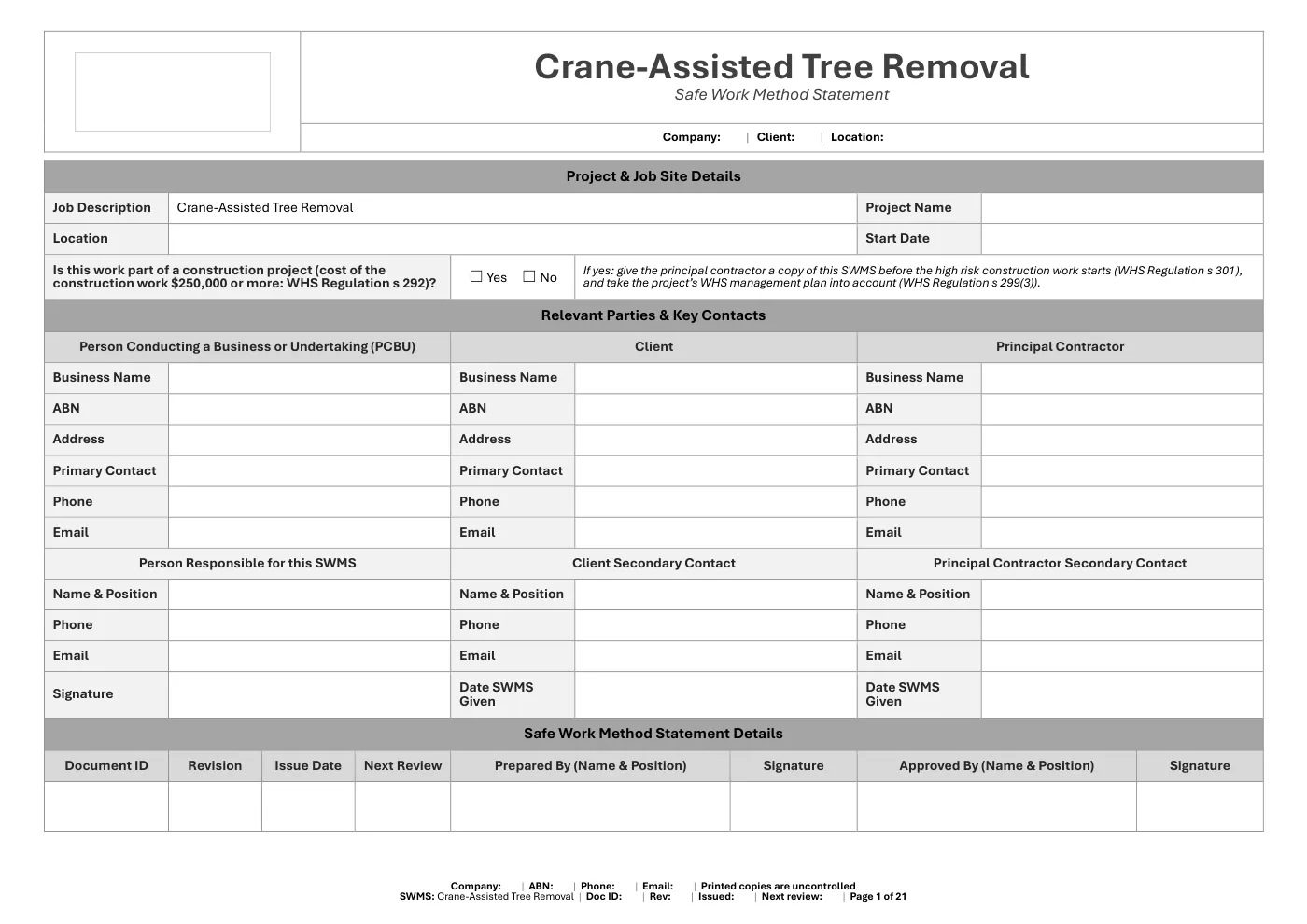
- An editable Microsoft Word document (21 A4 landscape pages). Type your business, client and job details once and they fill in on every page, with a space for your logo
- 11 job steps for this work, each with its hazards, controls, initial and residual risk scores and the person responsible
- PPE listed for this job: climbing helmet with chin strap, face screen and ear muffs; hard hat for the ground crew and the dogger; cut-resistant chainsaw trousers and safety boots
- Emergency arrangements for: crane, boom, sling or section touches a power line, crane overturns, the boom fails or a section is dropped and climber hurt, unconscious or unable to descend
- Plus the parts every Work Safety QLD SWMS shares, from the s 291 checklist to the worker sign-on sheet (see the layout in our free SWMS template)
Adjust it for your site, plant and crew, and talk it through with your workers before work starts. Please make sure you read our Disclaimer before downloading this SWMS.
Checked against the Queensland laws and codes of practice listed above. Last reviewed November 2026.

Reviews