Skip to content

Trawl Net and Winch Operation SWMS

Operating trawl nets and winches on fishing boats in Queensland: entanglement, wire rope failure, falls overboard and heavy loads. An editable Word SWMS template.

RG

Written by Ryan Graham, health and safety professional (16 years on Queensland sites)

$39.99 incl. GST

AUD · one-off purchase · instant download

  • Instant download · your links arrive by email straight after checkout and work for 3 months, so save your copy
  • Make it yours in minutes · edit in Microsoft Word and add your logo
  • Quality guarantee · we'll fix any problem, then refund you or give store credit if you're still not happy
  • Secure checkout · card, Apple Pay or Google Pay through Stripe

About this template

For commercial trawler skippers, deckhands and fishing businesses who shoot, tow and haul trawl nets with a winch. It follows the trip from planning and the pre-start check of the vessel, winch and wire rope through shooting the net, towing, hauling back, landing the doors and codend, handling the catch, winch maintenance, falls overboard and emergency response, to unloading. Marine safety law that sets vessel and survival equipment standards sits outside this template: follow it and the vessel’s own written safe operating procedures.

Work on a fishing vessel is not high risk construction work, so a SWMS is legally required only if the work is part of high risk construction work (WHS Regulation s 299). Otherwise this works as a written safe work procedure and task risk assessment, and no item is pre-ticked. If the work is construction work, for example building or repairing a wharf, jetty or boat ramp, tick the items that apply, such as work in or near water with a risk of drowning.

Similar job: if it is closer to your work, see the Pot Hauler and Crab Pot Handling SWMS.

New to SWMS? Read What Is A Safe Work Method Statement?

What Is Covered In Our Trawl Net and Winch Operation SWMS?

After the standard pre-start checks, the job steps run from “Plan the trip, check the weather and brief the crew” to “Return to shore, unload and make the vessel safe”. The hazards and controls include:

  • Hands and clothing drawn into the winch drum
  • Wire rope parting and whipping across the deck
  • Stored energy in loaded warps and bridles
  • Being pulled overboard by running net or warps
  • Snagged gear heeling the vessel
  • Trawl doors swinging and crushing
  • Heavy codend swinging or dropping
  • Falls overboard and drowning
  • Cuts, spines and infection from the catch
  • Slips on slimy, rolling decks
  • Fatigue on long tows and night work
  • Noise, heat and fuel fumes

High Risk Construction Work

None of the high risk construction work items (WHS Regulation 2011 (Qld) s 291) are pre-ticked, because this job is not high risk construction work by itself. Tick any that apply on your site.

Licences, Training and Competency

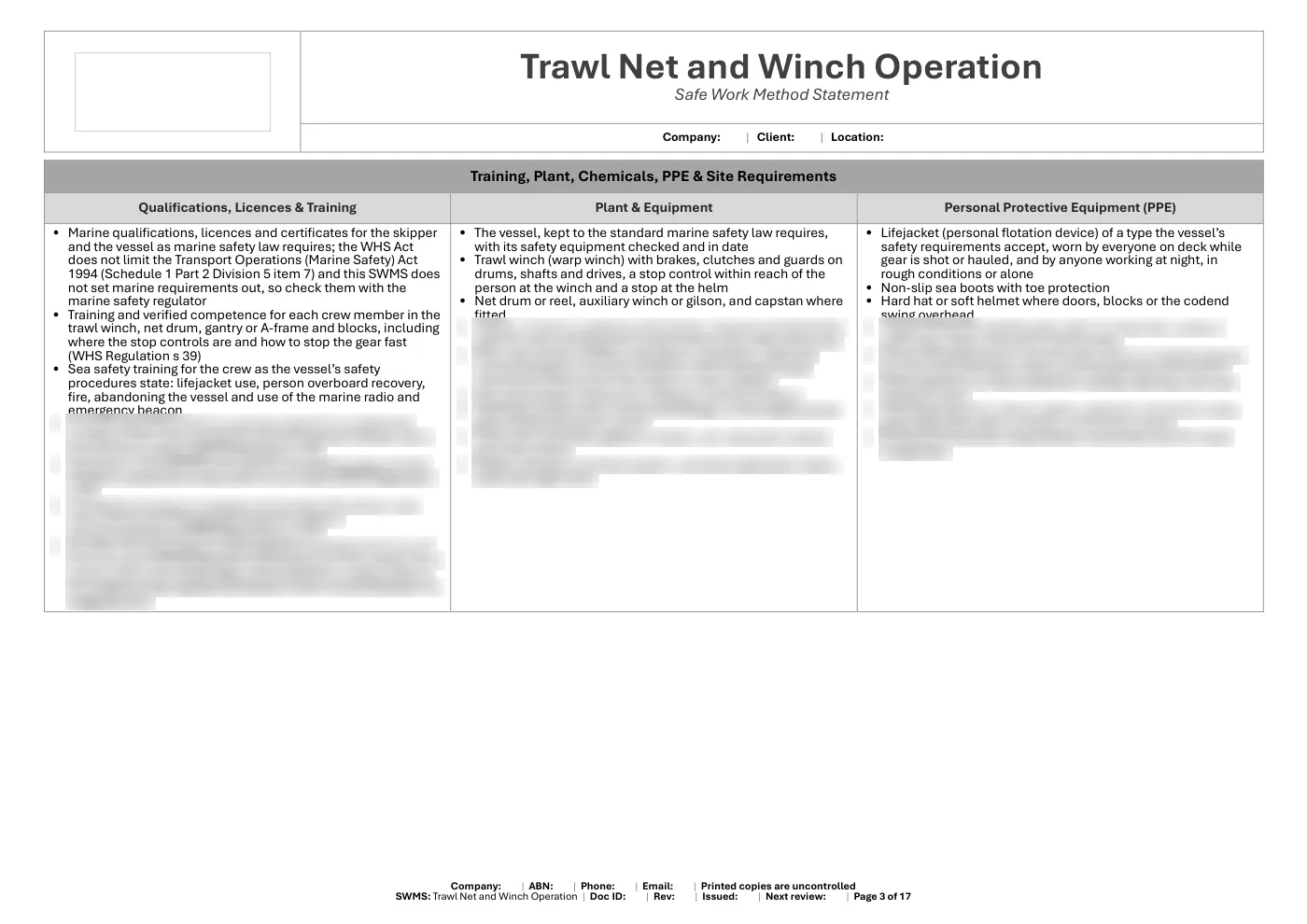
  • Marine qualifications, licences and certificates for the skipper and the vessel as marine safety law requires; the WHS Act does not limit the Transport Operations (Marine Safety) Act 1994 (Schedule 1 Part 2 Division 5 item 7) and this SWMS does not set marine requirements out, so check them with the marine safety regulator
  • Training and verified competence for each crew member in the trawl winch, net drum, gantry or A-frame and blocks, including where the stop controls are and how to stop the gear fast (WHS Regulation s 39)
  • Sea safety training for the crew as the vessel’s safety procedures state: lifejacket use, person overboard recovery, fire, abandoning the vessel and use of the marine radio and emergency beacon
  • First aid training suited to a remote vessel for an adequate number of the crew, as the first aid assessment shows, and a first aid kit to match (WHS Regulation s 42)
  • Induction in this SWMS, the vessel’s emergency plan and the skipper’s authority to stop work or turn back (WHS Regulation s 43)
  • Competent person to maintain and inspect the winch, wire rope, blocks and fittings following the maker’s recommendations (WHS Regulation s 213)
  • No high risk work licence class applies to a trawl winch or net drum as such (WHS Regulation Schedule 3); if the vessel has a crane or the crew sling loads, check whether a crane class or the dogging class applies (Schedule 3 item 4 and Schedule 19, dogging work)

Legislation and Codes of Practice Referenced

  • Work Health and Safety Act 2011 (Qld)
  • Work Health and Safety Regulation 2011 (Qld)
  • Work Health and Safety Act 2011 (Qld): s 8 (a workplace includes a vessel and any waters where work is carried out for a business or undertaking)
  • Work Health and Safety Act 2011 (Qld): Schedule 1 Part 2 Division 5 item 7 (the Act does not limit the Transport Operations (Marine Safety) Act 1994, which prevails to the extent it is inconsistent; a person with a WHS duty must still discharge it even where that Act prescribes a lesser duty)
  • Work Health and Safety Act 2011 (Qld): ss 35 to 39 (notifiable incidents and preserving the site)
  • Work Health and Safety Regulation 2011 (Qld): ss 203, 206, 208, 210, 211 and 213 (plant: risk management, proper use, guarding, operational controls, emergency stops, and maintenance and inspection)
  • Work Health and Safety Regulation 2011 (Qld): s 219 (plant that lifts or suspends loads, such as a winch and gantry lifting doors or a codend)
  • Work Health and Safety Regulation 2011 (Qld): ss 36, 39 and 42 to 44 and 48 (hierarchy of control measures, training, first aid, emergency plan, personal protective equipment and remote or isolated work)
  • Work Health and Safety Regulation 2011 (Qld): ss 56 to 58 (noise), s 60 (hazardous manual tasks) and s 40 (workplace facilities, including heat)
  • Managing Risks of Plant in the Workplace Code of Practice 2021 (isolating energy sources, including stored energy)
  • Hazardous Manual Tasks Code of Practice 2021
  • Managing Noise and Preventing Hearing Loss at Work Code of Practice 2021
  • Managing Risks of Hazardous Chemicals in the Workplace Code of Practice 2021
  • Managing the Work Environment and Facilities Code of Practice 2021 (including remote or isolated work)
  • First Aid in the Workplace Code of Practice 2021
  • How to Manage Work Health and Safety Risks Code of Practice 2021
  • Marine safety law that applies to the vessel, such as the Transport Operations (Marine Safety) Act 1994 (named in the WHS Act) and, for domestic commercial vessels, the domestic commercial vessel national law (other Queensland legislation points to section 20 of the Transport Operations (Marine Safety-Domestic Commercial Vessel National Law Application) Act 2016 for it); this SWMS does not set out their requirements, so check which applies and what it requires
  • Safe Work Australia model Code of Practice: Managing the risk of fatigue at work (model code, not approved in Queensland; guidance only)
  • Safe Work Australia model Code of Practice: Managing the risks of biological hazards at work (model code, not approved in Queensland; guidance only)

What You Get

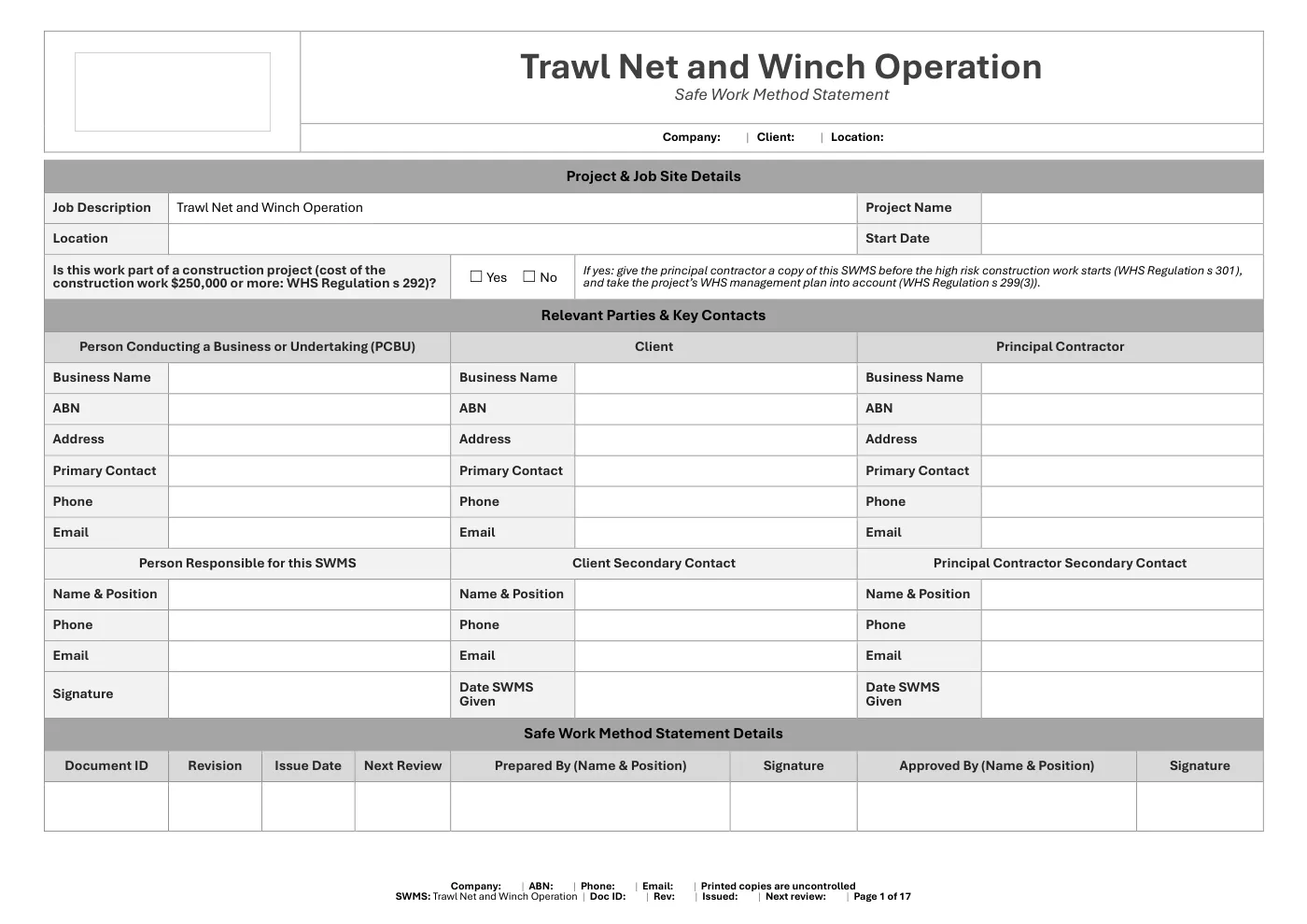
  • An editable Microsoft Word document (17 A4 landscape pages). Type your business, client and job details once and they fill in on every page, with a space for your logo
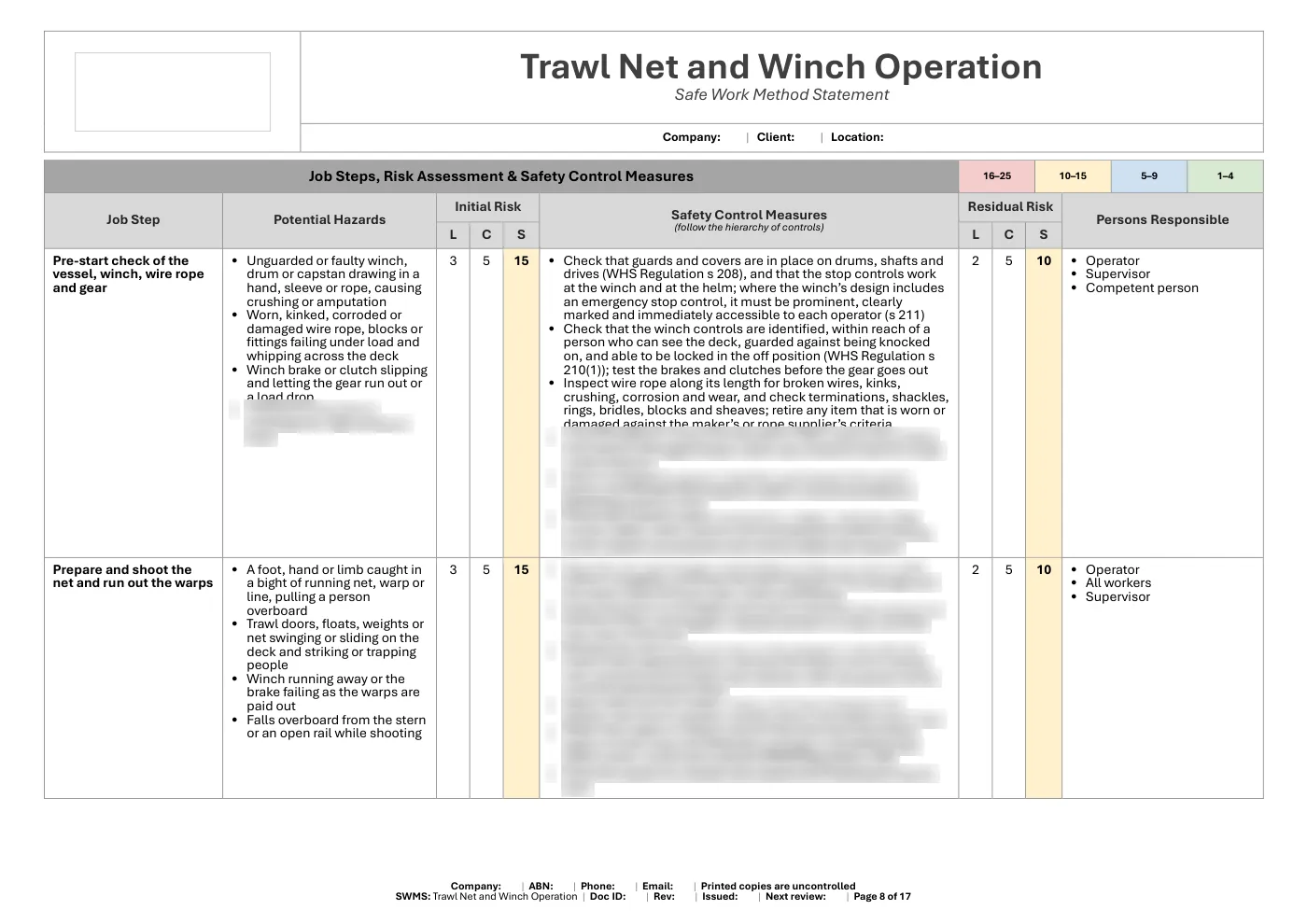
  • 11 job steps for this work, each with its hazards, controls, initial and residual risk scores and the person responsible
  • PPE listed for this job: lifejacket (personal flotation device) of a type the vessel’s safety requirements accept, worn by everyone on deck while gear is shot or hauled, and by anyone working at night, in rough conditions or alone
  • Emergency arrangements for: person overboard, person caught in the winch, drum or gear and wire rope or gear failure
  • Plus the parts every Work Safety QLD SWMS shares, from the s 291 checklist to the worker sign-on sheet (see the layout in our free SWMS template)

Adjust it for your site, plant and crew, and talk it through with your workers before work starts. Please make sure you read our Disclaimer before downloading this SWMS.

Checked against the Queensland laws and codes of practice listed above. Last reviewed November 2026.

Having trouble with your download? Contact us any time. Please read our Disclaimer before downloading.

How to use it

From download to site in three steps

Buy and download

Check out with card, Apple Pay or Google Pay. Your download buttons appear straight away and the links are emailed to you. Links work for 3 months, so save your copies.

Make it yours

Open it in Microsoft Word or Excel. Add your logo, business details, site and job information, and adjust it to how the work is done.

Brief your crew

Talk it through with the workers doing the job, have them sign on, and keep it on site. Review it whenever the job or conditions change.

FAQ

Before you buy

Something else? Ask us and a real person will reply.

What format is it?

Microsoft Word. Edit it in Word, or free in Word for the web, and add your own logo and business details.

How do I get it after I pay?

Your download buttons appear as soon as checkout finishes, and the links are emailed to you. You can re-download from your account at any time.

Is it compliant with Queensland law?

It's written around Queensland's Work Health and Safety Act 2011 and Regulation 2011. Tailor it to your site, consult your workers and review it whenever conditions change; no template can guarantee compliance on its own.

What if it isn't right for my job?

If it doesn't match its description or has a fault, tell us and we'll fix it. If you're still not happy, we'll refund you or give you store credit, your choice. Check the sample pages first, as we don't refund a change of mind.
Reviews

Be the first to review “Trawl Net and Winch Operation SWMS”

Your email address will not be published. Required fields are marked *

Bought or downloaded this template from us? Leave an honest review, good or bad, and we'll email you a code for a free template of your choice (single templates, not packs). One per order.

More templates like this