For erection crews, riggers, scaffolders and the builders who engage them. It follows the work in order, from the foundation, anchor and tie plan through crane lifts of mast sections, climbing, fitting ties and landing gates, to commissioning, handover and dismantling, and sets out the Queensland licence and registration rules that apply. Operating the finished platform is outside this document.
One item is ticked for you: a fall of more than 2 metres while erecting or dismantling at height (WHS Regulation s 291), so a SWMS is required before the work starts (s 299). Tick movement of powered mobile plant if a crane, truck or telehandler works in the area, energised electrical installations or services if the supply or power lines are close to the work, and any other item that applies.
New to SWMS? Read What Is A Safe Work Method Statement?
What Is Covered In Our Mast Climbing Work Platform Erection and Dismantling SWMS?
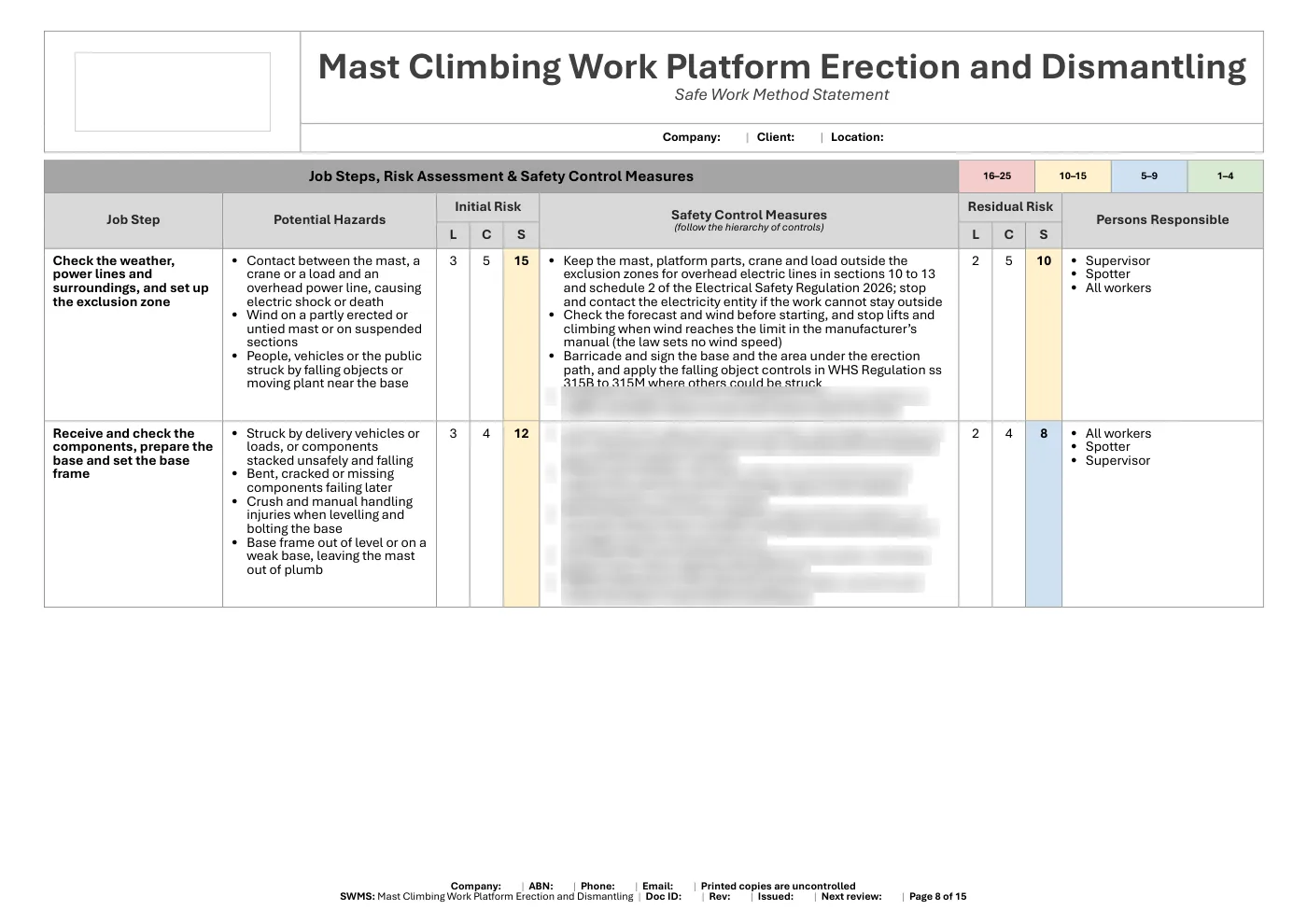
After the standard pre-start checks, the job steps run from “Plan the erection and confirm the foundation, anchors and ties” to “Load out and clear the site”. The hazards and controls include:
- Mast collapse from a weak base, late ties or wrong sequence
- Anchors pulling out of the structure
- Falls from the mast, platform and building edges
- Dropped sections and crane overturn
- Struck by loads and crush when bolting
- Dropped bolts and tools striking people below
- Contact with overhead power lines
- Electric shock when connecting the supply
- Wind on a partly erected mast
- Silica dust and noise from drilling anchors
- Gates and edge protection not fitted before use
- Safety devices not tested before handover
- Manual handling of heavy sections
High Risk Construction Work
These high risk construction work items (WHS Regulation 2011 (Qld) s 291) are already ticked because they are part of this work. Tick any others that apply to your job:
- Involves a risk of a person falling more than 2m
Licences, Training and Competency
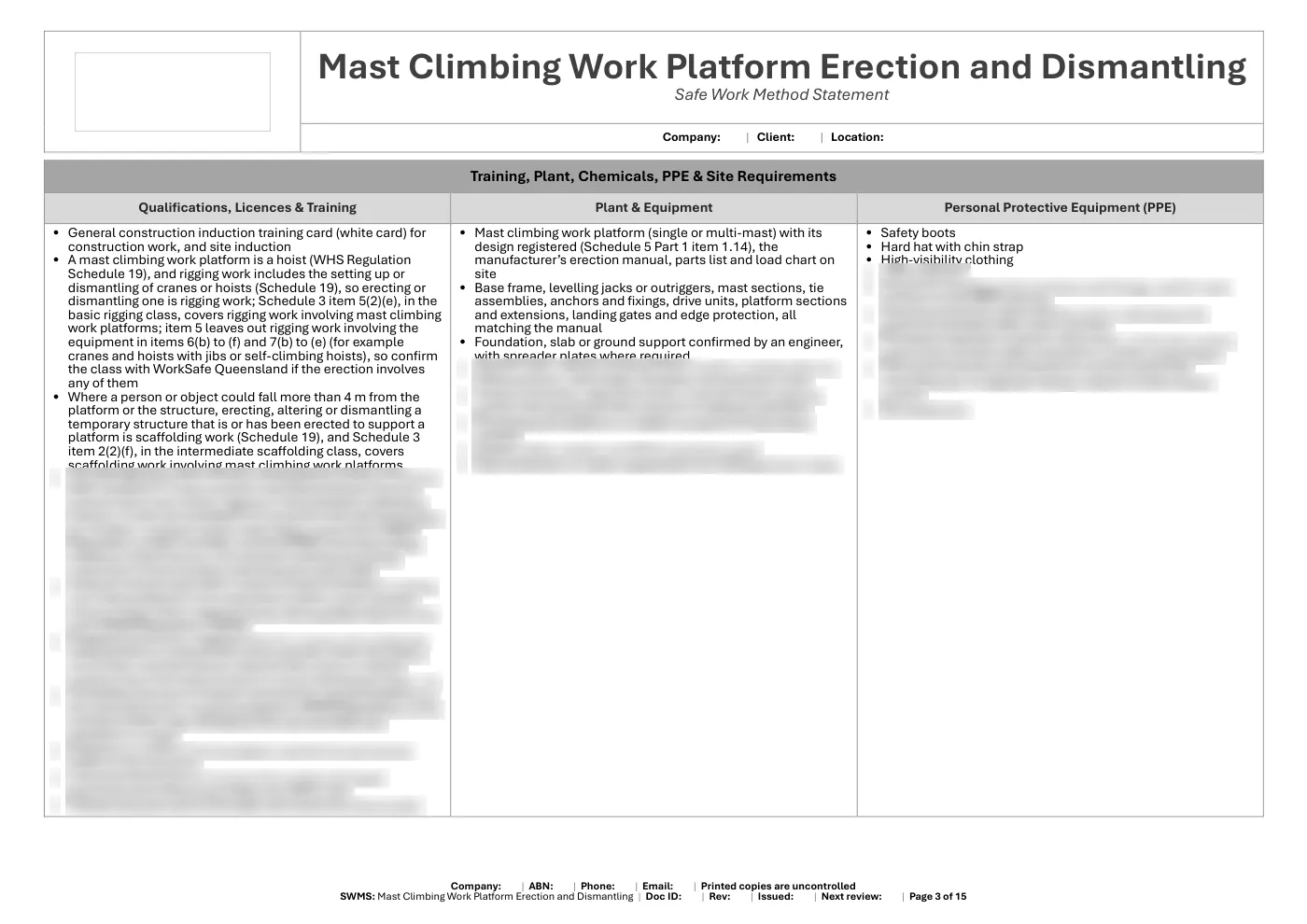
- General construction induction training card (white card) for construction work, and site induction
- A mast climbing work platform is a hoist (WHS Regulation Schedule 19), and rigging work includes the setting up or dismantling of cranes or hoists (Schedule 19), so erecting or dismantling one is rigging work; Schedule 3 item 5(2)(e), in the basic rigging class, covers rigging work involving mast climbing work platforms; item 5 leaves out rigging work involving the equipment in items 6(b) to (f) and 7(b) to (e) (for example cranes and hoists with jibs or self-climbing hoists), so confirm the class with WorkSafe Queensland if the erection involves any of them
- Where a person or object could fall more than 4 m from the platform or the structure, erecting, altering or dismantling a temporary structure that is or has been erected to support a platform is scaffolding work (Schedule 19), and Schedule 3 item 2(2)(f), in the intermediate scaffolding class, covers scaffolding work involving mast climbing work platforms
- The Managing the Risk of Falls at Workplaces Code of Practice 2021 (section 5.1) says erection and dismantling is done by workers who hold a basic rigging or intermediate scaffolding licence, or who are enrolled in a course for one and supervised by a holder; a trainee works under direct supervision (WHS Regulation ss 82(1) and 84), and the PCBU must see written evidence of the licence, of a trainee’s training and of the supervisor’s licence before directing the work (s 85)
- A person whose work with a crane or hoist is limited to setting up or dismantling it is not required to hold a crane operator licence if they hold a rigging licence that qualifies them for the work (WHS Regulation s 82(4))
- Dogging licence (or a rigging class) for anyone who slings the mast sections or directs the crane operator when the load is out of view, and the licence class for the crane or vehicle loading crane (10 metre tonnes or more is Schedule 3 item 13)
- Competent person to inspect and test the erected platform to the manufacturer’s recommendations (WHS Regulation s 213) and give written sign-off before first use and after any alteration or repair
- Engineer to confirm the foundation and the tie and anchor loads on the structure
- Licensed electrician to connect the supply and repair electrical parts (Electrical Safety Act 2002 s 55)
- Trained rescuers and a first aider who know the rescue plan
Legislation and Codes of Practice Referenced
- Work Health and Safety Act 2011 (Qld)
- Work Health and Safety Regulation 2011 (Qld)
- WHS Regulation s 291 (high risk construction work), ss 81, 82, 84 and 85 (licences, trainees under direct supervision, evidence of licence), Schedule 3 items 2, 5 and 13, and Schedule 19 (hoist, mast climbing work platform, rigging work, scaffolding work, dogging work)
- WHS Regulation s 243 and Schedule 5 Part 1 item 1.14: design registration for mast climbing work platforms
- WHS Regulation ss 78 to 80 (falls and rescue), ss 306C, 306D, 306E and 306I (construction falls, edge protection, fall arrest harness systems) and ss 315B to 315M (falling objects)
- WHS Regulation s 213 (maintenance and inspection of plant by a competent person), s 219 (plant that lifts), ss 56 and 57 (noise), s 60 (hazardous manual tasks)
- WHS Regulation chapter 8A (crystalline silica), including ss 529B, 529C, 529CA and 529CD
- WHS Act ss 35 to 39: notifiable incidents, including the fall or release from a height of any plant, substance or thing and the collapse or partial collapse of a structure (s 37(f) and (h))
- Managing the Risk of Falls at Workplaces Code of Practice 2021 (temporary work platforms, mast climbing work platforms)
- Managing Risks of Plant in the Workplace Code of Practice 2021
- Mobile Crane Code of Practice 2024
- Managing respirable crystalline silica dust exposure in construction and manufacturing of construction elements Code of Practice 2022
- Hazardous Manual Tasks Code of Practice 2021
- Managing Noise and Preventing Hearing Loss at Work Code of Practice 2021
- First Aid in the Workplace Code of Practice 2021
- How to Manage Work Health and Safety Risks Code of Practice 2021
- Electrical Safety Act 2002 (Qld) s 55
- Electrical Safety Regulation 2026 (Qld): overhead line exclusion zones (ss 10 to 13 and schedule 2), s 140 (AS/NZS 3012 for construction work) and ss 197 and 198 (isolation for electrical work)
- Electrical Safety Code of Practice 2020 – Working near overhead and underground electric lines (distances come from the Electrical Safety Regulation 2026)
- AS 2550.16 Cranes – Safe use – Part 16: Mast climbing work platforms (cited in the Falls Code)
What You Get
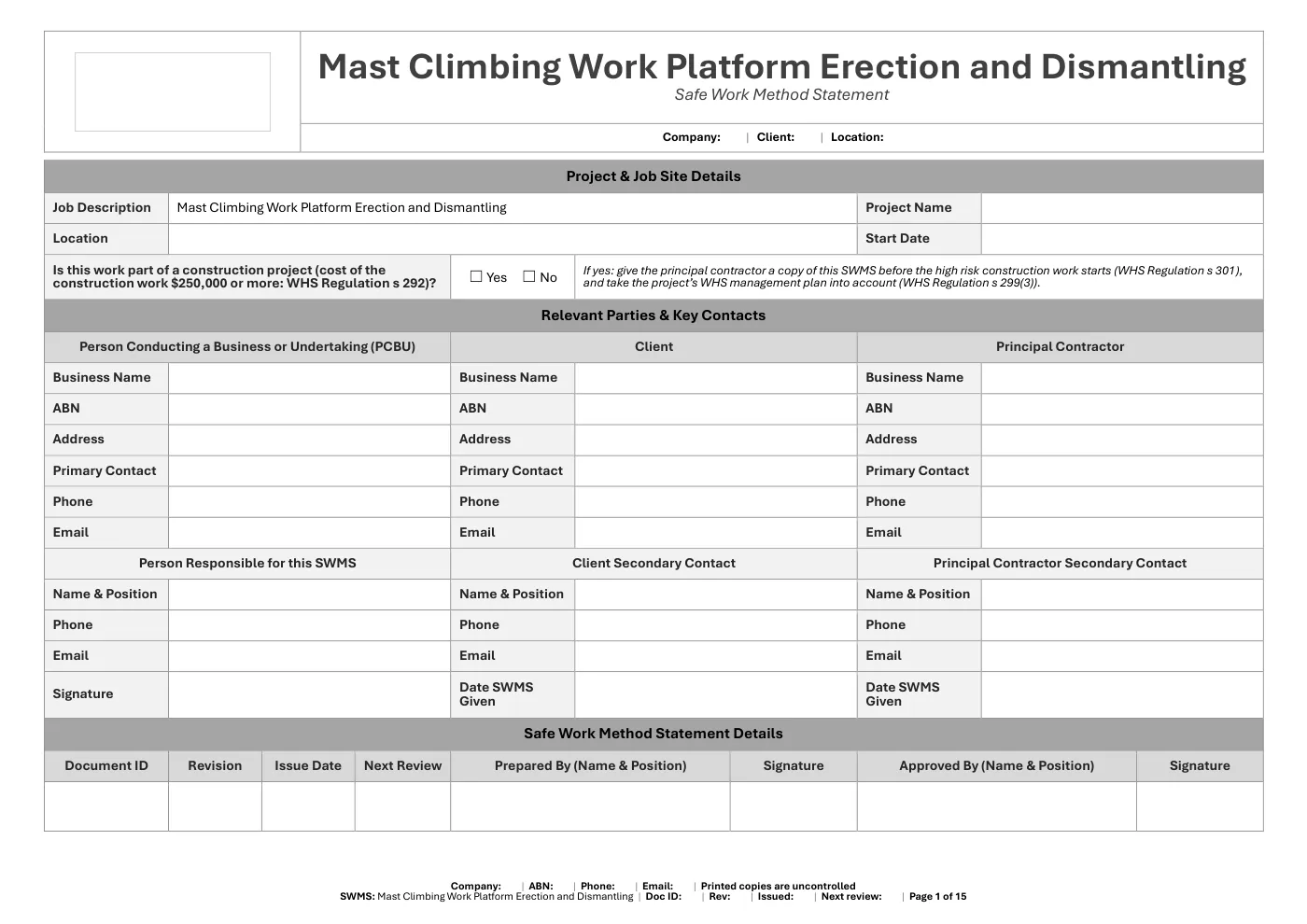
- An editable Microsoft Word document (15 A4 landscape pages). Type your business, client and job details once and they fill in on every page, with a space for your logo
- 10 job steps for this work, each with its hazards, controls, initial and residual risk scores and the person responsible
- PPE listed for this job: safety boots; hard hat with chin strap; high-visibility clothing; safety glasses
- Emergency arrangements for: fall from height or a person hanging in a harness, mast, tie or platform failure, or a dropped section and contact with a power line
- Plus the parts every Work Safety QLD SWMS shares, from the s 291 checklist to the worker sign-on sheet (see the layout in our free SWMS template)
Adjust it for your site, plant and crew, and talk it through with your workers before work starts. Please make sure you read our Disclaimer before downloading this SWMS.
Checked against the Queensland laws and codes of practice listed above. Last reviewed November 2026.

Reviews